 Add to Chrome
 Add to Firefox
 Add to Edge
How Post-Training Shapes Biological Reasoning Models
Jun 15, 2026
Scientific reasoning models for biology combine language models with foundation models trained on multimodal biological data, including DNA, RNA, and proteins. These models are built through post-training, yet how each stage shapes reasoning and generalization remains poorly understood. We study when post-training improves performance and when it induces over-specialization. Across genomics, transcriptomics, and proteins, we train and evaluate more than 100 biological reasoning models under controlled variation in backbone, continued pre-training (CPT), supervised fine-tuning (SFT), and reinforcement learning (RL), measuring both in-domain (ID) and out-of-domain (OOD) performance. We find that each post-training stage reshapes generalization in a distinct way rather than contributing uniform gains. CPT improves downstream performance by aligning models with biological language. SFT consistently increases ID performance but causes OOD performance to peak early and decline as models fit the training distribution. RL, when applied to strong SFT checkpoints with aligned rewards, improves OOD performance and partially recovers generalization. These results show that biological reasoning does not improve monotonically with additional supervision or compute. Instead, performance depends on how training stages are composed. Under fixed post-training budgets, the strongest ID-OOD trade-off comes from brief SFT, larger RL allocations, and asymmetric adaptation capacity across stages.

Agents' Last Exam
Jun 03, 2026Recent AI systems have achieved strong results on a wide range of benchmarks, yet these gains have not translated into economically meaningful deployment across many professional domains. We argue that this gap is largely an evaluation problem: widely used benchmarks lack sustained performance measurement on real and economically valuable workflows. This paper introduces Agents' Last Exam (ALE), a benchmark designed to evaluate AI agents on long-horizon, economically valuable, real-world tasks with verifiable outcomes. Developed in collaboration with 250+ industry experts, ALE covers non-physical industries defined with reference to O*NET / SOC 2018 (the U.S. federal occupational taxonomy). It is organized around a task taxonomy with 55 subfields grouped into 13 industry clusters covering 1K+ tasks. Current results show that the hardest tier remains far from saturated: across mainstream harness and backbone configurations, the average full pass rate is 2.6%. ALE is designed as a living benchmark: its task pool grows continuously as new workflows and industries are onboarded. More broadly, ALE is intended not merely as another leaderboard, but as an instrument for closing the gap between benchmark success and GDP-relevant impact.
MuSEAgent: A Multimodal Reasoning Agent with Stateful Experiences
Mar 29, 2026Research agents have recently achieved significant progress in information seeking and synthesis across heterogeneous textual and visual sources. In this paper, we introduce MuSEAgent, a multimodal reasoning agent that enhances decision-making by extending the capabilities of research agents to discover and leverage stateful experiences. Rather than relying on trajectory-level retrieval, we propose a stateful experience learning paradigm that abstracts interaction data into atomic decision experiences through hindsight reasoning. These experiences are organized into a quality-filtered experience bank that supports policy-driven experience retrieval at inference time. Specifically, MuSEAgent enables adaptive experience exploitation through complementary wide- and deep-search strategies, allowing the agent to dynamically retrieve multimodal guidance across diverse compositional semantic viewpoints. Extensive experiments demonstrate that MuSEAgent consistently outperforms strong trajectory-level experience retrieval baselines on both fine-grained visual perception and complex multimodal reasoning tasks. These results validate the effectiveness of stateful experience modeling in improving multimodal agent reasoning.
PAVE: Premise-Aware Validation and Editing for Retrieval-Augmented LLMs
Mar 21, 2026Retrieval-augmented language models can retrieve relevant evidence yet still commit to answers before explicitly checking whether the retrieved context supports the conclusion. We present PAVE (Premise-Grounded Answer Validation and Editing), an inference-time validation layer for evidence-grounded question answering. PAVE decomposes retrieved context into question-conditioned atomic facts, drafts an answer, scores how well that draft is supported by the extracted premises, and revises low-support outputs before finalization. The resulting trace makes answer commitment auditable at the level of explicit premises, support scores, and revision decisions. In controlled ablations with a fixed retriever and backbone, PAVE outperforms simpler post-retrieval baselines in two evidence-grounded QA settings, with the largest gain reaching 32.7 accuracy points on a span-grounded benchmark. We view these findings as proof-of-concept evidence that explicit premise extraction plus support-gated revision can strengthen evidence-grounded consistency in retrieval-augmented LLM systems.
TensorCommitments: A Lightweight Verifiable Inference for Language Models
Feb 13, 2026Most large language models (LLMs) run on external clouds: users send a prompt, pay for inference, and must trust that the remote GPU executes the LLM without any adversarial tampering. We critically ask how to achieve verifiable LLM inference, where a prover (the service) must convince a verifier (the client) that an inference was run correctly without rerunning the LLM. Existing cryptographic works are too slow at the LLM scale, while non-cryptographic ones require a strong verifier GPU. We propose TensorCommitments (TCs), a tensor-native proof-of-inference scheme. TC binds the LLM inference to a commitment, an irreversible tag that breaks under tampering, organized in our multivariate Terkle Trees. For LLaMA2, TC adds only 0.97% prover and 0.12% verifier time over inference while improving robustness to tailored LLM attacks by up to 48% over the best prior work requiring a verifier GPU.
Multi-Agent Path Finding Among Dynamic Uncontrollable Agents with Statistical Safety Guarantees
Jul 29, 2025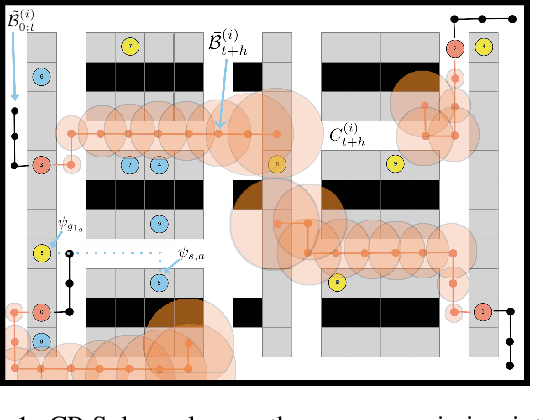
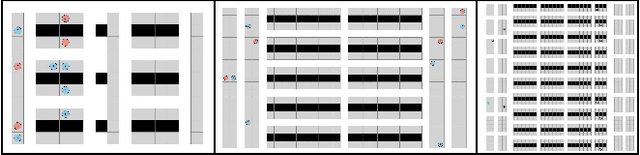
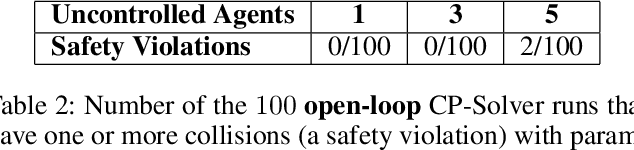

Existing multi-agent path finding (MAPF) solvers do not account for uncertain behavior of uncontrollable agents. We present a novel variant of Enhanced Conflict-Based Search (ECBS), for both one-shot and lifelong MAPF in dynamic environments with uncontrollable agents. Our method consists of (1) training a learned predictor for the movement of uncontrollable agents, (2) quantifying the prediction error using conformal prediction (CP), a tool for statistical uncertainty quantification, and (3) integrating these uncertainty intervals into our modified ECBS solver. Our method can account for uncertain agent behavior, comes with statistical guarantees on collision-free paths for one-shot missions, and scales to lifelong missions with a receding horizon sequence of one-shot instances. We run our algorithm, CP-Solver, across warehouse and game maps, with competitive throughput and reduced collisions.
CAST: Time-Varying Treatment Effects with Application to Chemotherapy and Radiotherapy on Head and Neck Squamous Cell Carcinoma
May 09, 2025Causal machine learning (CML) enables individualized estimation of treatment effects, offering critical advantages over traditional correlation-based methods. However, existing approaches for medical survival data with censoring such as causal survival forests estimate effects at fixed time points, limiting their ability to capture dynamic changes over time. We introduce Causal Analysis for Survival Trajectories (CAST), a novel framework that models treatment effects as continuous functions of time following treatment. By combining parametric and non-parametric methods, CAST overcomes the limitations of discrete time-point analysis to estimate continuous effect trajectories. Using the RADCURE dataset [1] of 2,651 patients with head and neck squamous cell carcinoma (HNSCC) as a clinically relevant example, CAST models how chemotherapy and radiotherapy effects evolve over time at the population and individual levels. By capturing the temporal dynamics of treatment response, CAST reveals how treatment effects rise, peak, and decline over the follow-up period, helping clinicians determine when and for whom treatment benefits are maximized. This framework advances the application of CML to personalized care in HNSCC and other life-threatening medical conditions. Source code/data available at: https://github.com/CAST-FW/HNSCC
TxGemma: Efficient and Agentic LLMs for Therapeutics
Apr 08, 2025Therapeutic development is a costly and high-risk endeavor that is often plagued by high failure rates. To address this, we introduce TxGemma, a suite of efficient, generalist large language models (LLMs) capable of therapeutic property prediction as well as interactive reasoning and explainability. Unlike task-specific models, TxGemma synthesizes information from diverse sources, enabling broad application across the therapeutic development pipeline. The suite includes 2B, 9B, and 27B parameter models, fine-tuned from Gemma-2 on a comprehensive dataset of small molecules, proteins, nucleic acids, diseases, and cell lines. Across 66 therapeutic development tasks, TxGemma achieved superior or comparable performance to the state-of-the-art generalist model on 64 (superior on 45), and against state-of-the-art specialist models on 50 (superior on 26). Fine-tuning TxGemma models on therapeutic downstream tasks, such as clinical trial adverse event prediction, requires less training data than fine-tuning base LLMs, making TxGemma suitable for data-limited applications. Beyond these predictive capabilities, TxGemma features conversational models that bridge the gap between general LLMs and specialized property predictors. These allow scientists to interact in natural language, provide mechanistic reasoning for predictions based on molecular structure, and engage in scientific discussions. Building on this, we further introduce Agentic-Tx, a generalist therapeutic agentic system powered by Gemini 2.5 that reasons, acts, manages diverse workflows, and acquires external domain knowledge. Agentic-Tx surpasses prior leading models on the Humanity's Last Exam benchmark (Chemistry & Biology) with 52.3% relative improvement over o3-mini (high) and 26.7% over o3-mini (high) on GPQA (Chemistry) and excels with improvements of 6.3% (ChemBench-Preference) and 2.4% (ChemBench-Mini) over o3-mini (high).
Enough Coin Flips Can Make LLMs Act Bayesian
Mar 06, 2025Large language models (LLMs) exhibit the ability to generalize given few-shot examples in their input prompt, an emergent capability known as in-context learning (ICL). We investigate whether LLMs utilize ICL to perform structured reasoning in ways that are consistent with a Bayesian framework or rely on pattern matching. Using a controlled setting of biased coin flips, we find that: (1) LLMs often possess biased priors, causing initial divergence in zero-shot settings, (2) in-context evidence outweighs explicit bias instructions, (3) LLMs broadly follow Bayesian posterior updates, with deviations primarily due to miscalibrated priors rather than flawed updates, and (4) attention magnitude has negligible effect on Bayesian inference. With sufficient demonstrations of biased coin flips via ICL, LLMs update their priors in a Bayesian manner.
Tx-LLM: A Large Language Model for Therapeutics
Jun 10, 2024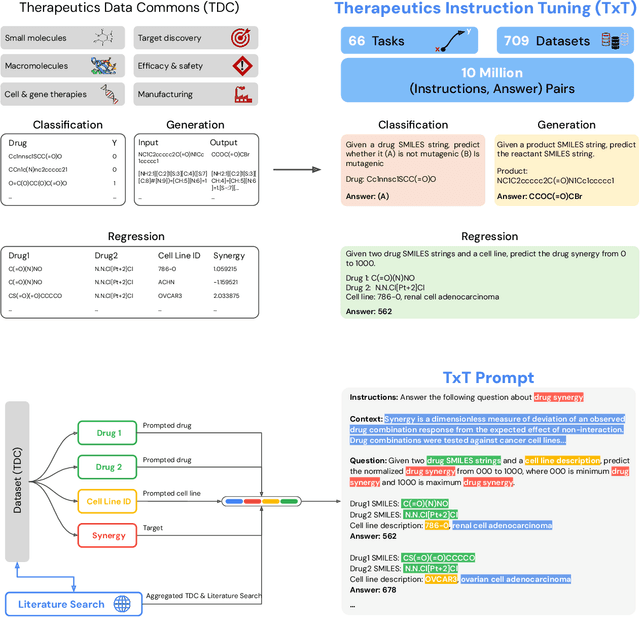
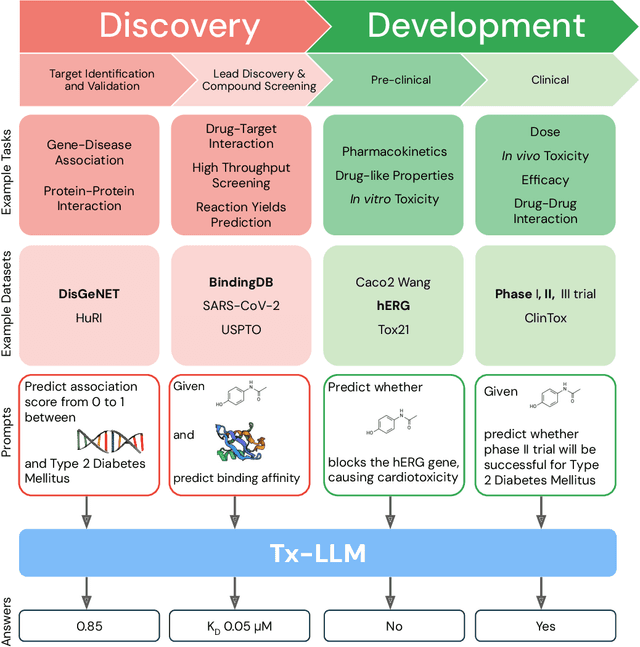
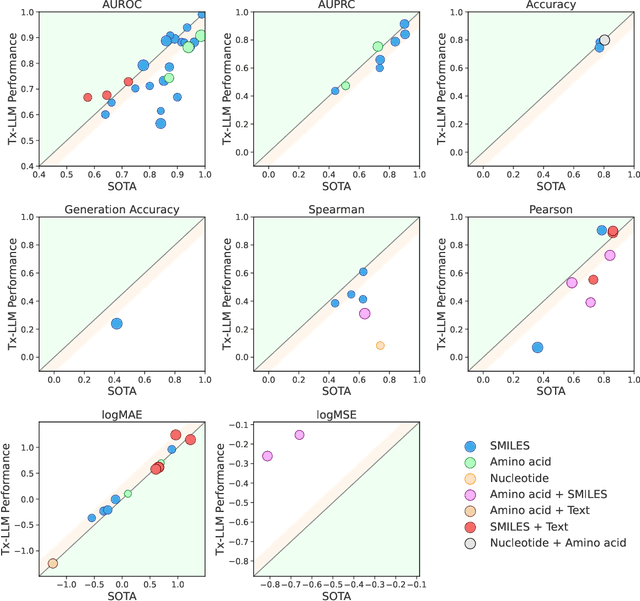
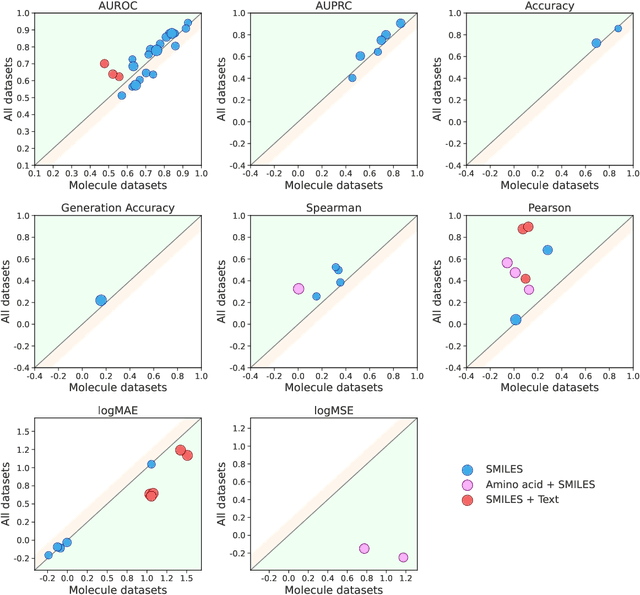
Developing therapeutics is a lengthy and expensive process that requires the satisfaction of many different criteria, and AI models capable of expediting the process would be invaluable. However, the majority of current AI approaches address only a narrowly defined set of tasks, often circumscribed within a particular domain. To bridge this gap, we introduce Tx-LLM, a generalist large language model (LLM) fine-tuned from PaLM-2 which encodes knowledge about diverse therapeutic modalities. Tx-LLM is trained using a collection of 709 datasets that target 66 tasks spanning various stages of the drug discovery pipeline. Using a single set of weights, Tx-LLM simultaneously processes a wide variety of chemical or biological entities(small molecules, proteins, nucleic acids, cell lines, diseases) interleaved with free-text, allowing it to predict a broad range of associated properties, achieving competitive with state-of-the-art (SOTA) performance on 43 out of 66 tasks and exceeding SOTA on 22. Among these, Tx-LLM is particularly powerful and exceeds best-in-class performance on average for tasks combining molecular SMILES representations with text such as cell line names or disease names, likely due to context learned during pretraining. We observe evidence of positive transfer between tasks with diverse drug types (e.g.,tasks involving small molecules and tasks involving proteins), and we study the impact of model size, domain finetuning, and prompting strategies on performance. We believe Tx-LLM represents an important step towards LLMs encoding biochemical knowledge and could have a future role as an end-to-end tool across the drug discovery development pipeline.