 Add to Chrome
 Add to Firefox
 Add to Edge
DDA-Thinker: Decoupled Dual-Atomic Reinforcement Learning for Reasoning-Driven Image Editing
Apr 28, 2026
Recent image editing models have achieved strong visual fidelity but often struggle with tasks requiring complex reasoning. To investigate and enhance the reasoning-grounded planning for image editing, we propose DDA-Thinker, a Thinker-centric framework designed for the independent optimization of a planning module (Thinker) over a fixed generative model (Editor). This decoupled Thinker-centric paradigm facilitates a controlled analysis of the planning module and makes its contribution under a fixed Editor easier to assess. To effectively guide this Thinker, we introduce a dual-atomic reinforcement learning framework. This framework decomposes feedback into two distinct atomic rewards implemented through verifiable checklists: a cognitive-atomic reward to directly assess the quality of the Thinker's executable plan, which serves as the actionable outcome of the Thinker's reasoning, and a visual-atomic reward to assess the final image quality. To improve checklist quality, our checklist synthesis is grounded not only in the source image and user instruction but also in a rational reference description of the ideal post-edit scene. To support this training, we further develop a two-stage data curation pipeline that first synthesizes a diverse and reasoning-focused dataset, then applies difficulty-aware refinement to curate an effective training curriculum for reinforcement learning. Extensive experiments on reasoning-driven image editing benchmarks, including RISE-Bench and KRIS-Bench, demonstrate that our approach substantially improves overall performance. Our method enables a community model to achieve results competitive with strong proprietary models, highlighting the practical potential of Thinker-centric optimization under a fixed-editor setting.

Tstars-Tryon 1.0: Robust and Realistic Virtual Try-On for Diverse Fashion Items
Apr 22, 2026Recent advances in image generation and editing have opened new opportunities for virtual try-on. However, existing methods still struggle to meet complex real-world demands. We present Tstars-Tryon 1.0, a commercial-scale virtual try-on system that is robust, realistic, versatile, and highly efficient. First, our system maintains a high success rate across challenging cases like extreme poses, severe illumination variations, motion blur, and other in-the-wild conditions. Second, it delivers highly photorealistic results with fine-grained details, faithfully preserving garment texture, material properties, and structural characteristics, while largely avoiding common AI-generated artifacts. Third, beyond apparel try-on, our model supports flexible multi-image composition (up to 6 reference images) across 8 fashion categories, with coordinated control over person identity and background. Fourth, to overcome the latency bottlenecks of commercial deployment, our system is heavily optimized for inference speed, delivering near real-time generation for a seamless user experience. These capabilities are enabled by an integrated system design spanning end-to-end model architecture, a scalable data engine, robust infrastructure, and a multi-stage training paradigm. Extensive evaluation and large-scale product deployment demonstrate that Tstars-Tryon1.0 achieves leading overall performance. To support future research, we also release a comprehensive benchmark. The model has been deployed at an industrial scale on the Taobao App, serving millions of users with tens of millions of requests.
Image2Sentence based Asymmetrical Zero-shot Composed Image Retrieval
Mar 03, 2024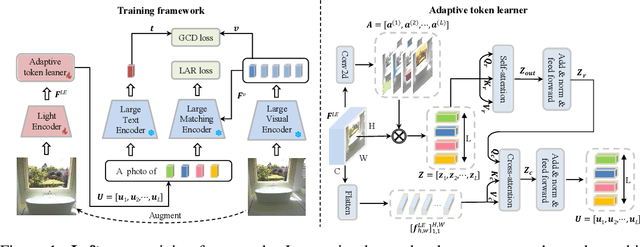
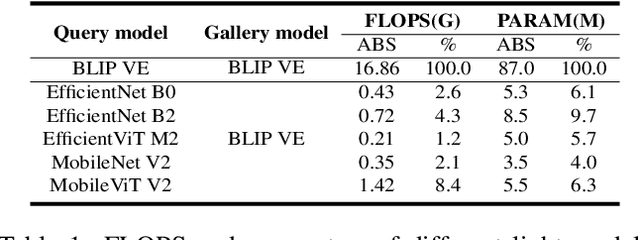
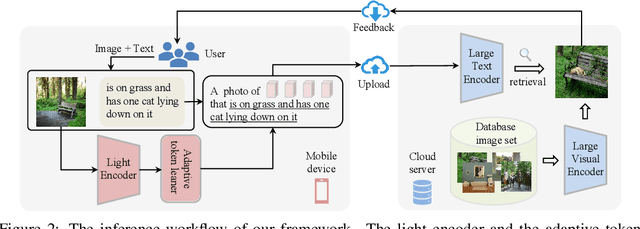
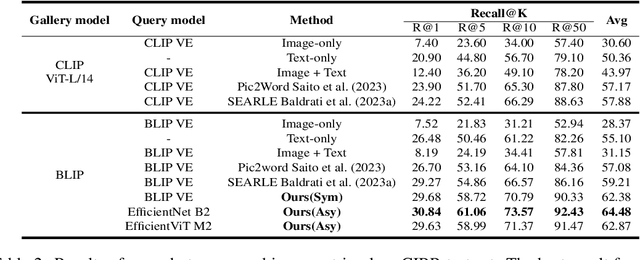
The task of composed image retrieval (CIR) aims to retrieve images based on the query image and the text describing the users' intent. Existing methods have made great progress with the advanced large vision-language (VL) model in CIR task, however, they generally suffer from two main issues: lack of labeled triplets for model training and difficulty of deployment on resource-restricted environments when deploying the large vision-language model. To tackle the above problems, we propose Image2Sentence based Asymmetric zero-shot composed image retrieval (ISA), which takes advantage of the VL model and only relies on unlabeled images for composition learning. In the framework, we propose a new adaptive token learner that maps an image to a sentence in the word embedding space of VL model. The sentence adaptively captures discriminative visual information and is further integrated with the text modifier. An asymmetric structure is devised for flexible deployment, in which the lightweight model is adopted for the query side while the large VL model is deployed on the gallery side. The global contrastive distillation and the local alignment regularization are adopted for the alignment between the light model and the VL model for CIR task. Our experiments demonstrate that the proposed ISA could better cope with the real retrieval scenarios and further improve retrieval accuracy and efficiency.