 Add to Chrome
 Add to Firefox
 Add to Edge
Overcoming Vocabulary Mismatch: Vocabulary-agnostic Teacher Guided Language Modeling
Mar 24, 2025
Using large teacher models to guide the training of smaller student models has become the prevailing paradigm for efficient and effective learning. However, vocabulary mismatches between teacher and student language models pose significant challenges in language modeling, resulting in divergent token sequences and output distributions. To overcome these limitations, we propose Vocabulary-agnostic Teacher Guided Language Modeling (VocAgnoLM), a novel approach that bridges the gap caused by vocabulary mismatch through two key methods: (1) Token-level Lexical Alignment, which aligns token sequences across mismatched vocabularies, and (2) Teacher Guided Loss, which leverages the loss of teacher model to guide effective student training. We demonstrate its effectiveness in language modeling with 1B student model using various 7B teacher models with different vocabularies. Notably, with Qwen2.5-Math-Instruct, a teacher model sharing only about 6% of its vocabulary with TinyLlama, VocAgnoLM achieves a 46% performance improvement compared to naive continual pretraining. Furthermore, we demonstrate that VocAgnoLM consistently benefits from stronger teacher models, providing a robust solution to vocabulary mismatches in language modeling.

AIGVE-Tool: AI-Generated Video Evaluation Toolkit with Multifaceted Benchmark
Mar 18, 2025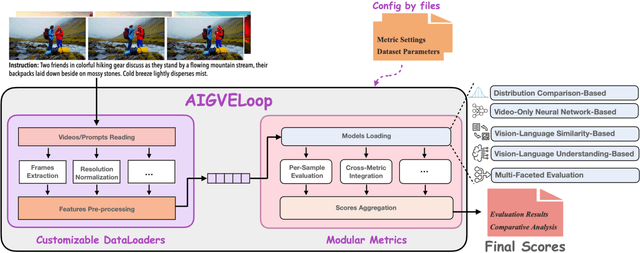
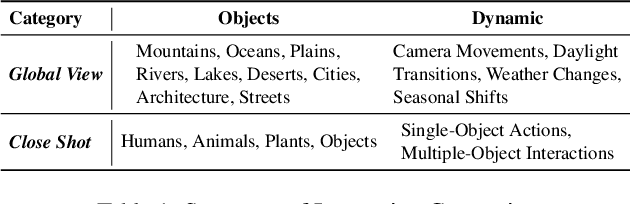
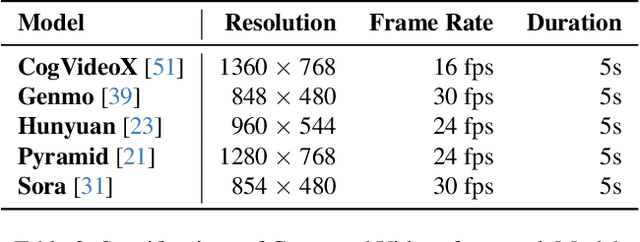
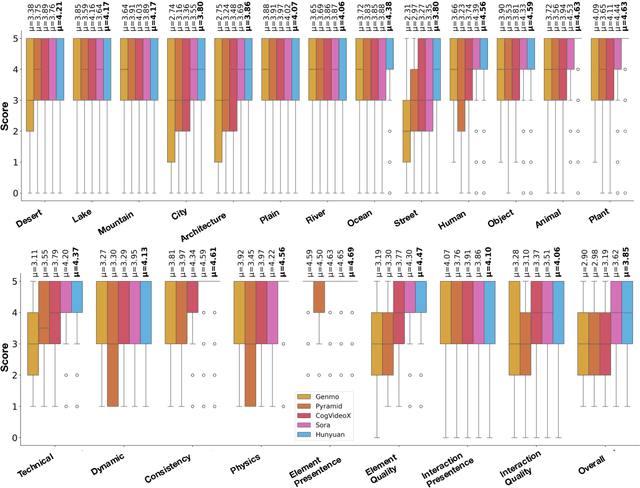
The rapid advancement in AI-generated video synthesis has led to a growth demand for standardized and effective evaluation metrics. Existing metrics lack a unified framework for systematically categorizing methodologies, limiting a holistic understanding of the evaluation landscape. Additionally, fragmented implementations and the absence of standardized interfaces lead to redundant processing overhead. Furthermore, many prior approaches are constrained by dataset-specific dependencies, limiting their applicability across diverse video domains. To address these challenges, we introduce AIGVE-Tool (AI-Generated Video Evaluation Toolkit), a unified framework that provides a structured and extensible evaluation pipeline for a comprehensive AI-generated video evaluation. Organized within a novel five-category taxonomy, AIGVE-Tool integrates multiple evaluation methodologies while allowing flexible customization through a modular configuration system. Additionally, we propose AIGVE-Bench, a large-scale benchmark dataset created with five SOTA video generation models based on hand-crafted instructions and prompts. This dataset systematically evaluates various video generation models across nine critical quality dimensions. Extensive experiments demonstrate the effectiveness of AIGVE-Tool in providing standardized and reliable evaluation results, highlighting specific strengths and limitations of current models and facilitating the advancements of next-generation AI-generated video techniques.
Process-based Self-Rewarding Language Models
Mar 05, 2025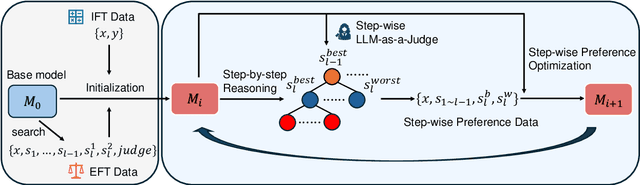
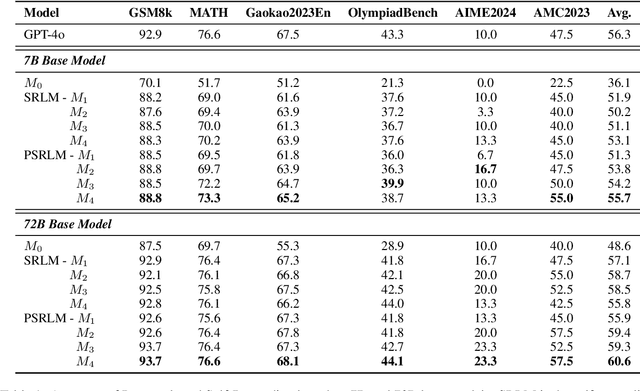
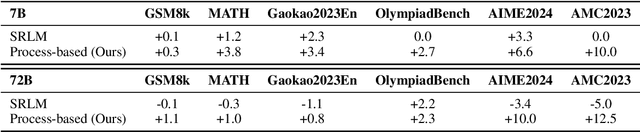
Large Language Models have demonstrated outstanding performance across various downstream tasks and have been widely applied in multiple scenarios. Human-annotated preference data is used for training to further improve LLMs' performance, which is constrained by the upper limit of human performance. Therefore, Self-Rewarding method has been proposed, where LLMs generate training data by rewarding their own outputs. However, the existing self-rewarding paradigm is not effective in mathematical reasoning scenarios and may even lead to a decline in performance. In this work, we propose the Process-based Self-Rewarding pipeline for language models, which introduces long-thought reasoning, step-wise LLM-as-a-Judge, and step-wise preference optimization within the self-rewarding paradigm. Our new paradigm successfully enhances the performance of LLMs on multiple mathematical reasoning benchmarks through iterative Process-based Self-Rewarding, demonstrating the immense potential of self-rewarding to achieve LLM reasoning that may surpass human capabilities.
Haste Makes Waste: Evaluating Planning Abilities of LLMs for Efficient and Feasible Multitasking with Time Constraints Between Actions
Mar 04, 2025While Large Language Model-based agents have demonstrated substantial progress in task completion, existing evaluation benchmarks tend to overemphasize single-task performance, with insufficient attention given to the crucial aspects of multitask planning and execution efficiency required in real-world scenarios. To bridge this gap, we present Recipe2Plan, a novel benchmark framework based on real-world cooking scenarios. Unlike conventional benchmarks, Recipe2Plan challenges agents to optimize cooking time through parallel task execution while respecting temporal constraints i.e. specific actions need to be performed within a particular time intervals following the preceding steps. Overly aggressive local parallelization may disrupt this constraint, potentially compromising the entire cooking process. This strict time constraint between actions raises a unique challenge for agents to balance between maximizing concurrent operations and adhering to critical timing constraints. Extensive experiments with state-of-the-art models reveal challenges in maintaining this balance between efficiency and feasibility. The results highlight the need for improved temporal awareness and global multitasking capabilities in large language models. We open-source our benchmark and code at https://github.com/WilliamZR/Recipe2Plan.
Automated Annotation of Evolving Corpora for Augmenting Longitudinal Network Data: A Framework Integrating Large Language Models and Expert Knowledge
Mar 03, 2025Longitudinal network data are essential for analyzing political, economic, and social systems and processes. In political science, these datasets are often generated through human annotation or supervised machine learning applied to evolving corpora. However, as semantic contexts shift over time, inferring dynamic interaction types on emerging issues among a diverse set of entities poses significant challenges, particularly in maintaining timely and consistent annotations. This paper presents the Expert-Augmented LLM Annotation (EALA) approach, which leverages Large Language Models (LLMs) in combination with historically annotated data and expert-constructed codebooks to extrapolate and extend datasets into future periods. We evaluate the performance and reliability of EALA using a dataset of climate negotiations. Our findings demonstrate that EALA effectively predicts nuanced interactions between negotiation parties and captures the evolution of topics over time. At the same time, we identify several limitations inherent to LLM-based annotation, highlighting areas for further improvement. Given the wide availability of codebooks and annotated datasets, EALA holds substantial promise for advancing research in political science and beyond.
Research advances on fish feeding behavior recognition and intensity quantification methods in aquaculture
Feb 21, 2025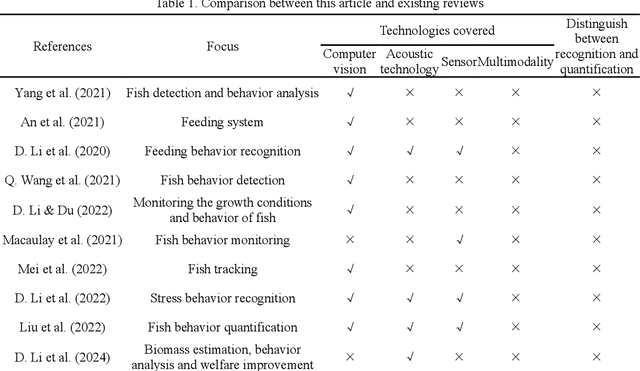
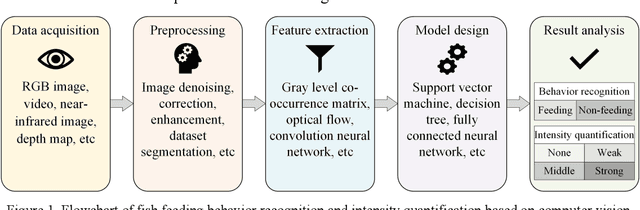
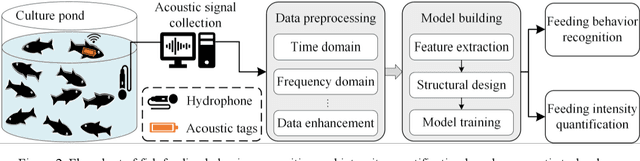
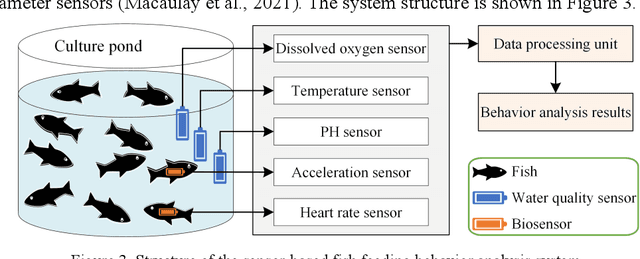
As a key part of aquaculture management, fish feeding behavior recognition and intensity quantification has been a hot area of great concern to researchers, and it plays a crucial role in monitoring fish health, guiding baiting work and improving aquaculture efficiency. In order to better carry out the related work in the future, this paper firstly reviews the research advances of fish feeding behavior recognition and intensity quantification methods based on computer vision, acoustics and sensors in a single modality. Then the application of the current emerging multimodal fusion in fish feeding behavior recognition and intensity quantification methods is expounded. Finally, the advantages and disadvantages of various techniques are compared and analyzed, and the future research directions are envisioned.
GATE: Graph-based Adaptive Tool Evolution Across Diverse Tasks
Feb 20, 2025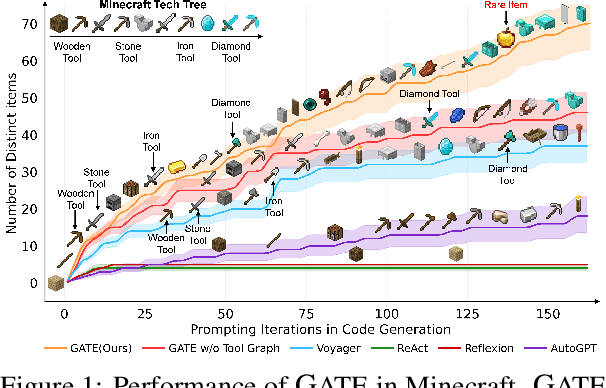
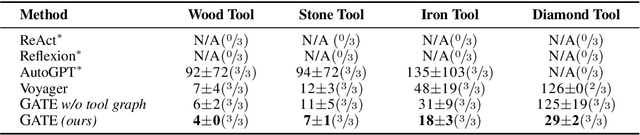
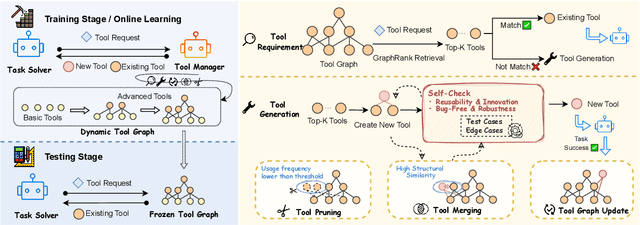
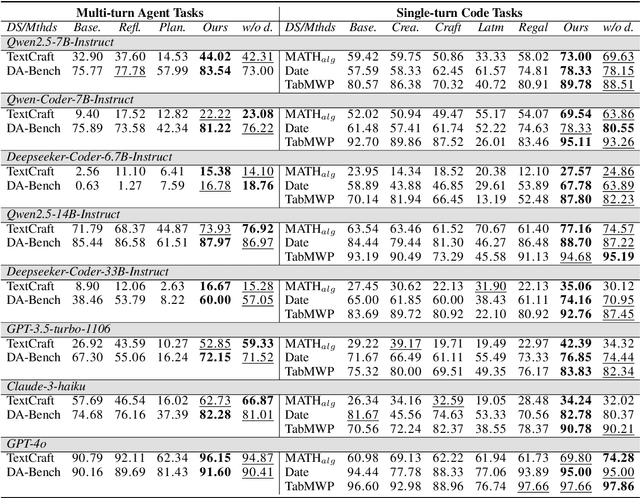
Large Language Models (LLMs) have shown great promise in tool-making, yet existing frameworks often struggle to efficiently construct reliable toolsets and are limited to single-task settings. To address these challenges, we propose GATE (Graph-based Adaptive Tool Evolution), an adaptive framework that dynamically constructs and evolves a hierarchical graph of reusable tools across multiple scenarios. We evaluate GATE on open-ended tasks (Minecraft), agent-based tasks (TextCraft, DABench), and code generation tasks (MATH, Date, TabMWP). Our results show that GATE achieves up to 4.3x faster milestone completion in Minecraft compared to the previous SOTA, and provides an average improvement of 9.23% over existing tool-making methods in code generation tasks and 10.03% in agent tasks. GATE demonstrates the power of adaptive evolution, balancing tool quantity, complexity, and functionality while maintaining high efficiency. Code and data are available at \url{https://github.com/ayanami2003/GATE}.
Redistribute Ensemble Training for Mitigating Memorization in Diffusion Models
Feb 13, 2025Diffusion models, known for their tremendous ability to generate high-quality samples, have recently raised concerns due to their data memorization behavior, which poses privacy risks. Recent methods for memory mitigation have primarily addressed the issue within the context of the text modality in cross-modal generation tasks, restricting their applicability to specific conditions. In this paper, we propose a novel method for diffusion models from the perspective of visual modality, which is more generic and fundamental for mitigating memorization. Directly exposing visual data to the model increases memorization risk, so we design a framework where models learn through proxy model parameters instead. Specially, the training dataset is divided into multiple shards, with each shard training a proxy model, then aggregated to form the final model. Additionally, practical analysis of training losses illustrates that the losses for easily memorable images tend to be obviously lower. Thus, we skip the samples with abnormally low loss values from the current mini-batch to avoid memorizing. However, balancing the need to skip memorization-prone samples while maintaining sufficient training data for high-quality image generation presents a key challenge. Thus, we propose IET-AGC+, which redistributes highly memorizable samples between shards, to mitigate these samples from over-skipping. Furthermore, we dynamically augment samples based on their loss values to further reduce memorization. Extensive experiments and analysis on four datasets show that our method successfully reduces memory capacity while maintaining performance. Moreover, we fine-tune the pre-trained diffusion models, e.g., Stable Diffusion, and decrease the memorization score by 46.7\%, demonstrating the effectiveness of our method. Code is available in: https://github.com/liuxiao-guan/IET_AGC.
Optimizing Large Language Model Training Using FP4 Quantization
Jan 28, 2025
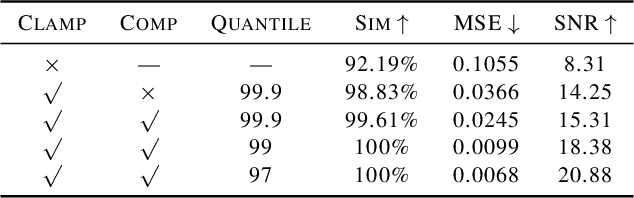


The growing computational demands of training large language models (LLMs) necessitate more efficient methods. Quantized training presents a promising solution by enabling low-bit arithmetic operations to reduce these costs. While FP8 precision has demonstrated feasibility, leveraging FP4 remains a challenge due to significant quantization errors and limited representational capacity. This work introduces the first FP4 training framework for LLMs, addressing these challenges with two key innovations: a differentiable quantization estimator for precise weight updates and an outlier clamping and compensation strategy to prevent activation collapse. To ensure stability, the framework integrates a mixed-precision training scheme and vector-wise quantization. Experimental results demonstrate that our FP4 framework achieves accuracy comparable to BF16 and FP8, with minimal degradation, scaling effectively to 13B-parameter LLMs trained on up to 100B tokens. With the emergence of next-generation hardware supporting FP4, our framework sets a foundation for efficient ultra-low precision training.
Sigma: Differential Rescaling of Query, Key and Value for Efficient Language Models
Jan 23, 2025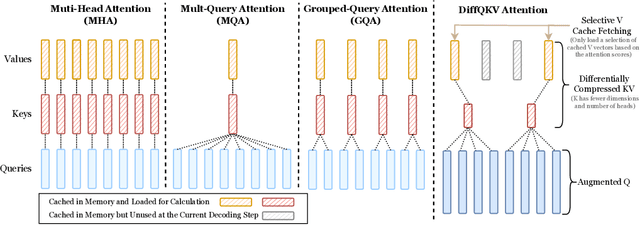

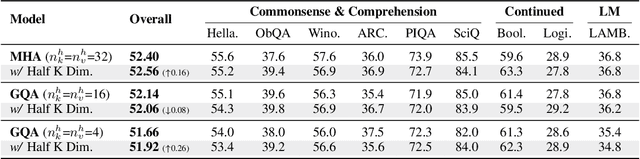

We introduce Sigma, an efficient large language model specialized for the system domain, empowered by a novel architecture including DiffQKV attention, and pre-trained on our meticulously collected system domain data. DiffQKV attention significantly enhances the inference efficiency of Sigma by optimizing the Query (Q), Key (K), and Value (V) components in the attention mechanism differentially, based on their varying impacts on the model performance and efficiency indicators. Specifically, we (1) conduct extensive experiments that demonstrate the model's varying sensitivity to the compression of K and V components, leading to the development of differentially compressed KV, and (2) propose augmented Q to expand the Q head dimension, which enhances the model's representation capacity with minimal impacts on the inference speed. Rigorous theoretical and empirical analyses reveal that DiffQKV attention significantly enhances efficiency, achieving up to a 33.36% improvement in inference speed over the conventional grouped-query attention (GQA) in long-context scenarios. We pre-train Sigma on 6T tokens from various sources, including 19.5B system domain data that we carefully collect and 1T tokens of synthesized and rewritten data. In general domains, Sigma achieves comparable performance to other state-of-arts models. In the system domain, we introduce the first comprehensive benchmark AIMicius, where Sigma demonstrates remarkable performance across all tasks, significantly outperforming GPT-4 with an absolute improvement up to 52.5%.