 Add to Chrome
 Add to Firefox
 Add to Edge
StartupBench: Benchmarking General-Purpose Agents on Market-Validated End-to-End Workflows
Aug 18, 2026
Recent advances in Large Language Models(LLMs) and agents have substantially improved the ability of AI systems to execute complex tasks. Yet existing benchmarks largely rely on researcher-selected tasks, leaving uncertain whether such progress extends to the work that real-world users actually demand from AI systems. We introduce \textbf{StartupBench}, an E2E agent benchmark grounded in market-validated AI startup products. Rather than defining tasks from pre-defined assumptions about useful agent capabilities, we systematically study AI products with demonstrated adoption, together with their product workflows and users, to identify real-world tasks for which AI has established practical demand across diverse professional domains. We translate these workflows into complete deliverable-oriented tasks and evaluate them with fine-grained rubrics capturing their complex requirements. Across representative models evaluated under a unified agent harness, even the strongest model successfully completes only approximately 30\% of StartupBench, despite making substantial partial progress on many tasks. Further analysis identifies aspects like complex instruction following and domain-specific expertise as major sources of failure. Our results reveal that many market-validated workflows remain beyond the reliable capabilities of current general-purpose agents, establishing StartupBench as an empirical measure of progress toward E2E completions of real-world user tasks.

SWE-Touch: Benchmarking Coding Agents When Users Touch the Code
Aug 03, 2026Real-world software development requires coding agents to operate in shared workspaces where users may inspect and modify code during an ongoing task, yet existing repository-level benchmarks typically evaluate agents working alone or restrict user participation to messages. This leads us to ask: how do coding agents understand and respond to code changes in a shared workspace? We introduce SWE-Touch, a framework that stress-tests this setting through validated Counter-Edits: plausible edits to task-relevant code that conflict with task completion. SWE-Touch mines task-critical regions from multiple repair trajectories, uses a separate User Patch Generator to construct the edits, and injects them with contextual user messages when agents reach the relevant code. We evaluate nine coding models on SWE-bench Verified, with additional experiments on longer-horizon tasks from SWE-Bench Pro and DeepSWE. Counter-Edit lowers average resolve rate by 7.7 percentage points on SWE-bench Verified, with degradation also persisting on both longer-horizon benchmarks. Trajectory analysis links these failures to limited awareness of the evolving workspace: agents may retain conflicting code or replace it without sufficiently re-inspecting the repository and validating the revised code with targeted tests. These findings show that strong autonomous performance does not yet ensure the state awareness and adaptive behavior needed for shared-workspace collaboration, and point to detecting workspace changes, reconciling conflicting edits with the task, and verifying the affected behavior as key capabilities for future optimization.
DV-World: Benchmarking Data Visualization Agents in Real-World Scenarios
Apr 28, 2026Real-world data visualization (DV) requires native environmental grounding, cross-platform evolution, and proactive intent alignment. Yet, existing benchmarks often suffer from code-sandbox confinement, single-language creation-only tasks, and assumption of perfect intent. To bridge these gaps, we introduce DV-World, a benchmark of 260 tasks designed to evaluate DV agents across real-world professional lifecycles. DV-World spans three domains: DV-Sheet for native spreadsheet manipulation including chart and dashboard creation as well as diagnostic repair; DV-Evolution for adapting and restructuring reference visual artifacts to fit new data across diverse programming paradigms and DV-Interact for proactive intent alignment with a user simulator that mimics real-world ambiguous requirements. Our hybrid evaluation framework integrates Table-value Alignment for numerical precision and MLLM-as-a-Judge with rubrics for semantic-visual assessment. Experiments reveal that state-of-the-art models achieve less than 50% overall performance, exposing critical deficits in handling the complex challenges of real-world data visualization. DV-World provides a realistic testbed to steer development toward the versatile expertise required in enterprise workflows. Our data and code are available at \href{https://github.com/DA-Open/DV-World}{this project page}.
GATE: Graph-based Adaptive Tool Evolution Across Diverse Tasks
Feb 20, 2025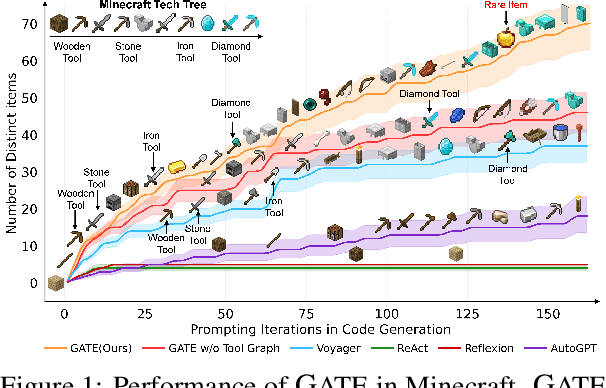
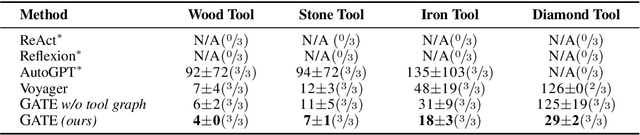
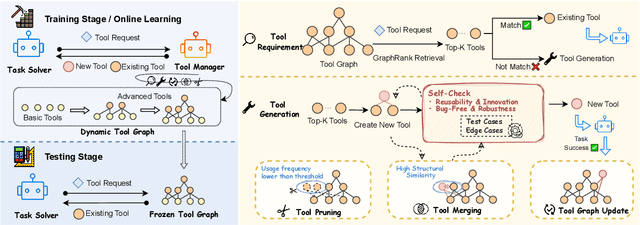
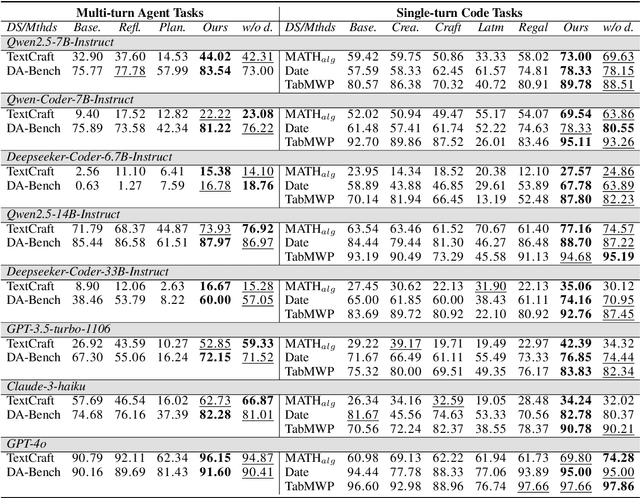
Large Language Models (LLMs) have shown great promise in tool-making, yet existing frameworks often struggle to efficiently construct reliable toolsets and are limited to single-task settings. To address these challenges, we propose GATE (Graph-based Adaptive Tool Evolution), an adaptive framework that dynamically constructs and evolves a hierarchical graph of reusable tools across multiple scenarios. We evaluate GATE on open-ended tasks (Minecraft), agent-based tasks (TextCraft, DABench), and code generation tasks (MATH, Date, TabMWP). Our results show that GATE achieves up to 4.3x faster milestone completion in Minecraft compared to the previous SOTA, and provides an average improvement of 9.23% over existing tool-making methods in code generation tasks and 10.03% in agent tasks. GATE demonstrates the power of adaptive evolution, balancing tool quantity, complexity, and functionality while maintaining high efficiency. Code and data are available at \url{https://github.com/ayanami2003/GATE}.