 Add to Chrome
 Add to Firefox
 Add to Edge
Sigma-MoE-Tiny Technical Report
Dec 19, 2025
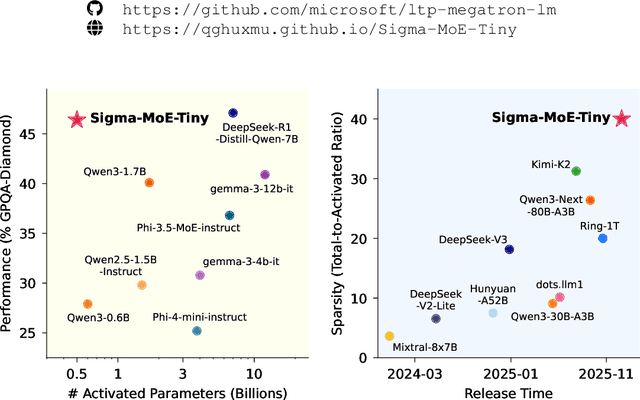
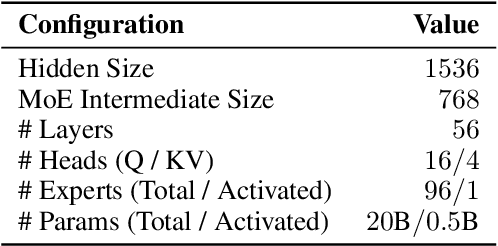
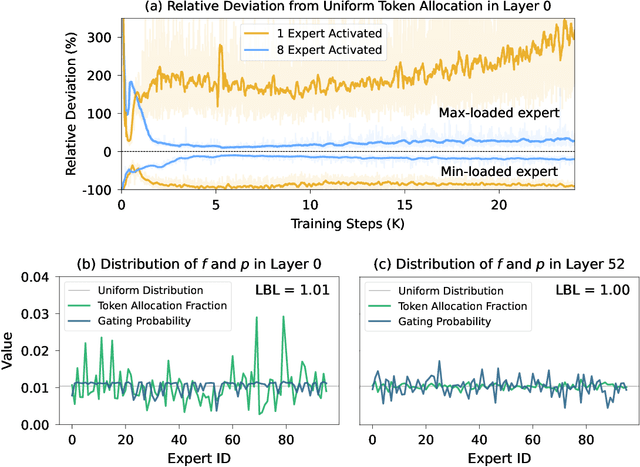
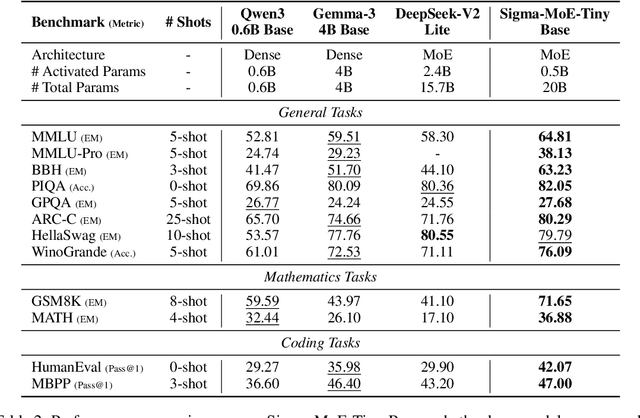
Mixture-of-Experts (MoE) has emerged as a promising paradigm for foundation models due to its efficient and powerful scalability. In this work, we present Sigma-MoE-Tiny, an MoE language model that achieves the highest sparsity compared to existing open-source models. Sigma-MoE-Tiny employs fine-grained expert segmentation with up to 96 experts per layer, while activating only one expert for each token, resulting in 20B total parameters with just 0.5B activated. The major challenge introduced by such extreme sparsity lies in expert load balancing. We find that the widely-used load balancing loss tends to become ineffective in the lower layers under this setting. To address this issue, we propose a progressive sparsification schedule aiming to balance expert utilization and training stability. Sigma-MoE-Tiny is pre-trained on a diverse and high-quality corpus, followed by post-training to further unlock its capabilities. The entire training process remains remarkably stable, with no occurrence of irrecoverable loss spikes. Comprehensive evaluations reveal that, despite activating only 0.5B parameters, Sigma-MoE-Tiny achieves top-tier performance among counterparts of comparable or significantly larger scale. In addition, we provide an in-depth discussion of load balancing in highly sparse MoE models, offering insights for advancing sparsity in future MoE architectures. Project page: https://qghuxmu.github.io/Sigma-MoE-Tiny Code: https://github.com/microsoft/ltp-megatron-lm

SIGMA: An AI-Empowered Training Stack on Early-Life Hardware
Dec 15, 2025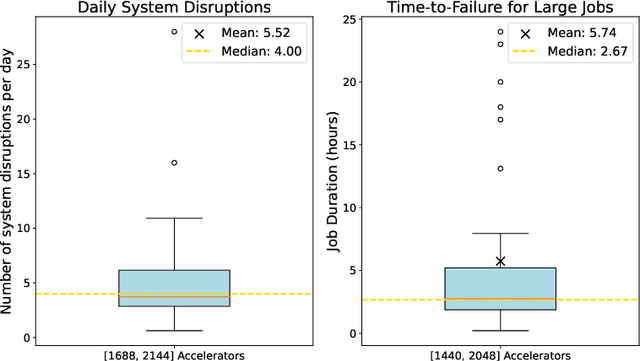

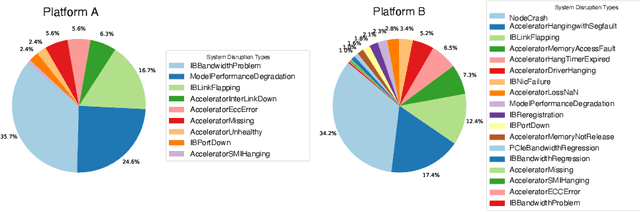
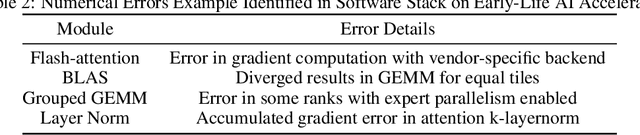
An increasing variety of AI accelerators is being considered for large-scale training. However, enabling large-scale training on early-life AI accelerators faces three core challenges: frequent system disruptions and undefined failure modes that undermine reliability; numerical errors and training instabilities that threaten correctness and convergence; and the complexity of parallelism optimization combined with unpredictable local noise that degrades efficiency. To address these challenges, SIGMA is an open-source training stack designed to improve the reliability, stability, and efficiency of large-scale distributed training on early-life AI hardware. The core of this initiative is the LUCIA TRAINING PLATFORM (LTP), the system optimized for clusters with early-life AI accelerators. Since its launch in March 2025, LTP has significantly enhanced training reliability and operational productivity. Over the past five months, it has achieved an impressive 94.45% effective cluster accelerator utilization, while also substantially reducing node recycling and job-recovery times. Building on the foundation of LTP, the LUCIA TRAINING FRAMEWORK (LTF) successfully trained SIGMA-MOE, a 200B MoE model, using 2,048 AI accelerators. This effort delivered remarkable stability and efficiency outcomes, achieving 21.08% MFU, state-of-the-art downstream accuracy, and encountering only one stability incident over a 75-day period. Together, these advances establish SIGMA, which not only tackles the critical challenges of large-scale training but also establishes a new benchmark for AI infrastructure and platform innovation, offering a robust, cost-effective alternative to prevailing established accelerator stacks and significantly advancing AI capabilities and scalability. The source code of SIGMA is available at https://github.com/microsoft/LuciaTrainingPlatform.
Recycling Pretrained Checkpoints: Orthogonal Growth of Mixture-of-Experts for Efficient Large Language Model Pre-Training
Oct 09, 2025The rapidly increasing computational cost of pretraining Large Language Models necessitates more efficient approaches. Numerous computational costs have been invested in existing well-trained checkpoints, but many of them remain underutilized due to engineering constraints or limited model capacity. To efficiently reuse this "sunk" cost, we propose to recycle pretrained checkpoints by expanding their parameter counts and continuing training. We propose orthogonal growth method well-suited for converged Mixture-of-Experts model: interpositional layer copying for depth growth and expert duplication with injected noise for width growth. To determine the optimal timing for such growth across checkpoints sequences, we perform comprehensive scaling experiments revealing that the final accuracy has a strong positive correlation with the amount of sunk cost, indicating that greater prior investment leads to better performance. We scale our approach to models with 70B parameters and over 1T training tokens, achieving 10.66% accuracy gain over training from scratch under the same additional compute budget. Our checkpoint recycling approach establishes a foundation for economically efficient large language model pretraining.
Training Matryoshka Mixture-of-Experts for Elastic Inference-Time Expert Utilization
Sep 30, 2025Mixture-of-Experts (MoE) has emerged as a promising paradigm for efficiently scaling large language models without a proportional increase in computational cost. However, the standard training strategy of Top-K router prevents MoE models from realizing their full potential for elastic inference. When the number of activated experts is altered at inference time, these models exhibit precipitous performance degradation. In this work, we introduce Matryoshka MoE (M-MoE), a training framework that instills a coarse-to-fine structure directly into the expert ensemble. By systematically varying the number of activated experts during training, M-MoE compels the model to learn a meaningful ranking: top-ranked experts collaborate to provide essential, coarse-grained capabilities, while subsequent experts add progressively finer-grained detail. We explore this principle at multiple granularities, identifying a layer-wise randomization strategy as the most effective. Our experiments demonstrate that a single M-MoE model achieves remarkable elasticity, with its performance at various expert counts closely matching that of an entire suite of specialist models, but at only a fraction of the total training cost. This flexibility not only unlocks elastic inference but also enables optimizing performance by allocating different computational budgets to different model layers. Our work paves the way for more practical and adaptable deployments of large-scale MoE models.
Detecting Manipulated Contents Using Knowledge-Grounded Inference
Apr 29, 2025The detection of manipulated content, a prevalent form of fake news, has been widely studied in recent years. While existing solutions have been proven effective in fact-checking and analyzing fake news based on historical events, the reliance on either intrinsic knowledge obtained during training or manually curated context hinders them from tackling zero-day manipulated content, which can only be recognized with real-time contextual information. In this work, we propose Manicod, a tool designed for detecting zero-day manipulated content. Manicod first sources contextual information about the input claim from mainstream search engines, and subsequently vectorizes the context for the large language model (LLM) through retrieval-augmented generation (RAG). The LLM-based inference can produce a "truthful" or "manipulated" decision and offer a textual explanation for the decision. To validate the effectiveness of Manicod, we also propose a dataset comprising 4270 pieces of manipulated fake news derived from 2500 recent real-world news headlines. Manicod achieves an overall F1 score of 0.856 on this dataset and outperforms existing methods by up to 1.9x in F1 score on their benchmarks on fact-checking and claim verification.
GeoTexBuild: 3D Building Model Generation from Map Footprints
Apr 11, 2025We introduce GeoTexBuild, a modular generative framework for creating 3D building models from map footprints. The proposed framework employs a three-stage process comprising height map generation, geometry reconstruction, and appearance stylization, culminating in building models with intricate geometry and appearance attributes. By integrating customized ControlNet and Text2Mesh models, we explore effective methods for controlling both geometric and visual attributes during the generation process. By this, we eliminate the problem of structural variations behind a single facade photo of the existing 3D generation techniques. Experimental results at each stage validate the capability of GeoTexBuild to generate detailed and accurate building models from footprints derived from site planning or map designs. Our framework significantly reduces manual labor in modeling buildings and can offer inspiration for designers.
Optimizing Large Language Model Training Using FP4 Quantization
Jan 28, 2025
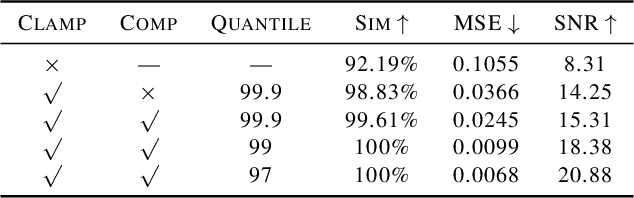


The growing computational demands of training large language models (LLMs) necessitate more efficient methods. Quantized training presents a promising solution by enabling low-bit arithmetic operations to reduce these costs. While FP8 precision has demonstrated feasibility, leveraging FP4 remains a challenge due to significant quantization errors and limited representational capacity. This work introduces the first FP4 training framework for LLMs, addressing these challenges with two key innovations: a differentiable quantization estimator for precise weight updates and an outlier clamping and compensation strategy to prevent activation collapse. To ensure stability, the framework integrates a mixed-precision training scheme and vector-wise quantization. Experimental results demonstrate that our FP4 framework achieves accuracy comparable to BF16 and FP8, with minimal degradation, scaling effectively to 13B-parameter LLMs trained on up to 100B tokens. With the emergence of next-generation hardware supporting FP4, our framework sets a foundation for efficient ultra-low precision training.
Addressing the Mutual Interference in Uplink ISAC Receivers: A Projection Method
Aug 29, 2024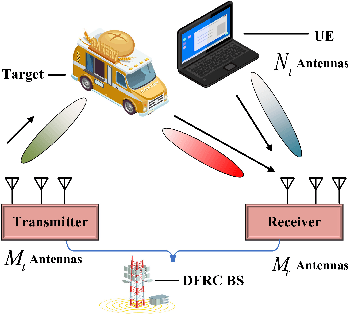
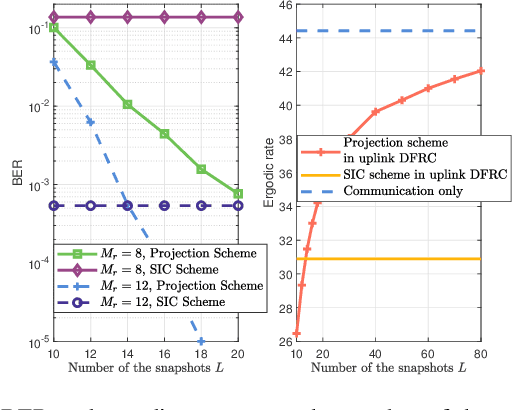
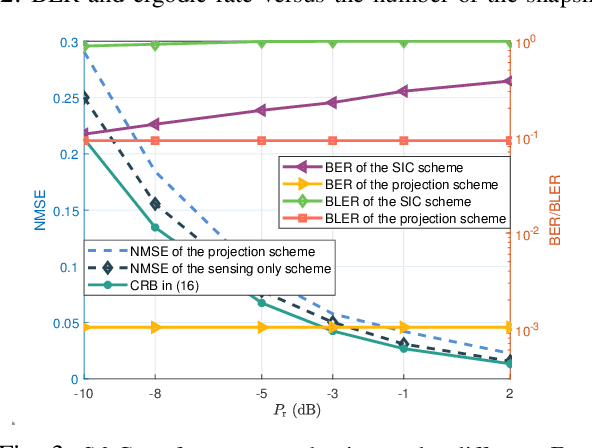
Dual function radar and communication (DFRC) is a promising research direction within integrated sensing and communication (ISAC), improving hardware and spectrum efficiency by merging sensing and communication (S&C) functionalities into a shared platform. However, the DFRC receiver (DFRC-R) is tasked with both uplink communication signal detection and simultaneously target-related parameter estimation from the echoes, leading to issues with mutual interference. In this paper, a projection-based scheme is proposed to equivalently transform the joint signal detection and target estimation problem into a joint signal detection process across multiple snapshots. Compared with conventional successive interference cancellation (SIC) schemes, our proposed approach achieves a higher signal-to-noise ratio (SNR), and a higher ergodic rate when the radar signal is non-negligible. Nonetheless, it introduces an ill-conditioned signal detection problem, which is addressed using a non-linear detector. By jointly processing an increased number of snapshots, the proposed scheme can achieve high S&C performance simultaneously.
Enhancement of 3D Gaussian Splatting using Raw Mesh for Photorealistic Recreation of Architectures
Jul 22, 2024The photorealistic reconstruction and rendering of architectural scenes have extensive applications in industries such as film, games, and transportation. It also plays an important role in urban planning, architectural design, and the city's promotion, especially in protecting historical and cultural relics. The 3D Gaussian Splatting, due to better performance over NeRF, has become a mainstream technology in 3D reconstruction. Its only input is a set of images but it relies heavily on geometric parameters computed by the SfM process. At the same time, there is an existing abundance of raw 3D models, that could inform the structural perception of certain buildings but cannot be applied. In this paper, we propose a straightforward method to harness these raw 3D models to guide 3D Gaussians in capturing the basic shape of the building and improve the visual quality of textures and details when photos are captured non-systematically. This exploration opens up new possibilities for improving the effectiveness of 3D reconstruction techniques in the field of architectural design.
Tensor Decomposition-based Time Varying Channel Estimation for mmWave MIMO-OFDM Systems
Mar 05, 2024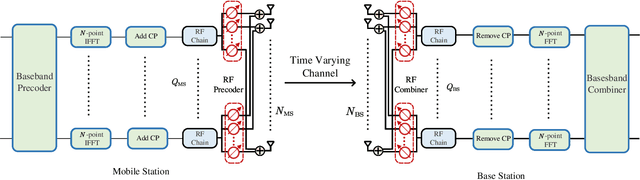
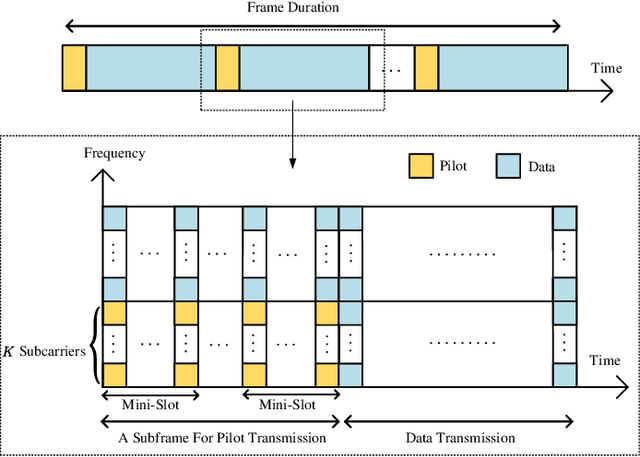
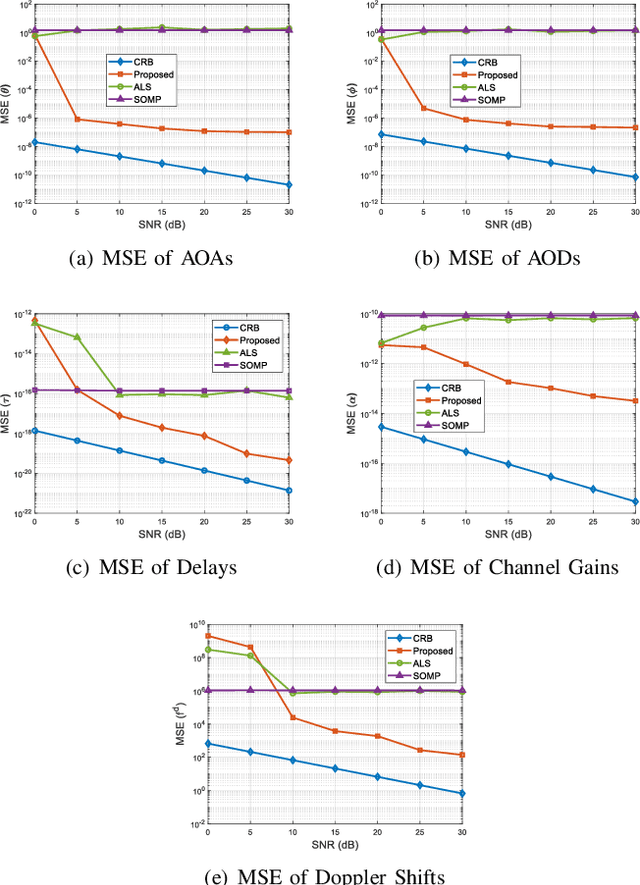
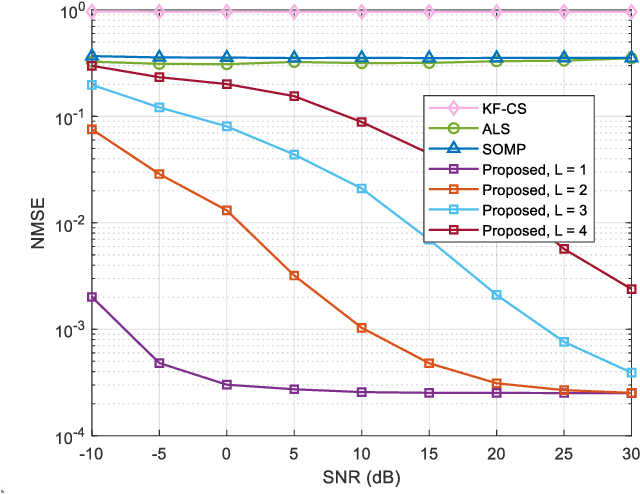
In this paper, we consider the time-varying channel estimation in millimeter wave (mmWave) multiple-input multiple-output MIMO systems with hybrid beamforming architectures. Different from the existing contributions that considered single-carrier mmWave systems with high mobility, the wideband orthogonal frequency division multiplexing (OFDM) system is considered in this work. To solve the channel estimation problem under channel double selectivity, we propose a pilot transmission scheme based on 5G OFDM, and the received signals are formed as a fourth-order tensor, which fits the low-rank CANDECOMP/PARAFAC (CP) model. By further exploring the Vandermonde structure of factor matrix, a tensor-subspace decomposition based channel estimation method is proposed to solve the CP decomposition, where the uniqueness condition is analyzed. Based on the decomposed factor matrices, the channel parameters, including angles of arrival/departure, delays, channel gains and Doppler shifts are estimated, and the Cram\'{e}r-Rao bound (CRB) results are derived as performance metrics. Simulation results demonstrate the superior performance of the proposed method over other benchmarks. Furthermore, the channel estimation methods are tested based on the channel parameters generated by Wireless InSites, and simulation results show the effectiveness of the proposed method in practical scenarios.