 Add to Chrome
 Add to Firefox
 Add to Edge
Inclusive Interactive Collisions for Multi-View Consistent Compositional 3D Generation
Jun 23, 2026
Recent breakthroughs in 3D generation have advanced notably with the development of text-to-image diffusion model. However, existing methods remain two practical challenges: (1) They primarily generate single 3D object, but struggle to generate multi-object compositional 3D assets due to the lack of the modeling for Gaussian primitives in reasonable interactions. (2) They often suffer from cross-view inconsistency during 3D optimization, as Score Distillation Sampling inherently performs on each single view, inevitably resulting in cross-view hallucinations. To solve above issues, we propose I2C-3D, a novel optimization-based method to generate multi-view consistent compositional 3D assets with reasonable interactions. Specifically, we propose an Inclusive Interactive Collisions strategy to guide Gaussian primitives appearing in reasonable interaction regions naturally, thereby ensuring objects in the compositional scene interact in a physically plausible and visually coherent way. Additionally, to enhance multi-view consistency, Multi-View Adaptive Score Distillation Sampling is devised to distill multi-view consistency prior and layout prior from pre-trained diffusion model by modulating attention map of instance token and spatial token across viewpoints. Benefiting from above elaborate designs, I2C-3D not only generates high-fidelity multi-view consistent compositional 3D assets but also supports 3D editing flexibly, facilitating complex scene generation. Extensive experiments demonstrate our I2C-3D outperforms existing methods in generation quality and multi-view consistency.

StoryTailor:A Zero-Shot Pipeline for Action-Rich Multi-Subject Visual Narratives
Feb 24, 2026Generating multi-frame, action-rich visual narratives without fine-tuning faces a threefold tension: action text faithfulness, subject identity fidelity, and cross-frame background continuity. We propose StoryTailor, a zero-shot pipeline that runs on a single RTX 4090 (24 GB) and produces temporally coherent, identity-preserving image sequences from a long narrative prompt, per-subject references, and grounding boxes. Three synergistic modules drive the system: Gaussian-Centered Attention (GCA) to dynamically focus on each subject core and ease grounding-box overlaps; Action-Boost Singular Value Reweighting (AB-SVR) to amplify action-related directions in the text embedding space; and Selective Forgetting Cache (SFC) that retains transferable background cues, forgets nonessential history, and selectively surfaces retained cues to build cross-scene semantic ties. Compared with baseline methods, experiments show that CLIP-T improves by up to 10-15%, with DreamSim lower than strong baselines, while CLIP-I stays in a visually acceptable, competitive range. With matched resolution and steps on a 24 GB GPU, inference is faster than FluxKontext. Qualitatively, StoryTailor delivers expressive interactions and evolving yet stable scenes.
Beyond Color and Lines: Zero-Shot Style-Specific Image Variations with Coordinated Semantics
Oct 24, 2024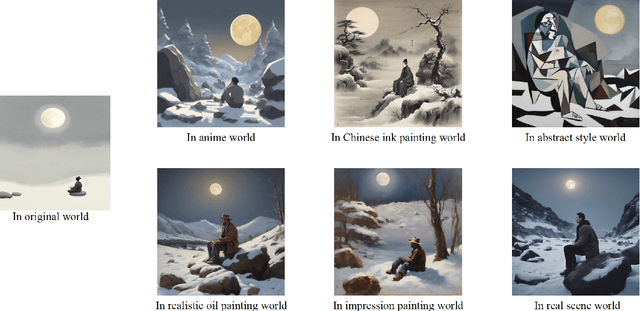


Traditionally, style has been primarily considered in terms of artistic elements such as colors, brushstrokes, and lighting. However, identical semantic subjects, like people, boats, and houses, can vary significantly across different artistic traditions, indicating that style also encompasses the underlying semantics. Therefore, in this study, we propose a zero-shot scheme for image variation with coordinated semantics. Specifically, our scheme transforms the image-to-image problem into an image-to-text-to-image problem. The image-to-text operation employs vision-language models e.g., BLIP) to generate text describing the content of the input image, including the objects and their positions. Subsequently, the input style keyword is elaborated into a detailed description of this style and then merged with the content text using the reasoning capabilities of ChatGPT. Finally, the text-to-image operation utilizes a Diffusion model to generate images based on the text prompt. To enable the Diffusion model to accommodate more styles, we propose a fine-tuning strategy that injects text and style constraints into cross-attention. This ensures that the output image exhibits similar semantics in the desired style. To validate the performance of the proposed scheme, we constructed a benchmark comprising images of various styles and scenes and introduced two novel metrics. Despite its simplicity, our scheme yields highly plausible results in a zero-shot manner, particularly for generating stylized images with high-fidelity semantics.