 Add to Chrome
 Add to Firefox
 Add to Edge
FlowTTS-GRPO: Online Reinforcement Learning with Multi-Objective Reward Optimization for Flow-Matching Based Text-to-Speech
Jun 22, 2026
Existing Reinforcement Learning (RL) research for Text-to-Speech (TTS) focuses on large language models (LLMs), leaving Flow-Matching (FM) under-explored. We present FlowTTS-GRPO, an online RL framework for FM-based TTS. By converting ordinary differential equation (ODE) trajectories into stochastic differential equation (SDE) paths, our method enables direct fine-tuning of open-source FM models without auxiliary models. We show that a weighted reward combination converges faster than a probabilistic scheme, and identify three practical optimizations: omitting classifier-free guidance (CFG) during training accelerates convergence; synthesizing hard cases improves robustness; and applying RL to the FM component enhances audio-detail metrics. Experiments on CosyVoice 3.0 and F5-TTS demonstrate objective and subjective preference gains in speaker similarity and perceptual quality, with F5-TTS also improving intelligibility.

LuSeeL: Language-queried Binaural Universal Sound Event Extraction and Localization
Jan 27, 2026Most universal sound extraction algorithms focus on isolating a target sound event from single-channel audio mixtures. However, the real world is three-dimensional, and binaural audio, which mimics human hearing, can capture richer spatial information, including sound source location. This spatial context is crucial for understanding and modeling complex auditory scenes, as it inherently informs sound detection and extraction. In this work, we propose a language-driven universal sound extraction network that isolates text-described sound events from binaural mixtures by effectively leveraging the spatial cues present in binaural signals. Additionally, we jointly predict the direction of arrival (DoA) of the target sound using spatial features from the extraction network. This dual-task approach exploits complementary location information to improve extraction performance while enabling accurate DoA estimation. Experimental results on the in-the-wild AudioCaps dataset show that our proposed LuSeeL model significantly outperforms single-channel and uni-task baselines.
FlowSE-GRPO: Training Flow Matching Speech Enhancement via Online Reinforcement Learning
Jan 23, 2026Generative speech enhancement offers a promising alternative to traditional discriminative methods by modeling the distribution of clean speech conditioned on noisy inputs. Post-training alignment via reinforcement learning (RL) effectively aligns generative models with human preferences and downstream metrics in domains such as natural language processing, but its use in speech enhancement remains limited, especially for online RL. Prior work explores offline methods like Direct Preference Optimization (DPO); online methods such as Group Relative Policy Optimization (GRPO) remain largely uninvestigated. In this paper, we present the first successful integration of online GRPO into a flow-matching speech enhancement framework, enabling efficient post-training alignment to perceptual and task-oriented metrics with few update steps. Unlike prior GRPO work on Large Language Models, we adapt the algorithm to the continuous, time-series nature of speech and to the dynamics of flow-matching generative models. We show that optimizing a single reward yields rapid metric gains but often induces reward hacking that degrades audio fidelity despite higher scores. To mitigate this, we propose a multi-metric reward optimization strategy that balances competing objectives, substantially reducing overfitting and improving overall performance. Our experiments validate online GRPO for speech enhancement and provide practical guidance for RL-based post-training of generative audio models.
E2E-AEC: Implementing an end-to-end neural network learning approach for acoustic echo cancellation
Jan 23, 2026We propose a novel neural network-based end-to-end acoustic echo cancellation (E2E-AEC) method capable of streaming inference, which operates effectively without reliance on traditional linear AEC (LAEC) techniques and time delay estimation. Our approach includes several key strategies: First, we introduce and refine progressive learning to gradually enhance echo suppression. Second, our model employs knowledge transfer by initializing with a pre-trained LAECbased model, harnessing the insights gained from LAEC training. Third, we optimize the attention mechanism with a loss function applied on attention weights to achieve precise time alignment between the reference and microphone signals. Lastly, we incorporate voice activity detection to enhance speech quality and improve echo removal by masking the network output when near-end speech is absent. The effectiveness of our approach is validated through experiments conducted on public datasets.
FunAudio-ASR Technical Report
Sep 15, 2025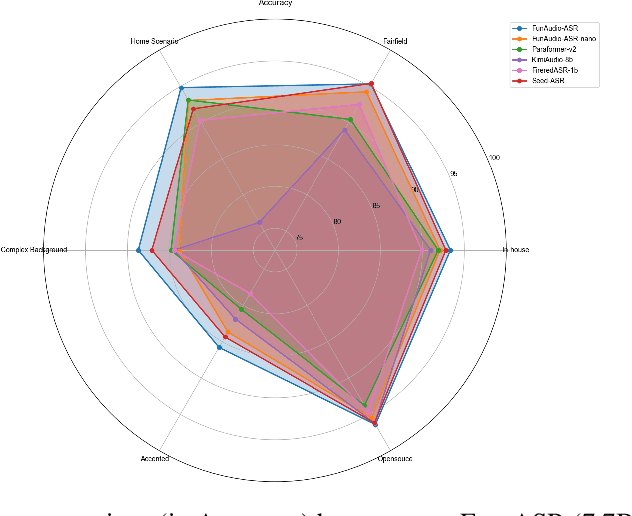
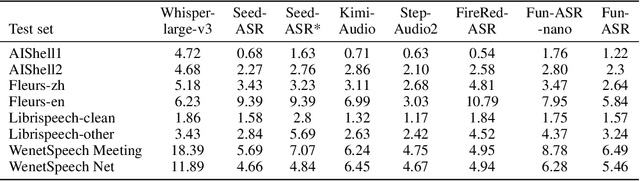
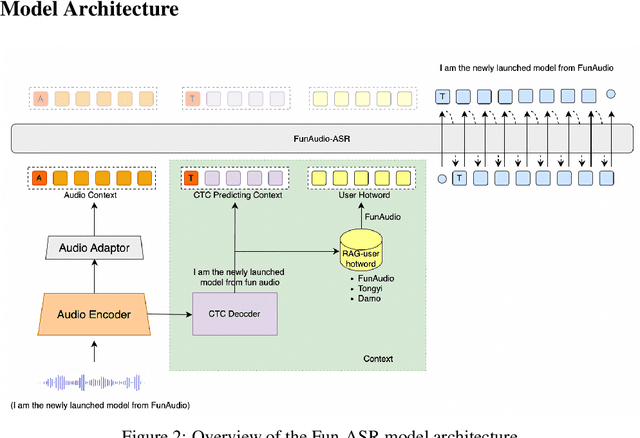
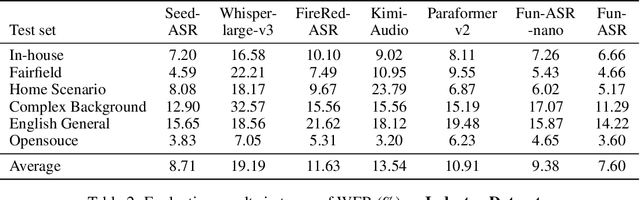
In recent years, automatic speech recognition (ASR) has witnessed transformative advancements driven by three complementary paradigms: data scaling, model size scaling, and deep integration with large language models (LLMs). However, LLMs are prone to hallucination, which can significantly degrade user experience in real-world ASR applications. In this paper, we present FunAudio-ASR, a large-scale, LLM-based ASR system that synergistically combines massive data, large model capacity, LLM integration, and reinforcement learning to achieve state-of-the-art performance across diverse and complex speech recognition scenarios. Moreover, FunAudio-ASR is specifically optimized for practical deployment, with enhancements in streaming capability, noise robustness, code-switching, hotword customization, and satisfying other real-world application requirements. Experimental results show that while most LLM-based ASR systems achieve strong performance on open-source benchmarks, they often underperform on real industry evaluation sets. Thanks to production-oriented optimizations, FunAudio-ASR achieves SOTA performance on real application datasets, demonstrating its effectiveness and robustness in practical settings.
FLASepformer: Efficient Speech Separation with Gated Focused Linear Attention Transformer
Aug 27, 2025Speech separation always faces the challenge of handling prolonged time sequences. Past methods try to reduce sequence lengths and use the Transformer to capture global information. However, due to the quadratic time complexity of the attention module, memory usage and inference time still increase significantly with longer segments. To tackle this, we introduce Focused Linear Attention and build FLASepformer with linear complexity for efficient speech separation. Inspired by SepReformer and TF-Locoformer, we have two variants: FLA-SepReformer and FLA-TFLocoformer. We also add a new Gated module to improve performance further. Experimental results on various datasets show that FLASepformer matches state-of-the-art performance with less memory consumption and faster inference. FLA-SepReformer-T/B/L increases speed by 2.29x, 1.91x, and 1.49x, with 15.8%, 20.9%, and 31.9% GPU memory usage, proving our model's effectiveness.
Exploring Efficient Directional and Distance Cues for Regional Speech Separation
Aug 11, 2025In this paper, we introduce a neural network-based method for regional speech separation using a microphone array. This approach leverages novel spatial cues to extract the sound source not only from specified direction but also within defined distance. Specifically, our method employs an improved delay-and-sum technique to obtain directional cues, substantially enhancing the signal from the target direction. We further enhance separation by incorporating the direct-to-reverberant ratio into the input features, enabling the model to better discriminate sources within and beyond a specified distance. Experimental results demonstrate that our proposed method leads to substantial gains across multiple objective metrics. Furthermore, our method achieves state-of-the-art performance on the CHiME-8 MMCSG dataset, which was recorded in real-world conversational scenarios, underscoring its effectiveness for speech separation in practical applications.
ZipEnhancer: Dual-Path Down-Up Sampling-based Zipformer for Monaural Speech Enhancement
Jan 09, 2025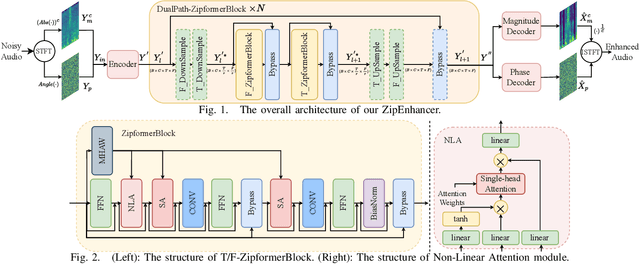
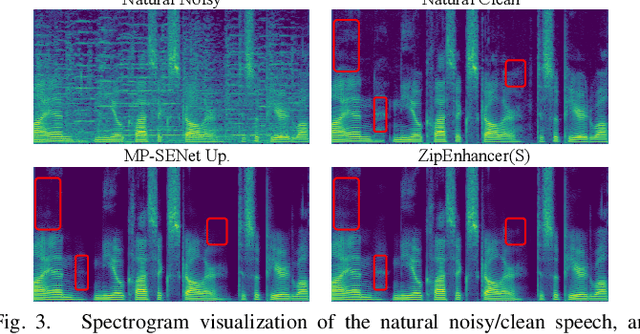
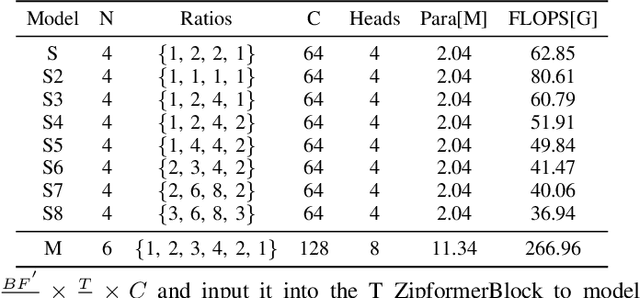
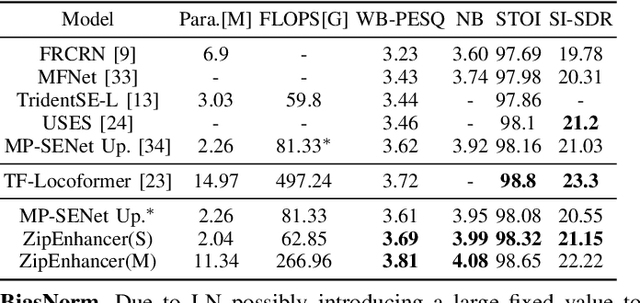
In contrast to other sequence tasks modeling hidden layer features with three axes, Dual-Path time and time-frequency domain speech enhancement models are effective and have low parameters but are computationally demanding due to their hidden layer features with four axes. We propose ZipEnhancer, which is Dual-Path Down-Up Sampling-based Zipformer for Monaural Speech Enhancement, incorporating time and frequency domain Down-Up sampling to reduce computational costs. We introduce the ZipformerBlock as the core block and propose the design of the Dual-Path DownSampleStacks that symmetrically scale down and scale up. Also, we introduce the ScaleAdam optimizer and Eden learning rate scheduler to improve the performance further. Our model achieves new state-of-the-art results on the DNS 2020 Challenge and Voicebank+DEMAND datasets, with a perceptual evaluation of speech quality (PESQ) of 3.69 and 3.63, using 2.04M parameters and 62.41G FLOPS, outperforming other methods with similar complexity levels.
MPS-AMS: Masked Patches Selection and Adaptive Masking Strategy Based Self-Supervised Medical Image Segmentation
Feb 27, 2023Existing self-supervised learning methods based on contrastive learning and masked image modeling have demonstrated impressive performances. However, current masked image modeling methods are mainly utilized in natural images, and their applications in medical images are relatively lacking. Besides, their fixed high masking strategy limits the upper bound of conditional mutual information, and the gradient noise is considerable, making less the learned representation information. Motivated by these limitations, in this paper, we propose masked patches selection and adaptive masking strategy based self-supervised medical image segmentation method, named MPS-AMS. We leverage the masked patches selection strategy to choose masked patches with lesions to obtain more lesion representation information, and the adaptive masking strategy is utilized to help learn more mutual information and improve performance further. Extensive experiments on three public medical image segmentation datasets (BUSI, Hecktor, and Brats2018) show that our proposed method greatly outperforms the state-of-the-art self-supervised baselines.
Joint Acoustic Echo Cancellation and Speech Dereverberation Using Kalman filters
Feb 09, 2023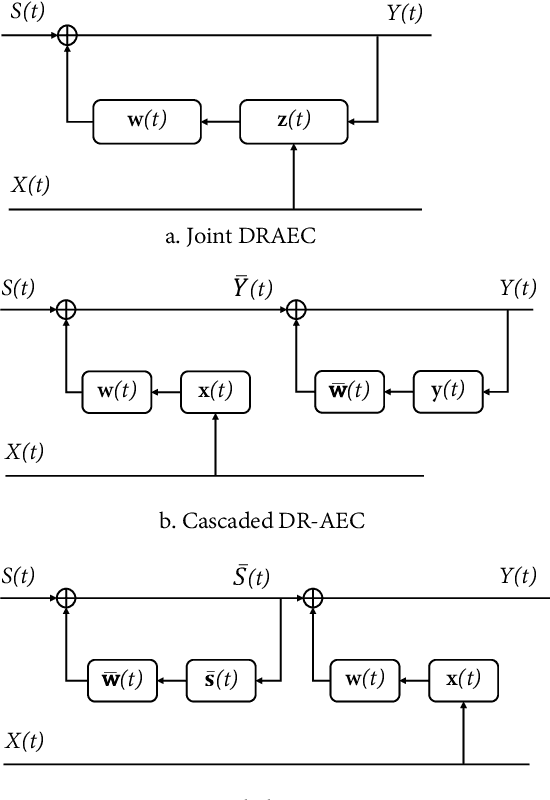
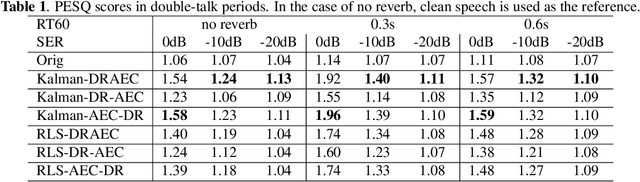
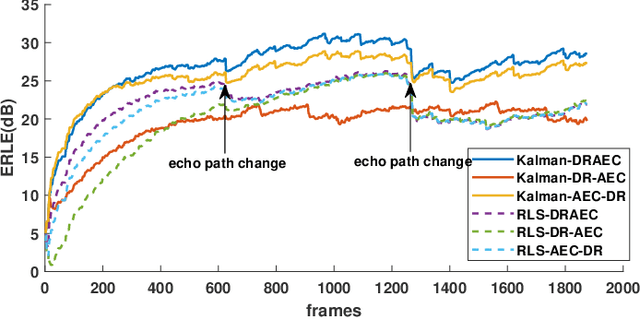

This paper proposes a joint acoustic echo cancellation (AEC) and speech dereverberation (DR) algorithm in the short-time Fourier transform domain. The reverberant microphone signals are described using an auto-regressive (AR) model. The AR coefficients and the loudspeaker-to-microphone acoustic transfer functions (ATFs) are considered time-varying and are modeled simultaneously using a first-order Markov process. This leads to a solution where these parameters can be optimally estimated using Kalman filters. It is shown that the proposed algorithm outperforms vanilla solutions that solve AEC and DR sequentially and one state-of-the-art joint DRAEC algorithm based on semi-blind source separation, in terms of both speech quality and echo reduction performance.