 Add to Chrome
 Add to Firefox
 Add to Edge
BareWave: Waveform-Native Flow-Matching Text-to-Speech
Jun 08, 2026
Removing intermediate representations and separately trained decoding stages has become an important direction in generative modeling. In text-to-speech, however, high-quality systems are still commonly built through an intermediate acoustic representation before waveform synthesis. In this work, we present BareWave, a fully waveform-native framework for direct text-to-wave generation in flow-matching TTS. We consider this setting to raise three training challenges: raw-waveform modeling lacks a strong pretrained representational scaffold, different stages of training benefit from different noise schedules, and data-space perceptual objectives do not automatically share the temporal structure of the velocity-space flow objective. As a result, direct waveform training is hard to optimize efficiently, hard to push toward a strong final operating point with a fixed recipe, and hard to integrate effective perceptual refinement. Guided by this view, we develop a direct text-to-wave training framework that combines training-time representation alignment, staged noise scheduling, and velocity-aware perceptual alignment (VAPA), while preserving a single waveform-native inference path without pretrained components at test time. Experiments on zero-shot voice cloning show that strong intelligibility, speaker similarity, and naturalness can be achieved under a fully waveform-native inference path, supporting waveform-native flow-matching TTS as a practical direction. Project page with audio demos is available at https://barewave.github.io/.

FGGM: Fisher-Guided Gradient Masking for Continual Learning
Jan 26, 2026Catastrophic forgetting impairs the continuous learning of large language models. We propose Fisher-Guided Gradient Masking (FGGM), a framework that mitigates this by strategically selecting parameters for updates using diagonal Fisher Information. FGGM dynamically generates binary masks with adaptive thresholds, preserving critical parameters to balance stability and plasticity without requiring historical data. Unlike magnitude-based methods such as MIGU, our approach offers a mathematically principled parameter importance estimation. On the TRACE benchmark, FGGM shows a 9.6% relative improvement in retaining general capabilities over supervised fine-tuning (SFT) and a 4.4% improvement over MIGU on TRACE tasks. Additional analysis on code generation tasks confirms FGGM's superior performance and reduced forgetting, establishing it as an effective solution.
Fun-Audio-Chat Technical Report
Dec 23, 2025Recent advancements in joint speech-text models show great potential for seamless voice interactions. However, existing models face critical challenges: temporal resolution mismatch between speech tokens (25Hz) and text tokens (~3Hz) dilutes semantic information, incurs high computational costs, and causes catastrophic forgetting of text LLM knowledge. We introduce Fun-Audio-Chat, a Large Audio Language Model addressing these limitations via two innovations from our previous work DrVoice. First, Dual-Resolution Speech Representations (DRSR): the Shared LLM processes audio at efficient 5Hz (via token grouping), while the Speech Refined Head generates high-quality tokens at 25Hz, balancing efficiency (~50% GPU reduction) and quality. Second, Core-Cocktail Training, a two-stage fine-tuning with intermediate merging that mitigates catastrophic forgetting. We then apply Multi-Task DPO Training to enhance robustness, audio understanding, instruction-following and voice empathy. This multi-stage post-training enables Fun-Audio-Chat to retain text LLM knowledge while gaining powerful audio understanding, reasoning, and generation. Unlike recent LALMs requiring large-scale audio-text pre-training, Fun-Audio-Chat leverages pre-trained models and extensive post-training. Fun-Audio-Chat 8B and MoE 30B-A3B achieve competitive performance on Speech-to-Text and Speech-to-Speech tasks, ranking top among similar-scale models on Spoken QA benchmarks. They also achieve competitive to superior performance on Audio Understanding, Speech Function Calling, Instruction-Following and Voice Empathy. We develop Fun-Audio-Chat-Duplex, a full-duplex variant with strong performance on Spoken QA and full-duplex interactions. We open-source Fun-Audio-Chat-8B with training and inference code, and provide an interactive demo.
SpeakerLM: End-to-End Versatile Speaker Diarization and Recognition with Multimodal Large Language Models
Aug 08, 2025The Speaker Diarization and Recognition (SDR) task aims to predict "who spoke when and what" within an audio clip, which is a crucial task in various real-world multi-speaker scenarios such as meeting transcription and dialogue systems. Existing SDR systems typically adopt a cascaded framework, combining multiple modules such as speaker diarization (SD) and automatic speech recognition (ASR). The cascaded systems suffer from several limitations, such as error propagation, difficulty in handling overlapping speech, and lack of joint optimization for exploring the synergy between SD and ASR tasks. To address these limitations, we introduce SpeakerLM, a unified multimodal large language model for SDR that jointly performs SD and ASR in an end-to-end manner. Moreover, to facilitate diverse real-world scenarios, we incorporate a flexible speaker registration mechanism into SpeakerLM, enabling SDR under different speaker registration settings. SpeakerLM is progressively developed with a multi-stage training strategy on large-scale real data. Extensive experiments show that SpeakerLM demonstrates strong data scaling capability and generalizability, outperforming state-of-the-art cascaded baselines on both in-domain and out-of-domain public SDR benchmarks. Furthermore, experimental results show that the proposed speaker registration mechanism effectively ensures robust SDR performance of SpeakerLM across diverse speaker registration conditions and varying numbers of registered speakers.
OmniDRCA: Parallel Speech-Text Foundation Model via Dual-Resolution Speech Representations and Contrastive Alignment
Jun 11, 2025Recent studies on end-to-end speech generation with large language models (LLMs) have attracted significant community attention, with multiple works extending text-based LLMs to generate discrete speech tokens. Existing approaches primarily fall into two categories: (1) Methods that generate discrete speech tokens independently without incorporating them into the LLM's autoregressive process, resulting in text generation being unaware of concurrent speech synthesis. (2) Models that generate interleaved or parallel speech-text tokens through joint autoregressive modeling, enabling mutual modality awareness during generation. This paper presents OmniDRCA, a parallel speech-text foundation model based on joint autoregressive modeling, featuring dual-resolution speech representations and contrastive cross-modal alignment. Our approach processes speech and text representations in parallel while enhancing audio comprehension through contrastive alignment. Experimental results on Spoken Question Answering benchmarks demonstrate that OmniDRCA establishes new state-of-the-art (SOTA) performance among parallel joint speech-text modeling based foundation models, and achieves competitive performance compared to interleaved models. Additionally, we explore the potential of extending the framework to full-duplex conversational scenarios.
Is ChatGPT a Good Multi-Party Conversation Solver?
Oct 25, 2023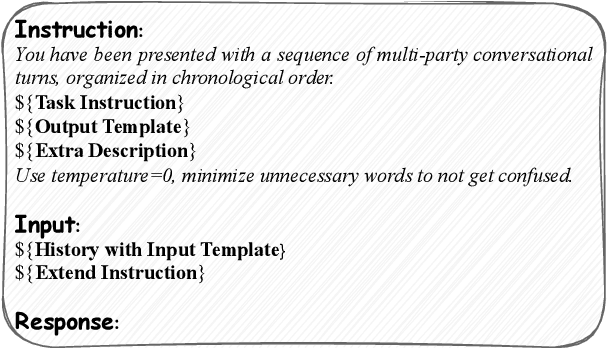
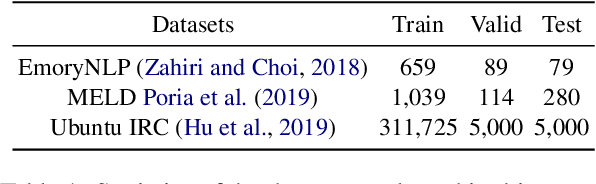
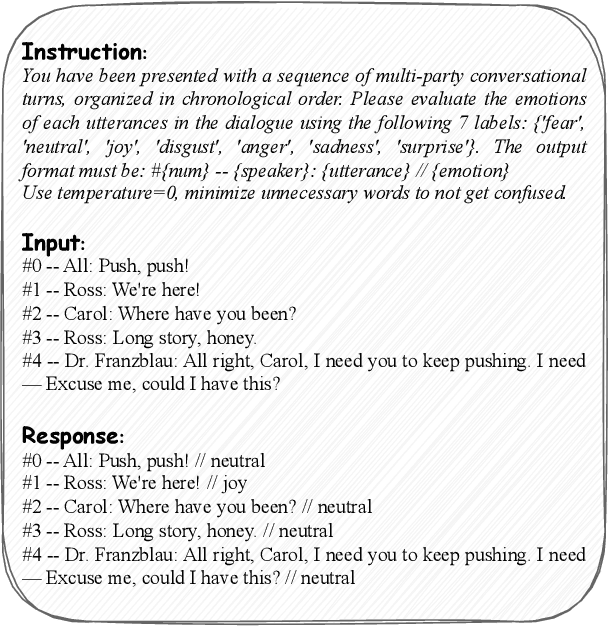
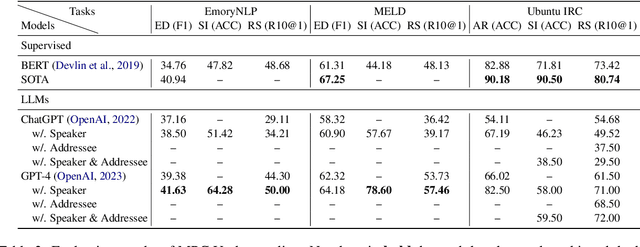
Large Language Models (LLMs) have emerged as influential instruments within the realm of natural language processing; nevertheless, their capacity to handle multi-party conversations (MPCs) -- a scenario marked by the presence of multiple interlocutors involved in intricate information exchanges -- remains uncharted. In this paper, we delve into the potential of generative LLMs such as ChatGPT and GPT-4 within the context of MPCs. An empirical analysis is conducted to assess the zero-shot learning capabilities of ChatGPT and GPT-4 by subjecting them to evaluation across three MPC datasets that encompass five representative tasks. The findings reveal that ChatGPT's performance on a number of evaluated MPC tasks leaves much to be desired, whilst GPT-4's results portend a promising future. Additionally, we endeavor to bolster performance through the incorporation of MPC structures, encompassing both speaker and addressee architecture. This study provides an exhaustive evaluation and analysis of applying generative LLMs to MPCs, casting a light upon the conception and creation of increasingly effective and robust MPC agents. Concurrently, this work underscores the challenges implicit in the utilization of LLMs for MPCs, such as deciphering graphical information flows and generating stylistically consistent responses.
MADNet: Maximizing Addressee Deduction Expectation for Multi-Party Conversation Generation
May 22, 2023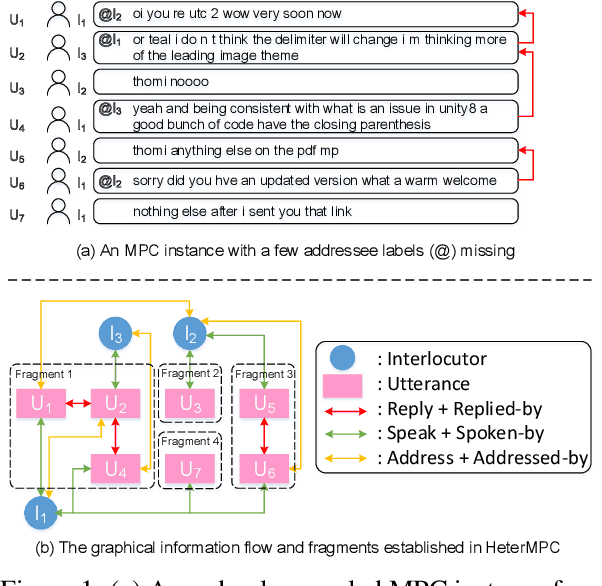
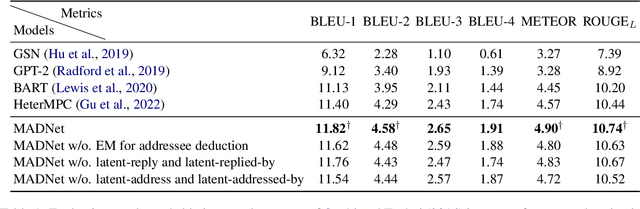
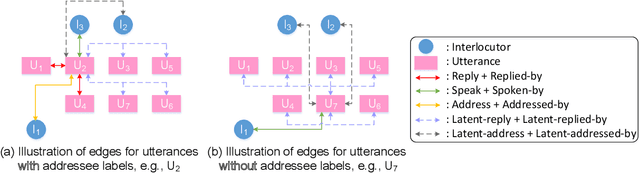
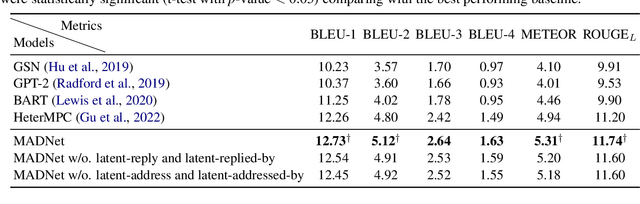
Modeling multi-party conversations (MPCs) with graph neural networks has been proven effective at capturing complicated and graphical information flows. However, existing methods rely heavily on the necessary addressee labels and can only be applied to an ideal setting where each utterance must be tagged with an addressee label. To study the scarcity of addressee labels which is a common issue in MPCs, we propose MADNet that maximizes addressee deduction expectation in heterogeneous graph neural networks for MPC generation. Given an MPC with a few addressee labels missing, existing methods fail to build a consecutively connected conversation graph, but only a few separate conversation fragments instead. To ensure message passing between these conversation fragments, four additional types of latent edges are designed to complete a fully-connected graph. Besides, to optimize the edge-type-dependent message passing for those utterances without addressee labels, an Expectation-Maximization-based method that iteratively generates silver addressee labels (E step), and optimizes the quality of generated responses (M step), is designed. Experimental results on two Ubuntu IRC channel benchmarks show that MADNet outperforms various baseline models on the task of MPC generation, especially under the more common and challenging setting where part of addressee labels are missing.
DiffuSIA: A Spiral Interaction Architecture for Encoder-Decoder Text Diffusion
May 19, 2023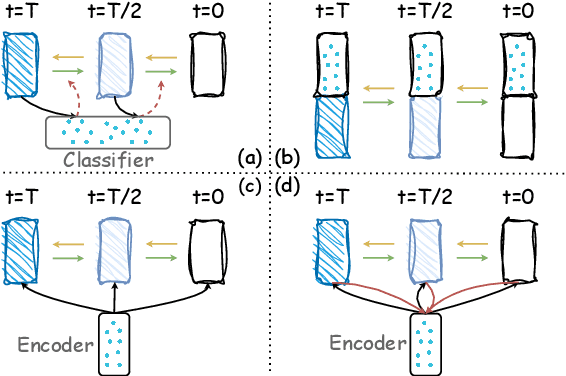

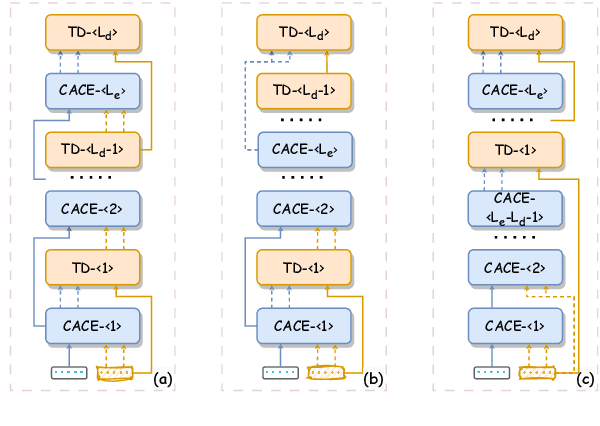
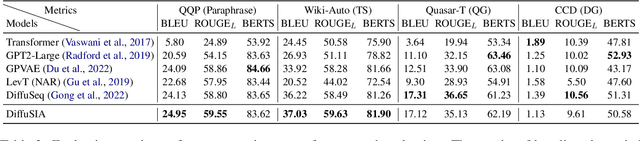
Diffusion models have emerged as the new state-of-the-art family of deep generative models, and their promising potentials for text generation have recently attracted increasing attention. Existing studies mostly adopt a single encoder architecture with partially noising processes for conditional text generation, but its degree of flexibility for conditional modeling is limited. In fact, the encoder-decoder architecture is naturally more flexible for its detachable encoder and decoder modules, which is extensible to multilingual and multimodal generation tasks for conditions and target texts. However, the encoding process of conditional texts lacks the understanding of target texts. To this end, a spiral interaction architecture for encoder-decoder text diffusion (DiffuSIA) is proposed. Concretely, the conditional information from encoder is designed to be captured by the diffusion decoder, while the target information from decoder is designed to be captured by the conditional encoder. These two types of information flow run through multilayer interaction spirally for deep fusion and understanding. DiffuSIA is evaluated on four text generation tasks, including paraphrase, text simplification, question generation, and open-domain dialogue generation. Experimental results show that DiffuSIA achieves competitive performance among previous methods on all four tasks, demonstrating the effectiveness and generalization ability of the proposed method.
TegTok: Augmenting Text Generation via Task-specific and Open-world Knowledge
Mar 16, 2022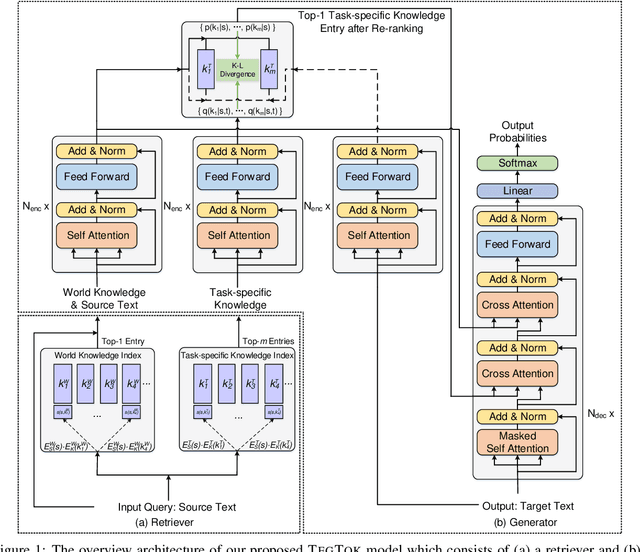
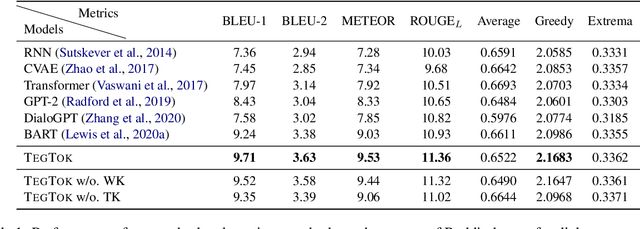
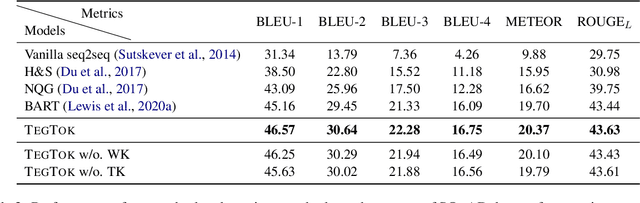
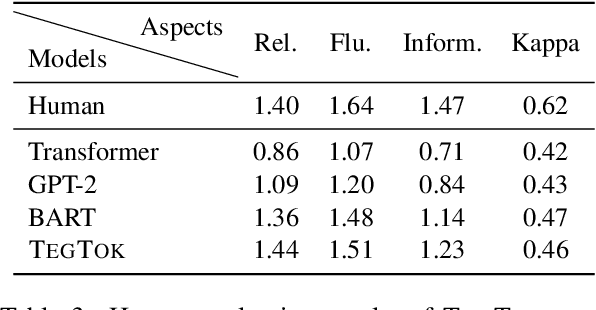
Generating natural and informative texts has been a long-standing problem in NLP. Much effort has been dedicated into incorporating pre-trained language models (PLMs) with various open-world knowledge, such as knowledge graphs or wiki pages. However, their ability to access and manipulate the task-specific knowledge is still limited on downstream tasks, as this type of knowledge is usually not well covered in PLMs and is hard to acquire. To address the problem, we propose augmenting TExt Generation via Task-specific and Open-world Knowledge (TegTok) in a unified framework. Our model selects knowledge entries from two types of knowledge sources through dense retrieval and then injects them into the input encoding and output decoding stages respectively on the basis of PLMs. With the help of these two types of knowledge, our model can learn what and how to generate. Experiments on two text generation tasks of dialogue generation and question generation, and on two datasets show that our method achieves better performance than various baseline models.
HeterMPC: A Heterogeneous Graph Neural Network for Response Generation in Multi-Party Conversations
Mar 16, 2022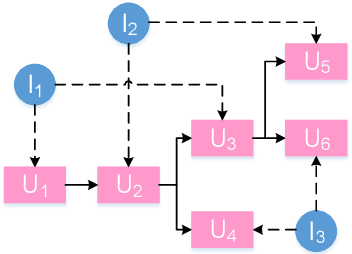
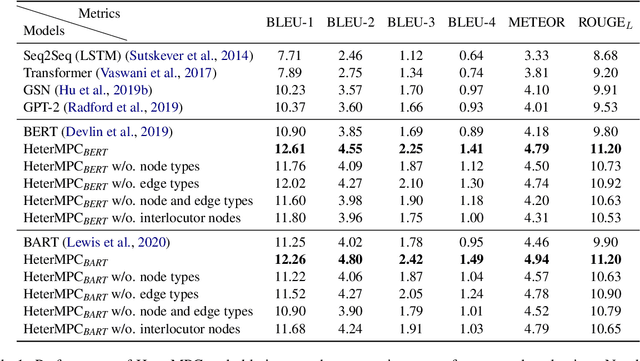
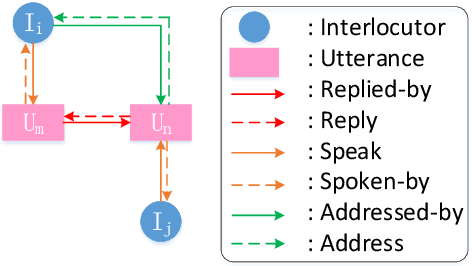
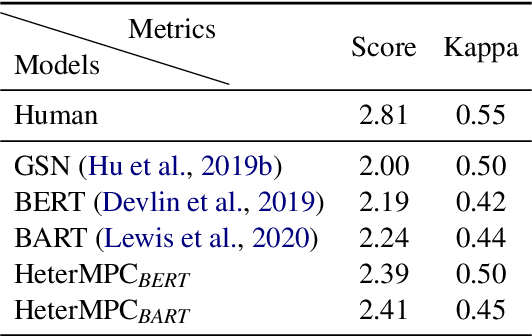
Recently, various response generation models for two-party conversations have achieved impressive improvements, but less effort has been paid to multi-party conversations (MPCs) which are more practical and complicated. Compared with a two-party conversation where a dialogue context is a sequence of utterances, building a response generation model for MPCs is more challenging, since there exist complicated context structures and the generated responses heavily rely on both interlocutors (i.e., speaker and addressee) and history utterances. To address these challenges, we present HeterMPC, a heterogeneous graph-based neural network for response generation in MPCs which models the semantics of utterances and interlocutors simultaneously with two types of nodes in a graph. Besides, we also design six types of meta relations with node-edge-type-dependent parameters to characterize the heterogeneous interactions within the graph. Through multi-hop updating, HeterMPC can adequately utilize the structural knowledge of conversations for response generation. Experimental results on the Ubuntu Internet Relay Chat (IRC) channel benchmark show that HeterMPC outperforms various baseline models for response generation in MPCs.