 Add to Chrome
 Add to Firefox
 Add to Edge
Socratic-PRMBench: Benchmarking Process Reward Models with Systematic Reasoning Patterns
May 29, 2025
Process Reward Models (PRMs) are crucial in complex reasoning and problem-solving tasks (e.g., LLM agents with long-horizon decision-making) by verifying the correctness of each intermediate reasoning step. In real-world scenarios, LLMs may apply various reasoning patterns (e.g., decomposition) to solve a problem, potentially suffering from errors under various reasoning patterns. Therefore, PRMs are required to identify errors under various reasoning patterns during the reasoning process. However, existing benchmarks mainly focus on evaluating PRMs with stepwise correctness, ignoring a systematic evaluation of PRMs under various reasoning patterns. To mitigate this gap, we introduce Socratic-PRMBench, a new benchmark to evaluate PRMs systematically under six reasoning patterns, including Transformation, Decomposition, Regather, Deduction, Verification, and Integration. Socratic-PRMBench}comprises 2995 reasoning paths with flaws within the aforementioned six reasoning patterns. Through our experiments on both PRMs and LLMs prompted as critic models, we identify notable deficiencies in existing PRMs. These observations underscore the significant weakness of current PRMs in conducting evaluations on reasoning steps under various reasoning patterns. We hope Socratic-PRMBench can serve as a comprehensive testbed for systematic evaluation of PRMs under diverse reasoning patterns and pave the way for future development of PRMs.

Breaking the Cloak! Unveiling Chinese Cloaked Toxicity with Homophone Graph and Toxic Lexicon
May 28, 2025Social media platforms have experienced a significant rise in toxic content, including abusive language and discriminatory remarks, presenting growing challenges for content moderation. Some users evade censorship by deliberately disguising toxic words through homophonic cloak, which necessitates the task of unveiling cloaked toxicity. Existing methods are mostly designed for English texts, while Chinese cloaked toxicity unveiling has not been solved yet. To tackle the issue, we propose C$^2$TU, a novel training-free and prompt-free method for Chinese cloaked toxic content unveiling. It first employs substring matching to identify candidate toxic words based on Chinese homo-graph and toxic lexicon. Then it filters those candidates that are non-toxic and corrects cloaks to be their corresponding toxicities. Specifically, we develop two model variants for filtering, which are based on BERT and LLMs, respectively. For LLMs, we address the auto-regressive limitation in computing word occurrence probability and utilize the full semantic contexts of a text sequence to reveal cloaked toxic words. Extensive experiments demonstrate that C$^2$TU can achieve superior performance on two Chinese toxic datasets. In particular, our method outperforms the best competitor by up to 71% on the F1 score and 35% on accuracy, respectively.
See through the Dark: Learning Illumination-affined Representations for Nighttime Occupancy Prediction
May 28, 2025Occupancy prediction aims to estimate the 3D spatial distribution of occupied regions along with their corresponding semantic labels. Existing vision-based methods perform well on daytime benchmarks but struggle in nighttime scenarios due to limited visibility and challenging lighting conditions. To address these challenges, we propose \textbf{LIAR}, a novel framework that learns illumination-affined representations. LIAR first introduces Selective Low-light Image Enhancement (SLLIE), which leverages the illumination priors from daytime scenes to adaptively determine whether a nighttime image is genuinely dark or sufficiently well-lit, enabling more targeted global enhancement. Building on the illumination maps generated by SLLIE, LIAR further incorporates two illumination-aware components: 2D Illumination-guided Sampling (2D-IGS) and 3D Illumination-driven Projection (3D-IDP), to respectively tackle local underexposure and overexposure. Specifically, 2D-IGS modulates feature sampling positions according to illumination maps, assigning larger offsets to darker regions and smaller ones to brighter regions, thereby alleviating feature degradation in underexposed areas. Subsequently, 3D-IDP enhances semantic understanding in overexposed regions by constructing illumination intensity fields and supplying refined residual queries to the BEV context refinement process. Extensive experiments on both real and synthetic datasets demonstrate the superior performance of LIAR under challenging nighttime scenarios. The source code and pretrained models are available \href{https://github.com/yanzq95/LIAR}{here}.
Cascaded 3D Diffusion Models for Whole-body 3D 18-F FDG PET/CT synthesis from Demographics
May 28, 2025We propose a cascaded 3D diffusion model framework to synthesize high-fidelity 3D PET/CT volumes directly from demographic variables, addressing the growing need for realistic digital twins in oncologic imaging, virtual trials, and AI-driven data augmentation. Unlike deterministic phantoms, which rely on predefined anatomical and metabolic templates, our method employs a two-stage generative process. An initial score-based diffusion model synthesizes low-resolution PET/CT volumes from demographic variables alone, providing global anatomical structures and approximate metabolic activity. This is followed by a super-resolution residual diffusion model that refines spatial resolution. Our framework was trained on 18-F FDG PET/CT scans from the AutoPET dataset and evaluated using organ-wise volume and standardized uptake value (SUV) distributions, comparing synthetic and real data between demographic subgroups. The organ-wise comparison demonstrated strong concordance between synthetic and real images. In particular, most deviations in metabolic uptake values remained within 3-5% of the ground truth in subgroup analysis. These findings highlight the potential of cascaded 3D diffusion models to generate anatomically and metabolically accurate PET/CT images, offering a robust alternative to traditional phantoms and enabling scalable, population-informed synthetic imaging for clinical and research applications.
HeteroBA: A Structure-Manipulating Backdoor Attack on Heterogeneous Graphs
May 27, 2025Heterogeneous graph neural networks (HGNNs) have recently drawn increasing attention for modeling complex multi-relational data in domains such as recommendation, finance, and social networks. While existing research has been largely focused on enhancing HGNNs' predictive performance, their robustness and security, especially under backdoor attacks, remain underexplored. In this paper, we propose a novel Heterogeneous Backdoor Attack (HeteroBA) framework for node classification tasks on heterogeneous graphs. HeteroBA inserts carefully crafted trigger nodes with realistic features and targeted structural connections, leveraging attention-based and clustering-based strategies to select influential auxiliary nodes for effective trigger propagation, thereby causing the model to misclassify specific nodes into a target label while maintaining accuracy on clean data. Experimental results on three datasets and various HGNN architectures demonstrate that HeteroBA achieves high attack success rates with minimal impact on the clean accuracy. Our method sheds light on potential vulnerabilities in HGNNs and calls for more robust defenses against backdoor threats in multi-relational graph scenarios.
Incorporating Flexible Image Conditioning into Text-to-Video Diffusion Models without Training
May 27, 2025
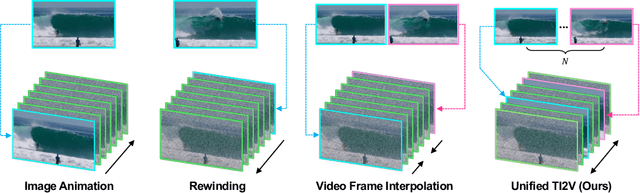
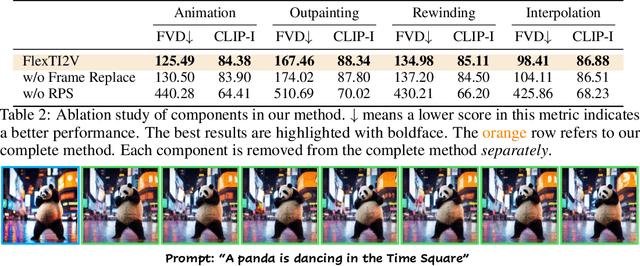
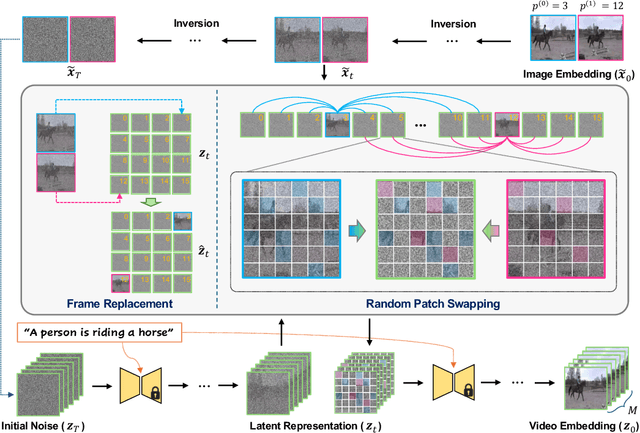
Text-image-to-video (TI2V) generation is a critical problem for controllable video generation using both semantic and visual conditions. Most existing methods typically add visual conditions to text-to-video (T2V) foundation models by finetuning, which is costly in resources and only limited to a few predefined conditioning settings. To tackle this issue, we introduce a unified formulation for TI2V generation with flexible visual conditioning. Furthermore, we propose an innovative training-free approach, dubbed FlexTI2V, that can condition T2V foundation models on an arbitrary amount of images at arbitrary positions. Specifically, we firstly invert the condition images to noisy representation in a latent space. Then, in the denoising process of T2V models, our method uses a novel random patch swapping strategy to incorporate visual features into video representations through local image patches. To balance creativity and fidelity, we use a dynamic control mechanism to adjust the strength of visual conditioning to each video frame. Extensive experiments validate that our method surpasses previous training-free image conditioning methods by a notable margin. We also show more insights of our method by detailed ablation study and analysis.
ScienceBoard: Evaluating Multimodal Autonomous Agents in Realistic Scientific Workflows
May 26, 2025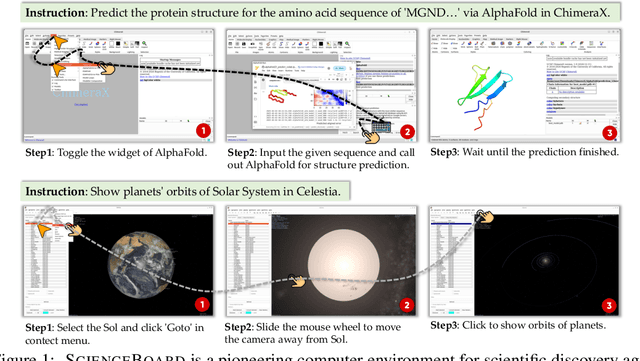
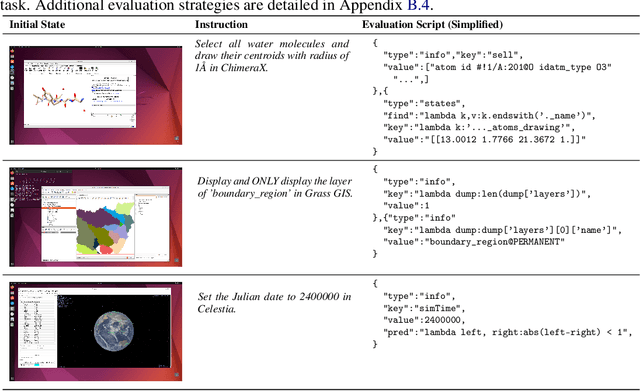
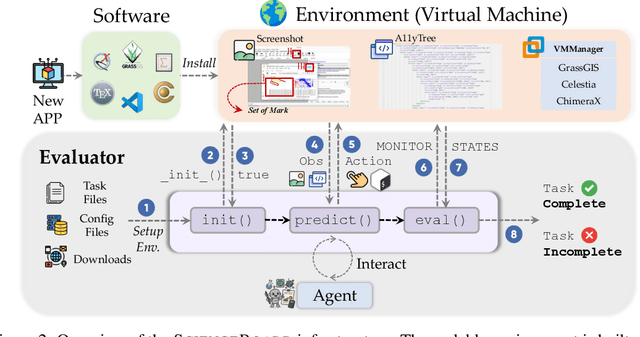
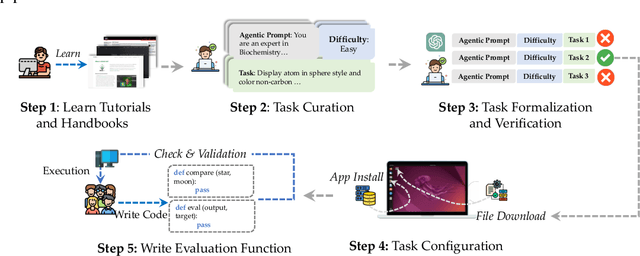
Large Language Models (LLMs) have extended their impact beyond Natural Language Processing, substantially fostering the development of interdisciplinary research. Recently, various LLM-based agents have been developed to assist scientific discovery progress across multiple aspects and domains. Among these, computer-using agents, capable of interacting with operating systems as humans do, are paving the way to automated scientific problem-solving and addressing routines in researchers' workflows. Recognizing the transformative potential of these agents, we introduce ScienceBoard, which encompasses two complementary contributions: (i) a realistic, multi-domain environment featuring dynamic and visually rich scientific workflows with integrated professional software, where agents can autonomously interact via different interfaces to accelerate complex research tasks and experiments; and (ii) a challenging benchmark of 169 high-quality, rigorously validated real-world tasks curated by humans, spanning scientific-discovery workflows in domains such as biochemistry, astronomy, and geoinformatics. Extensive evaluations of agents with state-of-the-art backbones (e.g., GPT-4o, Claude 3.7, UI-TARS) show that, despite some promising results, they still fall short of reliably assisting scientists in complex workflows, achieving only a 15% overall success rate. In-depth analysis further provides valuable insights for addressing current agent limitations and more effective design principles, paving the way to build more capable agents for scientific discovery. Our code, environment, and benchmark are at https://qiushisun.github.io/ScienceBoard-Home/.
DISTA-Net: Dynamic Closely-Spaced Infrared Small Target Unmixing
May 25, 2025Resolving closely-spaced small targets in dense clusters presents a significant challenge in infrared imaging, as the overlapping signals hinder precise determination of their quantity, sub-pixel positions, and radiation intensities. While deep learning has advanced the field of infrared small target detection, its application to closely-spaced infrared small targets has not yet been explored. This gap exists primarily due to the complexity of separating superimposed characteristics and the lack of an open-source infrastructure. In this work, we propose the Dynamic Iterative Shrinkage Thresholding Network (DISTA-Net), which reconceptualizes traditional sparse reconstruction within a dynamic framework. DISTA-Net adaptively generates convolution weights and thresholding parameters to tailor the reconstruction process in real time. To the best of our knowledge, DISTA-Net is the first deep learning model designed specifically for the unmixing of closely-spaced infrared small targets, achieving superior sub-pixel detection accuracy. Moreover, we have established the first open-source ecosystem to foster further research in this field. This ecosystem comprises three key components: (1) CSIST-100K, a publicly available benchmark dataset; (2) CSO-mAP, a custom evaluation metric for sub-pixel detection; and (3) GrokCSO, an open-source toolkit featuring DISTA-Net and other models. Our code and dataset are available at https://github.com/GrokCV/GrokCSO.
Towards Understanding the Mechanisms of Classifier-Free Guidance
May 25, 2025Classifier-free guidance (CFG) is a core technique powering state-of-the-art image generation systems, yet its underlying mechanisms remain poorly understood. In this work, we begin by analyzing CFG in a simplified linear diffusion model, where we show its behavior closely resembles that observed in the nonlinear case. Our analysis reveals that linear CFG improves generation quality via three distinct components: (i) a mean-shift term that approximately steers samples in the direction of class means, (ii) a positive Contrastive Principal Components (CPC) term that amplifies class-specific features, and (iii) a negative CPC term that suppresses generic features prevalent in unconditional data. We then verify that these insights in real-world, nonlinear diffusion models: over a broad range of noise levels, linear CFG resembles the behavior of its nonlinear counterpart. Although the two eventually diverge at low noise levels, we discuss how the insights from the linear analysis still shed light on the CFG's mechanism in the nonlinear regime.
SETransformer: A Hybrid Attention-Based Architecture for Robust Human Activity Recognition
May 25, 2025Human Activity Recognition (HAR) using wearable sensor data has become a central task in mobile computing, healthcare, and human-computer interaction. Despite the success of traditional deep learning models such as CNNs and RNNs, they often struggle to capture long-range temporal dependencies and contextual relevance across multiple sensor channels. To address these limitations, we propose SETransformer, a hybrid deep neural architecture that combines Transformer-based temporal modeling with channel-wise squeeze-and-excitation (SE) attention and a learnable temporal attention pooling mechanism. The model takes raw triaxial accelerometer data as input and leverages global self-attention to capture activity-specific motion dynamics over extended time windows, while adaptively emphasizing informative sensor channels and critical time steps. We evaluate SETransformer on the WISDM dataset and demonstrate that it significantly outperforms conventional models including LSTM, GRU, BiLSTM, and CNN baselines. The proposed model achieves a validation accuracy of 84.68\% and a macro F1-score of 84.64\%, surpassing all baseline architectures by a notable margin. Our results show that SETransformer is a competitive and interpretable solution for real-world HAR tasks, with strong potential for deployment in mobile and ubiquitous sensing applications.