 Add to Chrome
 Add to Firefox
 Add to Edge
MV3DIS: Multi-View Mask Matching via 3D Guides for Zero-Shot 3D Instance Segmentation
Apr 10, 2026
Conventional 3D instance segmentation methods rely on labor-intensive 3D annotations for supervised training, which limits their scalability and generalization to novel objects. Recent approaches leverage multi-view 2D masks from the Segment Anything Model (SAM) to guide the merging of 3D geometric primitives, thereby enabling zero-shot 3D instance segmentation. However, these methods typically process each frame independently and rely solely on 2D metrics, such as SAM prediction scores, to produce segmentation maps. This design overlooks multi-view correlations and inherent 3D priors, leading to inconsistent 2D masks across views and ultimately fragmented 3D segmentation. In this paper, we propose MV3DIS, a coarse-to-fine framework for zero-shot 3D instance segmentation that explicitly incorporates 3D priors. Specifically, we introduce a 3D-guided mask matching strategy that uses coarse 3D segments as a common reference to match 2D masks across views and consolidates multi-view mask consistency via 3D coverage distributions. Guided by these view-consistent 2D masks, the coarse 3D segments are further refined into precise 3D instances. Additionally, we introduce a depth consistency weighting scheme that quantifies projection reliability to suppress ambiguities from inter-object occlusions, thereby improving the robustness of 3D-to-2D correspondence. Extensive experiments on the ScanNetV2, ScanNet200, ScanNet++, Replica, and Matterport3D datasets demonstrate the effectiveness of MV3DIS, which achieves superior performance over previous methods

See through the Dark: Learning Illumination-affined Representations for Nighttime Occupancy Prediction
May 28, 2025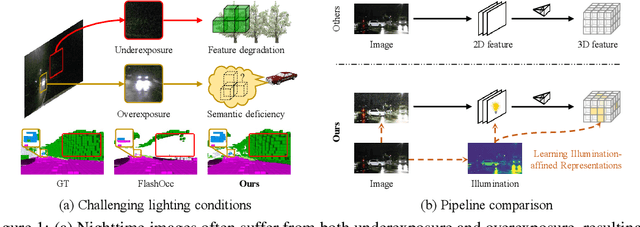
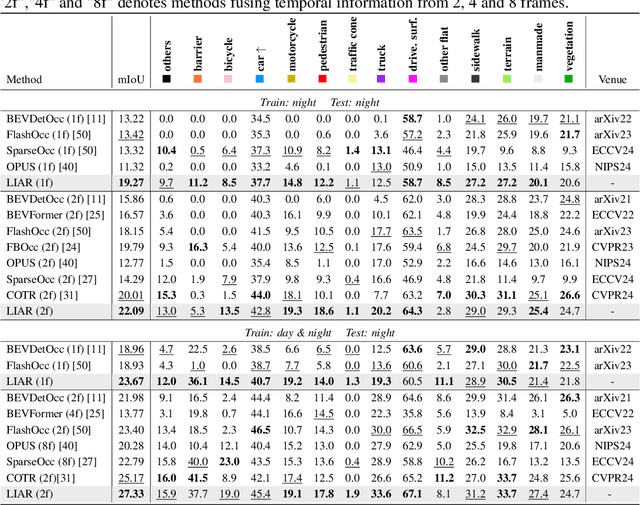
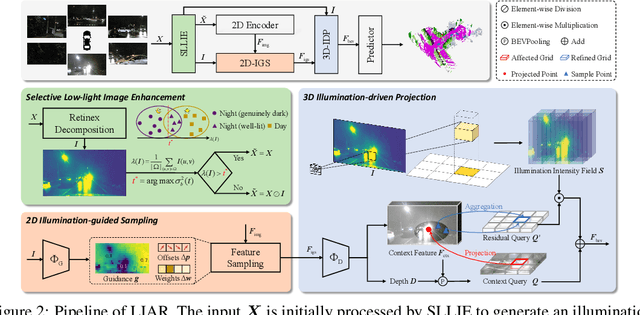
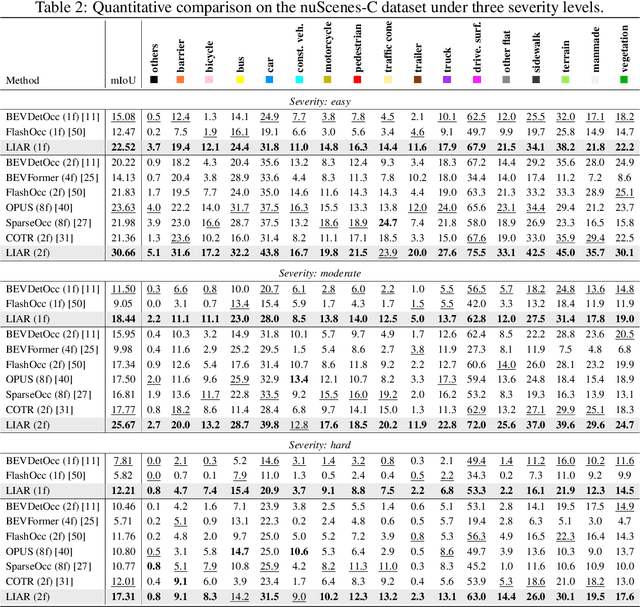
Occupancy prediction aims to estimate the 3D spatial distribution of occupied regions along with their corresponding semantic labels. Existing vision-based methods perform well on daytime benchmarks but struggle in nighttime scenarios due to limited visibility and challenging lighting conditions. To address these challenges, we propose \textbf{LIAR}, a novel framework that learns illumination-affined representations. LIAR first introduces Selective Low-light Image Enhancement (SLLIE), which leverages the illumination priors from daytime scenes to adaptively determine whether a nighttime image is genuinely dark or sufficiently well-lit, enabling more targeted global enhancement. Building on the illumination maps generated by SLLIE, LIAR further incorporates two illumination-aware components: 2D Illumination-guided Sampling (2D-IGS) and 3D Illumination-driven Projection (3D-IDP), to respectively tackle local underexposure and overexposure. Specifically, 2D-IGS modulates feature sampling positions according to illumination maps, assigning larger offsets to darker regions and smaller ones to brighter regions, thereby alleviating feature degradation in underexposed areas. Subsequently, 3D-IDP enhances semantic understanding in overexposed regions by constructing illumination intensity fields and supplying refined residual queries to the BEV context refinement process. Extensive experiments on both real and synthetic datasets demonstrate the superior performance of LIAR under challenging nighttime scenarios. The source code and pretrained models are available \href{https://github.com/yanzq95/LIAR}{here}.