 Add to Chrome
 Add to Firefox
 Add to Edge
Impromptu Cybercrime Euphemism Detection
Dec 03, 2024
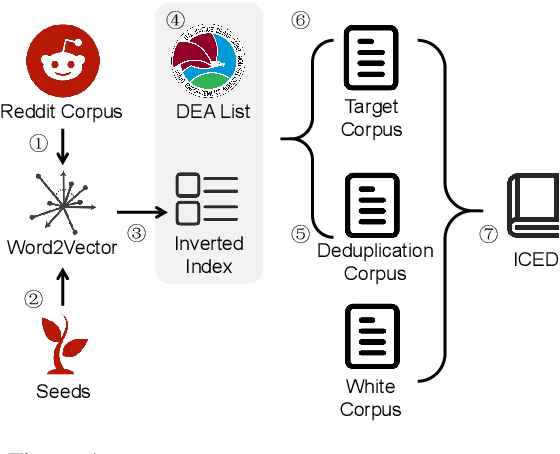
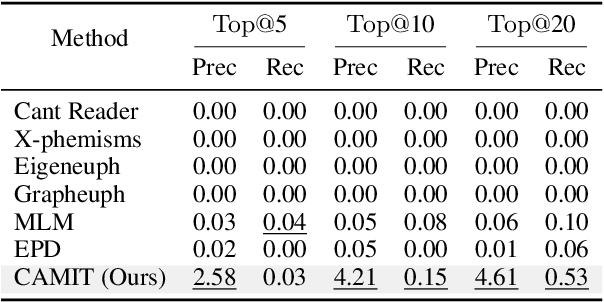
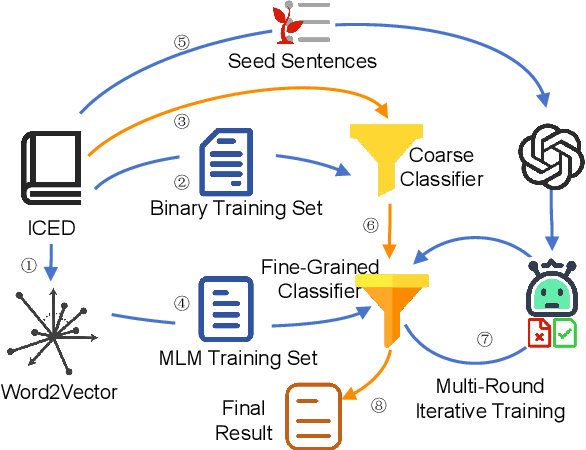
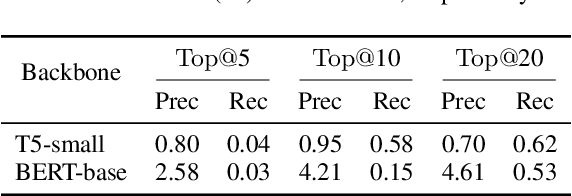
Detecting euphemisms is essential for content security on various social media platforms, but existing methods designed for detecting euphemisms are ineffective in impromptu euphemisms. In this work, we make a first attempt to an exploration of impromptu euphemism detection and introduce the Impromptu Cybercrime Euphemisms Detection (ICED) dataset. Moreover, we propose a detection framework tailored to this problem, which employs context augmentation modeling and multi-round iterative training. Our detection framework mainly consists of a coarse-grained and a fine-grained classification model. The coarse-grained classification model removes most of the harmless content in the corpus to be detected. The fine-grained model, impromptu euphemisms detector, integrates context augmentation and multi-round iterations training to better predicts the actual meaning of a masked token. In addition, we leverage ChatGPT to evaluate the mode's capability. Experimental results demonstrate that our approach achieves a remarkable 76-fold improvement compared to the previous state-of-the-art euphemism detector.

XQ-GAN: An Open-source Image Tokenization Framework for Autoregressive Generation
Dec 02, 2024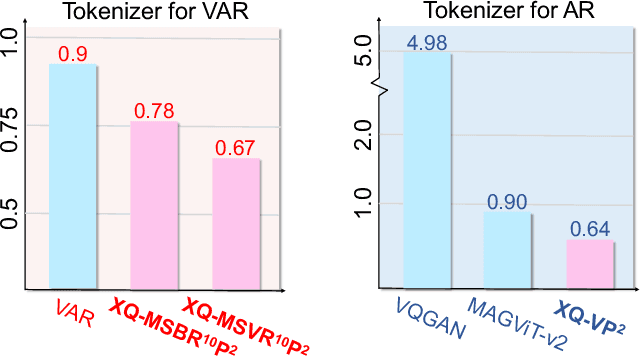


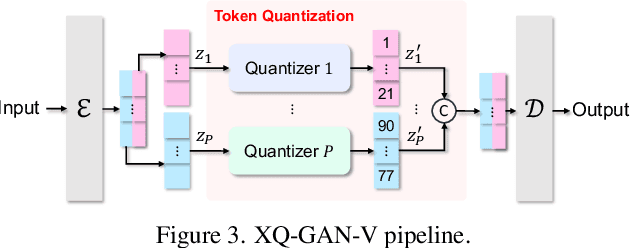
Image tokenizers play a critical role in shaping the performance of subsequent generative models. Since the introduction of VQ-GAN, discrete image tokenization has undergone remarkable advancements. Improvements in architecture, quantization techniques, and training recipes have significantly enhanced both image reconstruction and the downstream generation quality. In this paper, we present XQ-GAN, an image tokenization framework designed for both image reconstruction and generation tasks. Our framework integrates state-of-the-art quantization techniques, including vector quantization (VQ), residual quantization (RQ), multi-scale residual quantization (MSVQ), product quantization (PQ), lookup-free quantization (LFQ), and binary spherical quantization (BSQ), within a highly flexible and customizable training environment. On the standard ImageNet 256x256 benchmark, our released model achieves an rFID of 0.64, significantly surpassing MAGVIT-v2 (0.9 rFID) and VAR (0.9 rFID). Furthermore, we demonstrate that using XQ-GAN as a tokenizer improves gFID metrics alongside rFID. For instance, with the same VAR architecture, XQ-GAN+VAR achieves a gFID of 2.6, outperforming VAR's 3.3 gFID by a notable margin. To support further research, we provide pre-trained weights of different image tokenizers for the community to directly train the subsequent generative models on it or fine-tune for specialized tasks.
A Unified Interaction Control Framework for Safe Robotic Ultrasound Scanning with Human-Intention-Aware Compliance
Nov 29, 2024

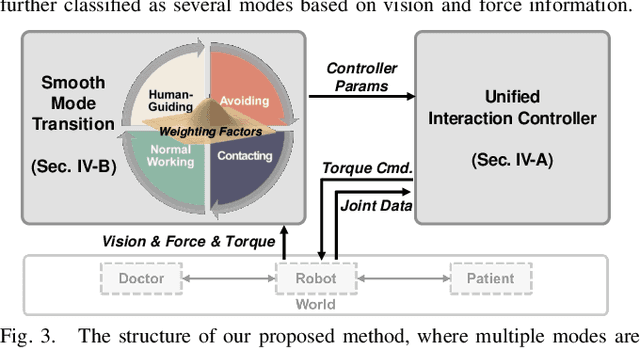

The ultrasound scanning robot operates in environments where frequent human-robot interactions occur. Most existing control methods for ultrasound scanning address only one specific interaction situation or implement hard switches between controllers for different situations, which compromises both safety and efficiency. In this paper, we propose a unified interaction control framework for ultrasound scanning robots capable of handling all common interactions, distinguishing both human-intended and unintended types, and adapting with appropriate compliance. Specifically, the robot suspends or modulates its ongoing main task if the interaction is intended, e.g., when the doctor grasps the robot to lead the end effector actively. Furthermore, it can identify unintended interactions and avoid potential collision in the null space beforehand. Even if that collision has happened, it can become compliant with the collision in the null space and try to reduce its impact on the main task (where the scan is ongoing) kinematically and dynamically. The multiple situations are integrated into a unified controller with a smooth transition to deal with the interactions by exhibiting human-intention-aware compliance. Experimental results validate the framework's ability to cope with all common interactions including intended intervention and unintended collision in a collaborative carotid artery ultrasound scanning task.
Perturbation Ontology based Graph Attention Networks
Nov 27, 2024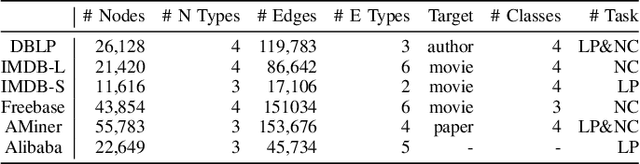
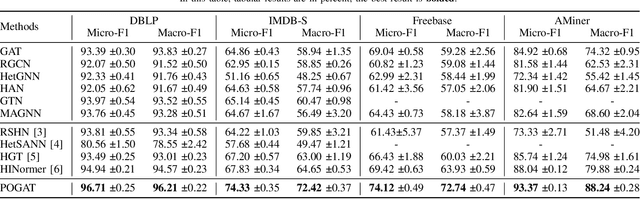
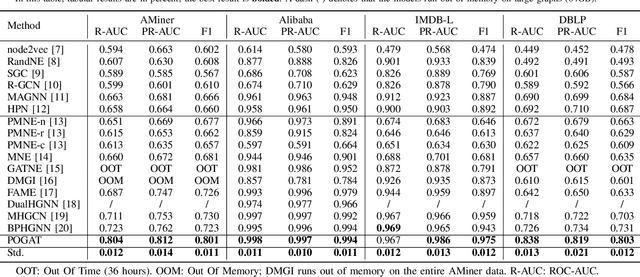
In recent years, graph representation learning has undergone a paradigm shift, driven by the emergence and proliferation of graph neural networks (GNNs) and their heterogeneous counterparts. Heterogeneous GNNs have shown remarkable success in extracting low-dimensional embeddings from complex graphs that encompass diverse entity types and relationships. While meta-path-based techniques have long been recognized for their ability to capture semantic affinities among nodes, their dependence on manual specification poses a significant limitation. In contrast, matrix-focused methods accelerate processing by utilizing structural cues but often overlook contextual richness. In this paper, we challenge the current paradigm by introducing ontology as a fundamental semantic primitive within complex graphs. Our goal is to integrate the strengths of both matrix-centric and meta-path-based approaches into a unified framework. We propose perturbation Ontology-based Graph Attention Networks (POGAT), a novel methodology that combines ontology subgraphs with an advanced self-supervised learning paradigm to achieve a deep contextual understanding. The core innovation of POGAT lies in our enhanced homogeneous perturbing scheme designed to generate rigorous negative samples, encouraging the model to explore minimal contextual features more thoroughly. Through extensive empirical evaluations, we demonstrate that POGAT significantly outperforms state-of-the-art baselines, achieving a groundbreaking improvement of up to 10.78\% in F1-score for the critical task of link prediction and 12.01\% in Micro-F1 for the critical task of node classification.
Symmetry Strikes Back: From Single-Image Symmetry Detection to 3D Generation
Nov 26, 2024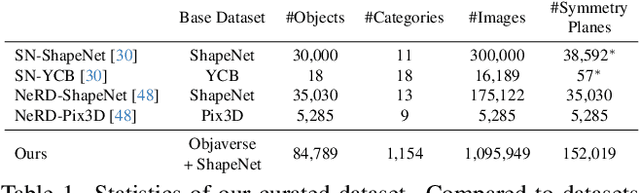
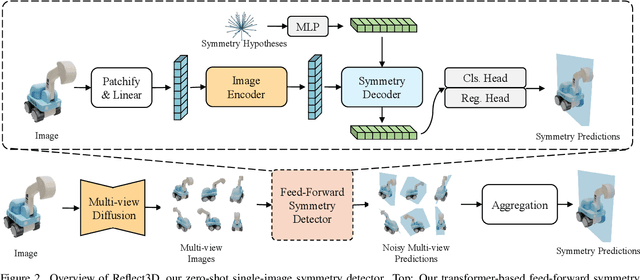
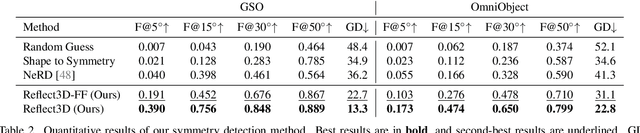
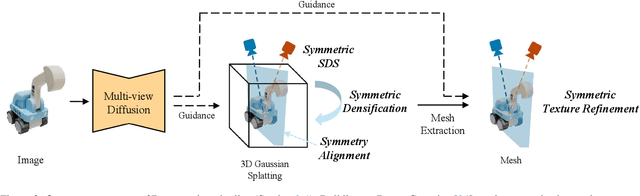
Symmetry is a ubiquitous and fundamental property in the visual world, serving as a critical cue for perception and structure interpretation. This paper investigates the detection of 3D reflection symmetry from a single RGB image, and reveals its significant benefit on single-image 3D generation. We introduce Reflect3D, a scalable, zero-shot symmetry detector capable of robust generalization to diverse and real-world scenarios. Inspired by the success of foundation models, our method scales up symmetry detection with a transformer-based architecture. We also leverage generative priors from multi-view diffusion models to address the inherent ambiguity in single-view symmetry detection. Extensive evaluations on various data sources demonstrate that Reflect3D establishes a new state-of-the-art in single-image symmetry detection. Furthermore, we show the practical benefit of incorporating detected symmetry into single-image 3D generation pipelines through a symmetry-aware optimization process. The integration of symmetry significantly enhances the structural accuracy, cohesiveness, and visual fidelity of the reconstructed 3D geometry and textures, advancing the capabilities of 3D content creation.
Robust Detection of Watermarks for Large Language Models Under Human Edits
Nov 21, 2024Watermarking has offered an effective approach to distinguishing text generated by large language models (LLMs) from human-written text. However, the pervasive presence of human edits on LLM-generated text dilutes watermark signals, thereby significantly degrading detection performance of existing methods. In this paper, by modeling human edits through mixture model detection, we introduce a new method in the form of a truncated goodness-of-fit test for detecting watermarked text under human edits, which we refer to as Tr-GoF. We prove that the Tr-GoF test achieves optimality in robust detection of the Gumbel-max watermark in a certain asymptotic regime of substantial text modifications and vanishing watermark signals. Importantly, Tr-GoF achieves this optimality \textit{adaptively} as it does not require precise knowledge of human edit levels or probabilistic specifications of the LLMs, in contrast to the optimal but impractical (Neyman--Pearson) likelihood ratio test. Moreover, we establish that the Tr-GoF test attains the highest detection efficiency rate in a certain regime of moderate text modifications. In stark contrast, we show that sum-based detection rules, as employed by existing methods, fail to achieve optimal robustness in both regimes because the additive nature of their statistics is less resilient to edit-induced noise. Finally, we demonstrate the competitive and sometimes superior empirical performance of the Tr-GoF test on both synthetic data and open-source LLMs in the OPT and LLaMA families.
Scalable Deep Metric Learning on Attributed Graphs
Nov 20, 2024We consider the problem of constructing embeddings of large attributed graphs and supporting multiple downstream learning tasks. We develop a graph embedding method, which is based on extending deep metric and unbiased contrastive learning techniques to 1) work with attributed graphs, 2) enabling a mini-batch based approach, and 3) achieving scalability. Based on a multi-class tuplet loss function, we present two algorithms -- DMT for semi-supervised learning and DMAT-i for the unsupervised case. Analyzing our methods, we provide a generalization bound for the downstream node classification task and for the first time relate tuplet loss to contrastive learning. Through extensive experiments, we show high scalability of representation construction, and in applying the method for three downstream tasks (node clustering, node classification, and link prediction) better consistency over any single existing method.
ManiSkill-ViTac 2025: Challenge on Manipulation Skill Learning With Vision and Tactile Sensing
Nov 19, 2024This article introduces the ManiSkill-ViTac Challenge 2025, which focuses on learning contact-rich manipulation skills using both tactile and visual sensing. Expanding upon the 2024 challenge, ManiSkill-ViTac 2025 includes 3 independent tracks: tactile manipulation, tactile-vision fusion manipulation, and tactile sensor structure design. The challenge aims to push the boundaries of robotic manipulation skills, emphasizing the integration of tactile and visual data to enhance performance in complex, real-world tasks. Participants will be evaluated using standardized metrics across both simulated and real-world environments, spurring innovations in sensor design and significantly advancing the field of vision-tactile fusion in robotics.
UMGAD: Unsupervised Multiplex Graph Anomaly Detection
Nov 19, 2024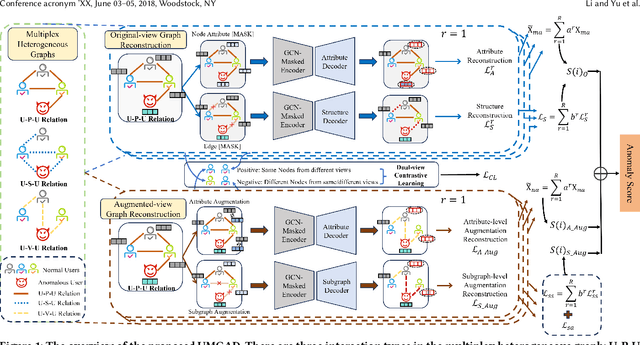

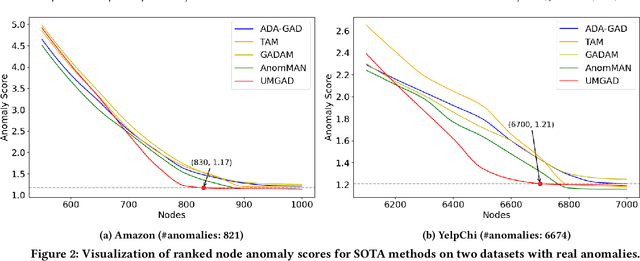

Graph anomaly detection (GAD) is a critical task in graph machine learning, with the primary objective of identifying anomalous nodes that deviate significantly from the majority. This task is widely applied in various real-world scenarios, including fraud detection and social network analysis. However, existing GAD methods still face two major challenges: (1) They are often limited to detecting anomalies in single-type interaction graphs and struggle with multiple interaction types in multiplex heterogeneous graphs; (2) In unsupervised scenarios, selecting appropriate anomaly score thresholds remains a significant challenge for accurate anomaly detection. To address the above challenges, we propose a novel Unsupervised Multiplex Graph Anomaly Detection method, named UMGAD. We first learn multi-relational correlations among nodes in multiplex heterogeneous graphs and capture anomaly information during node attribute and structure reconstruction through graph-masked autoencoder (GMAE). Then, to further weaken the influence of noise and redundant information on abnormal information extraction, we generate attribute-level and subgraph-level augmented-view graphs respectively, and perform attribute and structure reconstruction through GMAE. Finally, We learn to optimize node attributes and structural features through contrastive learning between original-view and augmented-view graphs to improve the model's ability to capture anomalies. Meanwhile, we also propose a new anomaly score threshold selection strategy, which allows the model to be independent of the ground truth in real unsupervised scenarios. Extensive experiments on four datasets show that our \model significantly outperforms state-of-the-art methods, achieving average improvements of 13.48% in AUC and 11.68% in Macro-F1 across all datasets.
Federated Contrastive Learning of Graph-Level Representations
Nov 18, 2024


Graph-level representations (and clustering/classification based on these representations) are required in a variety of applications. Examples include identifying malicious network traffic, prediction of protein properties, and many others. Often, data has to stay in isolated local systems (i.e., cannot be centrally shared for analysis) due to a variety of considerations like privacy concerns, lack of trust between the parties, regulations, or simply because the data is too large to be shared sufficiently quickly. This points to the need for federated learning for graph-level representations, a topic that has not been explored much, especially in an unsupervised setting. Addressing this problem, this paper presents a new framework we refer to as Federated Contrastive Learning of Graph-level Representations (FCLG). As the name suggests, our approach builds on contrastive learning. However, what is unique is that we apply contrastive learning at two levels. The first application is for local unsupervised learning of graph representations. The second level is to address the challenge associated with data distribution variation (i.e. the ``Non-IID issue") when combining local models. Through extensive experiments on the downstream task of graph-level clustering, we demonstrate FCLG outperforms baselines (which apply existing federated methods on existing graph-level clustering methods) with significant margins.