 Add to Chrome
 Add to Firefox
 Add to Edge
FASTopic: A Fast, Adaptive, Stable, and Transferable Topic Modeling Paradigm
May 28, 2024
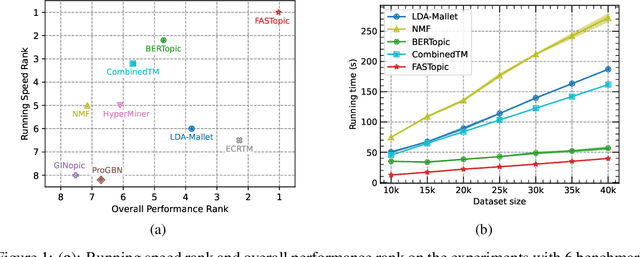
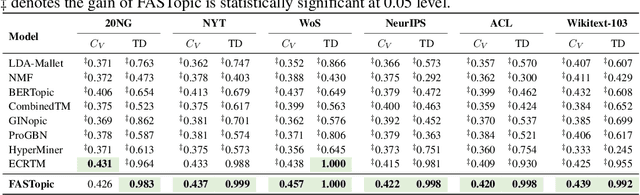

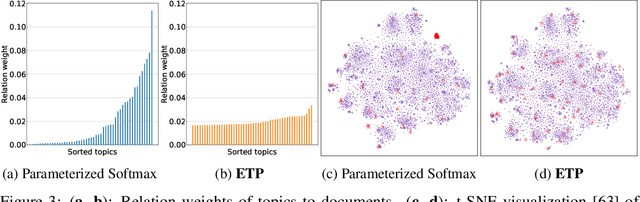
Topic models have been evolving rapidly over the years, from conventional to recent neural models. However, existing topic models generally struggle with either effectiveness, efficiency, or stability, highly impeding their practical applications. In this paper, we propose FASTopic, a fast, adaptive, stable, and transferable topic model. FASTopic follows a new paradigm: Dual Semantic-relation Reconstruction (DSR). Instead of previous conventional, neural VAE-based or clustering-based methods, DSR discovers latent topics by reconstruction through modeling the semantic relations among document, topic, and word embeddings. This brings about a neat and efficient topic modeling framework. We further propose a novel Embedding Transport Plan (ETP) method. Rather than early straightforward approaches, ETP explicitly regularizes the semantic relations as optimal transport plans. This addresses the relation bias issue and thus leads to effective topic modeling. Extensive experiments on benchmark datasets demonstrate that our FASTopic shows superior effectiveness, efficiency, adaptivity, stability, and transferability, compared to state-of-the-art baselines across various scenarios. Our code is available at https://github.com/bobxwu/FASTopic .

From Text to Pixel: Advancing Long-Context Understanding in MLLMs
May 23, 2024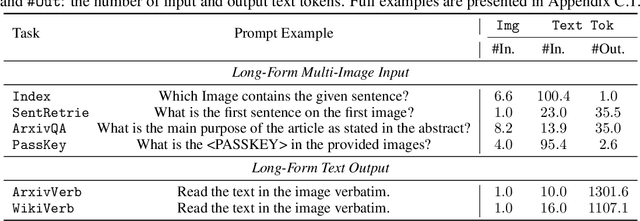

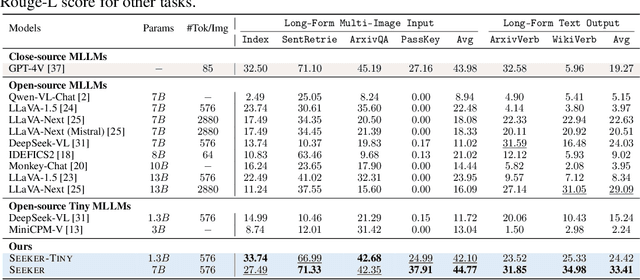
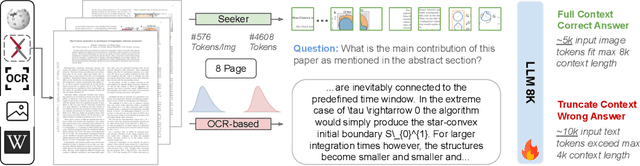
The rapid progress in Multimodal Large Language Models (MLLMs) has significantly advanced their ability to process and understand complex visual and textual information. However, the integration of multiple images and extensive textual contexts remains a challenge due to the inherent limitation of the models' capacity to handle long input sequences efficiently. In this paper, we introduce SEEKER, a multimodal large language model designed to tackle this issue. SEEKER aims to optimize the compact encoding of long text by compressing the text sequence into the visual pixel space via images, enabling the model to handle long text within a fixed token-length budget efficiently. Our empirical experiments on six long-context multimodal tasks demonstrate that SEEKER can leverage fewer image tokens to convey the same amount of textual information compared with the OCR-based approach, and is more efficient in understanding long-form multimodal input and generating long-form textual output, outperforming all existing proprietary and open-source MLLMs by large margins.
Automatic Layout Planning for Visually-Rich Documents with Instruction-Following Models
Apr 23, 2024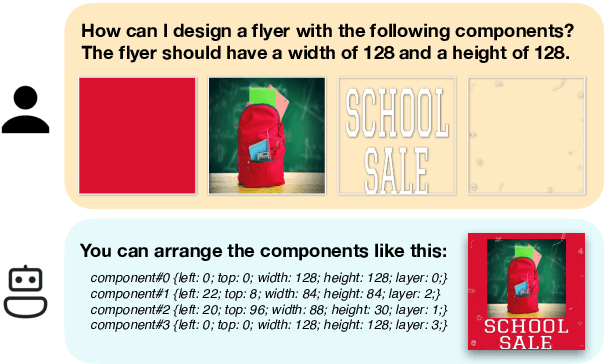
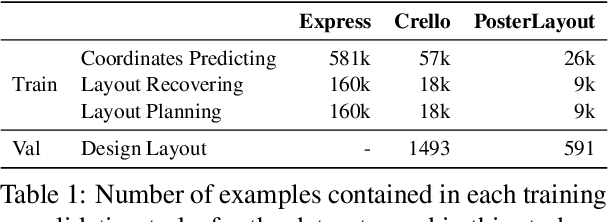
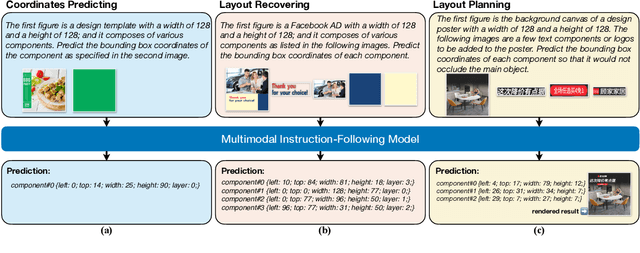
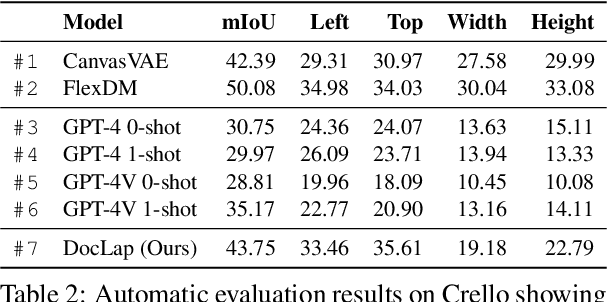
Recent advancements in instruction-following models have made user interactions with models more user-friendly and efficient, broadening their applicability. In graphic design, non-professional users often struggle to create visually appealing layouts due to limited skills and resources. In this work, we introduce a novel multimodal instruction-following framework for layout planning, allowing users to easily arrange visual elements into tailored layouts by specifying canvas size and design purpose, such as for book covers, posters, brochures, or menus. We developed three layout reasoning tasks to train the model in understanding and executing layout instructions. Experiments on two benchmarks show that our method not only simplifies the design process for non-professionals but also surpasses the performance of few-shot GPT-4V models, with mIoU higher by 12% on Crello. This progress highlights the potential of multimodal instruction-following models to automate and simplify the design process, providing an approachable solution for a wide range of design tasks on visually-rich documents.
Ferret-v2: An Improved Baseline for Referring and Grounding with Large Language Models
Apr 11, 2024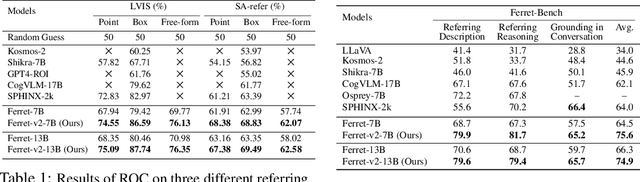


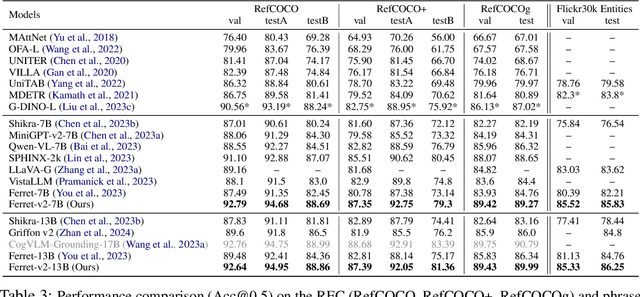
While Ferret seamlessly integrates regional understanding into the Large Language Model (LLM) to facilitate its referring and grounding capability, it poses certain limitations: constrained by the pre-trained fixed visual encoder and failed to perform well on broader tasks. In this work, we unveil Ferret-v2, a significant upgrade to Ferret, with three key designs. (1) Any resolution grounding and referring: A flexible approach that effortlessly handles higher image resolution, improving the model's ability to process and understand images in greater detail. (2) Multi-granularity visual encoding: By integrating the additional DINOv2 encoder, the model learns better and diverse underlying contexts for global and fine-grained visual information. (3) A three-stage training paradigm: Besides image-caption alignment, an additional stage is proposed for high-resolution dense alignment before the final instruction tuning. Experiments show that Ferret-v2 provides substantial improvements over Ferret and other state-of-the-art methods, thanks to its high-resolution scaling and fine-grained visual processing.
Who Evaluates the Evaluations? Objectively Scoring Text-to-Image Prompt Coherence Metrics with T2IScoreScore (TS2)
Apr 05, 2024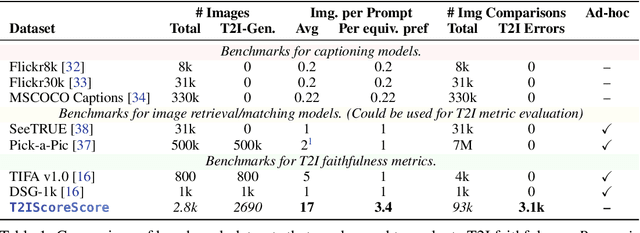
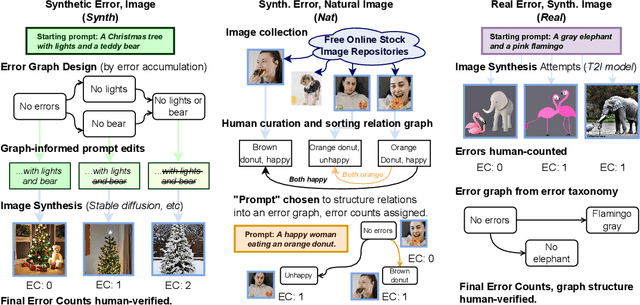
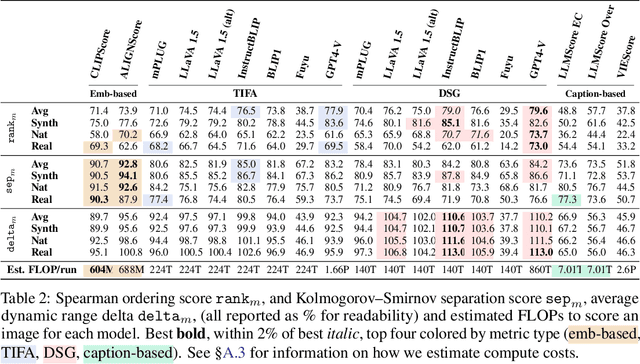
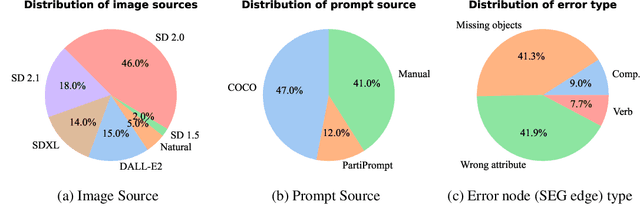
With advances in the quality of text-to-image (T2I) models has come interest in benchmarking their prompt faithfulness-the semantic coherence of generated images to the prompts they were conditioned on. A variety of T2I faithfulness metrics have been proposed, leveraging advances in cross-modal embeddings and vision-language models (VLMs). However, these metrics are not rigorously compared and benchmarked, instead presented against few weak baselines by correlation to human Likert scores over a set of easy-to-discriminate images. We introduce T2IScoreScore (TS2), a curated set of semantic error graphs containing a prompt and a set increasingly erroneous images. These allow us to rigorously judge whether a given prompt faithfulness metric can correctly order images with respect to their objective error count and significantly discriminate between different error nodes, using meta-metric scores derived from established statistical tests. Surprisingly, we find that the state-of-the-art VLM-based metrics (e.g., TIFA, DSG, LLMScore, VIEScore) we tested fail to significantly outperform simple feature-based metrics like CLIPScore, particularly on a hard subset of naturally-occurring T2I model errors. TS2 will enable the development of better T2I prompt faithfulness metrics through more rigorous comparison of their conformity to expected orderings and separations under objective criteria.
Towards Safety and Helpfulness Balanced Responses via Controllable Large Language Models
Apr 01, 2024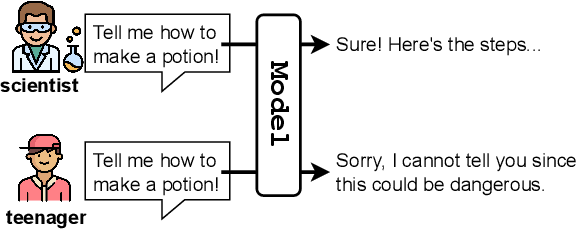
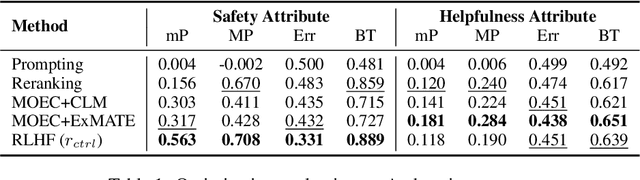

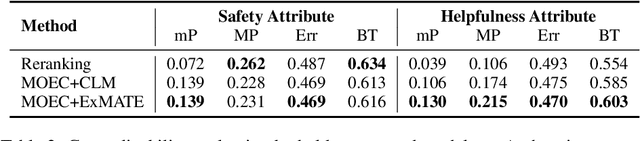
As large language models (LLMs) become easily accessible nowadays, the trade-off between safety and helpfulness can significantly impact user experience. A model that prioritizes safety will cause users to feel less engaged and assisted while prioritizing helpfulness will potentially cause harm. Possible harms include teaching people how to build a bomb, exposing youth to inappropriate content, and hurting users' mental health. In this work, we propose to balance safety and helpfulness in diverse use cases by controlling both attributes in LLM. We explore training-free and fine-tuning methods that do not require extra human annotations and analyze the challenges of controlling safety and helpfulness in LLMs. Our experiments demonstrate that our method can rewind a learned model and unlock its controllability.
Lost in Translation? Translation Errors and Challenges for Fair Assessment of Text-to-Image Models on Multilingual Concepts
Mar 17, 2024


Benchmarks of the multilingual capabilities of text-to-image (T2I) models compare generated images prompted in a test language to an expected image distribution over a concept set. One such benchmark, "Conceptual Coverage Across Languages" (CoCo-CroLa), assesses the tangible noun inventory of T2I models by prompting them to generate pictures from a concept list translated to seven languages and comparing the output image populations. Unfortunately, we find that this benchmark contains translation errors of varying severity in Spanish, Japanese, and Chinese. We provide corrections for these errors and analyze how impactful they are on the utility and validity of CoCo-CroLa as a benchmark. We reassess multiple baseline T2I models with the revisions, compare the outputs elicited under the new translations to those conditioned on the old, and show that a correction's impactfulness on the image-domain benchmark results can be predicted in the text domain with similarity scores. Our findings will guide the future development of T2I multilinguality metrics by providing analytical tools for practical translation decisions.
Reward Guided Latent Consistency Distillation
Mar 16, 2024Latent Consistency Distillation (LCD) has emerged as a promising paradigm for efficient text-to-image synthesis. By distilling a latent consistency model (LCM) from a pre-trained teacher latent diffusion model (LDM), LCD facilitates the generation of high-fidelity images within merely 2 to 4 inference steps. However, the LCM's efficient inference is obtained at the cost of the sample quality. In this paper, we propose compensating the quality loss by aligning LCM's output with human preference during training. Specifically, we introduce Reward Guided LCD (RG-LCD), which integrates feedback from a reward model (RM) into the LCD process by augmenting the original LCD loss with the objective of maximizing the reward associated with LCM's single-step generation. As validated through human evaluation, when trained with the feedback of a good RM, the 2-step generations from our RG-LCM are favored by humans over the 50-step DDIM samples from the teacher LDM, representing a 25 times inference acceleration without quality loss. As directly optimizing towards differentiable RMs can suffer from over-optimization, we overcome this difficulty by proposing the use of a latent proxy RM (LRM). This novel component serves as an intermediary, connecting our LCM with the RM. Empirically, we demonstrate that incorporating the LRM into our RG-LCD successfully avoids high-frequency noise in the generated images, contributing to both improved FID on MS-COCO and a higher HPSv2.1 score on HPSv2's test set, surpassing those achieved by the baseline LCM.
A Survey on Data Selection for Language Models
Mar 08, 2024A major factor in the recent success of large language models is the use of enormous and ever-growing text datasets for unsupervised pre-training. However, naively training a model on all available data may not be optimal (or feasible), as the quality of available text data can vary. Filtering out data can also decrease the carbon footprint and financial costs of training models by reducing the amount of training required. Data selection methods aim to determine which candidate data points to include in the training dataset and how to appropriately sample from the selected data points. The promise of improved data selection methods has caused the volume of research in the area to rapidly expand. However, because deep learning is mostly driven by empirical evidence and experimentation on large-scale data is expensive, few organizations have the resources for extensive data selection research. Consequently, knowledge of effective data selection practices has become concentrated within a few organizations, many of which do not openly share their findings and methodologies. To narrow this gap in knowledge, we present a comprehensive review of existing literature on data selection methods and related research areas, providing a taxonomy of existing approaches. By describing the current landscape of research, this work aims to accelerate progress in data selection by establishing an entry point for new and established researchers. Additionally, throughout this review we draw attention to noticeable holes in the literature and conclude the paper by proposing promising avenues for future research.
Updating Language Models with Unstructured Facts: Towards Practical Knowledge Editing
Feb 29, 2024Knowledge editing aims to inject knowledge updates into language models to keep them correct and up-to-date. However, its current evaluation strategies are notably impractical: they solely update with well-curated structured facts (triplets with subjects, relations, and objects), whereas real-world knowledge updates commonly emerge in unstructured texts like news articles. In this paper, we propose a new benchmark, Unstructured Knowledge Editing (UKE). It evaluates editing performance directly using unstructured texts as knowledge updates, termed unstructured facts. Hence UKE avoids the laborious construction of structured facts and enables efficient and responsive knowledge editing, becoming a more practical benchmark. We conduct extensive experiments on newly built datasets and demonstrate that UKE poses a significant challenge to state-of-the-art knowledge editing methods, resulting in their critical performance declines. We further show that this challenge persists even if we extract triplets as structured facts. Our analysis discloses key insights to motivate future research in UKE for more practical knowledge editing.