 Add to Chrome
 Add to Firefox
 Add to Edge
Seeing through the Conflict: Transparent Knowledge Conflict Handling in Retrieval-Augmented Generation
Jan 11, 2026
Large language models (LLMs) equipped with retrieval--the Retrieval-Augmented Generation (RAG) paradigm--should combine their parametric knowledge with external evidence, yet in practice they often hallucinate, over-trust noisy snippets, or ignore vital context. We introduce TCR (Transparent Conflict Resolution), a plug-and-play framework that makes this decision process observable and controllable. TCR (i) disentangles semantic match and factual consistency via dual contrastive encoders, (ii) estimates self-answerability to gauge confidence in internal memory, and (iii) feeds the three scalar signals to the generator through a lightweight soft-prompt with SNR-based weighting. Across seven benchmarks TCR improves conflict detection (+5-18 F1), raises knowledge-gap recovery by +21.4 pp and cuts misleading-context overrides by -29.3 pp, while adding only 0.3% parameters. The signals align with human judgements and expose temporal decision patterns.

Synergy over Discrepancy: A Partition-Based Approach to Multi-Domain LLM Fine-Tuning
Nov 11, 2025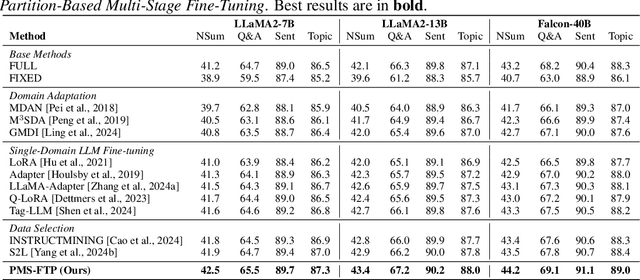
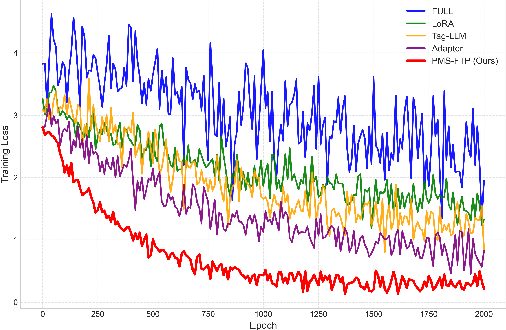
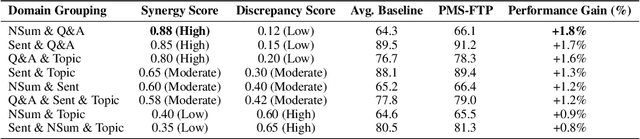
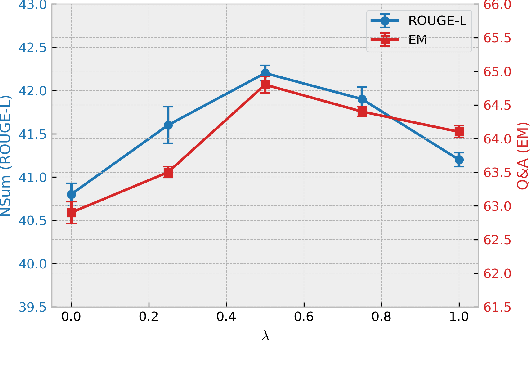
Large language models (LLMs) demonstrate impressive generalization abilities, yet adapting them effectively across multiple heterogeneous domains remains challenging due to inter-domain interference. To overcome this challenge, we propose a partition-based multi-stage fine-tuning framework designed to exploit inter-domain synergies while minimizing negative transfer. Our approach strategically partitions domains into subsets (stages) by balancing domain discrepancy, synergy, and model capacity constraints. We theoretically analyze the proposed framework and derive novel generalization bounds that justify our partitioning strategy. Extensive empirical evaluations on various language understanding tasks show that our method consistently outperforms state-of-the-art baselines.
Aligning by Misaligning: Boundary-aware Curriculum Learning for Multimodal Alignment
Nov 11, 2025Most multimodal models treat every negative pair alike, ignoring the ambiguous negatives that differ from the positive by only a small detail. We propose Boundary-Aware Curriculum with Local Attention (BACL), a lightweight add-on that turns these borderline cases into a curriculum signal. A Boundary-aware Negative Sampler gradually raises difficulty, while a Contrastive Local Attention loss highlights where the mismatch occurs. The two modules are fully differentiable and work with any off-the-shelf dual encoder. Theory predicts a fast O(1/n) error rate; practice shows up to +32% R@1 over CLIP and new SOTA on four large-scale benchmarks, all without extra labels.
All Robots in One: A New Standard and Unified Dataset for Versatile, General-Purpose Embodied Agents
Aug 20, 2024


Embodied AI is transforming how AI systems interact with the physical world, yet existing datasets are inadequate for developing versatile, general-purpose agents. These limitations include a lack of standardized formats, insufficient data diversity, and inadequate data volume. To address these issues, we introduce ARIO (All Robots In One), a new data standard that enhances existing datasets by offering a unified data format, comprehensive sensory modalities, and a combination of real-world and simulated data. ARIO aims to improve the training of embodied AI agents, increasing their robustness and adaptability across various tasks and environments. Building upon the proposed new standard, we present a large-scale unified ARIO dataset, comprising approximately 3 million episodes collected from 258 series and 321,064 tasks. The ARIO standard and dataset represent a significant step towards bridging the gaps of existing data resources. By providing a cohesive framework for data collection and representation, ARIO paves the way for the development of more powerful and versatile embodied AI agents, capable of navigating and interacting with the physical world in increasingly complex and diverse ways. The project is available on https://imaei.github.io/project_pages/ario/