 Add to Chrome
 Add to Firefox
 Add to Edge
CLAY: A Controllable Large-scale Generative Model for Creating High-quality 3D Assets
May 30, 2024

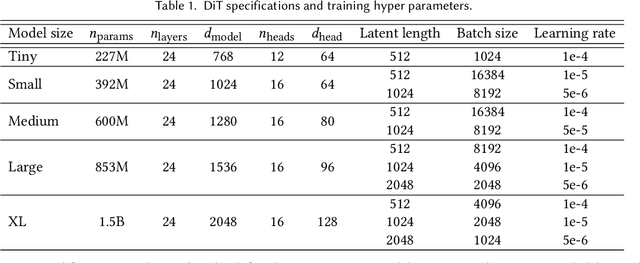

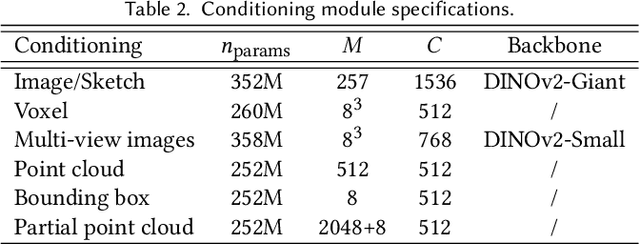
In the realm of digital creativity, our potential to craft intricate 3D worlds from imagination is often hampered by the limitations of existing digital tools, which demand extensive expertise and efforts. To narrow this disparity, we introduce CLAY, a 3D geometry and material generator designed to effortlessly transform human imagination into intricate 3D digital structures. CLAY supports classic text or image inputs as well as 3D-aware controls from diverse primitives (multi-view images, voxels, bounding boxes, point clouds, implicit representations, etc). At its core is a large-scale generative model composed of a multi-resolution Variational Autoencoder (VAE) and a minimalistic latent Diffusion Transformer (DiT), to extract rich 3D priors directly from a diverse range of 3D geometries. Specifically, it adopts neural fields to represent continuous and complete surfaces and uses a geometry generative module with pure transformer blocks in latent space. We present a progressive training scheme to train CLAY on an ultra large 3D model dataset obtained through a carefully designed processing pipeline, resulting in a 3D native geometry generator with 1.5 billion parameters. For appearance generation, CLAY sets out to produce physically-based rendering (PBR) textures by employing a multi-view material diffusion model that can generate 2K resolution textures with diffuse, roughness, and metallic modalities. We demonstrate using CLAY for a range of controllable 3D asset creations, from sketchy conceptual designs to production ready assets with intricate details. Even first time users can easily use CLAY to bring their vivid 3D imaginations to life, unleashing unlimited creativity.

Coupled Mamba: Enhanced Multi-modal Fusion with Coupled State Space Model
May 29, 2024

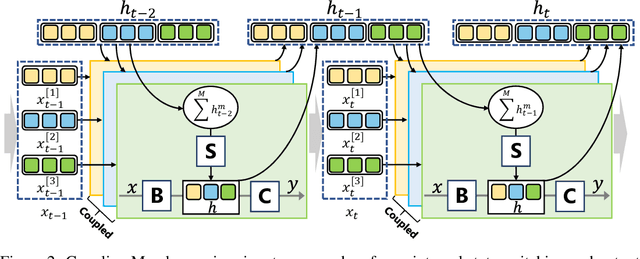
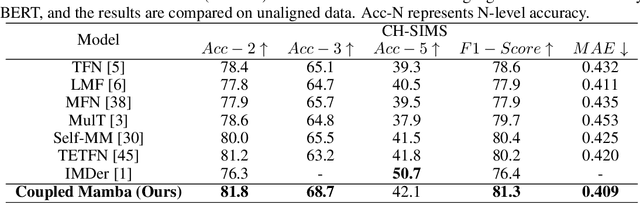
The essence of multi-modal fusion lies in exploiting the complementary information inherent in diverse modalities. However, prevalent fusion methods rely on traditional neural architectures and are inadequately equipped to capture the dynamics of interactions across modalities, particularly in presence of complex intra- and inter-modality correlations. Recent advancements in State Space Models (SSMs), notably exemplified by the Mamba model, have emerged as promising contenders. Particularly, its state evolving process implies stronger modality fusion paradigm, making multi-modal fusion on SSMs an appealing direction. However, fusing multiple modalities is challenging for SSMs due to its hardware-aware parallelism designs. To this end, this paper proposes the Coupled SSM model, for coupling state chains of multiple modalities while maintaining independence of intra-modality state processes. Specifically, in our coupled scheme, we devise an inter-modal hidden states transition scheme, in which the current state is dependent on the states of its own chain and that of the neighbouring chains at the previous time-step. To fully comply with the hardware-aware parallelism, we devise an expedite coupled state transition scheme and derive its corresponding global convolution kernel for parallelism. Extensive experiments on CMU-MOSEI, CH-SIMS, CH-SIMSV2 through multi-domain input verify the effectiveness of our model compared to current state-of-the-art methods, improved F1-Score by 0.4\%, 0.9\%, and 2.3\% on the three datasets respectively, 49\% faster inference and 83.7\% GPU memory save. The results demonstrate that Coupled Mamba model is capable of enhanced multi-modal fusion.
Ensembling Diffusion Models via Adaptive Feature Aggregation
May 27, 2024

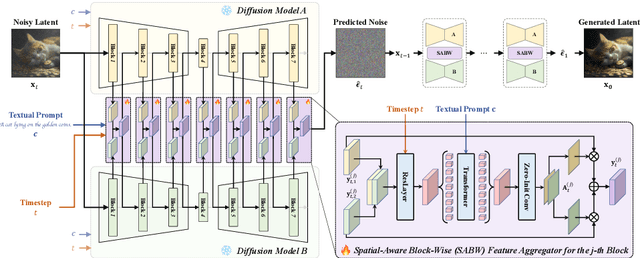
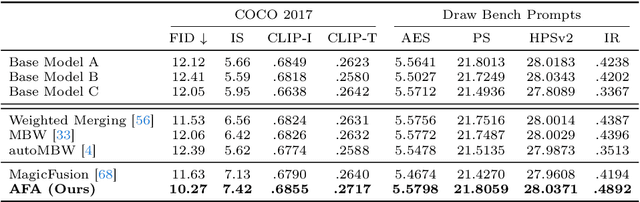
The success of the text-guided diffusion model has inspired the development and release of numerous powerful diffusion models within the open-source community. These models are typically fine-tuned on various expert datasets, showcasing diverse denoising capabilities. Leveraging multiple high-quality models to produce stronger generation ability is valuable, but has not been extensively studied. Existing methods primarily adopt parameter merging strategies to produce a new static model. However, they overlook the fact that the divergent denoising capabilities of the models may dynamically change across different states, such as when experiencing different prompts, initial noises, denoising steps, and spatial locations. In this paper, we propose a novel ensembling method, Adaptive Feature Aggregation (AFA), which dynamically adjusts the contributions of multiple models at the feature level according to various states (i.e., prompts, initial noises, denoising steps, and spatial locations), thereby keeping the advantages of multiple diffusion models, while suppressing their disadvantages. Specifically, we design a lightweight Spatial-Aware Block-Wise (SABW) feature aggregator that adaptive aggregates the block-wise intermediate features from multiple U-Net denoisers into a unified one. The core idea lies in dynamically producing an individual attention map for each model's features by comprehensively considering various states. It is worth noting that only SABW is trainable with about 50 million parameters, while other models are frozen. Both the quantitative and qualitative experiments demonstrate the effectiveness of our proposed Adaptive Feature Aggregation method. The code is available at https://github.com/tenvence/afa/.
TIGER: Text-Instructed 3D Gaussian Retrieval and Coherent Editing
May 23, 2024Editing objects within a scene is a critical functionality required across a broad spectrum of applications in computer vision and graphics. As 3D Gaussian Splatting (3DGS) emerges as a frontier in scene representation, the effective modification of 3D Gaussian scenes has become increasingly vital. This process entails accurately retrieve the target objects and subsequently performing modifications based on instructions. Though available in pieces, existing techniques mainly embed sparse semantics into Gaussians for retrieval, and rely on an iterative dataset update paradigm for editing, leading to over-smoothing or inconsistency issues. To this end, this paper proposes a systematic approach, namely TIGER, for coherent text-instructed 3D Gaussian retrieval and editing. In contrast to the top-down language grounding approach for 3D Gaussians, we adopt a bottom-up language aggregation strategy to generate a denser language embedded 3D Gaussians that supports open-vocabulary retrieval. To overcome the over-smoothing and inconsistency issues in editing, we propose a Coherent Score Distillation (CSD) that aggregates a 2D image editing diffusion model and a multi-view diffusion model for score distillation, producing multi-view consistent editing with much finer details. In various experiments, we demonstrate that our TIGER is able to accomplish more consistent and realistic edits than prior work.
SARATR-X: A Foundation Model for Synthetic Aperture Radar Images Target Recognition
May 15, 2024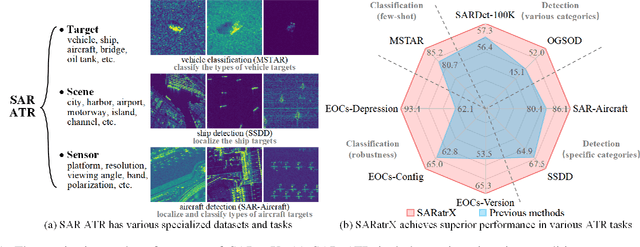
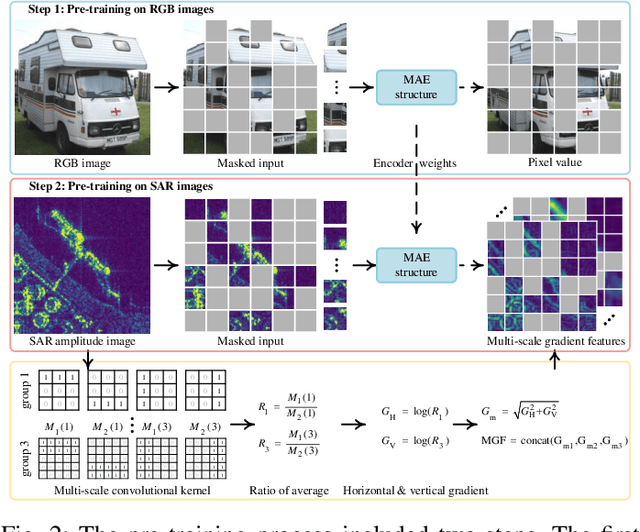
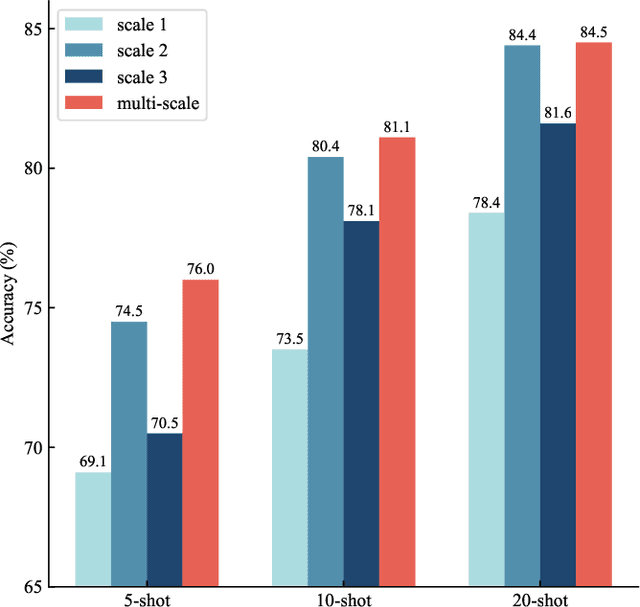
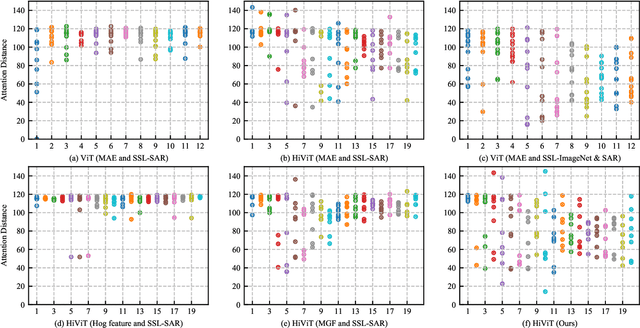
Synthetic aperture radar (SAR) is essential in actively acquiring information for Earth observation. SAR Automatic Target Recognition (ATR) focuses on detecting and classifying various target categories under different image conditions. The current deep learning-based SAR ATR methods are typically designed for specific datasets and applications. Various target characteristics, scene background information, and sensor parameters across ATR datasets challenge the generalization of those methods. This paper aims to achieve general SAR ATR based on a foundation model with Self-Supervised Learning (SSL). Our motivation is to break through the specific dataset and condition limitations and obtain universal perceptual capabilities across the target, scene, and sensor. A foundation model named SARATR-X is proposed with the following four aspects: pre-training dataset, model backbone, SSL, and evaluation task. First, we integrated 14 datasets with various target categories and imaging conditions as a pre-training dataset. Second, different model backbones were discussed to find the most suitable approaches for remote-sensing images. Third, we applied two-stage training and SAR gradient features to ensure the diversity and scalability of SARATR-X. Finally, SARATR-X has achieved competitive and superior performance on 5 datasets with 8 task settings, which shows that the foundation model can achieve universal SAR ATR. We believe it is time to embrace fundamental models for SAR image interpretation in the era of increasing big data.
Sifting out communities in large sparse networks
May 01, 2024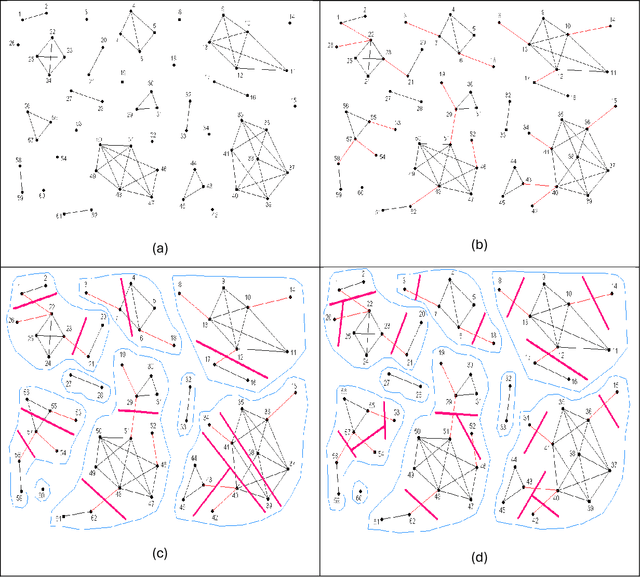
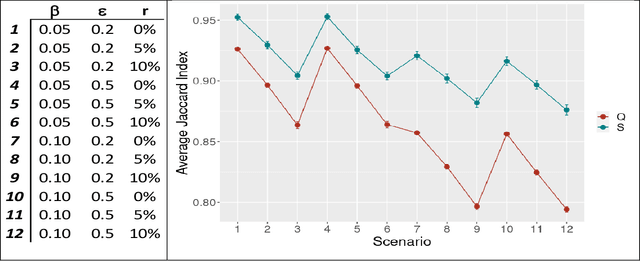
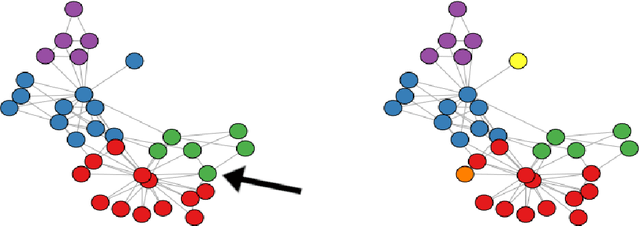
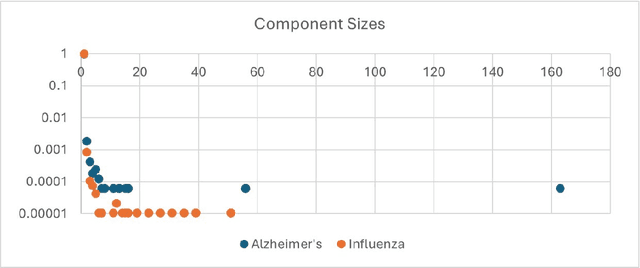
Research data sets are growing to unprecedented sizes and network modeling is commonly used to extract complex relationships in diverse domains, such as genetic interactions involved in disease, logistics, and social communities. As the number of nodes increases in a network, an increasing sparsity of edges is a practical limitation due to memory restrictions. Moreover, many of these sparse networks exhibit very large numbers of nodes with no adjacent edges, as well as disjoint components of nodes with no edges connecting them. A prevalent aim in network modeling is the identification of clusters, or communities, of nodes that are highly interrelated. Several definitions of strong community structure have been introduced to facilitate this task, each with inherent assumptions and biases. We introduce an intuitive objective function for quantifying the quality of clustering results in large sparse networks. We utilize a two-step method for identifying communities which is especially well-suited for this domain as the first step efficiently divides the network into the disjoint components, while the second step optimizes clustering of the produced components based on the new objective. Using simulated networks, optimization based on the new objective function consistently yields significantly higher accuracy than those based on the modularity function, with the widest gaps appearing for the noisiest networks. Additionally, applications to benchmark problems illustrate the intuitive correctness of our approach. Finally, the practicality of our approach is demonstrated in real-world data in which we identify complex genetic interactions in large-scale networks comprised of tens of thousands of nodes. Based on these three different types of trials, our results clearly demonstrate the usefulness of our two-step procedure and the accuracy of our simple objective.
EfficientGS: Streamlining Gaussian Splatting for Large-Scale High-Resolution Scene Representation
Apr 19, 2024

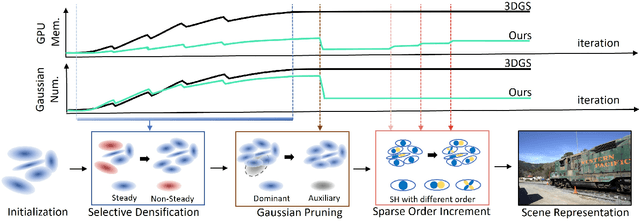
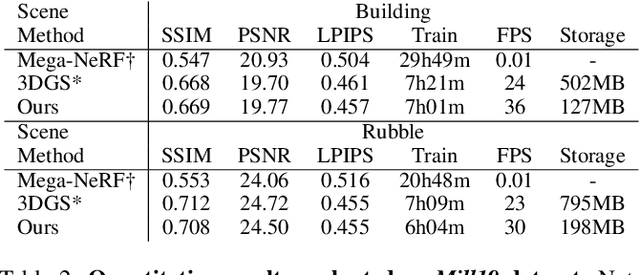
In the domain of 3D scene representation, 3D Gaussian Splatting (3DGS) has emerged as a pivotal technology. However, its application to large-scale, high-resolution scenes (exceeding 4k$\times$4k pixels) is hindered by the excessive computational requirements for managing a large number of Gaussians. Addressing this, we introduce 'EfficientGS', an advanced approach that optimizes 3DGS for high-resolution, large-scale scenes. We analyze the densification process in 3DGS and identify areas of Gaussian over-proliferation. We propose a selective strategy, limiting Gaussian increase to key primitives, thereby enhancing the representational efficiency. Additionally, we develop a pruning mechanism to remove redundant Gaussians, those that are merely auxiliary to adjacent ones. For further enhancement, we integrate a sparse order increment for Spherical Harmonics (SH), designed to alleviate storage constraints and reduce training overhead. Our empirical evaluations, conducted on a range of datasets including extensive 4K+ aerial images, demonstrate that 'EfficientGS' not only expedites training and rendering times but also achieves this with a model size approximately tenfold smaller than conventional 3DGS while maintaining high rendering fidelity.
Attacking Transformers with Feature Diversity Adversarial Perturbation
Mar 10, 2024Understanding the mechanisms behind Vision Transformer (ViT), particularly its vulnerability to adversarial perturba tions, is crucial for addressing challenges in its real-world applications. Existing ViT adversarial attackers rely on la bels to calculate the gradient for perturbation, and exhibit low transferability to other structures and tasks. In this paper, we present a label-free white-box attack approach for ViT-based models that exhibits strong transferability to various black box models, including most ViT variants, CNNs, and MLPs, even for models developed for other modalities. Our inspira tion comes from the feature collapse phenomenon in ViTs, where the critical attention mechanism overly depends on the low-frequency component of features, causing the features in middle-to-end layers to become increasingly similar and eventually collapse. We propose the feature diversity attacker to naturally accelerate this process and achieve remarkable performance and transferability.
Reaching Consensus in Cooperative Multi-Agent Reinforcement Learning with Goal Imagination
Mar 05, 2024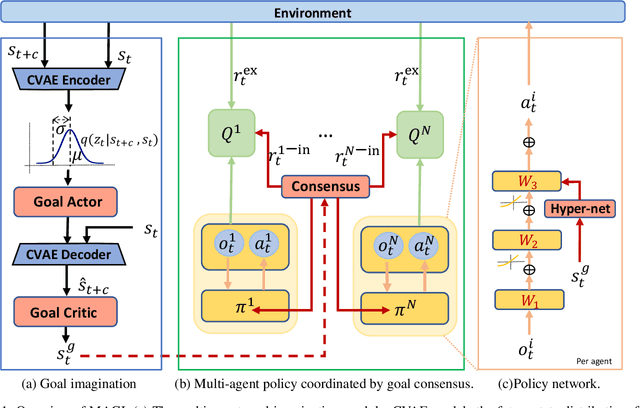
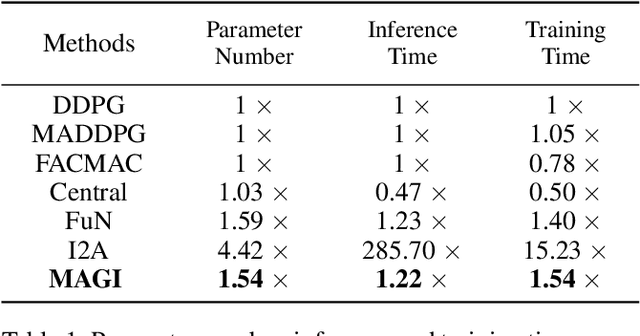
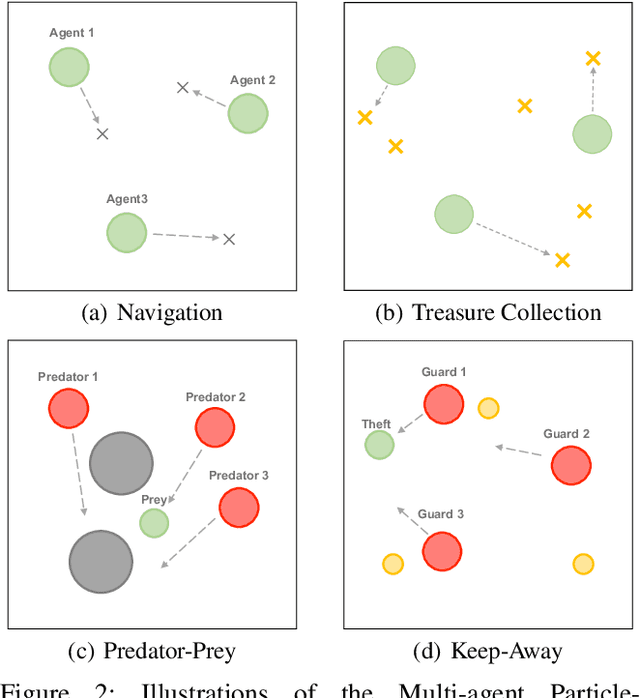
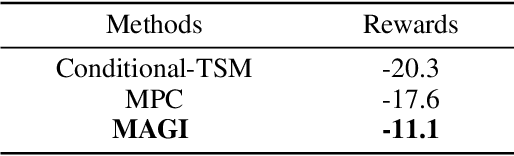
Reaching consensus is key to multi-agent coordination. To accomplish a cooperative task, agents need to coherently select optimal joint actions to maximize the team reward. However, current cooperative multi-agent reinforcement learning (MARL) methods usually do not explicitly take consensus into consideration, which may cause miscoordination problem. In this paper, we propose a model-based consensus mechanism to explicitly coordinate multiple agents. The proposed Multi-agent Goal Imagination (MAGI) framework guides agents to reach consensus with an Imagined common goal. The common goal is an achievable state with high value, which is obtained by sampling from the distribution of future states. We directly model this distribution with a self-supervised generative model, thus alleviating the "curse of dimensinality" problem induced by multi-agent multi-step policy rollout commonly used in model-based methods. We show that such efficient consensus mechanism can guide all agents cooperatively reaching valuable future states. Results on Multi-agent Particle-Environments and Google Research Football environment demonstrate the superiority of MAGI in both sample efficiency and performance.
GaussianHair: Hair Modeling and Rendering with Light-aware Gaussians
Feb 16, 2024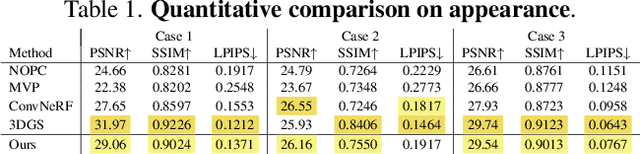
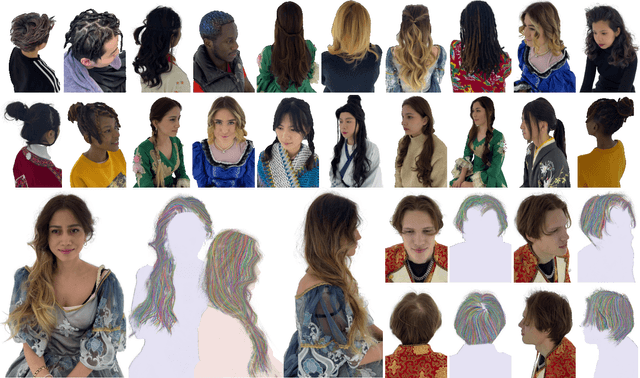
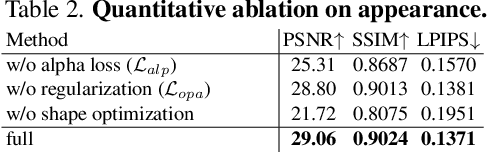

Hairstyle reflects culture and ethnicity at first glance. In the digital era, various realistic human hairstyles are also critical to high-fidelity digital human assets for beauty and inclusivity. Yet, realistic hair modeling and real-time rendering for animation is a formidable challenge due to its sheer number of strands, complicated structures of geometry, and sophisticated interaction with light. This paper presents GaussianHair, a novel explicit hair representation. It enables comprehensive modeling of hair geometry and appearance from images, fostering innovative illumination effects and dynamic animation capabilities. At the heart of GaussianHair is the novel concept of representing each hair strand as a sequence of connected cylindrical 3D Gaussian primitives. This approach not only retains the hair's geometric structure and appearance but also allows for efficient rasterization onto a 2D image plane, facilitating differentiable volumetric rendering. We further enhance this model with the "GaussianHair Scattering Model", adept at recreating the slender structure of hair strands and accurately capturing their local diffuse color in uniform lighting. Through extensive experiments, we substantiate that GaussianHair achieves breakthroughs in both geometric and appearance fidelity, transcending the limitations encountered in state-of-the-art methods for hair reconstruction. Beyond representation, GaussianHair extends to support editing, relighting, and dynamic rendering of hair, offering seamless integration with conventional CG pipeline workflows. Complementing these advancements, we have compiled an extensive dataset of real human hair, each with meticulously detailed strand geometry, to propel further research in this field.