 Add to Chrome
 Add to Firefox
 Add to Edge
EventRL: Enhancing Event Extraction with Outcome Supervision for Large Language Models
Feb 18, 2024
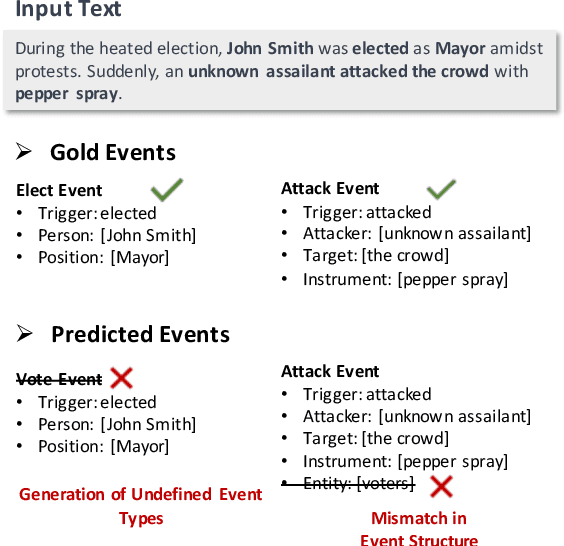
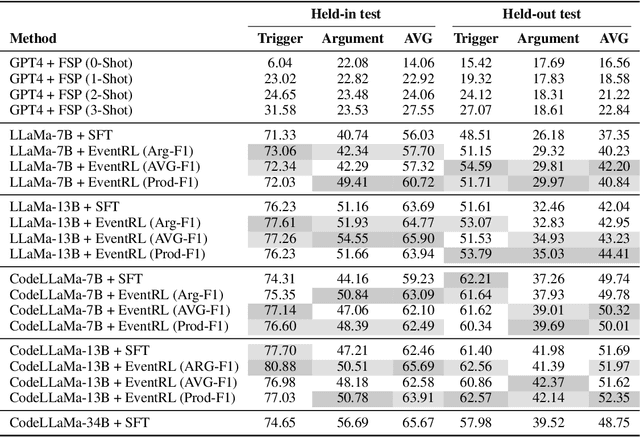
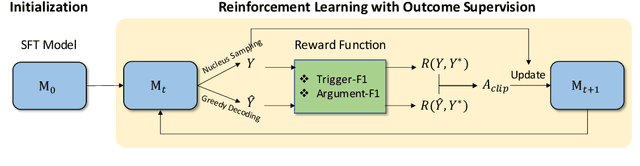
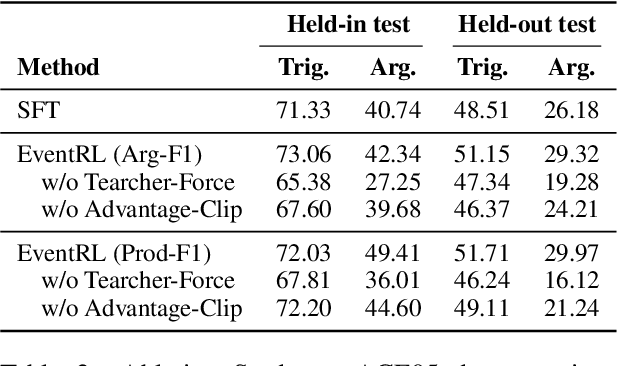
In this study, we present EventRL, a reinforcement learning approach developed to enhance event extraction for large language models (LLMs). EventRL utilizes outcome supervision with specific reward functions to tackle prevalent challenges in LLMs, such as instruction following and hallucination, manifested as the mismatch of event structure and the generation of undefined event types. We evaluate EventRL against existing methods like Few-Shot Prompting (FSP) (based on GPT4) and Supervised Fine-Tuning (SFT) across various LLMs, including GPT-4, LLaMa, and CodeLLaMa models. Our findings show that EventRL significantly outperforms these conventional approaches by improving the performance in identifying and structuring events, particularly in handling novel event types. The study emphasizes the critical role of reward function selection and demonstrates the benefits of incorporating code data for better event extraction. While increasing model size leads to higher accuracy, maintaining the ability to generalize is essential to avoid overfitting.

Rethinking Human-like Translation Strategy: Integrating Drift-Diffusion Model with Large Language Models for Machine Translation
Feb 16, 2024


Large language models (LLMs) have demonstrated promising potential in various downstream tasks, including machine translation. However, prior work on LLM-based machine translation has mainly focused on better utilizing training data, demonstrations, or pre-defined and universal knowledge to improve performance, with a lack of consideration of decision-making like human translators. In this paper, we incorporate Thinker with the Drift-Diffusion Model (Thinker-DDM) to address this issue. We then redefine the Drift-Diffusion process to emulate human translators' dynamic decision-making under constrained resources. We conduct extensive experiments under the high-resource, low-resource, and commonsense translation settings using the WMT22 and CommonMT datasets, in which Thinker-DDM outperforms baselines in the first two scenarios. We also perform additional analysis and evaluation on commonsense translation to illustrate the high effectiveness and efficacy of the proposed method.
Generalizing across Temporal Domains with Koopman Operators
Feb 15, 2024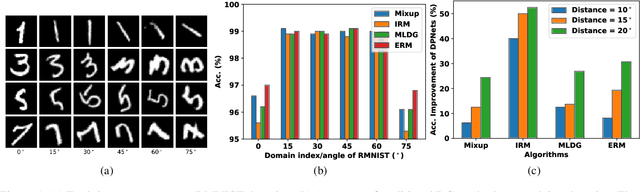
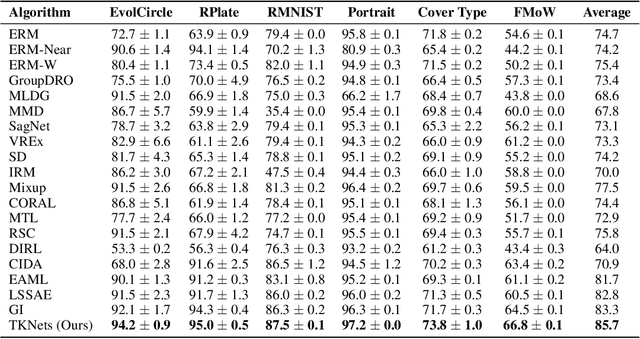


In the field of domain generalization, the task of constructing a predictive model capable of generalizing to a target domain without access to target data remains challenging. This problem becomes further complicated when considering evolving dynamics between domains. While various approaches have been proposed to address this issue, a comprehensive understanding of the underlying generalization theory is still lacking. In this study, we contribute novel theoretic results that aligning conditional distribution leads to the reduction of generalization bounds. Our analysis serves as a key motivation for solving the Temporal Domain Generalization (TDG) problem through the application of Koopman Neural Operators, resulting in Temporal Koopman Networks (TKNets). By employing Koopman Operators, we effectively address the time-evolving distributions encountered in TDG using the principles of Koopman theory, where measurement functions are sought to establish linear transition relations between evolving domains. Through empirical evaluations conducted on synthetic and real-world datasets, we validate the effectiveness of our proposed approach.
TinyLLM: Learning a Small Student from Multiple Large Language Models
Feb 07, 2024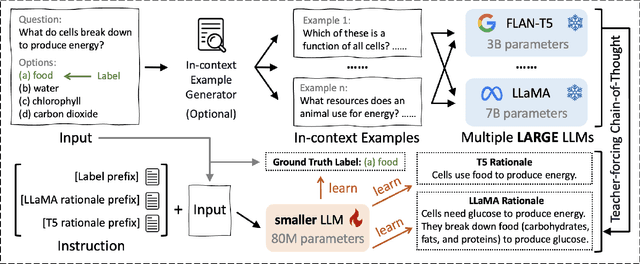
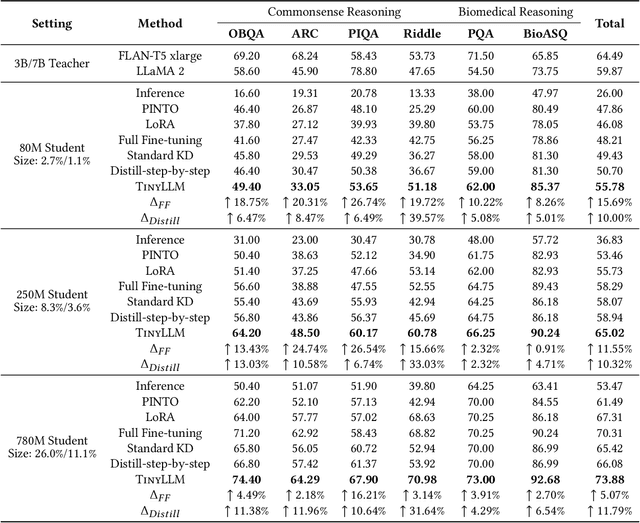
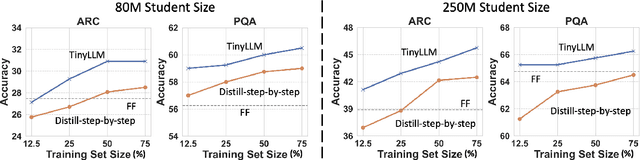
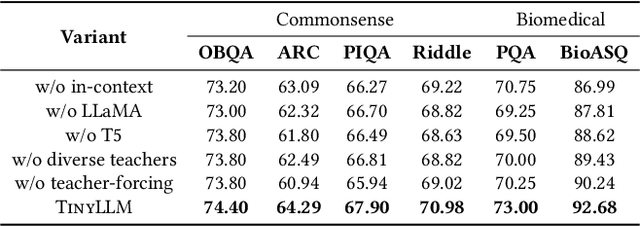
Transferring the reasoning capability from stronger large language models (LLMs) to smaller ones has been quite appealing, as smaller LLMs are more flexible to deploy with less expense. Among the existing solutions, knowledge distillation stands out due to its outstanding efficiency and generalization. However, existing methods suffer from several drawbacks, including limited knowledge diversity and the lack of rich contextual information. To solve the problems and facilitate the learning of compact language models, we propose TinyLLM, a novel knowledge distillation paradigm to learn a small student LLM from multiple large teacher LLMs. In particular, we encourage the student LLM to not only generate the correct answers but also understand the rationales behind these answers. Given that different LLMs possess diverse reasoning skills, we guide the student model to assimilate knowledge from various teacher LLMs. We further introduce an in-context example generator and a teacher-forcing Chain-of-Thought strategy to ensure that the rationales are accurate and grounded in contextually appropriate scenarios. Extensive experiments on six datasets across two reasoning tasks demonstrate the superiority of our method. Results show that TinyLLM can outperform large teacher LLMs significantly, despite having a considerably smaller model size.
Phrase Grounding-based Style Transfer for Single-Domain Generalized Object Detection
Feb 05, 2024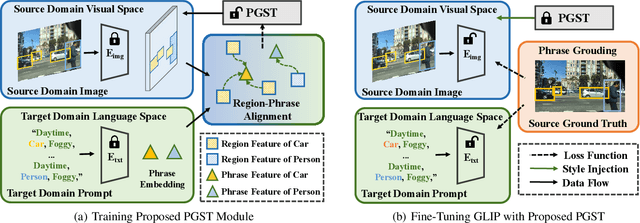
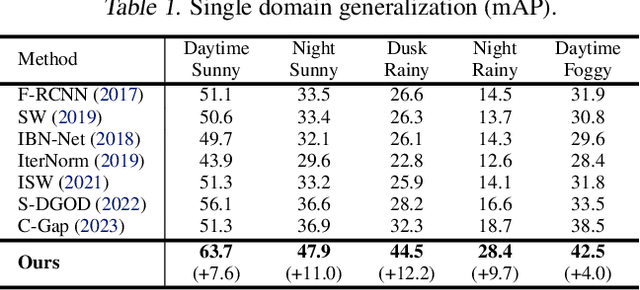
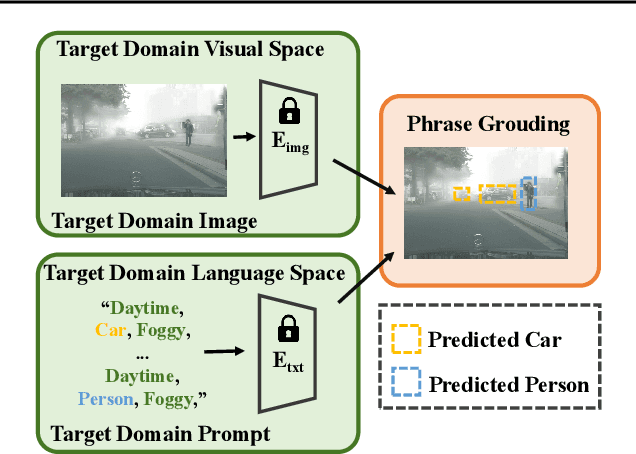
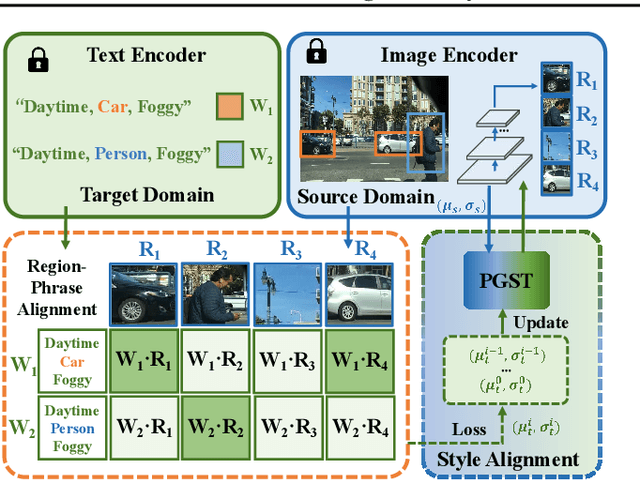
Single-domain generalized object detection aims to enhance a model's generalizability to multiple unseen target domains using only data from a single source domain during training. This is a practical yet challenging task as it requires the model to address domain shift without incorporating target domain data into training. In this paper, we propose a novel phrase grounding-based style transfer (PGST) approach for the task. Specifically, we first define textual prompts to describe potential objects for each unseen target domain. Then, we leverage the grounded language-image pre-training (GLIP) model to learn the style of these target domains and achieve style transfer from the source to the target domain. The style-transferred source visual features are semantically rich and could be close to imaginary counterparts in the target domain. Finally, we employ these style-transferred visual features to fine-tune GLIP. By introducing imaginary counterparts, the detector could be effectively generalized to unseen target domains using only a single source domain for training. Extensive experimental results on five diverse weather driving benchmarks demonstrate our proposed approach achieves state-of-the-art performance, even surpassing some domain adaptive methods that incorporate target domain images into the training process.The source codes and pre-trained models will be made available.
A Survey on Self-Supervised Learning for Non-Sequential Tabular Data
Feb 05, 2024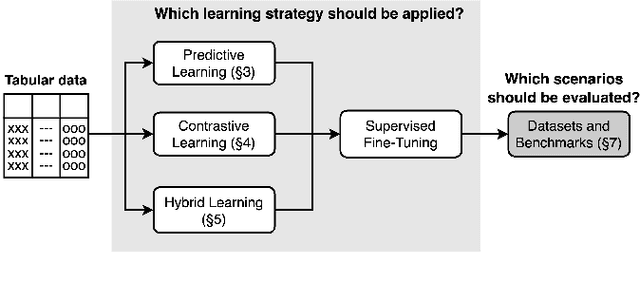
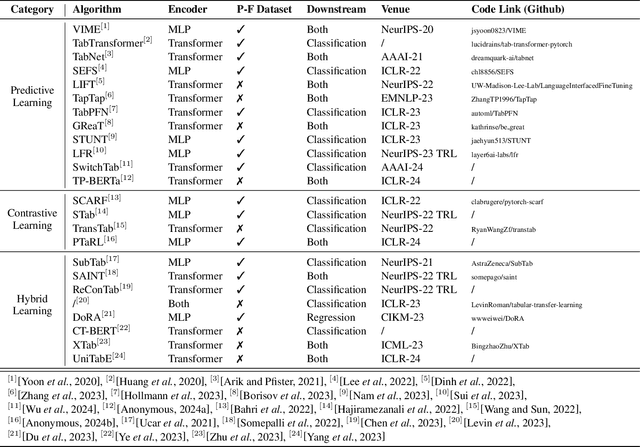

Self-supervised learning (SSL) has been incorporated into many state-of-the-art models in various domains, where SSL defines pretext tasks based on unlabeled datasets to learn contextualized and robust representations. Recently, SSL has been a new trend in exploring the representation learning capability in the realm of tabular data, which is more challenging due to not having explicit relations for learning descriptive representations. This survey aims to systematically review and summarize the recent progress and challenges of SSL for non-sequential tabular data (SSL4NS-TD). We first present a formal definition of NS-TD and clarify its correlation to related studies. Then, these approaches are categorized into three groups -- predictive learning, contrastive learning, and hybrid learning, with their motivations and strengths of representative methods within each direction. On top of this, application issues of SSL4NS-TD are presented, including automatic data engineering, cross-table transferability, and domain knowledge integration. In addition, we elaborate on existing benchmarks and datasets for NS-TD applications to discuss the performance of existing tabular models. Finally, we discuss the challenges of SSL4NS-TD and provide potential directions for future research. We expect our work to be useful in terms of encouraging more research on lowering the barrier to entry SSL for the tabular domain and improving the foundations for implicit tabular data.
Data Distribution Dynamics in Real-World WiFi-Based Patient Activity Monitoring for Home Healthcare
Feb 03, 2024This paper examines the application of WiFi signals for real-world monitoring of daily activities in home healthcare scenarios. While the state-of-the-art of WiFi-based activity recognition is promising in lab environments, challenges arise in real-world settings due to environmental, subject, and system configuration variables, affecting accuracy and adaptability. The research involved deploying systems in various settings and analyzing data shifts. It aims to guide realistic development of robust, context-aware WiFi sensing systems for elderly care. The findings suggest a shift in WiFi-based activity sensing, bridging the gap between academic research and practical applications, enhancing life quality through technology.
Polyp-DAM: Polyp segmentation via depth anything model
Feb 03, 2024
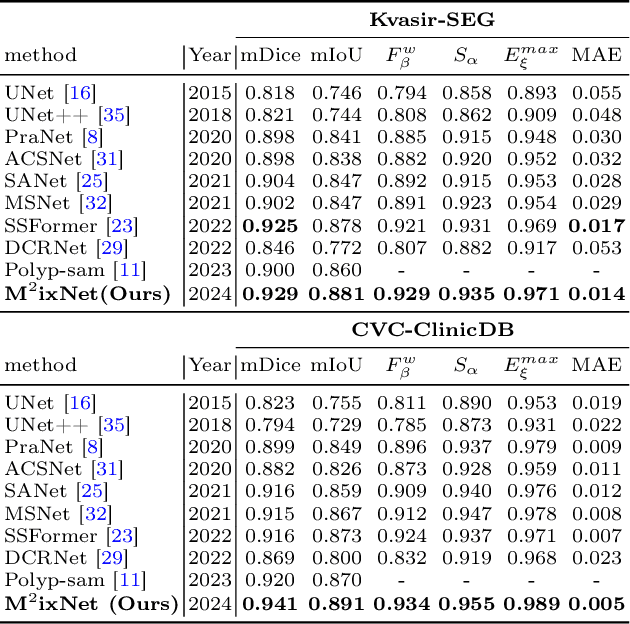

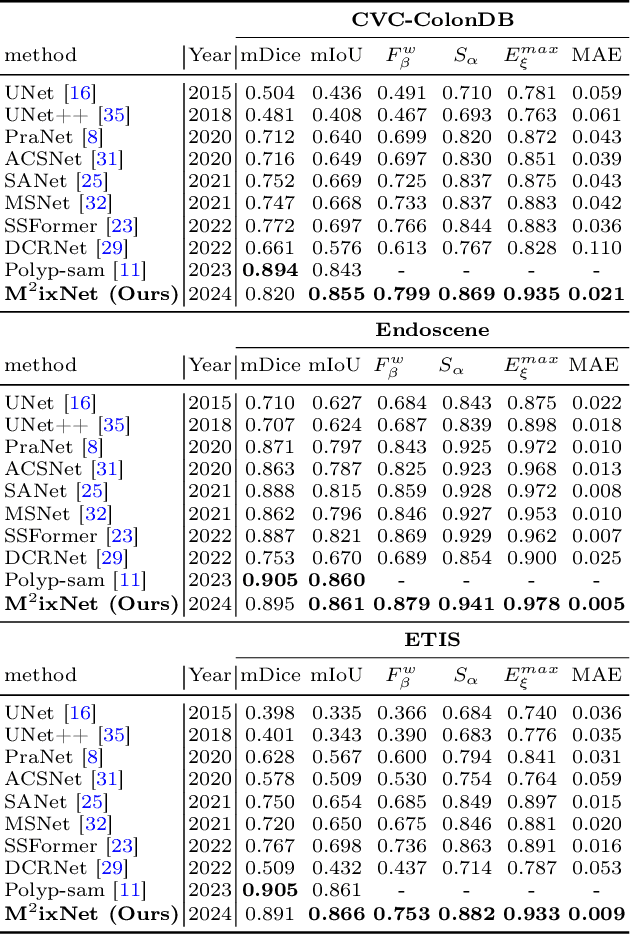
Recently, large models (Segment Anything model) came on the scene to provide a new baseline for polyp segmentation tasks. This demonstrates that large models with a sufficient image level prior can achieve promising performance on a given task. In this paper, we unfold a new perspective on polyp segmentation modeling by leveraging the Depth Anything Model (DAM) to provide depth prior to polyp segmentation models. Specifically, the input polyp image is first passed through a frozen DAM to generate a depth map. The depth map and the input polyp images are then concatenated and fed into a convolutional neural network with multiscale to generate segmented images. Extensive experimental results demonstrate the effectiveness of our method, and in addition, we observe that our method still performs well on images of polyps with noise. The URL of our code is \url{https://github.com/zzr-idam/Polyp-DAM}.
SeFi-IDE: Semantic-Fidelity Identity Embedding for Personalized Diffusion-Based Generation
Jan 31, 2024Advanced diffusion-based Text-to-Image (T2I) models, such as the Stable Diffusion Model, have made significant progress in generating diverse and high-quality images using text prompts alone. However, T2I models are unable to accurately map identities (IDs) when non-famous users require personalized image generation. The main problem is that existing T2I models do not learn the ID-image alignments of new users. The previous methods either failed to accurately fit the face region or lost the interactive generative ability with other existing concepts in T2I models (i.e., unable to generate other concepts described in given prompts such as scenes, actions, and facial attributes). In this paper, we focus on accurate and semantic-fidelity ID embedding into the Stable Diffusion Model for personalized generation. We address this challenge from two perspectives: face-wise region fitting, and semantic-fidelity token optimization. Specifically, we first visualize the attention overfit problem, and propose a face-wise attention loss to fit the face region instead of the whole target image. This key trick significantly enhances the ID accuracy and interactive generative ability with other existing concepts. Then, we optimize one ID representation as multiple per-stage tokens where each token contains two disentangled features. This expansion of the textual conditioning space enhances semantic-fidelity control. Extensive experiments validate that our results exhibit superior ID accuracy and manipulation ability compared to previous methods.
On the Emergence of Symmetrical Reality
Jan 26, 2024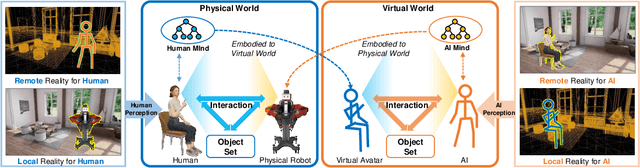
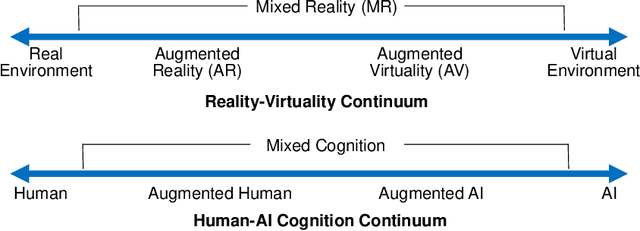
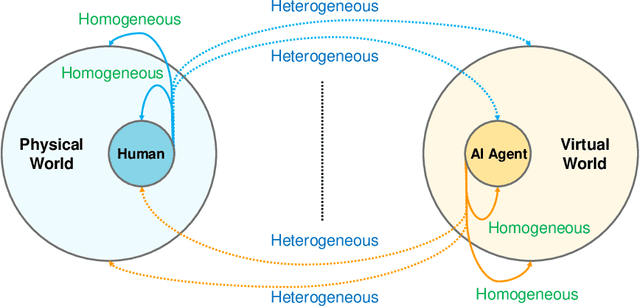
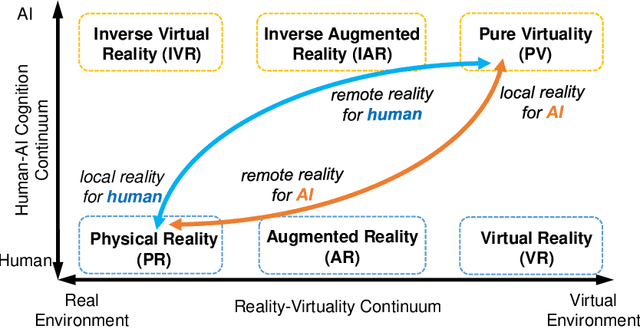
Artificial intelligence (AI) has revolutionized human cognitive abilities and facilitated the development of new AI entities capable of interacting with humans in both physical and virtual environments. Despite the existence of virtual reality, mixed reality, and augmented reality for several years, integrating these technical fields remains a formidable challenge due to their disparate application directions. The advent of AI agents, capable of autonomous perception and action, further compounds this issue by exposing the limitations of traditional human-centered research approaches. It is imperative to establish a comprehensive framework that accommodates the dual perceptual centers of humans and AI agents in both physical and virtual worlds. In this paper, we introduce the symmetrical reality framework, which offers a unified representation encompassing various forms of physical-virtual amalgamations. This framework enables researchers to better comprehend how AI agents can collaborate with humans and how distinct technical pathways of physical-virtual integration can be consolidated from a broader perspective. We then delve into the coexistence of humans and AI, demonstrating a prototype system that exemplifies the operation of symmetrical reality systems for specific tasks, such as pouring water. Subsequently, we propose an instance of an AI-driven active assistance service that illustrates the potential applications of symmetrical reality. This paper aims to offer beneficial perspectives and guidance for researchers and practitioners in different fields, thus contributing to the ongoing research about human-AI coexistence in both physical and virtual environments.