 Add to Chrome
 Add to Firefox
 Add to Edge
ANCHOR-RE: An Agentic Neuro-Symbolic Framework for Grounded Biomedical Relation Extraction
Aug 04, 2026
Biomedical relation extraction (BioRE) extracts structured knowledge from biomedical literature for applications such as knowledge base construction and hypothesis generation. Traditional symbolic systems such as SemRep provide high precision but limited recall, while large language models (LLMs) offer stronger contextual reasoning but remain prone to false-positive predictions. We developed ANCHOR-RE, a framework that integrates ontology-guided reasoning, external knowledge grounding, and data-driven verification rules into LLM inference. We evaluated it on three BioRE benchmarks (SemRepGS, DDI, and ChemProt) using both proprietary and open-weight LLMs. To assess generalizability beyond benchmark datasets while reducing potential evaluation bias from LLM pretraining contamination, we conducted a temporal evaluation using 100 biomedical articles published in 2026. With the proprietary backbone, ANCHOR-RE outperformed direct LLM prompting, improving micro-F1 from 0.654 to 0.676 on SemRepGS, from 0.769 to 0.872 on DDI, and from 0.939 to 0.941 on ChemProt. On DDI and ChemProt, it also outperformed previously reported inference-only methods and approached fine-tuned or instruction-tuned systems without parameter updates. Similar performance gains observed with open-weight LLMs indicate that the benefits were not limited to the proprietary backbone. On the post-cutoff set, manual assessment of 500 randomly sampled predictions yielded a precision of 69%, maintaining consistent precision on previously unseen biomedical literature. Neuro-symbolic reasoning can improve the reliability of LLM-based BioRE without fine-tuning. Results across multiple benchmarks, model families, and post-cutoff literature support ANCHOR-RE as a practical training-free approach to biomedical literature mining.

When Evidence Conflicts: Uncertainty and Order Effects in Retrieval-Augmented Biomedical Question Answering
May 13, 2026Biomedical retrieval-augmented large language models (LLMs) often face evidence that is incomplete, misleading, or internally contradictory, yet evaluation usually emphasizes answer accuracy under helpful context rather than reliability under conflict. Using HealthContradict, we evaluate six open-weight LLMs under five controlled evidence conditions: no retrieved context, correct-only context, incorrect-only context, and two mixed conditions containing both correct and contradictory documents in opposite orders. In this conflicting-evidence order contrast, where the same two documents are both present and only their order is reversed, accuracy drops for every model and 11.4%--25.2% of predictions flip. To support abstention in these difficult cases, we also evaluate a conflict-aware abstention score that combines model confidence with a detector of evidence conflict. In the two hardest conditions, this score improves selective accuracy over confidence-only, with mean gains of 7.2--33.4 points in incorrect-only (`IC') and 3.6--14.4 points in incorrect-first conflicting (`ICC') conditions across 75%, 50%, and 25% coverage. These results show that conflicting biomedical evidence is both an uncertainty and robustness problem and motivate evaluation and abstention methods that explicitly account for evidence disagreement.
MedConceal: A Benchmark for Clinical Hidden-Concern Reasoning Under Partial Observability
Apr 09, 2026Patient-clinician communication is an asymmetric-information problem: patients often do not disclose fears, misconceptions, or practical barriers unless clinicians elicit them skillfully. Effective medical dialogue therefore requires reasoning under partial observability: clinicians must elicit latent concerns, confirm them through interaction, and respond in ways that guide patients toward appropriate care. However, existing medical dialogue benchmarks largely sidestep this challenge by exposing hidden patient state, collapsing elicitation into extraction, or evaluating responses without modeling what remains hidden. We present MedConceal, a benchmark with an interactive patient simulator for evaluating hidden-concern reasoning in medical dialogue, comprising 300 curated cases and 600 clinician-LLM interactions. Built from clinician-answered online health discussions, each case pairing clinician-visible context with simulator-internal hidden concerns derived from prior literature and structured using an expert-developed taxonomy. The simulator withholds these concerns from the dialogue agent, tracks whether they have been revealed and addressed via theory-grounded turn-level communication signals, and is clinician-reviewed for clinical plausibility. This enables process-aware evaluation of both task success and the interaction process that leads to it. We study two abilities: confirmation, surfacing hidden concerns through multi-turn dialogue, and intervention, addressing the primary concern and guiding the patient toward a target plan. Results show that no single system dominates: frontier models lead on different confirmation metrics, while human clinicians (N=159) remain strongest on intervention success. Together, these results identify hidden-concern reasoning under partial observability as a key unresolved challenge for medical dialogue systems.
Large Language Models on Fine-grained Emotion Detection Dataset with Data Augmentation and Transfer Learning
Mar 10, 2024This paper delves into enhancing the classification performance on the GoEmotions dataset, a large, manually annotated dataset for emotion detection in text. The primary goal of this paper is to address the challenges of detecting subtle emotions in text, a complex issue in Natural Language Processing (NLP) with significant practical applications. The findings offer valuable insights into addressing the challenges of emotion detection in text and suggest directions for future research, including the potential for a survey paper that synthesizes methods and performances across various datasets in this domain.
TinyLLM: Learning a Small Student from Multiple Large Language Models
Feb 07, 2024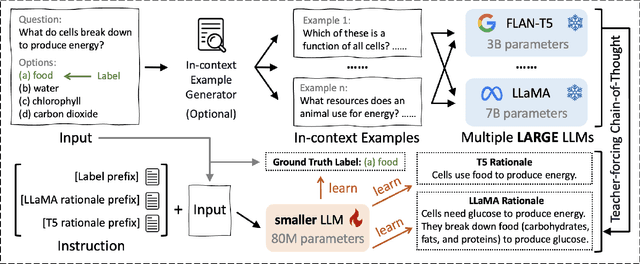
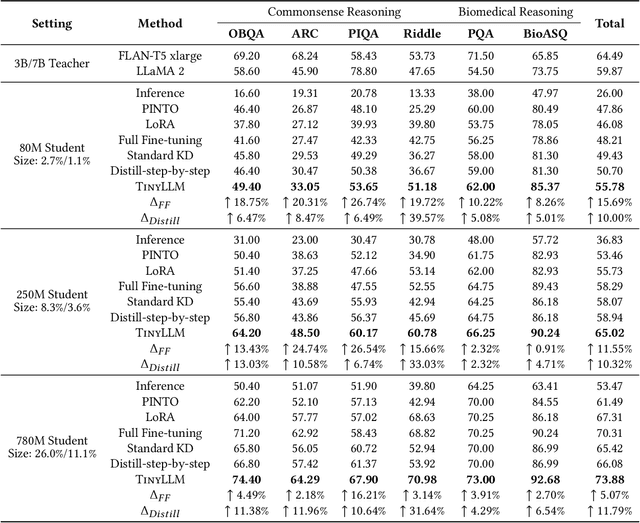
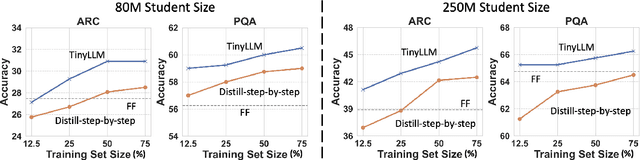
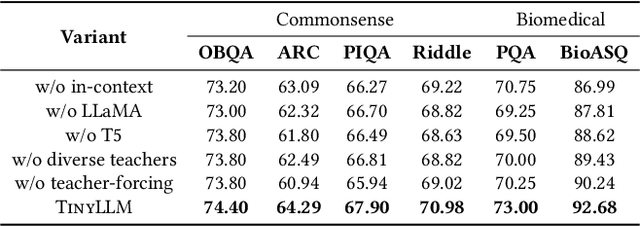
Transferring the reasoning capability from stronger large language models (LLMs) to smaller ones has been quite appealing, as smaller LLMs are more flexible to deploy with less expense. Among the existing solutions, knowledge distillation stands out due to its outstanding efficiency and generalization. However, existing methods suffer from several drawbacks, including limited knowledge diversity and the lack of rich contextual information. To solve the problems and facilitate the learning of compact language models, we propose TinyLLM, a novel knowledge distillation paradigm to learn a small student LLM from multiple large teacher LLMs. In particular, we encourage the student LLM to not only generate the correct answers but also understand the rationales behind these answers. Given that different LLMs possess diverse reasoning skills, we guide the student model to assimilate knowledge from various teacher LLMs. We further introduce an in-context example generator and a teacher-forcing Chain-of-Thought strategy to ensure that the rationales are accurate and grounded in contextually appropriate scenarios. Extensive experiments on six datasets across two reasoning tasks demonstrate the superiority of our method. Results show that TinyLLM can outperform large teacher LLMs significantly, despite having a considerably smaller model size.
When Large Language Models Meet Vector Databases: A Survey
Feb 06, 2024This survey explores the synergistic potential of Large Language Models (LLMs) and Vector Databases (VecDBs), a burgeoning but rapidly evolving research area. With the proliferation of LLMs comes a host of challenges, including hallucinations, outdated knowledge, prohibitive commercial application costs, and memory issues. VecDBs emerge as a compelling solution to these issues by offering an efficient means to store, retrieve, and manage the high-dimensional vector representations intrinsic to LLM operations. Through this nuanced review, we delineate the foundational principles of LLMs and VecDBs and critically analyze their integration's impact on enhancing LLM functionalities. This discourse extends into a discussion on the speculative future developments in this domain, aiming to catalyze further research into optimizing the confluence of LLMs and VecDBs for advanced data handling and knowledge extraction capabilities.
A Community Detection and Graph Neural Network Based Link Prediction Approach for Scientific Literature
Jan 04, 2024

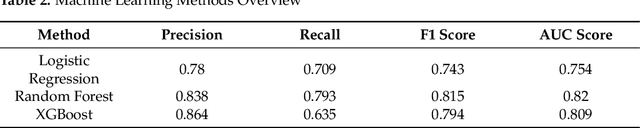

This study introduces an innovative approach that integrates community detection algorithms with Graph Neural Network (GNN) models to enhance link prediction in scientific literature networks. We specifically focus on the utilization of the Louvain community detection algorithm to uncover latent community structures within these networks, which are then incorporated into GNN architectures to predict potential links. Our methodology demonstrates the importance of understanding community dynamics in complex networks and leverages the strengths of both community detection and GNNs to improve predictive accuracy. Through extensive experiments on bipartite graphs representing scientific collaborations and citations, our approach not only highlights the synergy between community detection and GNNs but also addresses some of the prevalent challenges in link prediction, such as scalability and resolution limits. The results suggest that incorporating community-level information can significantly enhance the performance of GNNs in link prediction tasks. This work contributes to the evolving field of network science by offering a novel perspective on integrating advanced machine learning techniques with traditional network analysis methods to better understand and predict the intricate patterns of scientific collaborations.
A Comprehensive Survey on Vector Database: Storage and Retrieval Technique, Challenge
Oct 18, 2023A vector database is used to store high-dimensional data that cannot be characterized by traditional DBMS. Although there are not many articles describing existing or introducing new vector database architectures, the approximate nearest neighbor search problem behind vector databases has been studied for a long time, and considerable related algorithmic articles can be found in the literature. This article attempts to comprehensively review relevant algorithms to provide a general understanding of this booming research area. The basis of our framework categorises these studies by the approach of solving ANNS problem, respectively hash-based, tree-based, graph-based and quantization-based approaches. Then we present an overview of existing challenges for vector databases. Lastly, we sketch how vector databases can be combined with large language models and provide new possibilities.