 Add to Chrome
 Add to Firefox
 Add to Edge
Measuring the Inconsistency of Large Language Models in Preferential Ranking
Oct 11, 2024
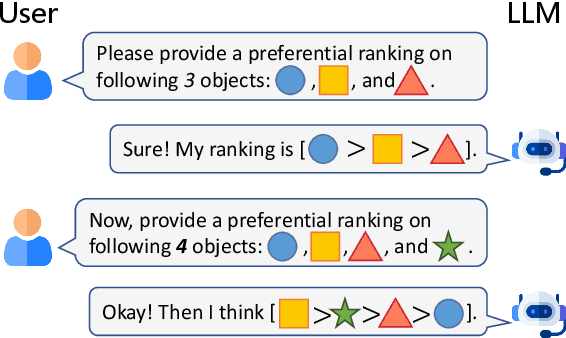
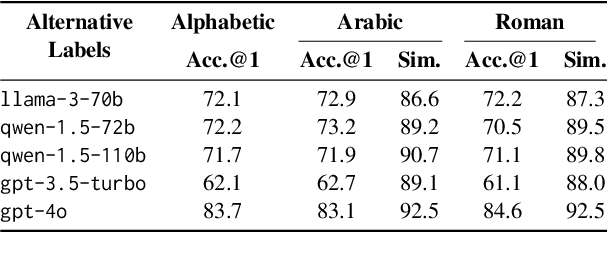
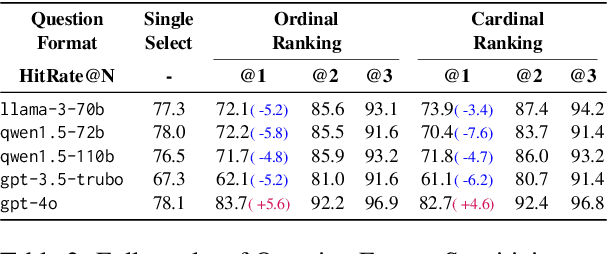
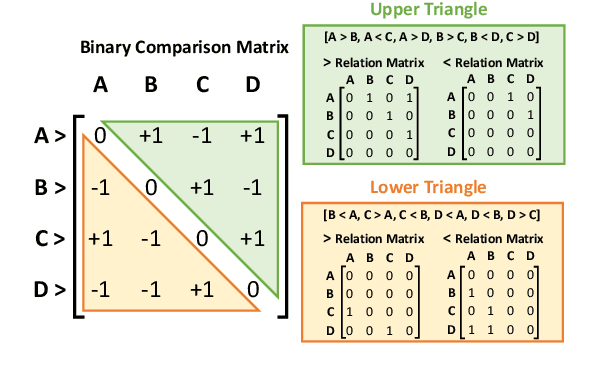
Despite large language models' (LLMs) recent advancements, their bias and hallucination issues persist, and their ability to offer consistent preferential rankings remains underexplored. This study investigates the capacity of LLMs to provide consistent ordinal preferences, a crucial aspect in scenarios with dense decision space or lacking absolute answers. We introduce a formalization of consistency based on order theory, outlining criteria such as transitivity, asymmetry, reversibility, and independence from irrelevant alternatives. Our diagnostic experiments on selected state-of-the-art LLMs reveal their inability to meet these criteria, indicating a strong positional bias and poor transitivity, with preferences easily swayed by irrelevant alternatives. These findings highlight a significant inconsistency in LLM-generated preferential rankings, underscoring the need for further research to address these limitations.

AgentBank: Towards Generalized LLM Agents via Fine-Tuning on 50000+ Interaction Trajectories
Oct 10, 2024
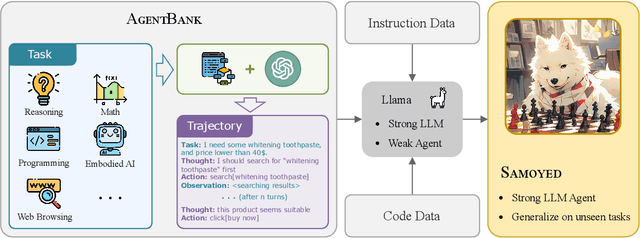


Fine-tuning on agent-environment interaction trajectory data holds significant promise for surfacing generalized agent capabilities in open-source large language models (LLMs). In this work, we introduce AgentBank, by far the largest trajectory tuning data collection featuring more than 50k diverse high-quality interaction trajectories which comprises 16 tasks covering five distinct agent skill dimensions. Leveraging a novel annotation pipeline, we are able to scale the annotated trajectories and generate a trajectory dataset with minimized difficulty bias. Furthermore, we fine-tune LLMs on AgentBank to get a series of agent models, Samoyed. Our comparative experiments demonstrate the effectiveness of scaling the interaction trajectory data to acquire generalized agent capabilities. Additional studies also reveal some key observations regarding trajectory tuning and agent skill generalization.
A physics-driven sensor placement optimization methodology for temperature field reconstruction
Sep 27, 2024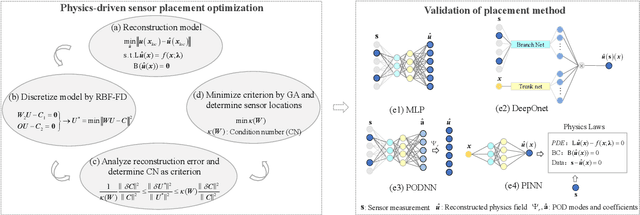
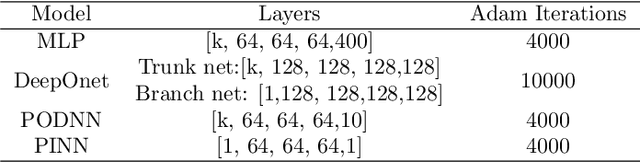
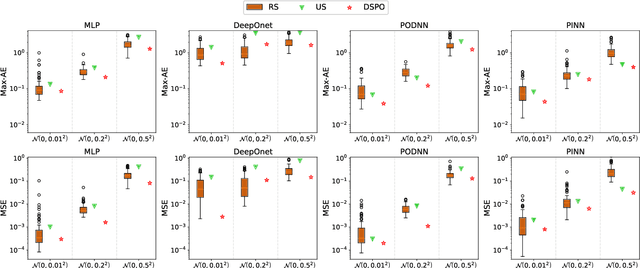

Perceiving the global field from sparse sensors has been a grand challenge in the monitoring, analysis, and design of physical systems. In this context, sensor placement optimization is a crucial issue. Most existing works require large and sufficient data to construct data-based criteria, which are intractable in data-free scenarios without numerical and experimental data. To this end, we propose a novel physics-driven sensor placement optimization (PSPO) method for temperature field reconstruction using a physics-based criterion to optimize sensor locations. In our methodological framework, we firstly derive the theoretical upper and lower bounds of the reconstruction error under noise scenarios by analyzing the optimal solution, proving that error bounds correlate with the condition number determined by sensor locations. Furthermore, the condition number, as the physics-based criterion, is used to optimize sensor locations by the genetic algorithm. Finally, the best sensors are validated by reconstruction models, including non-invasive end-to-end models, non-invasive reduced-order models, and physics-informed models. Experimental results, both on a numerical and an application case, demonstrate that the PSPO method significantly outperforms random and uniform selection methods, improving the reconstruction accuracy by nearly an order of magnitude. Moreover, the PSPO method can achieve comparable reconstruction accuracy to the existing data-driven placement optimization methods.
Brain-Cognition Fingerprinting via Graph-GCCA with Contrastive Learning
Sep 20, 2024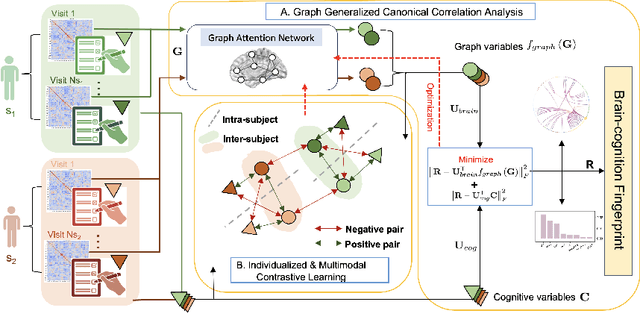
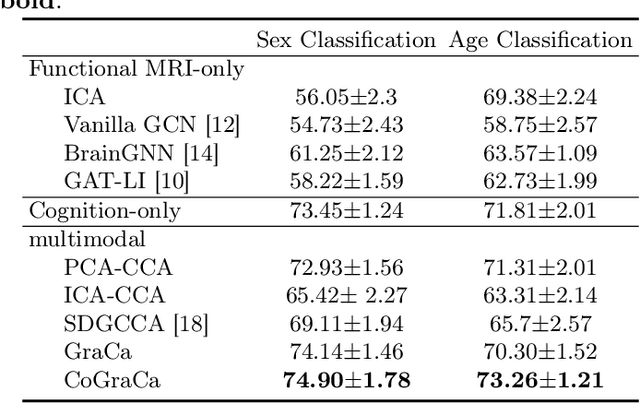
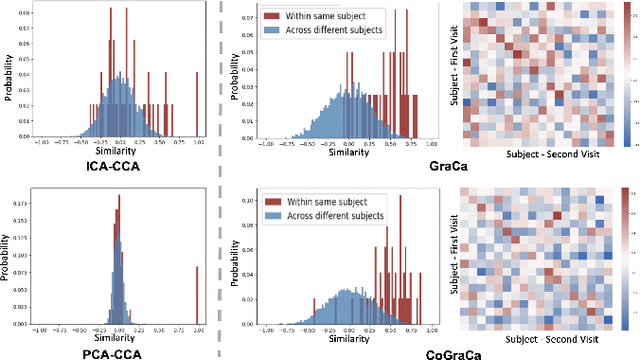
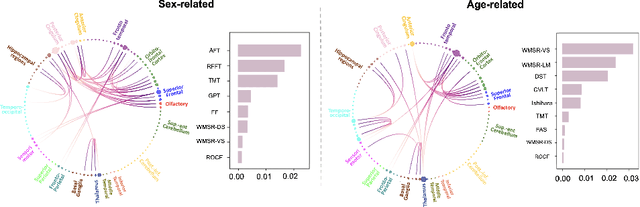
Many longitudinal neuroimaging studies aim to improve the understanding of brain aging and diseases by studying the dynamic interactions between brain function and cognition. Doing so requires accurate encoding of their multidimensional relationship while accounting for individual variability over time. For this purpose, we propose an unsupervised learning model (called \underline{\textbf{Co}}ntrastive Learning-based \underline{\textbf{Gra}}ph Generalized \underline{\textbf{Ca}}nonical Correlation Analysis (CoGraCa)) that encodes their relationship via Graph Attention Networks and generalized Canonical Correlational Analysis. To create brain-cognition fingerprints reflecting unique neural and cognitive phenotype of each person, the model also relies on individualized and multimodal contrastive learning. We apply CoGraCa to longitudinal dataset of healthy individuals consisting of resting-state functional MRI and cognitive measures acquired at multiple visits for each participant. The generated fingerprints effectively capture significant individual differences and outperform current single-modal and CCA-based multimodal models in identifying sex and age. More importantly, our encoding provides interpretable interactions between those two modalities.
Evaluating the Quality of Brain MRI Generators
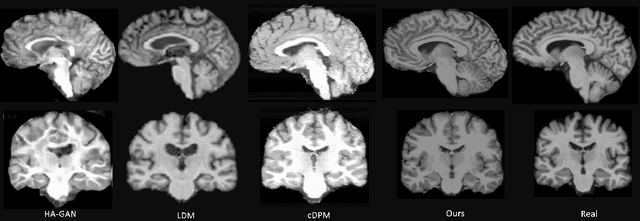
Sep 13, 2024Deep learning models generating structural brain MRIs have the potential to significantly accelerate discovery of neuroscience studies. However, their use has been limited in part by the way their quality is evaluated. Most evaluations of generative models focus on metrics originally designed for natural images (such as structural similarity index and Frechet inception distance). As we show in a comparison of 6 state-of-the-art generative models trained and tested on over 3000 MRIs, these metrics are sensitive to the experimental setup and inadequately assess how well brain MRIs capture macrostructural properties of brain regions (i.e., anatomical plausibility). This shortcoming of the metrics results in inconclusive findings even when qualitative differences between the outputs of models are evident. We therefore propose a framework for evaluating models generating brain MRIs, which requires uniform processing of the real MRIs, standardizing the implementation of the models, and automatically segmenting the MRIs generated by the models. The segmentations are used for quantifying the plausibility of anatomy displayed in the MRIs. To ensure meaningful quantification, it is crucial that the segmentations are highly reliable. Our framework rigorously checks this reliability, a step often overlooked by prior work. Only 3 of the 6 generative models produced MRIs, of which at least 95% had highly reliable segmentations. More importantly, the assessment of each model by our framework is in line with qualitative assessments, reinforcing the validity of our approach.
Latent 3D Brain MRI Counterfactual
Sep 09, 2024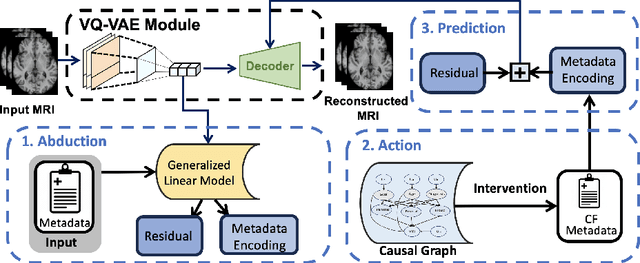
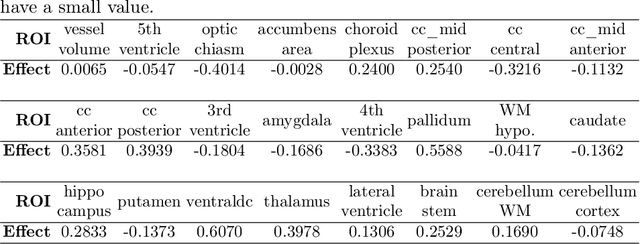
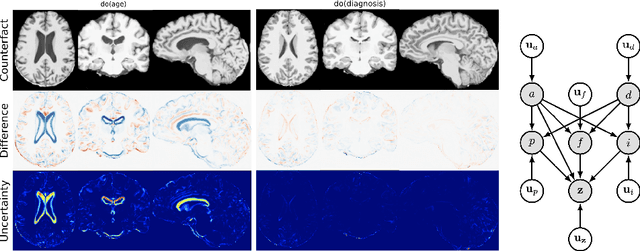
The number of samples in structural brain MRI studies is often too small to properly train deep learning models. Generative models show promise in addressing this issue by effectively learning the data distribution and generating high-fidelity MRI. However, they struggle to produce diverse, high-quality data outside the distribution defined by the training data. One way to address the issue is using causal models developed for 3D volume counterfactuals. However, accurately modeling causality in high-dimensional spaces is a challenge so that these models generally generate 3D brain MRIS of lower quality. To address these challenges, we propose a two-stage method that constructs a Structural Causal Model (SCM) within the latent space. In the first stage, we employ a VQ-VAE to learn a compact embedding of the MRI volume. Subsequently, we integrate our causal model into this latent space and execute a three-step counterfactual procedure using a closed-form Generalized Linear Model (GLM). Our experiments conducted on real-world high-resolution MRI data (1mm) demonstrate that our method can generate high-quality 3D MRI counterfactuals.
PFDiff: Training-free Acceleration of Diffusion Models through the Gradient Guidance of Past and Future
Aug 16, 2024Diffusion Probabilistic Models (DPMs) have shown remarkable potential in image generation, but their sampling efficiency is hindered by the need for numerous denoising steps. Most existing solutions accelerate the sampling process by proposing fast ODE solvers. However, the inevitable discretization errors of the ODE solvers are significantly magnified when the number of function evaluations (NFE) is fewer. In this work, we propose PFDiff, a novel training-free and orthogonal timestep-skipping strategy, which enables existing fast ODE solvers to operate with fewer NFE. Based on two key observations: a significant similarity in the model's outputs at time step size that is not excessively large during the denoising process of existing ODE solvers, and a high resemblance between the denoising process and SGD. PFDiff, by employing gradient replacement from past time steps and foresight updates inspired by Nesterov momentum, rapidly updates intermediate states, thereby reducing unnecessary NFE while correcting for discretization errors inherent in first-order ODE solvers. Experimental results demonstrate that PFDiff exhibits flexible applicability across various pre-trained DPMs, particularly excelling in conditional DPMs and surpassing previous state-of-the-art training-free methods. For instance, using DDIM as a baseline, we achieved 16.46 FID (4 NFE) compared to 138.81 FID with DDIM on ImageNet 64x64 with classifier guidance, and 13.06 FID (10 NFE) on Stable Diffusion with 7.5 guidance scale.
CTISum: A New Benchmark Dataset For Cyber Threat Intelligence Summarization
Aug 13, 2024

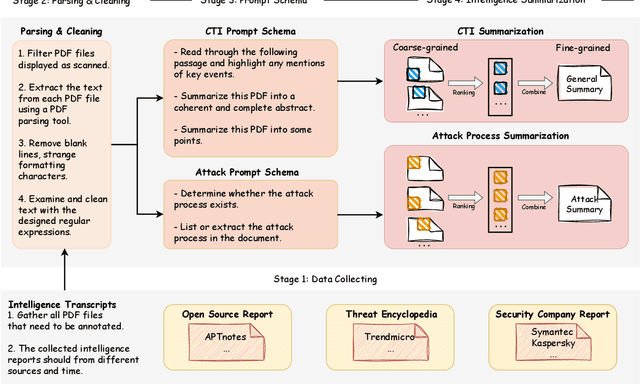
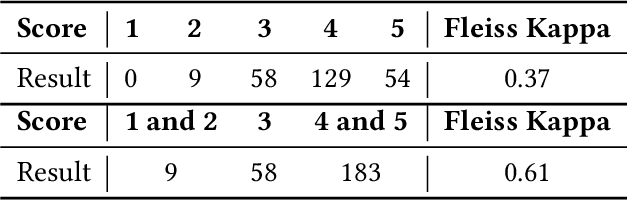
Cyber Threat Intelligence (CTI) summarization task requires the system to generate concise and accurate highlights from raw intelligence data, which plays an important role in providing decision-makers with crucial information to quickly detect and respond to cyber threats in the cybersecurity domain. However, efficient techniques for summarizing CTI reports, including facts, analytical insights, attack processes, etc., have largely been unexplored, primarily due to the lack of available dataset. To this end, we present CTISum, a new benchmark for CTI summarization task. Considering the importance of attack process, a novel fine-grained subtask of attack process summarization is proposed to enable defenders to assess risk, identify security gaps, vulnerabilities, and so on. Specifically, we first design a multi-stage annotation pipeline to gather and annotate the CTI data, and then benchmark the CTISum with a collection of extractive and abstractive summarization methods. Experimental results show that current state-of-the-art models exhibit limitations when applied to CTISum, underscoring the fact that automatically producing concise summaries of CTI reports remains an open research challenge.
HeteroMorpheus: Universal Control Based on Morphological Heterogeneity Modeling
Aug 02, 2024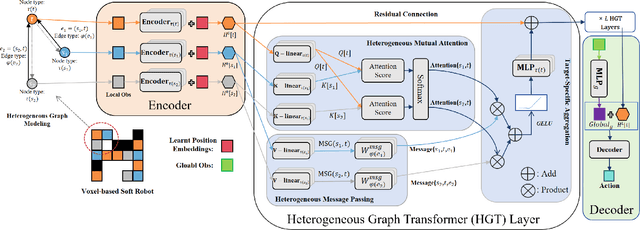


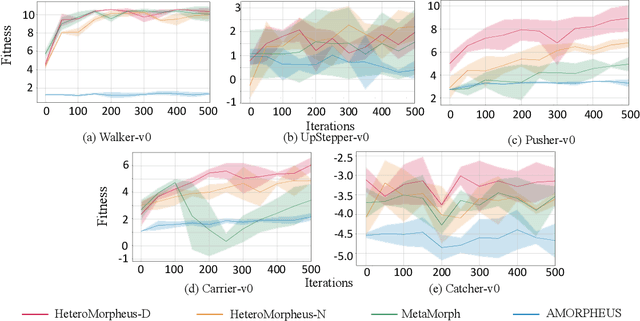
In the field of robotic control, designing individual controllers for each robot leads to high computational costs. Universal control policies, applicable across diverse robot morphologies, promise to mitigate this challenge. Predominantly, models based on Graph Neural Networks (GNN) and Transformers are employed, owing to their effectiveness in capturing relational dynamics across a robot's limbs. However, these models typically employ homogeneous graph structures that overlook the functional diversity of different limbs. To bridge this gap, we introduce HeteroMorpheus, a novel method based on heterogeneous graph Transformer. This method uniquely addresses limb heterogeneity, fostering better representation of robot dynamics of various morphologies. Through extensive experiments we demonstrate the superiority of HeteroMorpheus against state-of-the-art methods in the capability of policy generalization, including zero-shot generalization and sample-efficient transfer to unfamiliar robot morphologies.
Efficiently and Effectively: A Two-stage Approach to Balance Plaintext and Encrypted Text for Traffic Classification
Jul 29, 2024Encrypted traffic classification is the task of identifying the application or service associated with encrypted network traffic. One effective approach for this task is to use deep learning methods to encode the raw traffic bytes directly and automatically extract features for classification (byte-based models). However, current byte-based models input raw traffic bytes, whether plaintext or encrypted text, for automated feature extraction, neglecting the distinct impacts of plaintext and encrypted text on downstream tasks. Additionally, these models primarily focus on improving classification accuracy, with little emphasis on the efficiency of models. In this paper, for the first time, we analyze the impact of plaintext and encrypted text on the model's effectiveness and efficiency. Based on our observations and findings, we propose a two-phase approach to balance the trade-off between plaintext and encrypted text in traffic classification. Specifically, Stage one is to Determine whether the Plain text is enough to be accurately Classified (DPC) using the proposed DPC Selector. This stage quickly identifies samples that can be classified using plaintext, leveraging explicit byte features in plaintext to enhance model's efficiency. Stage two aims to adaptively make a classification with the result from stage one. This stage incorporates encrypted text information for samples that cannot be classified using plaintext alone, ensuring the model's effectiveness on traffic classification tasks. Experiments on two datasets demonstrate that our proposed model achieves state-of-the-art results in both effectiveness and efficiency.