 Add to Chrome
 Add to Firefox
 Add to Edge
CoNav-UAV: Cooperative Dual-Altitude Aerial Navigation via Stackelberg Learning
Aug 03, 2026
Target-oriented vision-and-language navigation (VLN) on aerial platforms is attracting growing attention for missions such as disaster rescue, infrastructure inspection, and security patrol. In this task, an unmanned aerial vehicle (UAV) needs to locate targets given only a concise description of their appearance and surroundings. This requires global exploration and grounding as well as collision-free close-range approach, two interleaved processes difficult to reconcile within a single agent. Most existing methods transfer the ground VLN paradigm to a low-altitude UAV and compensate for its inefficient exploration with external assistance. A recent attempt deploys two UAVs at complementary altitudes yet still relies on privileged information and trains its two agents independently, precluding any mutual adaptation essential for cooperation. Here we propose CoNav-UAV, which explicitly models the task as a Stackelberg game between a high-altitude leader and a low-altitude follower, with the system operating on onboard visual and linguistic inputs alone. To solve this game, we introduce Iterative Stackelberg Learning. The leader's high-level vision-language reasoning is refined via memory-based in-context learning, while the follower's precise motion control is updated via DAgger-style expert distillation. The alternation drives both agents toward a Stackelberg equilibrium. CoNav-UAV consistently outperforms single- and dual-agent baselines across three high-fidelity urban scenes from the AerialVLN benchmark. Success rate improves by up to 30.8 points on the learning scene, and 9.0 points under cross-scene transfer while using about 3x less adaptation data. Further analyses validate the complementary gains of the leader and follower updates and reveal robust gains yet distinct learning dynamics across VLM backbones.

$G^2$-Reader: Dual Evolving Graphs for Multimodal Document QA
Jan 29, 2026Retrieval-augmented generation is a practical paradigm for question answering over long documents, but it remains brittle for multimodal reading where text, tables, and figures are interleaved across many pages. First, flat chunking breaks document-native structure and cross-modal alignment, yielding semantic fragments that are hard to interpret in isolation. Second, even iterative retrieval can fail in long contexts by looping on partial evidence or drifting into irrelevant sections as noise accumulates, since each step is guided only by the current snippet without a persistent global search state. We introduce $G^2$-Reader, a dual-graph system, to address both issues. It evolves a Content Graph to preserve document-native structure and cross-modal semantics, and maintains a Planning Graph, an agentic directed acyclic graph of sub-questions, to track intermediate findings and guide stepwise navigation for evidence completion. On VisDoMBench across five multimodal domains, $G^2$-Reader with Qwen3-VL-32B-Instruct reaches 66.21\% average accuracy, outperforming strong baselines and a standalone GPT-5 (53.08\%).
Leveraging Dual Process Theory in Language Agent Framework for Real-time Simultaneous Human-AI Collaboration
Feb 17, 2025Agents built on large language models (LLMs) have excelled in turn-by-turn human-AI collaboration but struggle with simultaneous tasks requiring real-time interaction. Latency issues and the challenge of inferring variable human strategies hinder their ability to make autonomous decisions without explicit instructions. Through experiments with current independent System 1 and System 2 methods, we validate the necessity of using Dual Process Theory (DPT) in real-time tasks. We propose DPT-Agent, a novel language agent framework that integrates System 1 and System 2 for efficient real-time simultaneous human-AI collaboration. DPT-Agent's System 1 uses a Finite-state Machine (FSM) and code-as-policy for fast, intuitive, and controllable decision-making. DPT-Agent's System 2 integrates Theory of Mind (ToM) and asynchronous reflection to infer human intentions and perform reasoning-based autonomous decisions. We demonstrate the effectiveness of DPT-Agent through further experiments with rule-based agents and human collaborators, showing significant improvements over mainstream LLM-based frameworks. To the best of our knowledge, DPT-Agent is the first language agent framework that achieves successful real-time simultaneous human-AI collaboration autonomously. Code of DPT-Agent can be found in https://github.com/sjtu-marl/DPT-Agent.
HeteroMorpheus: Universal Control Based on Morphological Heterogeneity Modeling
Aug 02, 2024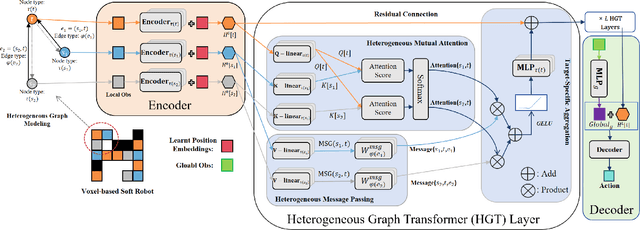


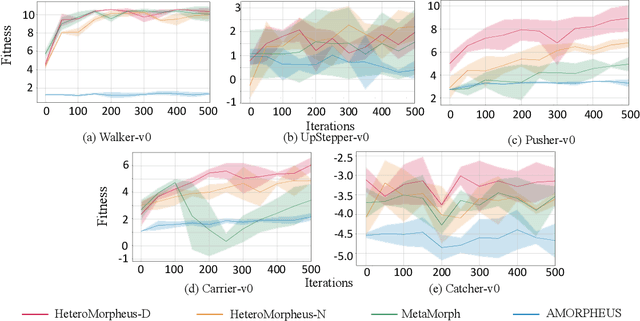
In the field of robotic control, designing individual controllers for each robot leads to high computational costs. Universal control policies, applicable across diverse robot morphologies, promise to mitigate this challenge. Predominantly, models based on Graph Neural Networks (GNN) and Transformers are employed, owing to their effectiveness in capturing relational dynamics across a robot's limbs. However, these models typically employ homogeneous graph structures that overlook the functional diversity of different limbs. To bridge this gap, we introduce HeteroMorpheus, a novel method based on heterogeneous graph Transformer. This method uniquely addresses limb heterogeneity, fostering better representation of robot dynamics of various morphologies. Through extensive experiments we demonstrate the superiority of HeteroMorpheus against state-of-the-art methods in the capability of policy generalization, including zero-shot generalization and sample-efficient transfer to unfamiliar robot morphologies.