 Add to Chrome
 Add to Firefox
 Add to Edge
ResAware: Cross-Environment Website Fingerprinting via Resource-Privileged Distillation
Jun 16, 2026
While Website Fingerprinting (WF) attacks achieve high accuracy in controlled laboratory settings, they often degrade substantially in real-world environments due to spatio-temporal drift, browser heterogeneity, proxy obfuscation and etc. This limitation stems from their sole reliance on low-level traffic features that are noisy and highly sensitive to environmental perturbations. To address this problem, we propose \textbf{ResAware}, a cross-environment resource-aware distillation framework under a \textit{training-rich/inference-poor} asymmetric setting. Specifically, ResAware trains a teacher model on resource-level features, and then distills the resulting privileged knowledge into a student model through heterogeneous knowledge distillation. At deployment time, the student model performs inference using only encrypted traffic, incurring zero additional cost. We evaluate ResAware on a large-scale dataset collected over five months from six globally distributed vantage points, comprising more than $160{,}000$ paired samples. The results show that ResAware significantly enhances the cross-environment robustness of diverse WF baselines. Under a 150-day temporal drift, for example, ResAware improves the F1-score of Var-CNN from $72.77\%$ to $81.49\%$ and the open-world $TPR@1\%FPR$ from $22.40\%$ to $27.20\%$. Our results demonstrate that resource-level supervision improves WF robustness without expanding online observation capabilities.

CTISum: A New Benchmark Dataset For Cyber Threat Intelligence Summarization
Aug 13, 2024

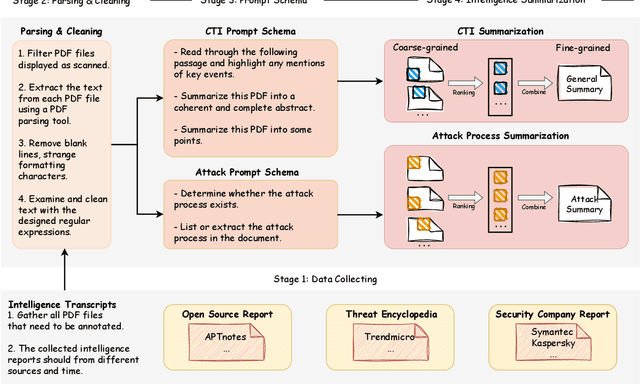
Cyber Threat Intelligence (CTI) summarization task requires the system to generate concise and accurate highlights from raw intelligence data, which plays an important role in providing decision-makers with crucial information to quickly detect and respond to cyber threats in the cybersecurity domain. However, efficient techniques for summarizing CTI reports, including facts, analytical insights, attack processes, etc., have largely been unexplored, primarily due to the lack of available dataset. To this end, we present CTISum, a new benchmark for CTI summarization task. Considering the importance of attack process, a novel fine-grained subtask of attack process summarization is proposed to enable defenders to assess risk, identify security gaps, vulnerabilities, and so on. Specifically, we first design a multi-stage annotation pipeline to gather and annotate the CTI data, and then benchmark the CTISum with a collection of extractive and abstractive summarization methods. Experimental results show that current state-of-the-art models exhibit limitations when applied to CTISum, underscoring the fact that automatically producing concise summaries of CTI reports remains an open research challenge.