 Add to Chrome
 Add to Firefox
 Add to Edge
Emotion Across Speech and Faces: Shared Affective Mechanisms in Multimodal Foundation Models
Aug 17, 2026
Modern multimodal foundation models (MFMs) have made rapid progress on tasks requiring integrated perception across speech, vision, and language, including emotion recognition. However, it remains unclear whether they recognize speech and facial emotion through shared affective functional units or modality-specific pathways. We explore emotion-sensitive neurons (ESNs), sparse decoder neurons selectively associated with emotion categories, in three MFMs: Gemma-4-12B-it, MiniCPM-o-4.5, and Qwen2.5-Omni-7B. Using speech emotion recognition and facial expression recognition as complementary probes, we identify acoustic and visual ESNs. Visual ESNs are causally meaningful: deactivating them selectively impairs recognition of the associated facial emotion, whereas steering their activations selectively enhances recognition of that emotion relative to other emotion categories. Acoustic and visual ESNs further show emotion-matched overlap and similar layer-wise distributions, indicating partial structural alignment between affective representations across speech and faces. Finally, cross-modal interventions reveal bidirectional causal transfer: ESNs identified from one modality produce emotion-specific effects when applied to the other. Our findings provide one of the first cross-modality activation-level analyses of affective functional units in MFMs, suggesting that speech and facial emotion recognition partially converge onto sparse decoder-level components that can be localized and manipulated without training.

Multilingual Emotion Neurons in Large Audio-Language Models
Aug 09, 2026Emotion is central to human communication, and its expression varies across languages. Large audio-language models (LALMs) achieve strong performance on multilingual speech tasks, yet it remains unclear whether they encode emotion through language-specific correlations or language-agnostic representations. We present the first neuron-level interpretability study of this question. We define Multilingual Emotion Neurons (MLENs) as functional units exhibiting stable emotional selectivity and aligned causal effects across languages, and introduce Consistency-Regularized Fusion (CR-Fusion) to identify them. Across four modern LALMs and 12 typologically diverse languages, emotion-sensitive neurons identified independently per language show minimal overlap, and additional monolingual identification data saturates quickly without isolating more transferable units, motivating identification from pooled cross-lingual evidence. Causal interventions demonstrate that MLENs identified by CR-Fusion provide more precise and transferable affective control than monolingual neuron sets in both zero-shot and low-resource settings. Leave-one-out ablations further reveal asymmetric transfer: individual identification languages, including low-resource ones, contribute non-redundant evidence, while several low-resource languages benefit most from the resulting cross-lingual transfer. Together, our findings provide the first causal, neuron-level account of how LALMs encode emotion across languages, and establish multilingual neuron identification as an effective mechanism for understanding cross-lingual affective behavior.
AffectDF: The Most Comprehensive Benchmark for Speech Deepfake Detection against Emotionally Expressive Attacks
Aug 06, 2026Speech deepfake detection (SDD) systems achieve strong performance on conventional benchmarks; however, existing datasets provide limited coverage of emotionally expressive and recent large audio-language model (LALM)-based attacks. Existing emotional spoofing datasets are also limited in scale and attack diversity, typically covering only voice conversion (VC) or text-to-speech (TTS) attacks. We introduce AffectDF, the most comprehensive benchmark for emotionally expressive speech deepfakes, spanning TTS, VC, emotional VC, and LALM-based spoofing attacks across both acted and spontaneous emotional speech. AffectDF contains approximately 260 hours of speech generated using 21 spoofing attacks across five emotional states. We benchmark state-of-the-art SDD systems under conventional and emotional spoofing conditions, including LALM-based detectors evaluated with both inference-only prompting and supervised fine-tuning. Our experiments reveal severe robustness degradation when models trained on conventional benchmarks are evaluated on AffectDF, with several systems approaching near-random performance. Surprisingly, even large-scale emotional training does not consistently improve cross-domain robustness, indicating that current SDD systems fail to learn generalized spoof representations under emotional and prosodic variability. Robustness further varies substantially across emotional states, attack families, and acted vs spontaneous emotional speech conditions. These findings expose fundamental limitations of current SDD systems and establish AffectDF as a benchmark for developing more robust spoof detection models.
Disentangling the Interpretive and Predictive Roles of LIWC: Controlled Substitution in Depression-Related Classification
Jul 24, 2026Linguistic Inquiry and Word Count (LIWC) provides auditable psycholinguistic categories that are widely used to interpret depression-related language, but its incremental predictive role in modern multimodal systems remains unclear. We evaluate LIWC across five English and Chinese depression-related corpora under matched participant-level cross-validation. We ask whether LIWC improves classification and what any performance change reflects. Intact LIWC is compared with three fold-local substitutes: a PCA-rotated version that removes direct access to named category coordinates, a participant-shuffled version that preserves real LIWC profiles while breaking participant alignment, and a random-marginal version that preserves feature-wise distributions. Across multiple fixed representation contexts, the results provide limited evidence for stable LIWC gains under frozen, participant-level early fusion. None of the prespecified dataset-blocked contrasts survives multiple-comparison correction. A separate SBERT calibration produces larger observed intact-versus-shuffled and intact-versus-random separations, indicating that larger participant-aligned signals can produce correspondingly larger separations under the same procedure, while not resolving the five-corpus power limitation. LIWC remains useful as an auditable, corpus-conditioned interpretive layer. These conclusions should not be generalized to fine-tuned, sequence-aware, or end-to-end architectures.
TRACE-EVC: Text-Guided Relative Affective Control for Zero-Shot Emotional Voice Conversion
Jul 04, 2026Traditional emotional voice conversion (EVC) conditions generation on explicit target emotions like labels or references, defining the target affective state but omitting the direction or nature of the transition. We introduce instruction-guided relative emotional voice conversion, a task where natural-language instructions specify source-conditioned affective transformations (e.g., "make the speech slightly calmer" or "sound noticeably more confident") instead of fixed targets. To support this task, we construct TRACE-Instruct, a dataset of relative emotion instructions covering categorical transitions, intensity modifications, and open-ended affective changes. We propose TRACE-EVC, a zero-shot framework built around Emo-Compass, a module that models each conversion as a source-anchored rectified flow. Rather than conditioning on an explicit target, it predicts the direction and degree of the affective change. Experiments demonstrate that TRACE-EVC accurately follows relative emotion instructions while preserving speaker identity, linguistic content, and speech quality, and remains competitive with conventional EVC systems on standard categorical emotion conversion.
Neuron-Level Emotion Control in Speech-Generative Large Audio-Language Models
Mar 18, 2026Large audio-language models (LALMs) can produce expressive speech, yet reliable emotion control remains elusive: conversions often miss the target affect and may degrade linguistic fidelity through refusals, hallucinations, or paraphrase. We present, to our knowledge, the first neuron-level study of emotion control in speech-generative LALMs and demonstrate that compact emotion-sensitive neurons (ESNs) are causally actionable, enabling training-free emotion steering at inference time. ESNs are identified via success-filtered activation aggregation enforcing both emotion realization and content preservation. Across three LALMs (Qwen2.5-Omni-7B, MiniCPM-o 4.5, Kimi-Audio), ESN interventions yield emotion-specific gains that generalize to unseen speakers and are supported by automatic and human evaluation. Controllability depends on selector design, mask sparsity, filtering, and intervention strength. Our results establish a mechanistic framework for training-free emotion control in speech generation.
Discovering and Causally Validating Emotion-Sensitive Neurons in Large Audio-Language Models
Jan 06, 2026Emotion is a central dimension of spoken communication, yet, we still lack a mechanistic account of how modern large audio-language models (LALMs) encode it internally. We present the first neuron-level interpretability study of emotion-sensitive neurons (ESNs) in LALMs and provide causal evidence that such units exist in Qwen2.5-Omni, Kimi-Audio, and Audio Flamingo 3. Across these three widely used open-source models, we compare frequency-, entropy-, magnitude-, and contrast-based neuron selectors on multiple emotion recognition benchmarks. Using inference-time interventions, we reveal a consistent emotion-specific signature: ablating neurons selected for a given emotion disproportionately degrades recognition of that emotion while largely preserving other classes, whereas gain-based amplification steers predictions toward the target emotion. These effects arise with modest identification data and scale systematically with intervention strength. We further observe that ESNs exhibit non-uniform layer-wise clustering with partial cross-dataset transfer. Taken together, our results offer a causal, neuron-level account of emotion decisions in LALMs and highlight targeted neuron interventions as an actionable handle for controllable affective behaviors.
An Electoral Approach to Diversify LLM-based Multi-Agent Collective Decision-Making
Oct 19, 2024


Modern large language models (LLMs) have exhibited cooperative synergy on complex task-solving, and collective decision-making (CDM) is a pivotal component in LLM-based multi-agent collaboration frameworks. Our survey on 52 recent such systems uncovers a severe lack of diversity, with a heavy reliance on dictatorial and plurality voting for CDM. Through the lens of social choice theory, we scrutinize widely-adopted CDM methods and identify their limitations. To enrich current landscape of LLM-based CDM, we present GEDI, an electoral CDM module that incorporates various ordinal preferential voting mechanisms. Our empirical case study across three benchmarks shows that the integration of certain CDM methods can markedly improve the reasoning capabilities and robustness of some leading LLMs, all without requiring intricate system designs. Additionally, we find that some CDM mechanisms generate positive synergies even with as few as three agents. The voting-based methods also demonstrate robustness against single points of failure, as well as diversity in terms of hit-rate@k and subject-wise impacts.
ORCHID: A Chinese Debate Corpus for Target-Independent Stance Detection and Argumentative Dialogue Summarization
Oct 17, 2024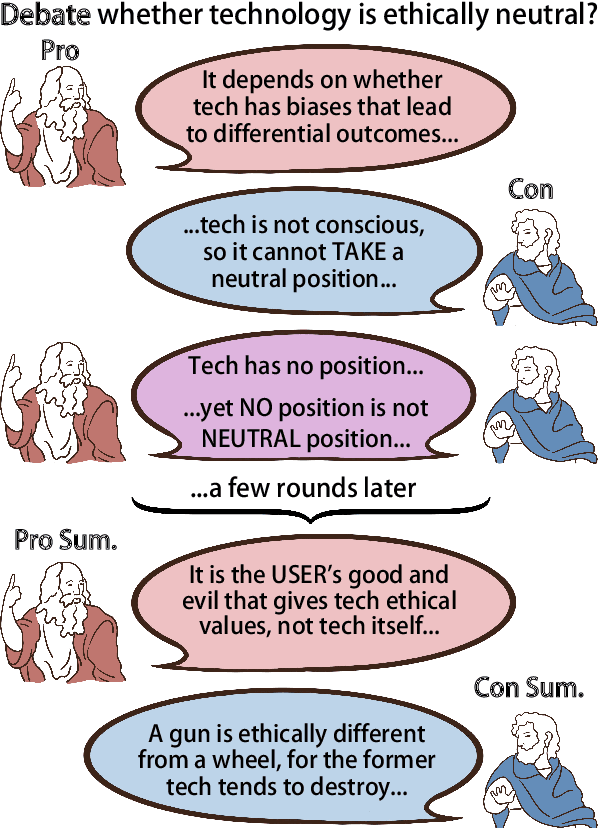


Dialogue agents have been receiving increasing attention for years, and this trend has been further boosted by the recent progress of large language models (LLMs). Stance detection and dialogue summarization are two core tasks of dialogue agents in application scenarios that involve argumentative dialogues. However, research on these tasks is limited by the insufficiency of public datasets, especially for non-English languages. To address this language resource gap in Chinese, we present ORCHID (Oral Chinese Debate), the first Chinese dataset for benchmarking target-independent stance detection and debate summarization. Our dataset consists of 1,218 real-world debates that were conducted in Chinese on 476 unique topics, containing 2,436 stance-specific summaries and 14,133 fully annotated utterances. Besides providing a versatile testbed for future research, we also conduct an empirical study on the dataset and propose an integrated task. The results show the challenging nature of the dataset and suggest a potential of incorporating stance detection in summarization for argumentative dialogue.
Measuring the Inconsistency of Large Language Models in Preferential Ranking
Oct 11, 2024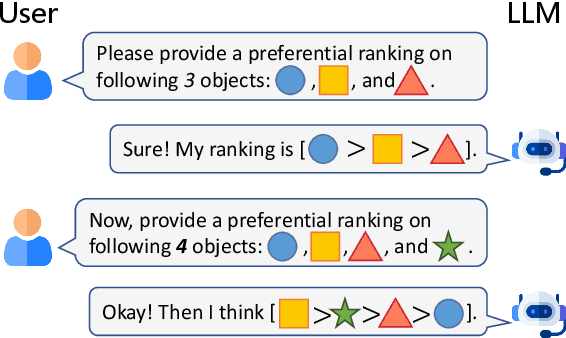
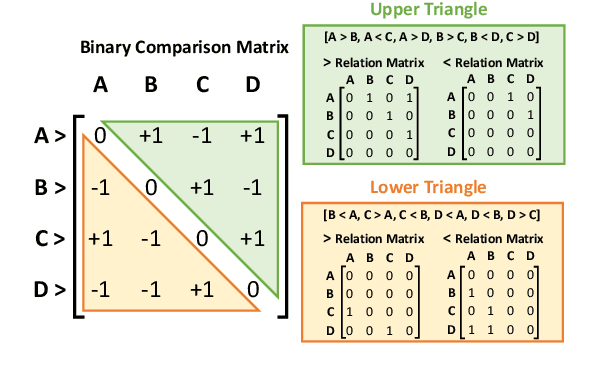
Despite large language models' (LLMs) recent advancements, their bias and hallucination issues persist, and their ability to offer consistent preferential rankings remains underexplored. This study investigates the capacity of LLMs to provide consistent ordinal preferences, a crucial aspect in scenarios with dense decision space or lacking absolute answers. We introduce a formalization of consistency based on order theory, outlining criteria such as transitivity, asymmetry, reversibility, and independence from irrelevant alternatives. Our diagnostic experiments on selected state-of-the-art LLMs reveal their inability to meet these criteria, indicating a strong positional bias and poor transitivity, with preferences easily swayed by irrelevant alternatives. These findings highlight a significant inconsistency in LLM-generated preferential rankings, underscoring the need for further research to address these limitations.