 Add to Chrome
 Add to Firefox
 Add to Edge
Reflection or Re-Generation? Why LLM Revision Fails Where Human Revision Succeeds
Jul 31, 2026
Reflection, the ability to revisit and revise prior reasoning, is central to how humans improve their answers. Large language models (LLMs) are increasingly prompted to "reflect," yet whether this resembles human revision remains unclear. We introduce the Human-LLM Reflection Framework (HRF), a controlled two-pass protocol comparing human and LLM revision under identical conditions across self-, peer-, and cross-agent settings. Using an information-theoretic analysis based on per-iteration cross-entropy reduction, we find two failure modes of LLM reflection. On objective tasks with finite answer spaces, reflection yields near-zero information gain (Delta I approx 0), behaving as neutral re-generation indistinguishable from re-sampling. On subjective tasks, it yields significant negative gain (Delta I < 0), moving predictions away from the target. Human revision, by contrast, yields positive gain in both settings. Cross-agent experiments localize the failure to the revision step, not input quality: LLMs degrade even high-quality human responses. Diagnostic analyses (revision conditioned on first-pass correctness, and oracle-guided revision against a random-reshuffle baseline) show that which sub-step dominates varies by task and by model rather than reducing to a single mechanism: self-error detection is present on objective multiple-choice tasks but weak on subjective ones, and recovery under an oracle error signal exceeds the baseline for some models and falls below it for others. The unifying account is structural: without external information, self-conditioned revision cannot reduce uncertainty about the target, so LLM reflection is better understood as conditioned re-generation than as genuine error-driven revision.

SWE-Marathon: Can Agents Autonomously Complete Ultra-Long-Horizon Software Work?
Jun 05, 2026AI agents are increasingly expected to complete long-horizon workflows that require sustained progress over hours, millions of tokens, and complex environments. Yet current agent benchmarks largely evaluate short-form tasks, such as single pull requests, small tickets, or 5-10 minute exercises, limiting our ability to measure agents' capabilities in planning, long-context understanding, and memory use. We introduce SWE-Marathon, a benchmark of 20 long-horizon tasks spanning software engineering and adjacent technical domains. Each task consists of a unique executable environment, a human-written reference solution, and a multi-layer verification suite. Logged agent attempts average 27.2M total tokens, making SWE-Marathon substantially longer-horizon than existing SWE and command-line agent benchmarks. Current frontier coding agents solve fewer than 30% of tasks. Failures often arise from poor self-verification, self-reported infeasibility, and premature termination. We also observe reward-hacking behavior in 13.8% of rollouts, where agents attempt to exploit the environment or verifier to bypass the intended workflow. SWE-Marathon includes adversarial review of test suites and execution environments, as well as multi-layer checks designed to prevent shortcut solutions. We release SWE-Marathon, evaluation code, and agent trajectories at https://swe-marathon.org/.
Lean4Agent: Formal Modeling and Verification for Agent Workflow and Trajectory
Jun 02, 2026Equipping Large Language Models (LLMs) to execute reliable multi-step workflows has become a central challenge in artificial intelligence. Despite recent advances in LLMs' agentic capabilities, most agent systems still lack formal methods for specifying, verifying, and debugging their workflow and execution trajectories. This challenge mirrors a long-standing problem in mathematics, where the ambiguity of natural languages (NLs) motivates the development of formal languages (FLs). Inspired by this paradigm, we propose **Lean4Agent**, to the best of our knowledge, the first framework that uses Lean4, a dependent-type FL to model and verify agent behavior. **Lean4Agent** launches **FormalAgentLib**, an extensible Lean4 library for formally modeling and verifying agent workflows' semantic consistency under explicit assumptions, and enabling localization of execution-time failures revealed by trajectories. Building on **FormalAgentLib**, we further develop **LeanEvolve**, which applies results in **FormalAgentLib** to revise workflows to enhance its capability. Extensive experiments on a hard problem subset of SWE-Bench-Verified and a subset of ELAIP-Bench across 5 leading LLMs indicate that the verification-passing workflows outperform the failing ones by an average of **11.94%**, and **LeanEvolve** further improves SWE performance by **7.47%** on average. Furthermore, **Lean4Agent** establishes a foundation for a new field of using expressive dependent-type FL to formally model and verify agent behavior.
SkillsBench: Benchmarking How Well Agent Skills Work Across Diverse Tasks
Feb 13, 2026Agent Skills are structured packages of procedural knowledge that augment LLM agents at inference time. Despite rapid adoption, there is no standard way to measure whether they actually help. We present SkillsBench, a benchmark of 86 tasks across 11 domains paired with curated Skills and deterministic verifiers. Each task is evaluated under three conditions: no Skills, curated Skills, and self-generated Skills. We test 7 agent-model configurations over 7,308 trajectories. Curated Skills raise average pass rate by 16.2 percentage points(pp), but effects vary widely by domain (+4.5pp for Software Engineering to +51.9pp for Healthcare) and 16 of 84 tasks show negative deltas. Self-generated Skills provide no benefit on average, showing that models cannot reliably author the procedural knowledge they benefit from consuming. Focused Skills with 2--3 modules outperform comprehensive documentation, and smaller models with Skills can match larger models without them.
Learning LLM Preference over Intra-Dialogue Pairs: A Framework for Utterance-level Understandings
Mar 07, 2025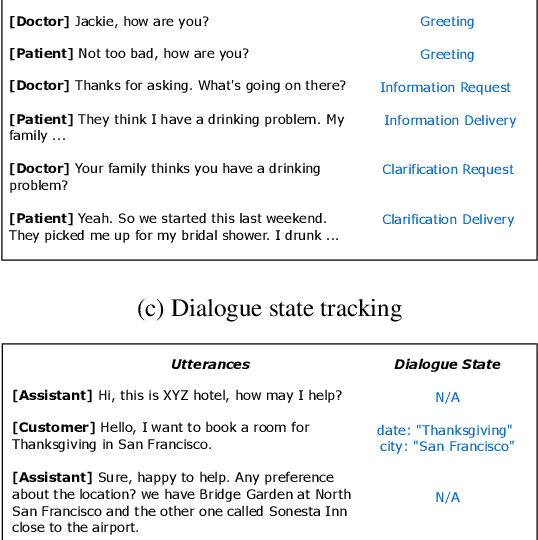
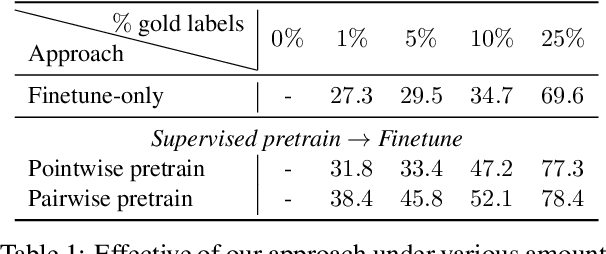
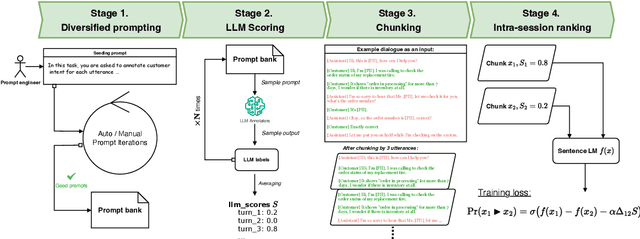
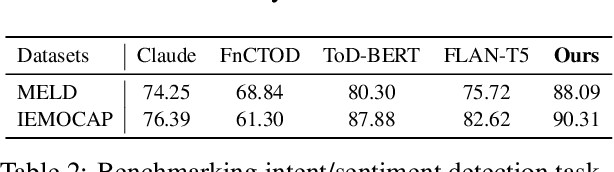
Large language models (LLMs) have demonstrated remarkable capabilities in handling complex dialogue tasks without requiring use case-specific fine-tuning. However, analyzing live dialogues in real-time necessitates low-latency processing systems, making it impractical to deploy models with billions of parameters due to latency constraints. As a result, practitioners often prefer smaller models with millions of parameters, trained on high-quality, human-annotated datasets. Yet, curating such datasets is both time-consuming and costly. Consequently, there is a growing need to combine the scalability of LLM-generated labels with the precision of human annotations, enabling fine-tuned smaller models to achieve both higher speed and accuracy comparable to larger models. In this paper, we introduce a simple yet effective framework to address this challenge. Our approach is specifically designed for per-utterance classification problems, which encompass tasks such as intent detection, dialogue state tracking, and more. To mitigate the impact of labeling errors from LLMs -- the primary source of inaccuracies in student models -- we propose a noise-reduced preference learning loss. Experimental results demonstrate that our method significantly improves accuracy across utterance-level dialogue tasks, including sentiment detection (over $2\%$), dialogue act classification (over $1.5\%$), etc.
CSR-Bench: Benchmarking LLM Agents in Deployment of Computer Science Research Repositories
Feb 10, 2025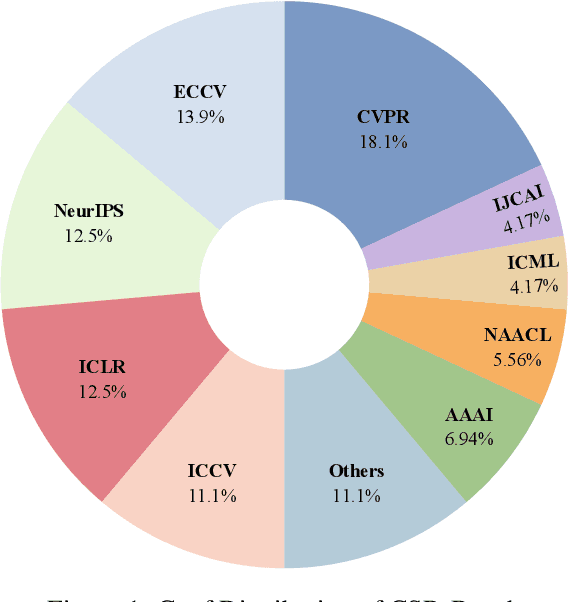

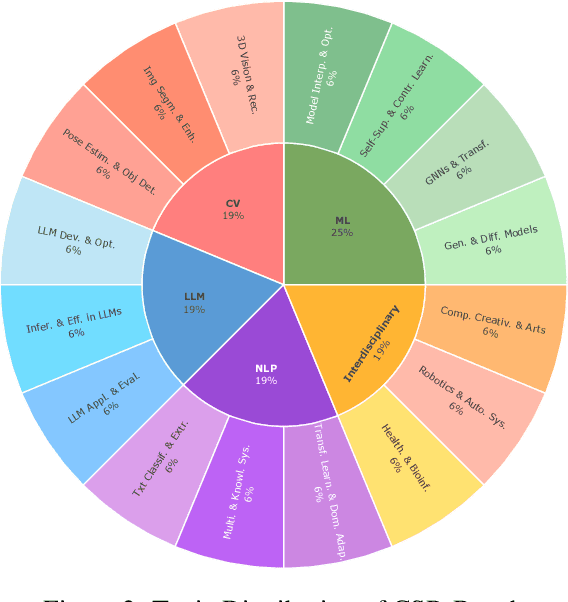
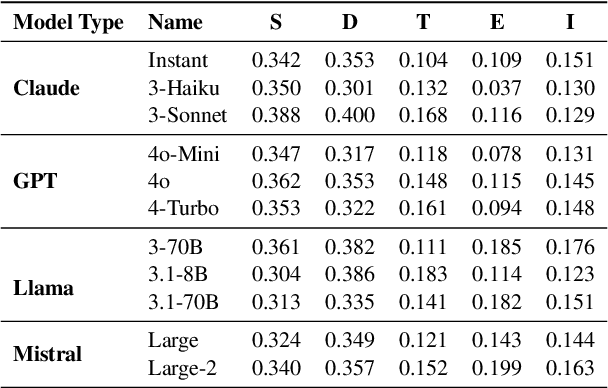
The increasing complexity of computer science research projects demands more effective tools for deploying code repositories. Large Language Models (LLMs), such as Anthropic Claude and Meta Llama, have demonstrated significant advancements across various fields of computer science research, including the automation of diverse software engineering tasks. To evaluate the effectiveness of LLMs in handling complex code development tasks of research projects, particularly for NLP/CV/AI/ML/DM topics, we introduce CSR-Bench, a benchmark for Computer Science Research projects. This benchmark assesses LLMs from various aspects including accuracy, efficiency, and deployment script quality, aiming to explore their potential in conducting computer science research autonomously. We also introduce a novel framework, CSR-Agents, that utilizes multiple LLM agents to automate the deployment of GitHub code repositories of computer science research projects. Specifically, by checking instructions from markdown files and interpreting repository structures, the model generates and iteratively improves bash commands that set up the experimental environments and deploy the code to conduct research tasks. Preliminary results from CSR-Bench indicate that LLM agents can significantly enhance the workflow of repository deployment, thereby boosting developer productivity and improving the management of developmental workflows.
GRAM: Generative Retrieval Augmented Matching of Data Schemas in the Context of Data Security
Jun 04, 2024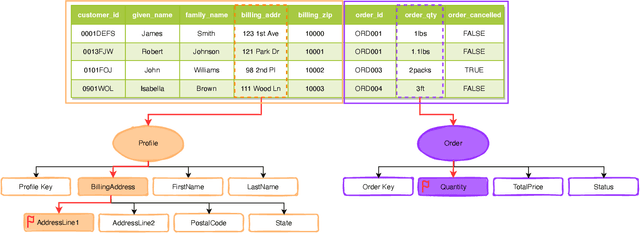
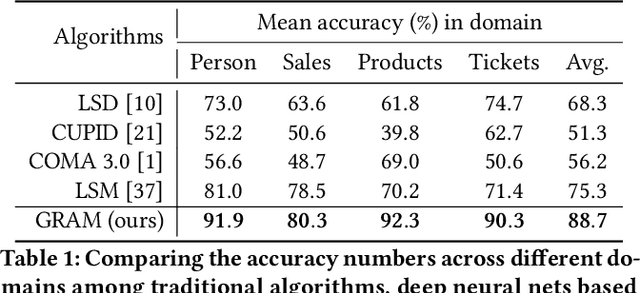
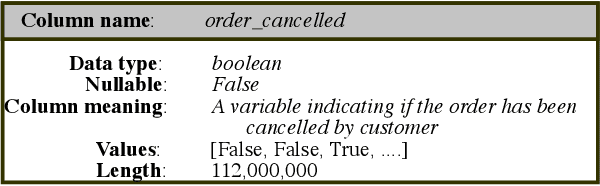
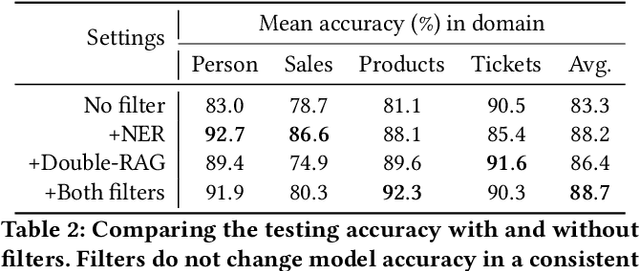
Schema matching constitutes a pivotal phase in the data ingestion process for contemporary database systems. Its objective is to discern pairwise similarities between two sets of attributes, each associated with a distinct data table. This challenge emerges at the initial stages of data analytics, such as when incorporating a third-party table into existing databases to inform business insights. Given its significance in the realm of database systems, schema matching has been under investigation since the 2000s. This study revisits this foundational problem within the context of large language models. Adhering to increasingly stringent data security policies, our focus lies on the zero-shot and few-shot scenarios: the model should analyze only a minimal amount of customer data to execute the matching task, contrasting with the conventional approach of scrutinizing the entire data table. We emphasize that the zero-shot or few-shot assumption is imperative to safeguard the identity and privacy of customer data, even at the potential cost of accuracy. The capability to accurately match attributes under such stringent requirements distinguishes our work from previous literature in this domain.
Neural Locality Sensitive Hashing for Entity Blocking
Jan 31, 2024Locality-sensitive hashing (LSH) is a fundamental algorithmic technique widely employed in large-scale data processing applications, such as nearest-neighbor search, entity resolution, and clustering. However, its applicability in some real-world scenarios is limited due to the need for careful design of hashing functions that align with specific metrics. Existing LSH-based Entity Blocking solutions primarily rely on generic similarity metrics such as Jaccard similarity, whereas practical use cases often demand complex and customized similarity rules surpassing the capabilities of generic similarity metrics. Consequently, designing LSH functions for these customized similarity rules presents considerable challenges. In this research, we propose a neuralization approach to enhance locality-sensitive hashing by training deep neural networks to serve as hashing functions for complex metrics. We assess the effectiveness of this approach within the context of the entity resolution problem, which frequently involves the use of task-specific metrics in real-world applications. Specifically, we introduce NLSHBlock (Neural-LSH Block), a novel blocking methodology that leverages pre-trained language models, fine-tuned with a novel LSH-based loss function. Through extensive evaluations conducted on a diverse range of real-world datasets, we demonstrate the superiority of NLSHBlock over existing methods, exhibiting significant performance improvements. Furthermore, we showcase the efficacy of NLSHBlock in enhancing the performance of the entity matching phase, particularly within the semi-supervised setting.
Entity Anchored ICD Coding
Aug 15, 2022
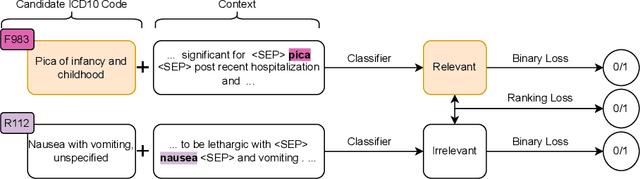
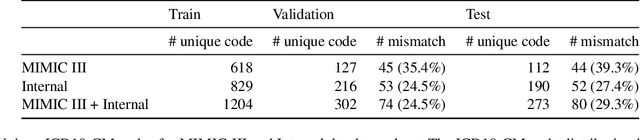

Medical coding is a complex task, requiring assignment of a subset of over 72,000 ICD codes to a patient's notes. Modern natural language processing approaches to these tasks have been challenged by the length of the input and size of the output space. We limit our model inputs to a small window around medical entities found in our documents. From those local contexts, we build contextualized representations of both ICD codes and entities, and aggregate over these representations to form document-level predictions. In contrast to existing methods which use a representation fixed either in size or by codes seen in training, we represent ICD codes by encoding the code description with local context. We discuss metrics appropriate to deploying coding systems in practice. We show that our approach is superior to existing methods in both standard and deployable measures, including performance on rare and unseen codes.
Kronecker Factorization for Preventing Catastrophic Forgetting in Large-scale Medical Entity Linking
Nov 11, 2021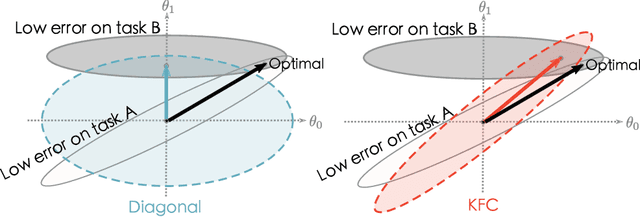
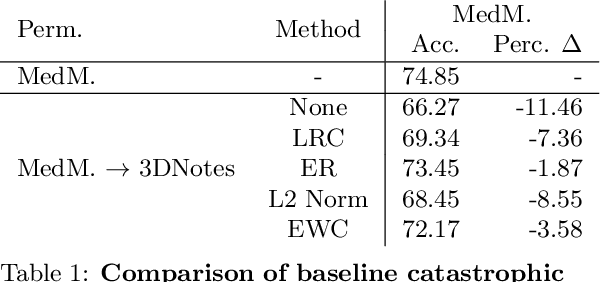
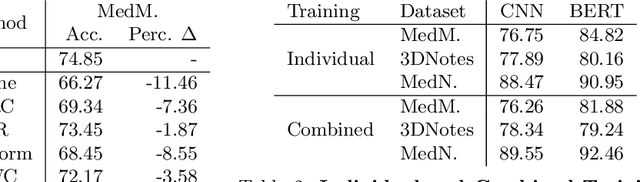
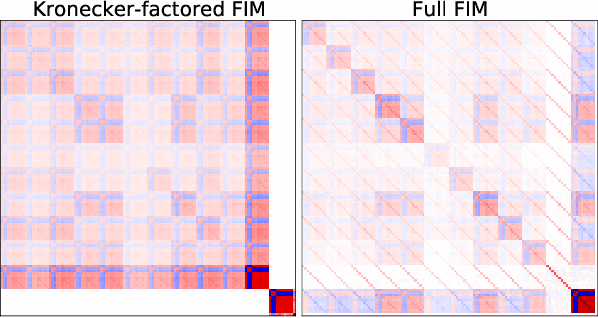
Multi-task learning is useful in NLP because it is often practically desirable to have a single model that works across a range of tasks. In the medical domain, sequential training on tasks may sometimes be the only way to train models, either because access to the original (potentially sensitive) data is no longer available, or simply owing to the computational costs inherent to joint retraining. A major issue inherent to sequential learning, however, is catastrophic forgetting, i.e., a substantial drop in accuracy on prior tasks when a model is updated for a new task. Elastic Weight Consolidation is a recently proposed method to address this issue, but scaling this approach to the modern large models used in practice requires making strong independence assumptions about model parameters, limiting its effectiveness. In this work, we apply Kronecker Factorization--a recent approach that relaxes independence assumptions--to prevent catastrophic forgetting in convolutional and Transformer-based neural networks at scale. We show the effectiveness of this technique on the important and illustrative task of medical entity linking across three datasets, demonstrating the capability of the technique to be used to make efficient updates to existing methods as new medical data becomes available. On average, the proposed method reduces catastrophic forgetting by 51% when using a BERT-based model, compared to a 27% reduction using standard Elastic Weight Consolidation, while maintaining spatial complexity proportional to the number of model parameters.