 Add to Chrome
 Add to Firefox
 Add to Edge
FlashMem: Supporting Modern DNN Workloads on Mobile with GPU Memory Hierarchy Optimizations
Feb 17, 2026
The increasing size and complexity of modern deep neural networks (DNNs) pose significant challenges for on-device inference on mobile GPUs, with limited memory and computational resources. Existing DNN acceleration frameworks primarily deploy a weight preloading strategy, where all model parameters are loaded into memory before execution on mobile GPUs. We posit that this approach is not adequate for modern DNN workloads that comprise very large model(s) and possibly execution of several distinct models in succession. In this work, we introduce FlashMem, a memory streaming framework designed to efficiently execute large-scale modern DNNs and multi-DNN workloads while minimizing memory consumption and reducing inference latency. Instead of fully preloading weights, FlashMem statically determines model loading schedules and dynamically streams them on demand, leveraging 2.5D texture memory to minimize data transformations and improve execution efficiency. Experimental results on 11 models demonstrate that FlashMem achieves 2.0x to 8.4x memory reduction and 1.7x to 75.0x speedup compared to existing frameworks, enabling efficient execution of large-scale models and multi-DNN support on resource-constrained mobile GPUs.

From Bits to Chips: An LLM-based Hardware-Aware Quantization Agent for Streamlined Deployment of LLMs
Jan 07, 2026Deploying models, especially large language models (LLMs), is becoming increasingly attractive to a broader user base, including those without specialized expertise. However, due to the resource constraints of certain hardware, maintaining high accuracy with larger model while meeting the hardware requirements remains a significant challenge. Model quantization technique helps mitigate memory and compute bottlenecks, yet the added complexities of tuning and deploying quantized models further exacerbates these challenges, making the process unfriendly to most of the users. We introduce the Hardware-Aware Quantization Agent (HAQA), an automated framework that leverages LLMs to streamline the entire quantization and deployment process by enabling efficient hyperparameter tuning and hardware configuration, thereby simultaneously improving deployment quality and ease of use for a broad range of users. Our results demonstrate up to a 2.3x speedup in inference, along with increased throughput and improved accuracy compared to unoptimized models on Llama. Additionally, HAQA is designed to implement adaptive quantization strategies across diverse hardware platforms, as it automatically finds optimal settings even when they appear counterintuitive, thereby reducing extensive manual effort and demonstrating superior adaptability. Code will be released.
Exploring Token Pruning in Vision State Space Models
Sep 27, 2024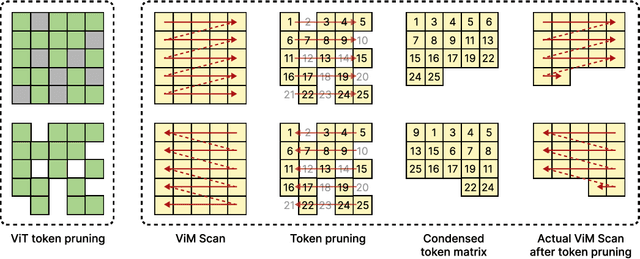
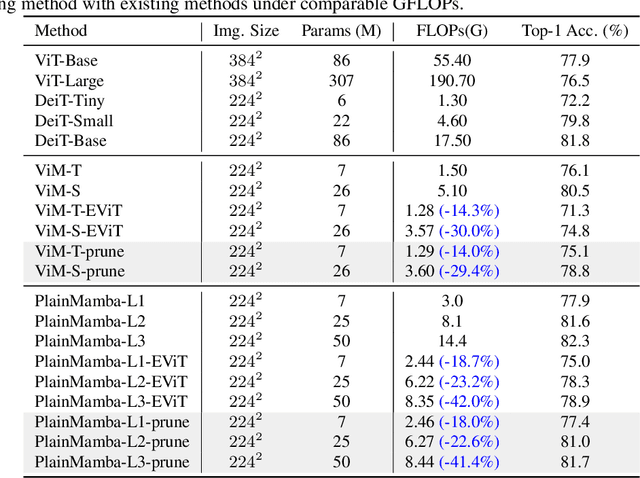
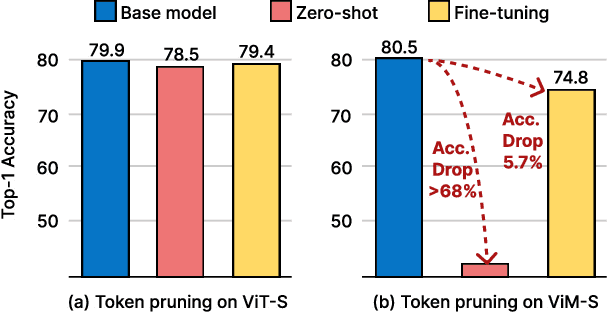
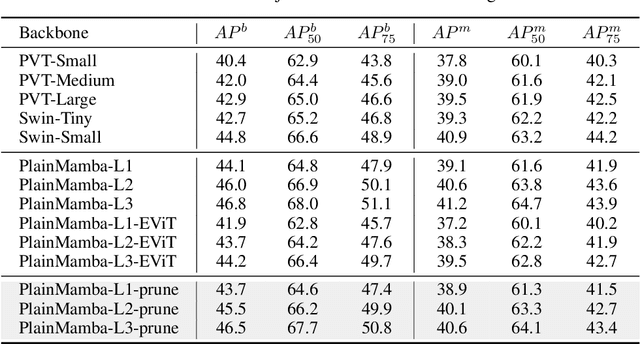
State Space Models (SSMs) have the advantage of keeping linear computational complexity compared to attention modules in transformers, and have been applied to vision tasks as a new type of powerful vision foundation model. Inspired by the observations that the final prediction in vision transformers (ViTs) is only based on a subset of most informative tokens, we take the novel step of enhancing the efficiency of SSM-based vision models through token-based pruning. However, direct applications of existing token pruning techniques designed for ViTs fail to deliver good performance, even with extensive fine-tuning. To address this issue, we revisit the unique computational characteristics of SSMs and discover that naive application disrupts the sequential token positions. This insight motivates us to design a novel and general token pruning method specifically for SSM-based vision models. We first introduce a pruning-aware hidden state alignment method to stabilize the neighborhood of remaining tokens for performance enhancement. Besides, based on our detailed analysis, we propose a token importance evaluation method adapted for SSM models, to guide the token pruning. With efficient implementation and practical acceleration methods, our method brings actual speedup. Extensive experiments demonstrate that our approach can achieve significant computation reduction with minimal impact on performance across different tasks. Notably, we achieve 81.7\% accuracy on ImageNet with a 41.6\% reduction in the FLOPs for pruned PlainMamba-L3. Furthermore, our work provides deeper insights into understanding the behavior of SSM-based vision models for future research.