 Add to Chrome
 Add to Firefox
 Add to Edge
Thinking with Anchors: Grounded and Efficient Document Reasoning
Aug 05, 2026
Existing document understanding benchmarks have largely focused on locating page elements, yet real-world document intelligence requires models to reason jointly about region semantics, spatial relations, and visual structure. We present ADOPD 2026, a reasoning-oriented extension of ADOPD that turns page decomposition into spatially grounded document understanding. ADOPD 2026 enriches page anchors inherited from ADOPD 2024 dataset with human-cleaned captions, semantic tags, and generated chain-of-thought (CoT) traces grounded to document regions. Instead of treating boxes, masks, and tags as independent supervision signals, we cast text blocks, visual entities, semantic labels, bounding boxes, and polygon masks as a shared vocabulary of visual anchors. This representation supports three connected capabilities. First, region-level semantic tagging asks models to identify document element types from both page context and local appearance, revealing long-tail semantic failures that standard layout benchmarks often hide. Second, unified vision-language grounding generates text regions and visual entities together with coordinates or polygonal outlines, transforming detection and segmentation outputs into structured anchors that can be reused by downstream reasoning systems. Third, current state-of-the-art models still struggle with dense counting tasks evaluated on DocCount, a benchmark derived from ADOPD 2026, highlighting the need for the Thinking-with-Anchors pipeline in document semantic understanding. By connecting page decomposition to verifiable visual-anchor reasoning, ADOPD 2026 provides a task framework that moves document understanding beyond localization toward anchor-grounded document intelligence.

QuartDepth: Post-Training Quantization for Real-Time Depth Estimation on the Edge
Mar 20, 2025
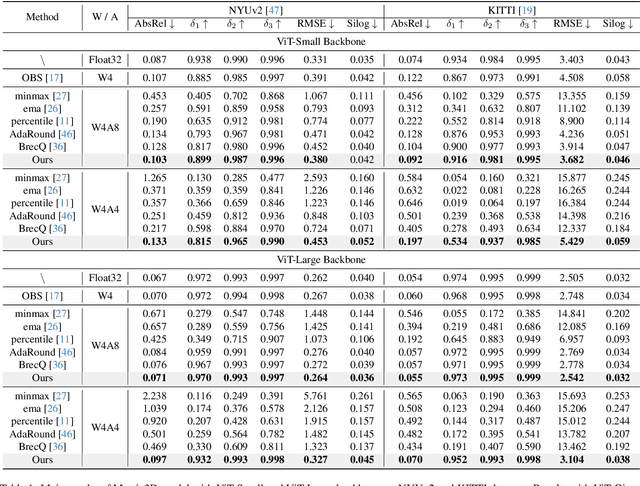
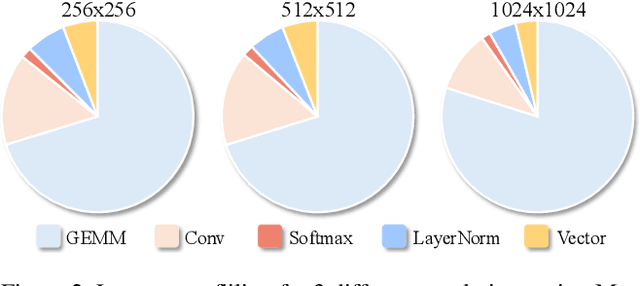
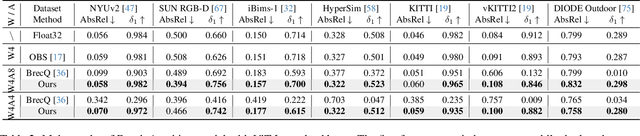
Monocular Depth Estimation (MDE) has emerged as a pivotal task in computer vision, supporting numerous real-world applications. However, deploying accurate depth estimation models on resource-limited edge devices, especially Application-Specific Integrated Circuits (ASICs), is challenging due to the high computational and memory demands. Recent advancements in foundational depth estimation deliver impressive results but further amplify the difficulty of deployment on ASICs. To address this, we propose QuartDepth which adopts post-training quantization to quantize MDE models with hardware accelerations for ASICs. Our approach involves quantizing both weights and activations to 4-bit precision, reducing the model size and computation cost. To mitigate the performance degradation, we introduce activation polishing and compensation algorithm applied before and after activation quantization, as well as a weight reconstruction method for minimizing errors in weight quantization. Furthermore, we design a flexible and programmable hardware accelerator by supporting kernel fusion and customized instruction programmability, enhancing throughput and efficiency. Experimental results demonstrate that our framework achieves competitive accuracy while enabling fast inference and higher energy efficiency on ASICs, bridging the gap between high-performance depth estimation and practical edge-device applicability. Code: https://github.com/shawnricecake/quart-depth