 Add to Chrome
 Add to Firefox
 Add to Edge
Deep Q-Learning-Based Intelligent Scheduling for ETL Optimization in Heterogeneous Data Environments
Dec 15, 2025
This paper addresses the challenges of low scheduling efficiency, unbalanced resource allocation, and poor adaptability in ETL (Extract-Transform-Load) processes under heterogeneous data environments by proposing an intelligent scheduling optimization framework based on deep Q-learning. The framework formalizes the ETL scheduling process as a Markov Decision Process and enables adaptive decision-making by a reinforcement learning agent in high-dimensional state spaces to dynamically optimize task allocation and resource scheduling. The model consists of a state representation module, a feature embedding network, a Q-value estimator, and a reward evaluation mechanism, which collectively consider task dependencies, node load states, and data flow characteristics to derive the optimal scheduling strategy in complex environments. A multi-objective reward function is designed to balance key performance indicators such as average scheduling delay, task completion rate, throughput, and resource utilization. Sensitivity experiments further verify the model's robustness under changes in hyperparameters, environmental dynamics, and data scale. Experimental results show that the proposed deep Q-learning scheduling framework significantly reduces scheduling delay, improves system throughput, and enhances execution stability under multi-source heterogeneous task conditions, demonstrating the strong potential of reinforcement learning in complex data scheduling and resource management, and providing an efficient and scalable optimization strategy for intelligent data pipeline construction.

OPV: Outcome-based Process Verifier for Efficient Long Chain-of-Thought Verification
Dec 11, 2025Large language models (LLMs) have achieved significant progress in solving complex reasoning tasks by Reinforcement Learning with Verifiable Rewards (RLVR). This advancement is also inseparable from the oversight automated by reliable verifiers. However, current outcome-based verifiers (OVs) are unable to inspect the unreliable intermediate steps in the long reasoning chains of thought (CoTs). Meanwhile, current process-based verifiers (PVs) have difficulties in reliably detecting errors in the complex long CoTs, limited by the scarcity of high-quality annotations due to the prohibitive costs of human annotations. Therefore, we propose the Outcome-based Process Verifier (OPV), which verifies the rationale process of summarized outcomes from long CoTs to achieve both accurate and efficient verification and enable large-scale annotation. To empower the proposed verifier, we adopt an iterative active learning framework with expert annotations to progressively improve the verification capability of OPV with fewer annotation costs. Specifically, in each iteration, the most uncertain cases of the current best OPV are annotated and then subsequently used to train a new OPV through Rejection Fine-Tuning (RFT) and RLVR for the next round. Extensive experiments demonstrate OPV's superior performance and broad applicability. It achieves new state-of-the-art results on our held-out OPV-Bench, outperforming much larger open-source models such as Qwen3-Max-Preview with an F1 score of 83.1 compared to 76.3. Furthermore, OPV effectively detects false positives within synthetic dataset, closely align with expert assessment. When collaborating with policy models, OPV consistently yields performance gains, e.g., raising the accuracy of DeepSeek-R1-Distill-Qwen-32B from 55.2% to 73.3% on AIME2025 as the compute budget scales.
InfoCom: Kilobyte-Scale Communication-Efficient Collaborative Perception with Information Bottleneck
Dec 11, 2025Precise environmental perception is critical for the reliability of autonomous driving systems. While collaborative perception mitigates the limitations of single-agent perception through information sharing, it encounters a fundamental communication-performance trade-off. Existing communication-efficient approaches typically assume MB-level data transmission per collaboration, which may fail due to practical network constraints. To address these issues, we propose InfoCom, an information-aware framework establishing the pioneering theoretical foundation for communication-efficient collaborative perception via extended Information Bottleneck principles. Departing from mainstream feature manipulation, InfoCom introduces a novel information purification paradigm that theoretically optimizes the extraction of minimal sufficient task-critical information under Information Bottleneck constraints. Its core innovations include: i) An Information-Aware Encoding condensing features into minimal messages while preserving perception-relevant information; ii) A Sparse Mask Generation identifying spatial cues with negligible communication cost; and iii) A Multi-Scale Decoding that progressively recovers perceptual information through mask-guided mechanisms rather than simple feature reconstruction. Comprehensive experiments across multiple datasets demonstrate that InfoCom achieves near-lossless perception while reducing communication overhead from megabyte to kilobyte-scale, representing 440-fold and 90-fold reductions per agent compared to Where2comm and ERMVP, respectively.
FashionMAC: Deformation-Free Fashion Image Generation with Fine-Grained Model Appearance Customization
Nov 18, 2025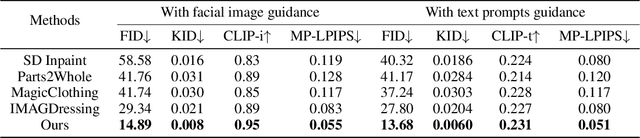
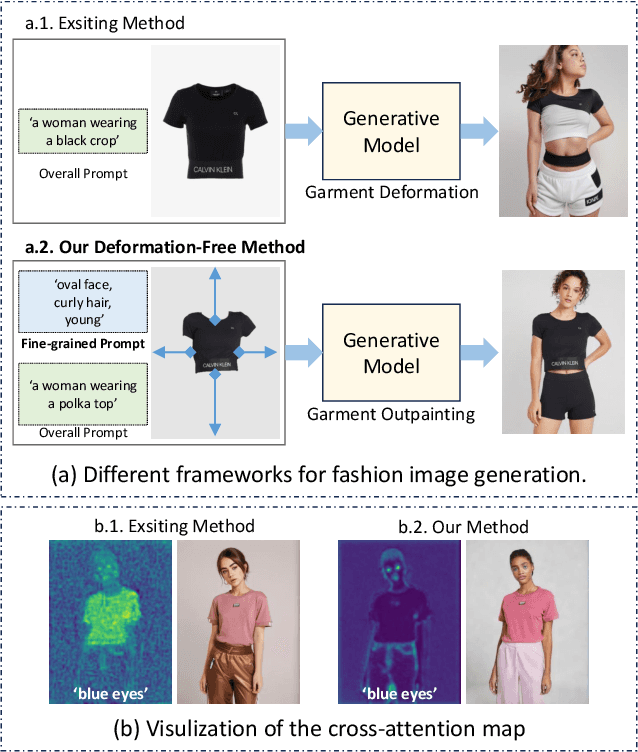
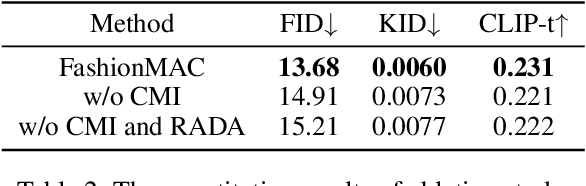
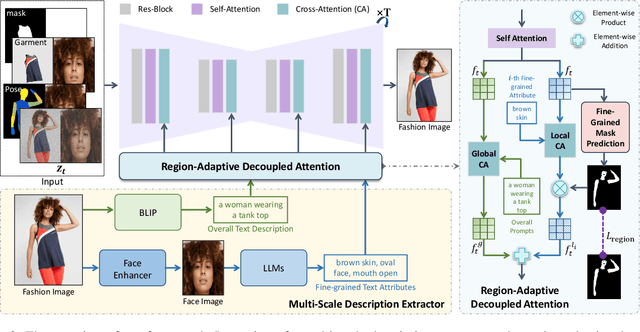
Garment-centric fashion image generation aims to synthesize realistic and controllable human models dressing a given garment, which has attracted growing interest due to its practical applications in e-commerce. The key challenges of the task lie in two aspects: (1) faithfully preserving the garment details, and (2) gaining fine-grained controllability over the model's appearance. Existing methods typically require performing garment deformation in the generation process, which often leads to garment texture distortions. Also, they fail to control the fine-grained attributes of the generated models, due to the lack of specifically designed mechanisms. To address these issues, we propose FashionMAC, a novel diffusion-based deformation-free framework that achieves high-quality and controllable fashion showcase image generation. The core idea of our framework is to eliminate the need for performing garment deformation and directly outpaint the garment segmented from a dressed person, which enables faithful preservation of the intricate garment details. Moreover, we propose a novel region-adaptive decoupled attention (RADA) mechanism along with a chained mask injection strategy to achieve fine-grained appearance controllability over the synthesized human models. Specifically, RADA adaptively predicts the generated regions for each fine-grained text attribute and enforces the text attribute to focus on the predicted regions by a chained mask injection strategy, significantly enhancing the visual fidelity and the controllability. Extensive experiments validate the superior performance of our framework compared to existing state-of-the-art methods.
Generative Photographic Control for Scene-Consistent Video Cinematic Editing
Nov 17, 2025Cinematic storytelling is profoundly shaped by the artful manipulation of photographic elements such as depth of field and exposure. These effects are crucial in conveying mood and creating aesthetic appeal. However, controlling these effects in generative video models remains highly challenging, as most existing methods are restricted to camera motion control. In this paper, we propose CineCtrl, the first video cinematic editing framework that provides fine control over professional camera parameters (e.g., bokeh, shutter speed). We introduce a decoupled cross-attention mechanism to disentangle camera motion from photographic inputs, allowing fine-grained, independent control without compromising scene consistency. To overcome the shortage of training data, we develop a comprehensive data generation strategy that leverages simulated photographic effects with a dedicated real-world collection pipeline, enabling the construction of a large-scale dataset for robust model training. Extensive experiments demonstrate that our model generates high-fidelity videos with precisely controlled, user-specified photographic camera effects.
SemanticVLA: Semantic-Aligned Sparsification and Enhancement for Efficient Robotic Manipulation
Nov 13, 2025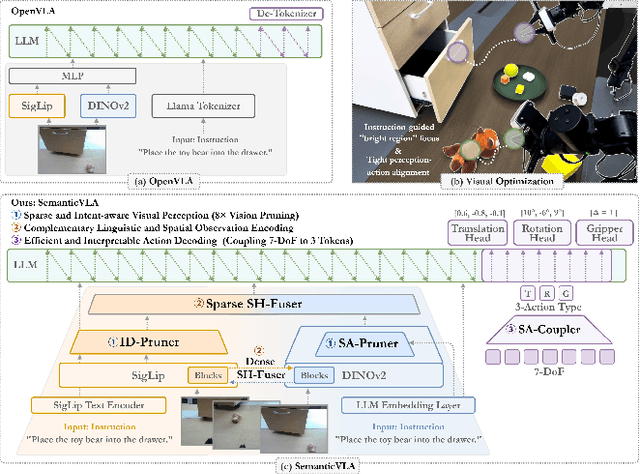
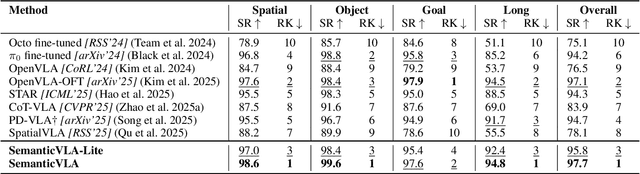
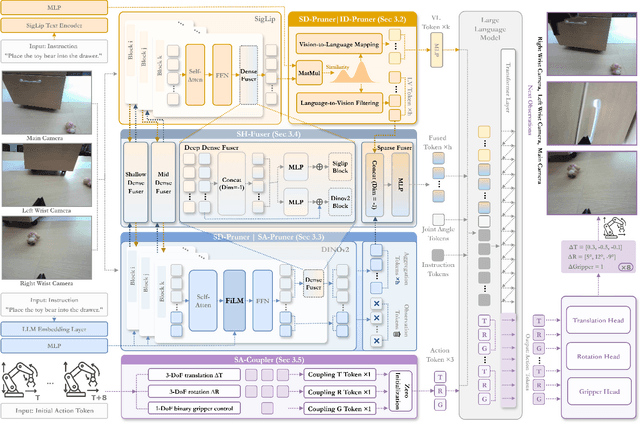

Vision-Language-Action (VLA) models have advanced in robotic manipulation, yet practical deployment remains hindered by two key limitations: 1) perceptual redundancy, where irrelevant visual inputs are processed inefficiently, and 2) superficial instruction-vision alignment, which hampers semantic grounding of actions. In this paper, we propose SemanticVLA, a novel VLA framework that performs Semantic-Aligned Sparsification and Enhancement for Efficient Robotic Manipulation. Specifically: 1) To sparsify redundant perception while preserving semantic alignment, Semantic-guided Dual Visual Pruner (SD-Pruner) performs: Instruction-driven Pruner (ID-Pruner) extracts global action cues and local semantic anchors in SigLIP; Spatial-aggregation Pruner (SA-Pruner) compacts geometry-rich features into task-adaptive tokens in DINOv2. 2) To exploit sparsified features and integrate semantics with spatial geometry, Semantic-complementary Hierarchical Fuser (SH-Fuser) fuses dense patches and sparse tokens across SigLIP and DINOv2 for coherent representation. 3) To enhance the transformation from perception to action, Semantic-conditioned Action Coupler (SA-Coupler) replaces the conventional observation-to-DoF approach, yielding more efficient and interpretable behavior modeling for manipulation tasks. Extensive experiments on simulation and real-world tasks show that SemanticVLA sets a new SOTA in both performance and efficiency. SemanticVLA surpasses OpenVLA on LIBERO benchmark by 21.1% in success rate, while reducing training cost and inference latency by 3.0-fold and 2.7-fold.SemanticVLA is open-sourced and publicly available at https://github.com/JiuTian-VL/SemanticVLA
Real Garment Benchmark (RGBench): A Comprehensive Benchmark for Robotic Garment Manipulation featuring a High-Fidelity Scalable Simulator
Nov 12, 2025While there has been significant progress to use simulated data to learn robotic manipulation of rigid objects, applying its success to deformable objects has been hindered by the lack of both deformable object models and realistic non-rigid body simulators. In this paper, we present Real Garment Benchmark (RGBench), a comprehensive benchmark for robotic manipulation of garments. It features a diverse set of over 6000 garment mesh models, a new high-performance simulator, and a comprehensive protocol to evaluate garment simulation quality with carefully measured real garment dynamics. Our experiments demonstrate that our simulator outperforms currently available cloth simulators by a large margin, reducing simulation error by 20% while maintaining a speed of 3 times faster. We will publicly release RGBench to accelerate future research in robotic garment manipulation. Website: https://rgbench.github.io/
Algorithm-Relative Trajectory Valuation in Policy Gradient Control
Nov 11, 2025We study how trajectory value depends on the learning algorithm in policy-gradient control. Using Trajectory Shapley in an uncertain LQR, we find a negative correlation between Persistence of Excitation (PE) and marginal value under vanilla REINFORCE ($r\approx-0.38$). We prove a variance-mediated mechanism: (i) for fixed energy, higher PE yields lower gradient variance; (ii) near saddles, higher variance increases escape probability, raising marginal contribution. When stabilized (state whitening or Fisher preconditioning), this variance channel is neutralized and information content dominates, flipping the correlation positive ($r\approx+0.29$). Hence, trajectory value is algorithm-relative. Experiments validate the mechanism and show decision-aligned scores (Leave-One-Out) complement Shapley for pruning, while Shapley identifies toxic subsets.
Mitigating Overthinking through Reasoning Shaping
Oct 10, 2025Large reasoning models (LRMs) boosted by Reinforcement Learning from Verifier Reward (RLVR) have shown great power in problem solving, yet they often cause overthinking: excessive, meandering reasoning that inflates computational cost. Prior designs of penalization in RLVR manage to reduce token consumption while often harming model performance, which arises from the oversimplicity of token-level supervision. In this paper, we argue that the granularity of supervision plays a crucial role in balancing efficiency and accuracy, and propose Group Relative Segment Penalization (GRSP), a step-level method to regularize reasoning. Since preliminary analyses show that reasoning segments are strongly correlated with token consumption and model performance, we design a length-aware weighting mechanism across segment clusters. Extensive experiments demonstrate that GRSP achieves superior token efficiency without heavily compromising accuracy, especially the advantages with harder problems. Moreover, GRSP stabilizes RL training and scales effectively across model sizes.
A Spatial-Spectral-Frequency Interactive Network for Multimodal Remote Sensing Classification
Oct 06, 2025Deep learning-based methods have achieved significant success in remote sensing Earth observation data analysis. Numerous feature fusion techniques address multimodal remote sensing image classification by integrating global and local features. However, these techniques often struggle to extract structural and detail features from heterogeneous and redundant multimodal images. With the goal of introducing frequency domain learning to model key and sparse detail features, this paper introduces the spatial-spectral-frequency interaction network (S$^2$Fin), which integrates pairwise fusion modules across the spatial, spectral, and frequency domains. Specifically, we propose a high-frequency sparse enhancement transformer that employs sparse spatial-spectral attention to optimize the parameters of the high-frequency filter. Subsequently, a two-level spatial-frequency fusion strategy is introduced, comprising an adaptive frequency channel module that fuses low-frequency structures with enhanced high-frequency details, and a high-frequency resonance mask that emphasizes sharp edges via phase similarity. In addition, a spatial-spectral attention fusion module further enhances feature extraction at intermediate layers of the network. Experiments on four benchmark multimodal datasets with limited labeled data demonstrate that S$^2$Fin performs superior classification, outperforming state-of-the-art methods. The code is available at https://github.com/HaoLiu-XDU/SSFin.