 Add to Chrome
 Add to Firefox
 Add to Edge
Deep Q-Learning-Based Intelligent Scheduling for ETL Optimization in Heterogeneous Data Environments
Dec 15, 2025
This paper addresses the challenges of low scheduling efficiency, unbalanced resource allocation, and poor adaptability in ETL (Extract-Transform-Load) processes under heterogeneous data environments by proposing an intelligent scheduling optimization framework based on deep Q-learning. The framework formalizes the ETL scheduling process as a Markov Decision Process and enables adaptive decision-making by a reinforcement learning agent in high-dimensional state spaces to dynamically optimize task allocation and resource scheduling. The model consists of a state representation module, a feature embedding network, a Q-value estimator, and a reward evaluation mechanism, which collectively consider task dependencies, node load states, and data flow characteristics to derive the optimal scheduling strategy in complex environments. A multi-objective reward function is designed to balance key performance indicators such as average scheduling delay, task completion rate, throughput, and resource utilization. Sensitivity experiments further verify the model's robustness under changes in hyperparameters, environmental dynamics, and data scale. Experimental results show that the proposed deep Q-learning scheduling framework significantly reduces scheduling delay, improves system throughput, and enhances execution stability under multi-source heterogeneous task conditions, demonstrating the strong potential of reinforcement learning in complex data scheduling and resource management, and providing an efficient and scalable optimization strategy for intelligent data pipeline construction.

Future Does Matter: Boosting 3D Object Detection with Temporal Motion Estimation in Point Cloud Sequences
Sep 06, 2024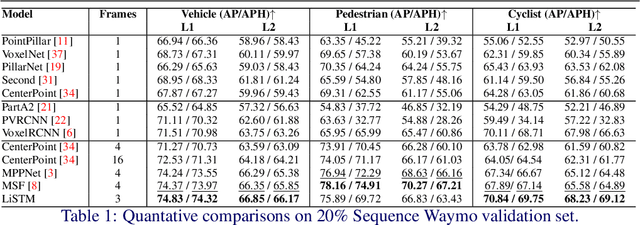

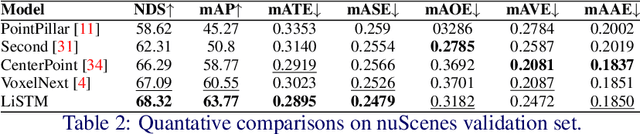

Accurate and robust LiDAR 3D object detection is essential for comprehensive scene understanding in autonomous driving. Despite its importance, LiDAR detection performance is limited by inherent constraints of point cloud data, particularly under conditions of extended distances and occlusions. Recently, temporal aggregation has been proven to significantly enhance detection accuracy by fusing multi-frame viewpoint information and enriching the spatial representation of objects. In this work, we introduce a novel LiDAR 3D object detection framework, namely LiSTM, to facilitate spatial-temporal feature learning with cross-frame motion forecasting information. We aim to improve the spatial-temporal interpretation capabilities of the LiDAR detector by incorporating a dynamic prior, generated from a non-learnable motion estimation model. Specifically, Motion-Guided Feature Aggregation (MGFA) is proposed to utilize the object trajectory from previous and future motion states to model spatial-temporal correlations into gaussian heatmap over a driving sequence. This motion-based heatmap then guides the temporal feature fusion, enriching the proposed object features. Moreover, we design a Dual Correlation Weighting Module (DCWM) that effectively facilitates the interaction between past and prospective frames through scene- and channel-wise feature abstraction. In the end, a cascade cross-attention-based decoder is employed to refine the 3D prediction. We have conducted experiments on the Waymo and nuScenes datasets to demonstrate that the proposed framework achieves superior 3D detection performance with effective spatial-temporal feature learning.