 Add to Chrome
 Add to Firefox
 Add to Edge
OmniCorpus: A Unified Multimodal Corpus of 10 Billion-Level Images Interleaved with Text
Jun 13, 2024
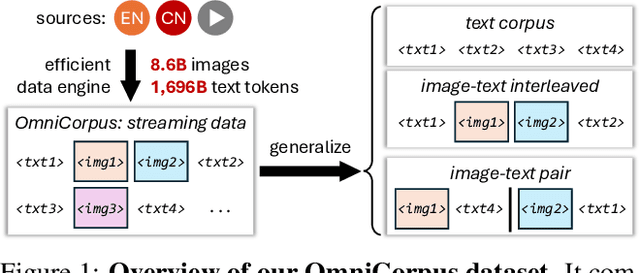


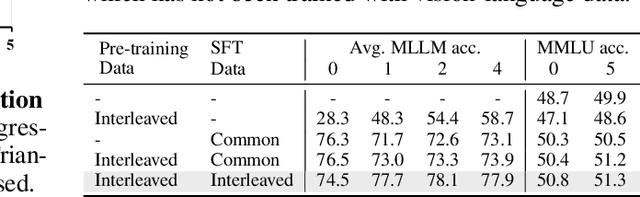
Image-text interleaved data, consisting of multiple images and texts arranged in a natural document format, aligns with the presentation paradigm of internet data and closely resembles human reading habits. Recent studies have shown that such data aids multimodal in-context learning and maintains the capabilities of large language models during multimodal fine-tuning. However, the limited scale and diversity of current image-text interleaved data restrict the development of multimodal large language models. In this paper, we introduce OmniCorpus, a 10 billion-scale image-text interleaved dataset. Using an efficient data engine, we filter and extract large-scale high-quality documents, which contain 8.6 billion images and 1,696 billion text tokens. Compared to counterparts (e.g., MMC4, OBELICS), our dataset 1) has 15 times larger scales while maintaining good data quality; 2) features more diverse sources, including both English and non-English websites as well as video-centric websites; 3) is more flexible, easily degradable from an image-text interleaved format to pure text corpus and image-text pairs. Through comprehensive analysis and experiments, we validate the quality, usability, and effectiveness of the proposed dataset. We hope this could provide a solid data foundation for future multimodal model research. Code and data are released at https://github.com/OpenGVLab/OmniCorpus.

Can Large Language Models Understand Spatial Audio?
Jun 12, 2024This paper explores enabling large language models (LLMs) to understand spatial information from multichannel audio, a skill currently lacking in auditory LLMs. By leveraging LLMs' advanced cognitive and inferential abilities, the aim is to enhance understanding of 3D environments via audio. We study 3 spatial audio tasks: sound source localization (SSL), far-field speech recognition (FSR), and localisation-informed speech extraction (LSE), achieving notable progress in each task. For SSL, our approach achieves an MAE of $2.70^{\circ}$ on the Spatial LibriSpeech dataset, substantially surpassing the prior benchmark of about $6.60^{\circ}$. Moreover, our model can employ spatial cues to improve FSR accuracy and execute LSE by selectively attending to sounds originating from a specified direction via text prompts, even amidst overlapping speech. These findings highlight the potential of adapting LLMs to grasp physical audio concepts, paving the way for LLM-based agents in 3D environments.
OmniCorpus: An Unified Multimodal Corpus of 10 Billion-Level Images Interleaved with Text
Jun 12, 2024Image-text interleaved data, consisting of multiple images and texts arranged in a natural document format, aligns with the presentation paradigm of internet data and closely resembles human reading habits. Recent studies have shown that such data aids multimodal in-context learning and maintains the capabilities of large language models during multimodal fine-tuning. However, the limited scale and diversity of current image-text interleaved data restrict the development of multimodal large language models. In this paper, we introduce OmniCorpus, a 10 billion-scale image-text interleaved dataset. Using an efficient data engine, we filter and extract large-scale high-quality documents, which contain 8.6 billion images and 1,696 billion text tokens. Compared to counterparts (e.g., MMC4, OBELICS), our dataset 1) has 15 times larger scales while maintaining good data quality; 2) features more diverse sources, including both English and non-English websites as well as video-centric websites; 3) is more flexible, easily degradable from an image-text interleaved format to pure text corpus and image-text pairs. Through comprehensive analysis and experiments, we validate the quality, usability, and effectiveness of the proposed dataset. We hope this could provide a solid data foundation for future multimodal model research. Code and data are released at https://github.com/OpenGVLab/OmniCorpus.
Dual-Pipeline with Low-Rank Adaptation for New Language Integration in Multilingual ASR
Jun 12, 2024This paper addresses challenges in integrating new languages into a pre-trained multilingual automatic speech recognition (mASR) system, particularly in scenarios where training data for existing languages is limited or unavailable. The proposed method employs a dual-pipeline with low-rank adaptation (LoRA). It maintains two data flow pipelines-one for existing languages and another for new languages. The primary pipeline follows the standard flow through the pre-trained parameters of mASR, while the secondary pipeline additionally utilizes language-specific parameters represented by LoRA and a separate output decoder module. Importantly, the proposed approach minimizes the performance degradation of existing languages and enables a language-agnostic operation mode, facilitated by a decoder selection strategy. We validate the effectiveness of the proposed method by extending the pre-trained Whisper model to 19 new languages from the FLEURS dataset
HalluDial: A Large-Scale Benchmark for Automatic Dialogue-Level Hallucination Evaluation
Jun 11, 2024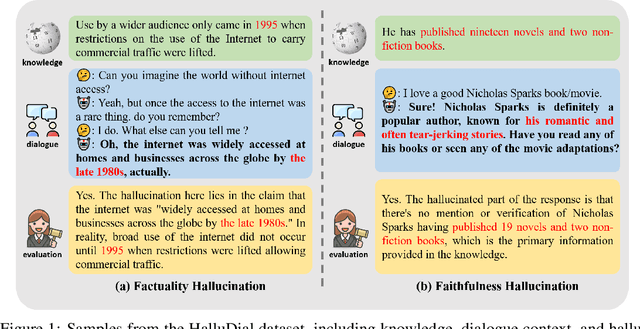
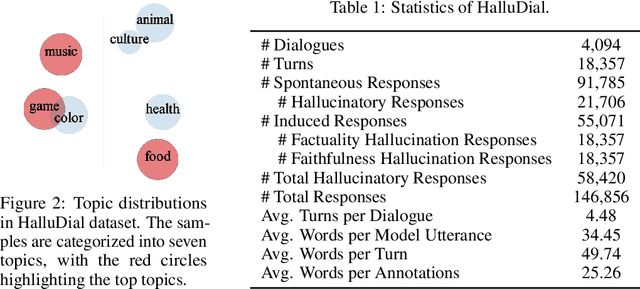
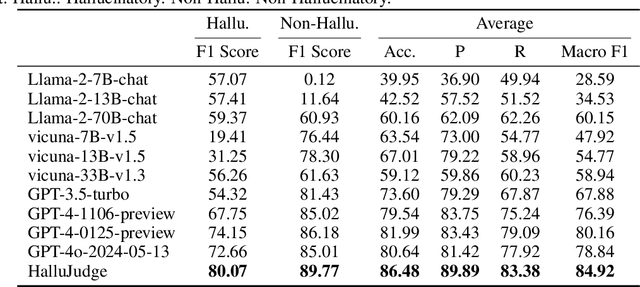

Large Language Models (LLMs) have significantly advanced the field of Natural Language Processing (NLP), achieving remarkable performance across diverse tasks and enabling widespread real-world applications. However, LLMs are prone to hallucination, generating content that either conflicts with established knowledge or is unfaithful to the original sources. Existing hallucination benchmarks primarily focus on sentence- or passage-level hallucination detection, neglecting dialogue-level evaluation, hallucination localization, and rationale provision. They also predominantly target factuality hallucinations while underestimating faithfulness hallucinations, often relying on labor-intensive or non-specialized evaluators. To address these limitations, we propose HalluDial, the first comprehensive large-scale benchmark for automatic dialogue-level hallucination evaluation. HalluDial encompasses both spontaneous and induced hallucination scenarios, covering factuality and faithfulness hallucinations. The benchmark includes 4,094 dialogues with a total of 146,856 samples. Leveraging HalluDial, we conduct a comprehensive meta-evaluation of LLMs' hallucination evaluation capabilities in information-seeking dialogues and introduce a specialized judge language model, HalluJudge. The high data quality of HalluDial enables HalluJudge to achieve superior or competitive performance in hallucination evaluation, facilitating the automatic assessment of dialogue-level hallucinations in LLMs and providing valuable insights into this phenomenon. The dataset and the code are available at https://github.com/FlagOpen/HalluDial.
PSBD: Prediction Shift Uncertainty Unlocks Backdoor Detection
Jun 09, 2024Deep neural networks are susceptible to backdoor attacks, where adversaries manipulate model predictions by inserting malicious samples into the training data. Currently, there is still a lack of direct filtering methods for identifying suspicious training data to unveil potential backdoor samples. In this paper, we propose a novel method, Prediction Shift Backdoor Detection (PSBD), leveraging an uncertainty-based approach requiring minimal unlabeled clean validation data. PSBD is motivated by an intriguing Prediction Shift (PS) phenomenon, where poisoned models' predictions on clean data often shift away from true labels towards certain other labels with dropout applied during inference, while backdoor samples exhibit less PS. We hypothesize PS results from neuron bias effect, making neurons favor features of certain classes. PSBD identifies backdoor training samples by computing the Prediction Shift Uncertainty (PSU), the variance in probability values when dropout layers are toggled on and off during model inference. Extensive experiments have been conducted to verify the effectiveness and efficiency of PSBD, which achieves state-of-the-art results among mainstream detection methods.
F-LMM: Grounding Frozen Large Multimodal Models
Jun 09, 2024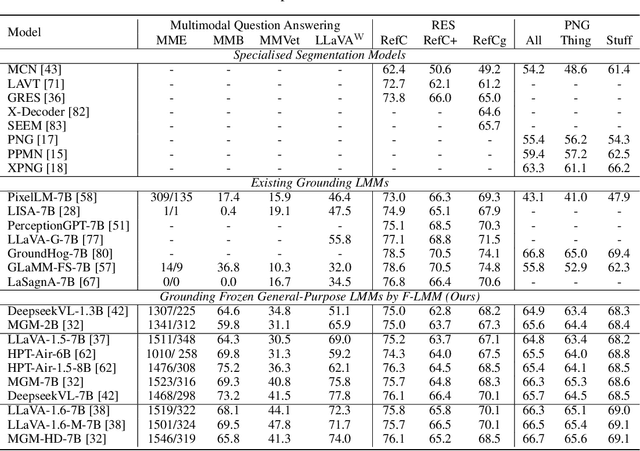
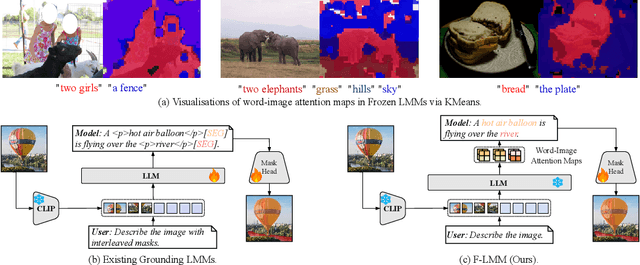
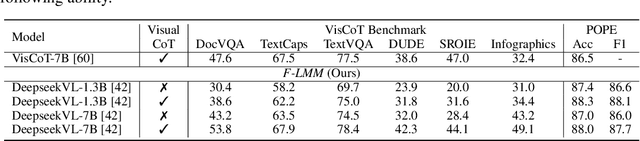

Endowing Large Multimodal Models (LMMs) with visual grounding capability can significantly enhance AIs' understanding of the visual world and their interaction with humans. However, existing methods typically fine-tune the parameters of LMMs to learn additional segmentation tokens and overfit grounding and segmentation datasets. Such a design would inevitably cause a catastrophic diminution in the indispensable conversational capability of general AI assistants. In this paper, we comprehensively evaluate state-of-the-art grounding LMMs across a suite of multimodal question-answering benchmarks, observing pronounced performance drops that indicate vanishing general knowledge comprehension and weakened instruction following ability. To address this issue, we present F-LMM -- grounding frozen off-the-shelf LMMs in human-AI conversations -- a straightforward yet effective design based on the fact that word-pixel correspondences conducive to visual grounding inherently exist in the attention weights of well-trained LMMs. Using only a few trainable CNN layers, we can translate word-pixel attention weights to mask logits, which a SAM-based mask refiner can further optimise. Our F-LMM neither learns special segmentation tokens nor utilises high-quality grounded instruction-tuning data, but achieves competitive performance on referring expression segmentation and panoptic narrative grounding benchmarks while completely preserving LMMs' original conversational ability. Additionally, with instruction-following ability preserved and grounding ability obtained, our F-LMM can perform visual chain-of-thought reasoning and better resist object hallucinations.
On the Effects of Data Scale on Computer Control Agents
Jun 06, 2024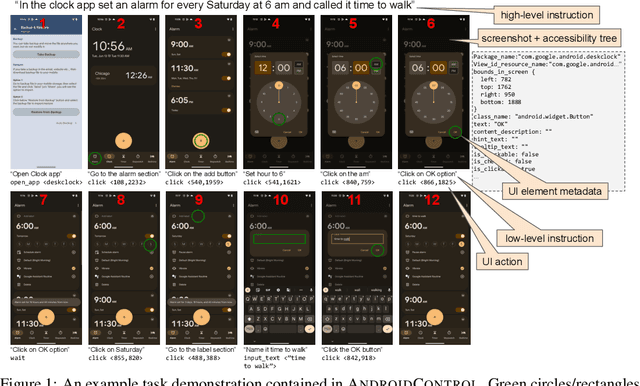
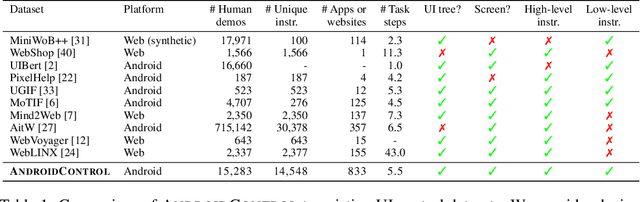
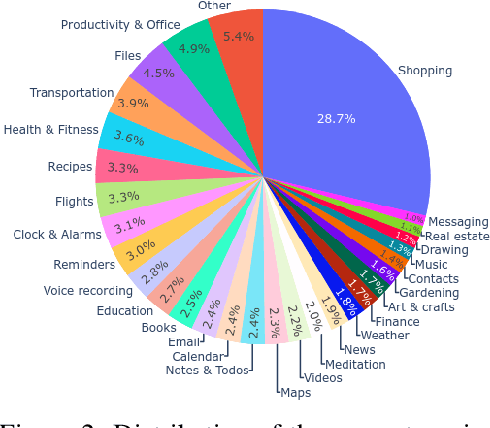
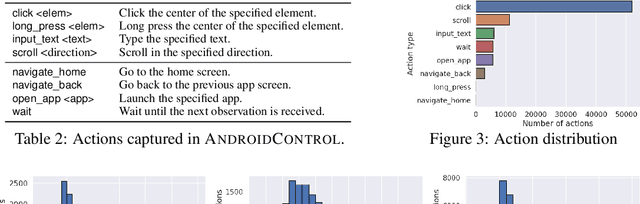
Autonomous agents that control computer interfaces to accomplish human tasks are emerging. Leveraging LLMs to power such agents has been of special interest, but unless fine-tuned on human-collected task demonstrations, performance is still relatively low. In this work we study whether fine-tuning alone is a viable approach for building real-world computer control agents. %In particularly, we investigate how performance measured on both high and low-level tasks in domain and out of domain scales as more training data is collected. To this end we collect and release a new dataset, AndroidControl, consisting of 15,283 demonstrations of everyday tasks with Android apps. Compared to existing datasets, each AndroidControl task instance includes both high and low-level human-generated instructions, allowing us to explore the level of task complexity an agent can handle. Moreover, AndroidControl is the most diverse computer control dataset to date, including 15,283 unique tasks over 833 Android apps, thus allowing us to conduct in-depth analysis of the model performance in and out of the domain of the training data. Using the dataset, we find that when tested in domain fine-tuned models outperform zero and few-shot baselines and scale in such a way that robust performance might feasibly be obtained simply by collecting more data. Out of domain, performance scales significantly more slowly and suggests that in particular for high-level tasks, fine-tuning on more data alone may be insufficient for achieving robust out-of-domain performance.
Organizing Background to Explore Latent Classes for Incremental Few-shot Semantic Segmentation
May 29, 2024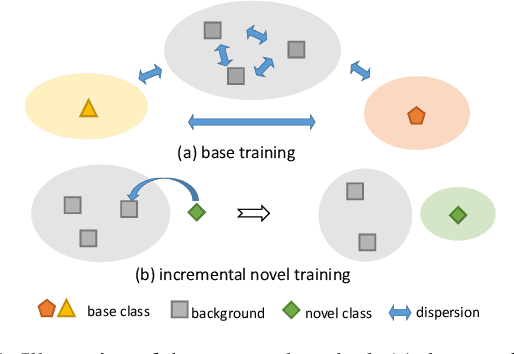
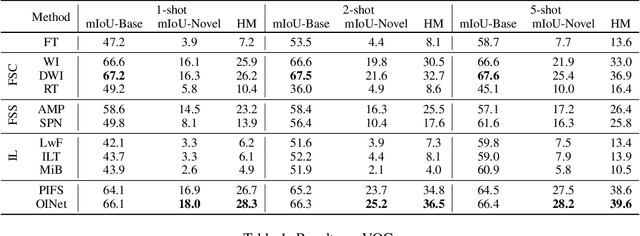
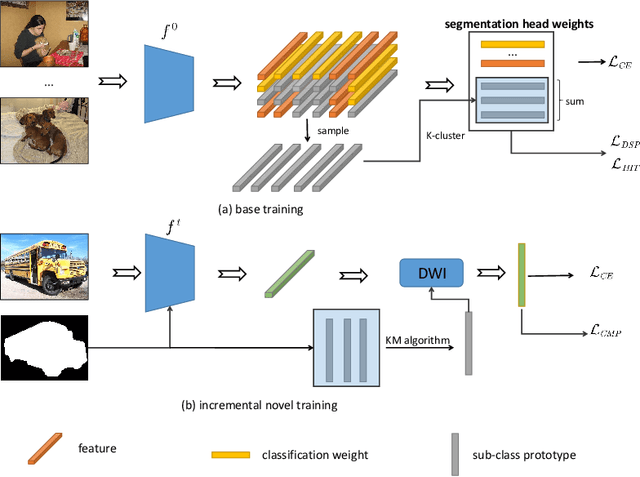
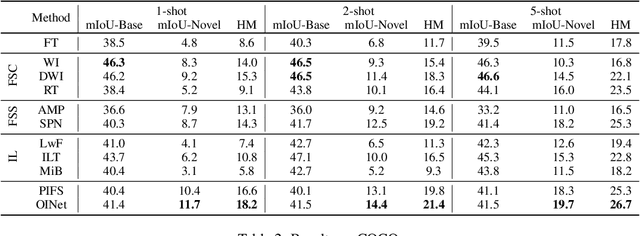
The goal of incremental Few-shot Semantic Segmentation (iFSS) is to extend pre-trained segmentation models to new classes via few annotated images without access to old training data. During incrementally learning novel classes, the data distribution of old classes will be destroyed, leading to catastrophic forgetting. Meanwhile, the novel classes have only few samples, making models impossible to learn the satisfying representations of novel classes. For the iFSS problem, we propose a network called OINet, i.e., the background embedding space \textbf{O}rganization and prototype \textbf{I}nherit Network. Specifically, when training base classes, OINet uses multiple classification heads for the background and sets multiple sub-class prototypes to reserve embedding space for the latent novel classes. During incrementally learning novel classes, we propose a strategy to select the sub-class prototypes that best match the current learning novel classes and make the novel classes inherit the selected prototypes' embedding space. This operation allows the novel classes to be registered in the embedding space using few samples without affecting the distribution of the base classes. Results on Pascal-VOC and COCO show that OINet achieves a new state of the art.
Lifelong Learning and Selective Forgetting via Contrastive Strategy
May 28, 2024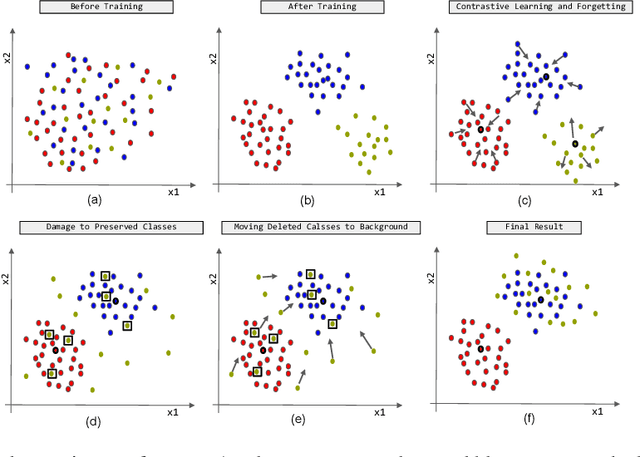
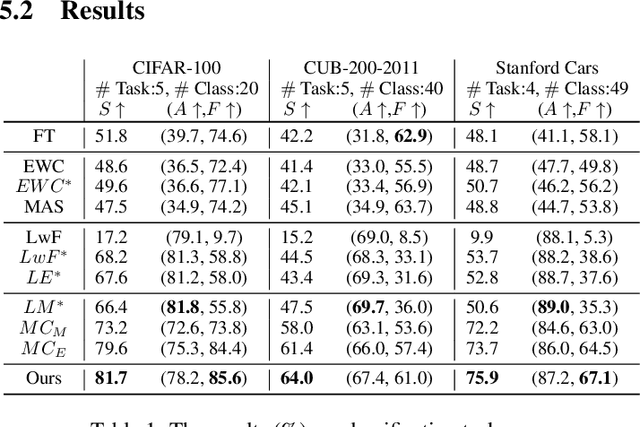
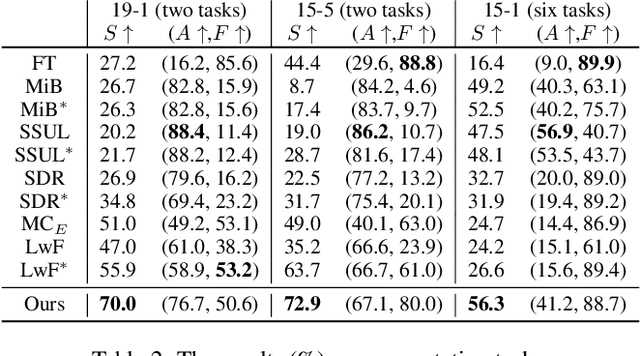
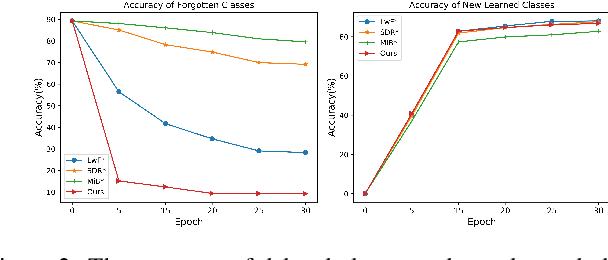
Lifelong learning aims to train a model with good performance for new tasks while retaining the capacity of previous tasks. However, some practical scenarios require the system to forget undesirable knowledge due to privacy issues, which is called selective forgetting. The joint task of the two is dubbed Learning with Selective Forgetting (LSF). In this paper, we propose a new framework based on contrastive strategy for LSF. Specifically, for the preserved classes (tasks), we make features extracted from different samples within a same class compacted. And for the deleted classes, we make the features from different samples of a same class dispersed and irregular, i.e., the network does not have any regular response to samples from a specific deleted class as if the network has no training at all. Through maintaining or disturbing the feature distribution, the forgetting and memory of different classes can be or independent of each other. Experiments are conducted on four benchmark datasets, and our method acieves new state-of-the-art.