 Add to Chrome
 Add to Firefox
 Add to Edge
Self-Compacting Language Model Agents
Jun 22, 2026
Long agent traces composed of chains of thought and tool calls accumulate stale content that anchor subsequent generations, and eventually outgrow the context window. Existing scaffolds mitigate it with fixed-interval compaction triggered at a token threshold. Such triggers pay no heed to trajectory structure, risking discard of partial results mid-derivation or mid-search. We propose SelfCompact, a scaffold that allows the model itself to decide when and how to compact. Specifically, it pairs two inference-time elements: (i) a compaction tool the model invokes to summarize the accumulated context, and (ii) a lightweight rubric specifying when to fire (a sub-task has resolved, or the trajectory is converging) and when to suppress (mid-derivation, or when stuck). Both are needed. The tool alone is unevenly used across open-weight models, often invoked at unhelpful moments or not at all; the rubric alone cannot act. Together, they elicit effective adaptive compaction without any fine-tuning or external supervision. We present empirical results on six benchmarks (competitive math and agentic search) and seven models. Our results show that SelfCompact matches or exceeds fixed-interval summarization at a fraction of the token cost, improving over a no-summarization baseline by up to 18.1 points on math and 5-9 points on agentic search at 30-70% lower per-question cost. Our results expose a meta-cognitive gap: although unprompted models cannot reliably tell when their own context is rotting, a lightweight rubric closes this gap, reframing when to compact as a capability that scaffolds can supply without training.

ThoughtTrace: Understanding User Thoughts in Real-World LLM Interactions
May 19, 2026Conversational AI has now reached billions of users, yet existing datasets capture only what people say, not what they think. We introduce ThoughtTrace, the first large-scale dataset that pairs real-world multi-turn human--AI conversations with users' self-reported thoughts: their reasons for sending prompts and reactions to assistant responses. ThoughtTrace comprises 1,058 users, 2,155 conversations, 17,058 turns, and 10,174 thought annotations collected across 20 language models. Our analysis shows that ThoughtTrace captures long-horizon, topically diverse interactions, and that thoughts are semantically distinct from messages, difficult for frontier LLMs to infer from context, diverse in content, and tied to conversation stages. We further demonstrate the utility of thoughts for downstream modeling. First, thoughts improve user-behavior prediction as inference-time context. Second, thought-guided rewrites provide fine-grained alignment signals for training personalized assistants. Together, ThoughtTrace establishes user thoughts as a new data modality for studying the cognitive dynamics behind human--AI interaction and provides a foundation for building assistants that better understand and adapt to users' latent goals, preferences, and needs.
Many-Tier Instruction Hierarchy in LLM Agents
Apr 14, 2026Large language model agents receive instructions from many sources-system messages, user prompts, tool outputs, other agents, and more-each carrying different levels of trust and authority. When these instructions conflict, agents must reliably follow the highest-privilege instruction to remain safe and effective. The dominant paradigm, instruction hierarchy (IH), assumes a fixed, small set of privilege levels (typically fewer than five) defined by rigid role labels (e.g., system > user). This is inadequate for real-world agentic settings, where conflicts can arise across far more sources and contexts. In this work, we propose Many-Tier Instruction Hierarchy (ManyIH), a paradigm for resolving instruction conflicts among instructions with arbitrarily many privilege levels. We introduce ManyIH-Bench, the first benchmark for ManyIH. ManyIH-Bench requires models to navigate up to 12 levels of conflicting instructions with varying privileges, comprising 853 agentic tasks (427 coding and 426 instruction-following). ManyIH-Bench composes constraints developed by LLMs and verified by humans to create realistic and difficult test cases spanning 46 real-world agents. Our experiments show that even the current frontier models perform poorly (~40% accuracy) when instruction conflict scales. This work underscores the urgent need for methods that explicitly target fine-grained, scalable instruction conflict resolution in agentic settings.
Reasoning over mathematical objects: on-policy reward modeling and test time aggregation
Mar 19, 2026The ability to precisely derive mathematical objects is a core requirement for downstream STEM applications, including mathematics, physics, and chemistry, where reasoning must culminate in formally structured expressions. Yet, current LM evaluations of mathematical and scientific reasoning rely heavily on simplified answer formats such as numerical values or multiple choice options due to the convenience of automated assessment. In this paper we provide three contributions for improving reasoning over mathematical objects: (i) we build and release training data and benchmarks for deriving mathematical objects, the Principia suite; (ii) we provide training recipes with strong LLM-judges and verifiers, where we show that on-policy judge training boosts performance; (iii) we show how on-policy training can also be used to scale test-time compute via aggregation. We find that strong LMs such as Qwen3-235B and o3 struggle on Principia, while our training recipes can bring significant improvements over different LLM backbones, while simultaneously improving results on existing numerical and MCQA tasks, demonstrating cross-format generalization of reasoning abilities.
Dr. Kernel: Reinforcement Learning Done Right for Triton Kernel Generations
Feb 05, 2026High-quality kernel is critical for scalable AI systems, and enabling LLMs to generate such code would advance AI development. However, training LLMs for this task requires sufficient data, a robust environment, and the process is often vulnerable to reward hacking and lazy optimization. In these cases, models may hack training rewards and prioritize trivial correctness over meaningful speedup. In this paper, we systematically study reinforcement learning (RL) for kernel generation. We first design KernelGYM, a robust distributed GPU environment that supports reward hacking check, data collection from multi-turn interactions and long-term RL training. Building on KernelGYM, we investigate effective multi-turn RL methods and identify a biased policy gradient issue caused by self-inclusion in GRPO. To solve this, we propose Turn-level Reinforce-Leave-One-Out (TRLOO) to provide unbiased advantage estimation for multi-turn RL. To alleviate lazy optimization, we incorporate mismatch correction for training stability and introduce Profiling-based Rewards (PR) and Profiling-based Rejection Sampling (PRS) to overcome the issue. The trained model, Dr.Kernel-14B, reaches performance competitive with Claude-4.5-Sonnet in Kernelbench. Finally, we study sequential test-time scaling for Dr.Kernel-14B. On the KernelBench Level-2 subset, 31.6% of the generated kernels achieve at least a 1.2x speedup over the Torch reference, surpassing Claude-4.5-Sonnet (26.7%) and GPT-5 (28.6%). When selecting the best candidate across all turns, this 1.2x speedup rate further increases to 47.8%. All resources, including environment, training code, models, and dataset, are included in https://www.github.com/hkust-nlp/KernelGYM.
Mini-o3: Scaling Up Reasoning Patterns and Interaction Turns for Visual Search
Sep 09, 2025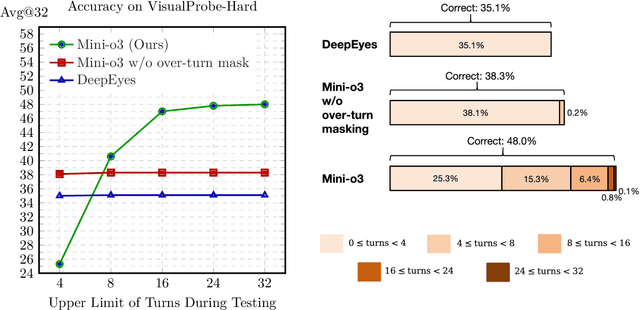
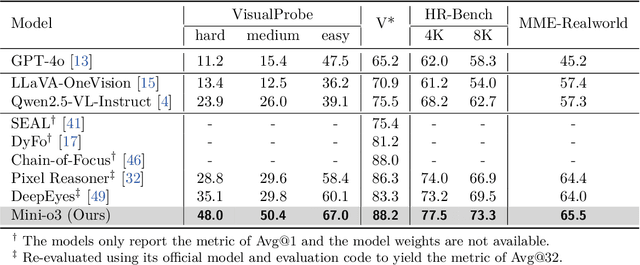
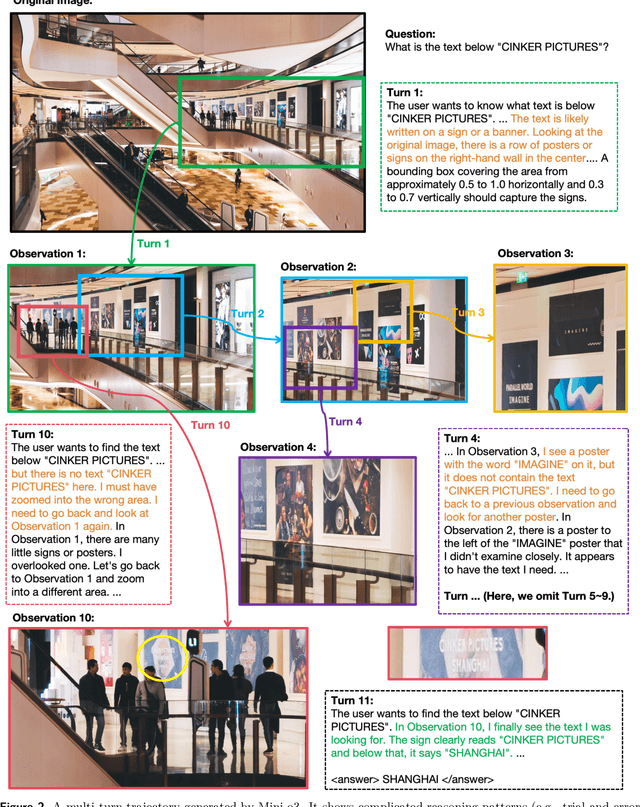

Recent advances in large multimodal models have leveraged image-based tools with reinforcement learning to tackle visual problems. However, existing open-source approaches often exhibit monotonous reasoning patterns and allow only a limited number of interaction turns, making them inadequate for difficult tasks that require trial-and-error exploration. In this work, we address this limitation by scaling up tool-based interactions and introduce Mini-o3, a system that executes deep, multi-turn reasoning -- spanning tens of steps -- and achieves state-of-the-art performance on challenging visual search tasks. Our recipe for reproducing OpenAI o3-style behaviors comprises three key components. First, we construct the Visual Probe Dataset, a collection of thousands of challenging visual search problems designed for exploratory reasoning. Second, we develop an iterative data collection pipeline to obtain cold-start trajectories that exhibit diverse reasoning patterns, including depth-first search, trial-and-error, and goal maintenance. Third, we propose an over-turn masking strategy that prevents penalization of over-turn responses (those that hit the maximum number of turns) during reinforcement learning, thereby balancing training-time efficiency with test-time scalability. Despite training with an upper bound of only six interaction turns, our model generates trajectories that naturally scale to tens of turns at inference time, with accuracy improving as the number of turns increases. Extensive experiments demonstrate that Mini-o3 produces rich reasoning patterns and deep thinking paths, effectively solving challenging visual search problems.
ZeCO: Zero Communication Overhead Sequence Parallelism for Linear Attention
Jul 02, 2025Linear attention mechanisms deliver significant advantages for Large Language Models (LLMs) by providing linear computational complexity, enabling efficient processing of ultra-long sequences (e.g., 1M context). However, existing Sequence Parallelism (SP) methods, essential for distributing these workloads across devices, become the primary bottleneck due to substantial communication overhead. In this paper, we introduce ZeCO (Zero Communication Overhead) sequence parallelism for linear attention models, a new SP method designed to overcome these limitations and achieve end-to-end near-linear scalability for long sequence training. For example, training a model with a 1M sequence length across 64 devices using ZeCO takes roughly the same time as training with an 16k sequence on a single device. At the heart of ZeCO lies All-Scan, a new collective communication primitive. All-Scan provides each SP rank with precisely the initial operator state it requires while maintaining a minimal communication footprint, effectively eliminating communication overhead. Theoretically, we prove the optimaity of ZeCO, showing that it introduces only negligible time and space overhead. Empirically, we compare the communication costs of different sequence parallelism strategies and demonstrate that All-Scan achieves the fastest communication in SP scenarios. Specifically, on 256 GPUs with an 8M sequence length, ZeCO achieves a 60\% speedup compared to the current state-of-the-art (SOTA) SP method. We believe ZeCO establishes a clear path toward efficiently training next-generation LLMs on previously intractable sequence lengths.
SIMPLEMIX: Frustratingly Simple Mixing of Off- and On-policy Data in Language Model Preference Learning
May 05, 2025Aligning language models with human preferences relies on pairwise preference datasets. While some studies suggest that on-policy data consistently outperforms off -policy data for preference learning, others indicate that the advantages of on-policy data may be task-dependent, highlighting the need for a systematic exploration of their interplay. In this work, we show that on-policy and off-policy data offer complementary strengths in preference optimization: on-policy data is particularly effective for reasoning tasks like math and coding, while off-policy data performs better on open-ended tasks such as creative writing and making personal recommendations. Guided by these findings, we introduce SIMPLEMIX, an approach to combine the complementary strengths of on-policy and off-policy preference learning by simply mixing these two data sources. Our empirical results across diverse tasks and benchmarks demonstrate that SIMPLEMIX substantially improves language model alignment. Specifically, SIMPLEMIX improves upon on-policy DPO and off-policy DPO by an average of 6.03% on Alpaca Eval 2.0. Moreover, it outperforms prior approaches that are much more complex in combining on- and off-policy data, such as HyPO and DPO-Mix-P, by an average of 3.05%.
Upsample or Upweight? Balanced Training on Heavily Imbalanced Datasets
Oct 06, 2024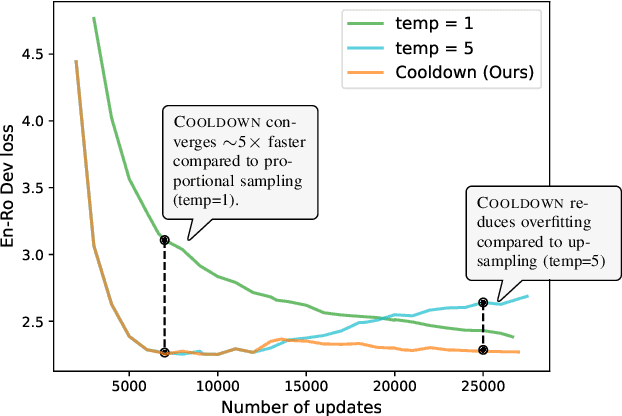
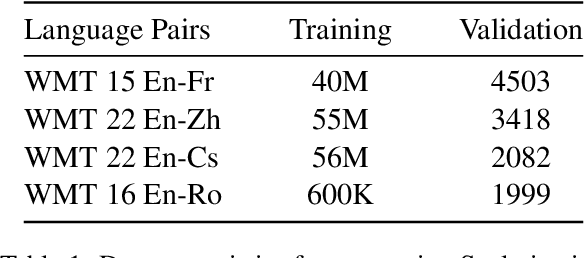
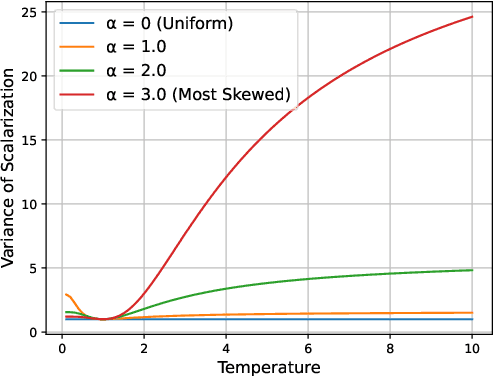
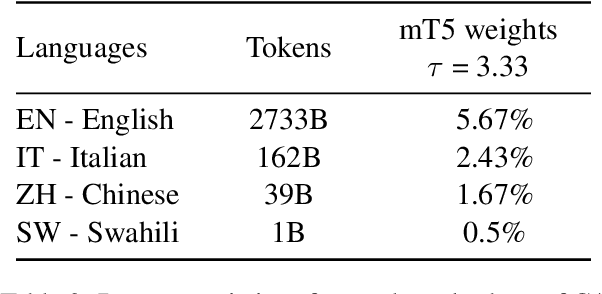
Data availability across domains often follows a long-tail distribution: a few domains have abundant data, while most face data scarcity. This imbalance poses challenges in training language models uniformly across all domains. In our study, we focus on multilingual settings, where data sizes vary significantly between high- and low-resource languages. Common strategies to address this include upsampling low-resource languages (Temperature Sampling) or upweighting their loss (Scalarization). Although often considered equivalent, this assumption has not been proven, which motivates our study. Through both theoretical and empirical analysis, we identify the conditions under which these approaches are equivalent and when they diverge. Specifically, we demonstrate that these two methods are equivalent under full gradient descent, but this equivalence breaks down with stochastic gradient descent. Empirically, we observe that Temperature Sampling converges more quickly but is prone to overfitting. We argue that this faster convergence is likely due to the lower variance in gradient estimations, as shown theoretically. Based on these insights, we propose Cooldown, a strategy that reduces sampling temperature during training, accelerating convergence without overfitting to low-resource languages. Our method is competitive with existing data re-weighting and offers computational efficiency.
Benchmarking Language Model Creativity: A Case Study on Code Generation
Jul 12, 2024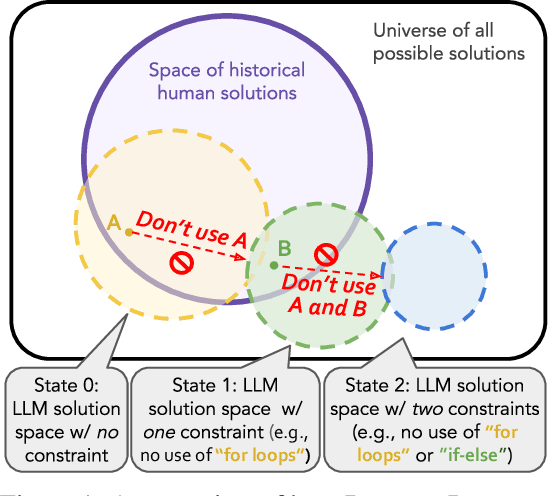
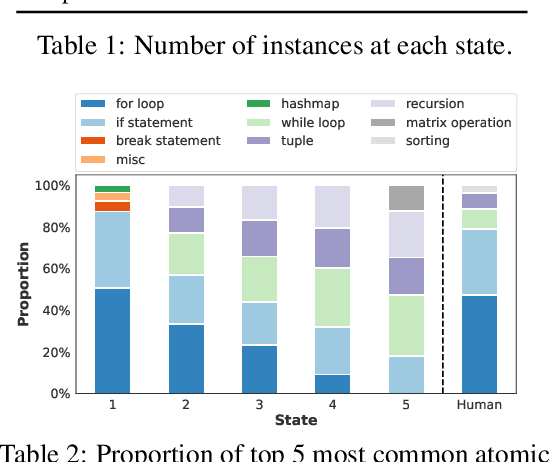
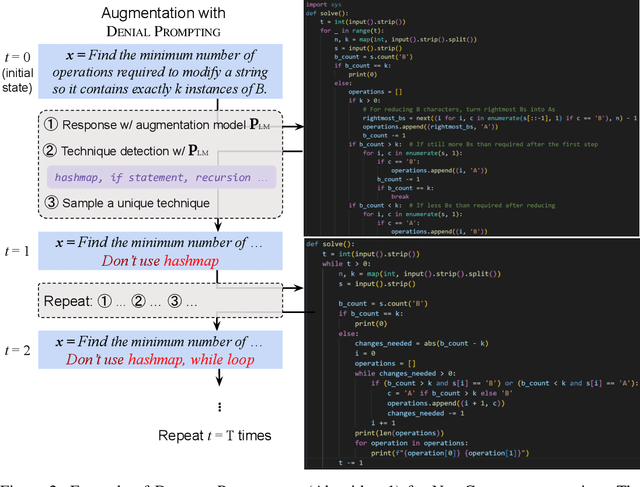
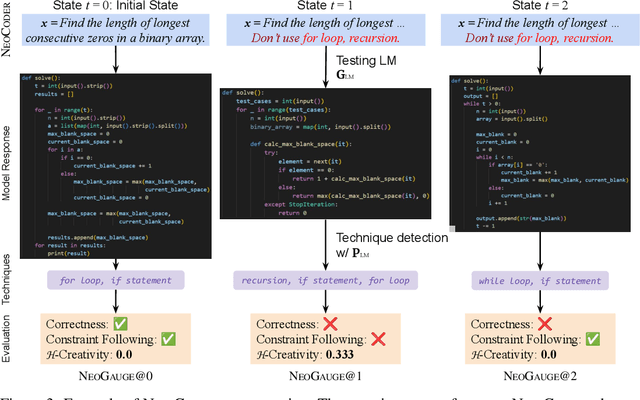
As LLMs become increasingly prevalent, it is interesting to consider how ``creative'' these models can be. From cognitive science, creativity consists of at least two key characteristics: \emph{convergent} thinking (purposefulness to achieve a given goal) and \emph{divergent} thinking (adaptability to new environments or constraints) \citep{runco2003critical}. In this work, we introduce a framework for quantifying LLM creativity that incorporates the two characteristics. This is achieved by (1) Denial Prompting pushes LLMs to come up with more creative solutions to a given problem by incrementally imposing new constraints on the previous solution, compelling LLMs to adopt new strategies, and (2) defining and computing the NeoGauge metric which examines both convergent and divergent thinking in the generated creative responses by LLMs. We apply the proposed framework on Codeforces problems, a natural data source for collecting human coding solutions. We quantify NeoGauge for various proprietary and open-source models and find that even the most creative model, GPT-4, still falls short of demonstrating human-like creativity. We also experiment with advanced reasoning strategies (MCTS, self-correction, etc.) and observe no significant improvement in creativity. As a by-product of our analysis, we release NeoCoder dataset for reproducing our results on future models.