 Add to Chrome
 Add to Firefox
 Add to Edge
There is No Theoretical Curse of Multilinguality For Embedding Space Structure
Aug 17, 2026
A central goal of multilingual NLP is to achieve high monolingual performance per language and cross-lingual alignment for large-scale language coverage with a multilingual model. The curse of multilinguality describes the phenomenon of degradation in multilingual model performance as we increase language coverage, posing a threat to the above goal. This paper asks whether multilingual embedding spaces are inherently incapable of achieving perfect multilinguality without a prohibitive increase in required capacity. We first formalize the goal of "perfect multilinguality", embodied in two multilinguality conditions. We then prove that the minimum dimensionality required for perfect multilinguality grows only logarithmically in the number of languages. That is, we show that there is no theoretical curse of multilinguality for embedding space structure. This suggests that the empirical curse of multilinguality is a result of real world data and training conditions. We back this understanding with a small-scale empirical study. Our paper provides the first theoretical and intrinsic perspective on the curse of multilinguality, with implications for the scientific understanding of this phenomenon.

Multilingual Emotion Neurons in Large Audio-Language Models
Aug 09, 2026Emotion is central to human communication, and its expression varies across languages. Large audio-language models (LALMs) achieve strong performance on multilingual speech tasks, yet it remains unclear whether they encode emotion through language-specific correlations or language-agnostic representations. We present the first neuron-level interpretability study of this question. We define Multilingual Emotion Neurons (MLENs) as functional units exhibiting stable emotional selectivity and aligned causal effects across languages, and introduce Consistency-Regularized Fusion (CR-Fusion) to identify them. Across four modern LALMs and 12 typologically diverse languages, emotion-sensitive neurons identified independently per language show minimal overlap, and additional monolingual identification data saturates quickly without isolating more transferable units, motivating identification from pooled cross-lingual evidence. Causal interventions demonstrate that MLENs identified by CR-Fusion provide more precise and transferable affective control than monolingual neuron sets in both zero-shot and low-resource settings. Leave-one-out ablations further reveal asymmetric transfer: individual identification languages, including low-resource ones, contribute non-redundant evidence, while several low-resource languages benefit most from the resulting cross-lingual transfer. Together, our findings provide the first causal, neuron-level account of how LALMs encode emotion across languages, and establish multilingual neuron identification as an effective mechanism for understanding cross-lingual affective behavior.
Strengthening Target-Language Features: SAE-Based Steering for Multilingual Inference
Aug 06, 2026Multilingual large language models exhibit substantial performance differences across languages, while existing adaptation methods often require parameter updates and considerable multilingual training data. We propose an inference-time multilingual steering method that uses pretrained sparse autoencoders to identify and strengthen target-language-related features. Using multilingual parallel sentences, we compare SAE activations across languages and select a small number of layer-specific features associated with each target language. These features are decoded into steering signals and injected into the model's hidden states without additional training. Experiments with Gemma-3-12B-it show average accuracy improvements of 10.9 percentage points on XCOPA, 5.3 points on XNLI, and 1.9 points on MGSM.
Contrastive ESA: Human Evaluation of Multiple Translations at Once
Jul 29, 2026Current human evaluation of machine translation typically assesses single outputs in isolation, a paradigm that suffers from high annotator noise and cost. We introduce Contrastive Error Span Annotation (cESA), a protocol that presents multiple translations of the source input (text, video, audio, image). In cESA, the annotator sees multiple translations of the same document, marks major and minor error spans, and then assigns a score from 0% to 100% on absolute scale. By allowing annotators to access the shared context across multiple outputs, cESA facilitates more consistent and efficient judgments. We validate cESA using a large-scale human evaluation of English->Japanese translations of 12 models, demonstrating reductions in annotation time and noise compared to standard pointwise evaluation. Unlike existing contrastive ranking methods, cESA yields absolute quality judgments that enable simple, interpretable non-parametric model rankings without the need for post-hoc corrections.
TRACE-EVC: Text-Guided Relative Affective Control for Zero-Shot Emotional Voice Conversion
Jul 04, 2026Traditional emotional voice conversion (EVC) conditions generation on explicit target emotions like labels or references, defining the target affective state but omitting the direction or nature of the transition. We introduce instruction-guided relative emotional voice conversion, a task where natural-language instructions specify source-conditioned affective transformations (e.g., "make the speech slightly calmer" or "sound noticeably more confident") instead of fixed targets. To support this task, we construct TRACE-Instruct, a dataset of relative emotion instructions covering categorical transitions, intensity modifications, and open-ended affective changes. We propose TRACE-EVC, a zero-shot framework built around Emo-Compass, a module that models each conversion as a source-anchored rectified flow. Rather than conditioning on an explicit target, it predicts the direction and degree of the affective change. Experiments demonstrate that TRACE-EVC accurately follows relative emotion instructions while preserving speaker identity, linguistic content, and speech quality, and remains competitive with conventional EVC systems on standard categorical emotion conversion.
Neuron-Level Emotion Control in Speech-Generative Large Audio-Language Models
Mar 18, 2026Large audio-language models (LALMs) can produce expressive speech, yet reliable emotion control remains elusive: conversions often miss the target affect and may degrade linguistic fidelity through refusals, hallucinations, or paraphrase. We present, to our knowledge, the first neuron-level study of emotion control in speech-generative LALMs and demonstrate that compact emotion-sensitive neurons (ESNs) are causally actionable, enabling training-free emotion steering at inference time. ESNs are identified via success-filtered activation aggregation enforcing both emotion realization and content preservation. Across three LALMs (Qwen2.5-Omni-7B, MiniCPM-o 4.5, Kimi-Audio), ESN interventions yield emotion-specific gains that generalize to unseen speakers and are supported by automatic and human evaluation. Controllability depends on selector design, mask sparsity, filtering, and intervention strength. Our results establish a mechanistic framework for training-free emotion control in speech generation.
SciTaRC: Benchmarking QA on Scientific Tabular Data that Requires Language Reasoning and Complex Computation
Mar 09, 2026We introduce SciTaRC, an expert-authored benchmark of questions about tabular data in scientific papers requiring both deep language reasoning and complex computation. We show that current state-of-the-art AI models fail on at least 23% of these questions, a gap that remains significant even for highly capable open-weight models like Llama-3.3-70B-Instruct, which fails on 65.5% of the tasks. Our analysis reveals a universal "execution bottleneck": both code and language models struggle to faithfully execute plans, even when provided with correct strategies. Specifically, code-based methods prove brittle on raw scientific tables, while natural language reasoning primarily fails due to initial comprehension issues and calculation errors.
Text Style Transfer with Parameter-efficient LLM Finetuning and Round-trip Translation
Feb 16, 2026This paper proposes a novel method for Text Style Transfer (TST) based on parameter-efficient fine-tuning of Large Language Models (LLMs). Addressing the scarcity of parallel corpora that map between styles, the study employs roundtrip translation to synthesize such parallel datasets from monolingual corpora. This approach creates 'neutralized' text devoid of stylistic attributes, essentially creating a shared input style at training-time and inference-time. Experimental results demonstrate consistent superiority of this method over zero-shot prompting and fewshot ICL techniques measured by BLEU scores and style accuracy scores across four investigated domains. Furthermore, the integration of retrieval-augmented generation (RAG) for terminology and name knowledge enhances robustness and stylistic consistency.
HiMATE: A Hierarchical Multi-Agent Framework for Machine Translation Evaluation
May 22, 2025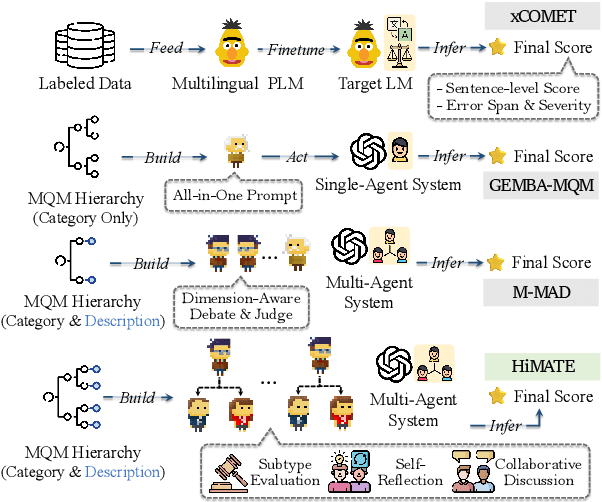
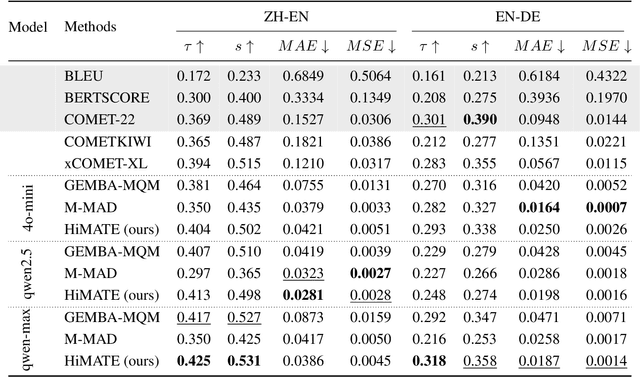
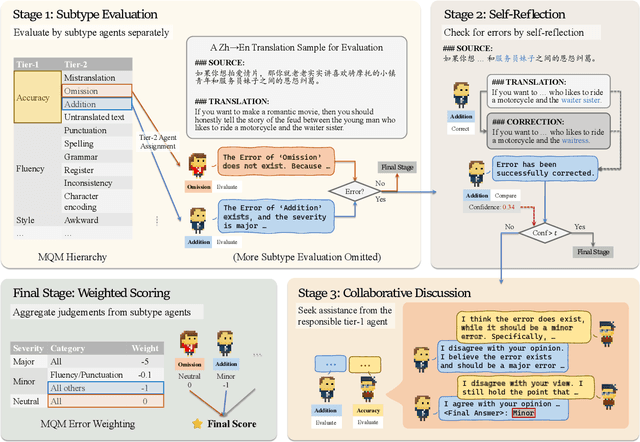
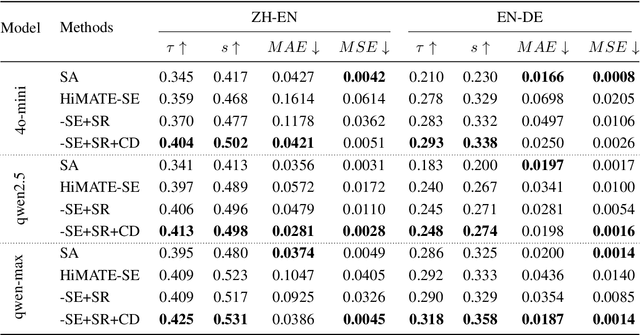
The advancement of Large Language Models (LLMs) enables flexible and interpretable automatic evaluations. In the field of machine translation evaluation, utilizing LLMs with translation error annotations based on Multidimensional Quality Metrics (MQM) yields more human-aligned judgments. However, current LLM-based evaluation methods still face challenges in accurately identifying error spans and assessing their severity. In this paper, we propose HiMATE, a Hierarchical Multi-Agent Framework for Machine Translation Evaluation. We argue that existing approaches inadequately exploit the fine-grained structural and semantic information within the MQM hierarchy. To address this, we develop a hierarchical multi-agent system grounded in the MQM error typology, enabling granular evaluation of subtype errors. Two key strategies are incorporated to further mitigate systemic hallucinations within the framework: the utilization of the model's self-reflection capability and the facilitation of agent discussion involving asymmetric information. Empirically, HiMATE outperforms competitive baselines across different datasets in conducting human-aligned evaluations. Further analyses underscore its significant advantage in error span detection and severity assessment, achieving an average F1-score improvement of 89% over the best-performing baseline. We make our code and data publicly available at https://anonymous.4open.science/r/HiMATE-Anony.
Token-level Ensembling of Models with Different Vocabularies
Feb 28, 2025Model ensembling is a technique to combine the predicted distributions of two or more models, often leading to improved robustness and performance. For ensembling in text generation, the next token's probability distribution is derived from a weighted sum of the distributions of each individual model. This requires the underlying models to share the same subword vocabulary, limiting the applicability of ensembling, since many open-sourced models have distinct vocabularies. In research settings, experimentation or upgrades to vocabularies may introduce multiple vocabulary sizes. This paper proposes an inference-time only algorithm that allows for ensembling models with different vocabularies, without the need to learn additional parameters or alter the underlying models. Instead, the algorithm ensures that tokens generated by the ensembled models \textit{agree} in their surface form. We apply this technique to combinations of traditional encoder-decoder models and decoder-only LLMs and evaluate on machine translation. In addition to expanding to model pairs that were previously incapable of token-level ensembling, our algorithm frequently improves translation performance over either model individually.