 Add to Chrome
 Add to Firefox
 Add to Edge
SLAI T-Rex: Full-Parameter Post-training of the DeepSeek-V4 Family on Ascend SuperPOD
Jul 22, 2026
Full-parameter post-training of trillion-parameter-scale MoE models introduces substantial system-level challenges for large-scale distributed training, including severe memory pressure, non-overlapped communication overhead, and inefficient kernel execution. While most large-scale LLM training systems are built around GPU-based clusters, this report presents an end-to-end optimization practice on the Ascend NPU SuperPOD. Using the DeepSeek-V4 model family as the target workload, we develop a hierarchical optimization framework spanning model-level parallelism, computation-communication orchestration, and low-level kernel execution. The resulting system achieves 34.22% Model FLOPs Utilization (MFU) with a 2.93x improvement over the open-source baseline recipe while maintaining training stability. Building on this optimized infrastructure, we further establish a CPT and SFT workflow for complex Operations Research (OR) tasks. We refer to the integrated framework as SLAI T-Rex. Using DeepSeek-V4-Flash, we develop OR-oriented CPT and SFT data pipelines that combine collected domain resources with solver-verified synthetic optimization documents. The resulting dataset contains 10K high-quality SFT samples spanning four task categories and three problem representations. The specialized model achieves the highest average zero-shot Pass@1 score among the evaluated models, reaching 71.81% and outperforming GPT-5.4-Mini and the base DeepSeek-V4-Flash model by 3.98 and 11.27 percentage points, respectively. Overall, this work demonstrates a full-stack pathway from efficient trillion-parameter model post-training on Ascend infra to domain-specialized Flash models for solver-grounded mathematical modeling, advancing frontier-model systems for complex reasoning.

SAM-Flow: Source-Anchored Masked Flow for Training-Free Image Editing
Jun 04, 2026Training-free image editing has recently attracted increasing attention due to its ability to modify real images using powerful pre-trained diffusion and flow-matching models without additional training. However, existing inversion-based and differential-flow-based methods usually perform global latent transport, which inevitably propagates editing effects to non-target regions and leads to background leakage. To address this problem, we propose SAM-Flow, a source-anchored masked flow framework for localized training-free image editing. Instead of updating the whole latent representation, SAM-Flow first uses a scout image and token-grounded attention maps to localize the editable semantic regions. It then applies differential velocity updates only within these regions, while anchoring the remaining areas to the source-image latent trajectory. To further improve spatial stability and boundary naturalness, we introduce a time-varying source-anchored projection mechanism with dynamic soft masks, transition regions, and temporal mask accumulation. The proposed method is plug-and-play and can be integrated with mainstream flow-matching backbones such as Stable Diffusion 3 and FLUX without any fine-tuning. Extensive qualitative and quantitative experiments demonstrate that SAM-Flow achieves accurate semantic editing while significantly improving background preservation, providing a simple and general localized editing paradigm for training-free image editing. Code is available at: https://github.com/chwbob/Sam-Flow.
BAHSD: Bridging the Long-tail Gap via Adaptive Distillation in Black-box Sequential Recommendation
Jun 04, 2026Sequential recommendation systems are widely adopted but often deployed as black-box APIs, which has driven recent interest in model extraction to replicate their capabilities locally. However, the long-tail distribution induces severe signal heterogeneity: dense head sequences trigger the solidification of teacher preference, biasing extraction toward local patterns, while sparse tail sequences yield flat, noisy predictions. Existing one-size-fits-all extraction overlooks this disparity, resulting in noise overfitting and suboptimal knowledge transfer. We propose BAHSD, a black-box adaptive distillation framework that handles signal heterogeneity via a multi-scale consistency probing mechanism to implicitly quantify signal reliability. Based on this, an adaptive hierarchical objective is designed: dynamic-temperature KL divergence mitigates preference solidification for high-confidence signals, while ranking consistency and InfoNCE contrastive learning provide noise-robust enhancement for low-confidence signals. BAHSD consistently outperforms baselines, achieving up to 4.98\% gain over the teacher and 80\%+ improvement on tail users, offering a plug-and-play solution for high-fidelity black-box recommendation extraction.
Adaptive Oscillatory-State Alignment for Time Series Forecasting
Jun 04, 2026Long-term time series forecasting benefits from inductive biases that expose recurring temporal structure. Existing periodic forecasting methods typically model recurrence through predefined periods, global spectral components, or fixed learnable templates. However, real-world temporal dynamics are rarely rigidly periodic: oscillatory behavior often evolves through amplitude modulation, phase drift, and local frequency variation. Under these conditions, fixed-template periodic modeling can become fundamentally mismatched to the underlying temporal states. We propose AOSNET, a Hilbert-guided forecasting framework that reformulates periodic forecasting from fixed template matching to adaptive oscillatory-state alignment. AOSNET extracts analytic-signal descriptors from both the observed sequence and a learnable global oscillatory prior, then adaptively aligns local states through a descriptor-conditioned gate that selectively preserves reliable observations while softly correcting mismatched regions. The learned prior serves not as a rigid repeated template but as a flexible oscillatory reference interpreted through local state dynamics. Experiments on eight benchmarks demonstrate state-of-the-art or highly competitive accuracy with fast inference speed. Controlled synthetic studies isolating amplitude modulation, phase drift, and local frequency variation confirm that the advantage of oscillatory-state alignment consistently increases as non-stationarity intensifies.
RecBundle: A Next-Generation Geometric Paradigm for Explainable Recommender Systems
Mar 17, 2026Recommender systems are inherently dynamic feedback loops where prolonged local interactions accumulate into macroscopic structural degradation such as information cocoons. Existing representation learning paradigms are universally constrained by the assumption of a single flat space, forcing topologically grounded user associations and semantically driven historical interactions to be fitted within the same vector space. This excessive coupling of heterogeneous information renders it impossible for researchers to mechanistically distinguish and identify the sources of systemic bias. To overcome this theoretical bottleneck, we introduce Fiber Bundle from modern differential geometry and propose a novel geometric analysis paradigm for recommender systems. This theory naturally decouples the system space into two hierarchical layers: the base manifold formed by user interaction networks, and the fibers attached to individual user nodes that carry their dynamic preferences. Building upon this, we construct RecBundle, a framework oriented toward next-generation recommender systems that formalizes user collaboration as geometric connection and parallel transport on the base manifold, while mapping content evolution to holonomy transformations on fibers. From this foundation, we identify future application directions encompassing quantitative mechanisms for information cocoons and evolutionary bias, geometric meta-theory for adaptive recommendation, and novel inference architectures integrating large language models (LLMs). Empirical analysis on real-world MovieLens and Amazon Beauty datasets validates the effectiveness of this geometric framework.
MO-SAE:Multi-Objective Stacked Autoencoders Optimization for Edge Anomaly Detection
Mar 14, 2026Stacked AutoEncoders (SAE) have been widely adopted in edge anomaly detection scenarios. However, the resource-intensive nature of SAE can pose significant challenges for edge devices, which are typically resource-constrained and must adapt rapidly to dynamic and changing conditions. Optimizing SAE to meet the heterogeneous demands of real-world deployment scenarios, including high performance under constrained storage, low power consumption, fast inference, and efficient model updates, remains a substantial challenge. To address this, we propose an integrated optimization framework that jointly considers these critical factors to achieve balanced and adaptive system-level optimization. Specifically, we formulate SAE optimization for edge anomaly detection as a multi-objective optimization problem and propose MO-SAE (Multi-Objective Stacked AutoEncoders). The multiple objectives are addressed by integrating model clipping, multi-branch exit design, and a matrix approximation technique. In addition, a multi-objective heuristic algorithm is employed to effectively balance the competing objectives in SAE optimization. Our results demonstrate that the proposed MO-SAE delivers substantial improvements over the original approach. On the x86 architecture, it reduces storage space and power consumption by at least 50%, improves runtime efficiency by no less than 28%, and achieves an 11.8% compression rate, all while maintaining application performance. Furthermore, MO-SAE runs efficiently on edge devices with ARM architecture. Experimental results show a 15% improvement in inference speed, facilitating efficient deployment in cloud-edge collaborative anomaly detection systems.
MiMo-V2-Flash Technical Report
Jan 08, 2026We present MiMo-V2-Flash, a Mixture-of-Experts (MoE) model with 309B total parameters and 15B active parameters, designed for fast, strong reasoning and agentic capabilities. MiMo-V2-Flash adopts a hybrid attention architecture that interleaves Sliding Window Attention (SWA) with global attention, with a 128-token sliding window under a 5:1 hybrid ratio. The model is pre-trained on 27 trillion tokens with Multi-Token Prediction (MTP), employing a native 32k context length and subsequently extended to 256k. To efficiently scale post-training compute, MiMo-V2-Flash introduces a novel Multi-Teacher On-Policy Distillation (MOPD) paradigm. In this framework, domain-specialized teachers (e.g., trained via large-scale reinforcement learning) provide dense and token-level reward, enabling the student model to perfectly master teacher expertise. MiMo-V2-Flash rivals top-tier open-weight models such as DeepSeek-V3.2 and Kimi-K2, despite using only 1/2 and 1/3 of their total parameters, respectively. During inference, by repurposing MTP as a draft model for speculative decoding, MiMo-V2-Flash achieves up to 3.6 acceptance length and 2.6x decoding speedup with three MTP layers. We open-source both the model weights and the three-layer MTP weights to foster open research and community collaboration.
MiMo-Audio: Audio Language Models are Few-Shot Learners
Dec 29, 2025Existing audio language models typically rely on task-specific fine-tuning to accomplish particular audio tasks. In contrast, humans are able to generalize to new audio tasks with only a few examples or simple instructions. GPT-3 has shown that scaling next-token prediction pretraining enables strong generalization capabilities in text, and we believe this paradigm is equally applicable to the audio domain. By scaling MiMo-Audio's pretraining data to over one hundred million of hours, we observe the emergence of few-shot learning capabilities across a diverse set of audio tasks. We develop a systematic evaluation of these capabilities and find that MiMo-Audio-7B-Base achieves SOTA performance on both speech intelligence and audio understanding benchmarks among open-source models. Beyond standard metrics, MiMo-Audio-7B-Base generalizes to tasks absent from its training data, such as voice conversion, style transfer, and speech editing. MiMo-Audio-7B-Base also demonstrates powerful speech continuation capabilities, capable of generating highly realistic talk shows, recitations, livestreaming and debates. At the post-training stage, we curate a diverse instruction-tuning corpus and introduce thinking mechanisms into both audio understanding and generation. MiMo-Audio-7B-Instruct achieves open-source SOTA on audio understanding benchmarks (MMSU, MMAU, MMAR, MMAU-Pro), spoken dialogue benchmarks (Big Bench Audio, MultiChallenge Audio) and instruct-TTS evaluations, approaching or surpassing closed-source models. Model checkpoints and full evaluation suite are available at https://github.com/XiaomiMiMo/MiMo-Audio.
Distributed Nonparametric Estimation: from Sparse to Dense Samples per Terminal
Jan 14, 2025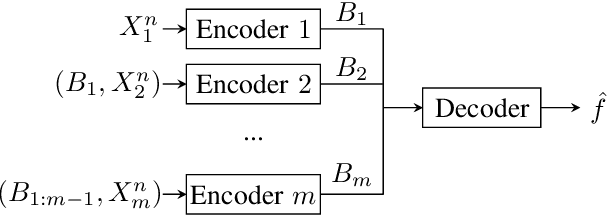
Consider the communication-constrained problem of nonparametric function estimation, in which each distributed terminal holds multiple i.i.d. samples. Under certain regularity assumptions, we characterize the minimax optimal rates for all regimes, and identify phase transitions of the optimal rates as the samples per terminal vary from sparse to dense. This fully solves the problem left open by previous works, whose scopes are limited to regimes with either dense samples or a single sample per terminal. To achieve the optimal rates, we design a layered estimation protocol by exploiting protocols for the parametric density estimation problem. We show the optimality of the protocol using information-theoretic methods and strong data processing inequalities, and incorporating the classic balls and bins model. The optimal rates are immediate for various special cases such as density estimation, Gaussian, binary, Poisson and heteroskedastic regression models.
Adaptive Refinement Protocols for Distributed Distribution Estimation under $\ell^p$-Losses
Oct 09, 2024
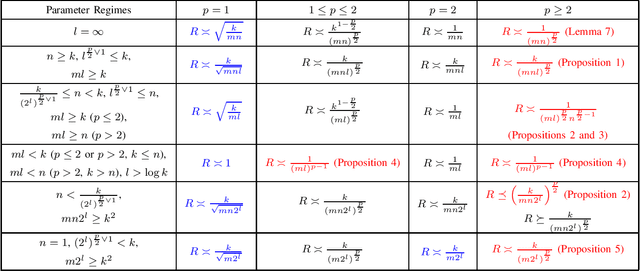
Consider the communication-constrained estimation of discrete distributions under $\ell^p$ losses, where each distributed terminal holds multiple independent samples and uses limited number of bits to describe the samples. We obtain the minimax optimal rates of the problem in most parameter regimes. An elbow effect of the optimal rates at $p=2$ is clearly identified. To show the optimal rates, we first design estimation protocols to achieve them. The key ingredient of these protocols is to introduce adaptive refinement mechanisms, which first generate rough estimate by partial information and then establish refined estimate in subsequent steps guided by the rough estimate. The protocols leverage successive refinement, sample compression and thresholding methods to achieve the optimal rates in different parameter regimes. The optimality of the protocols is shown by deriving compatible minimax lower bounds.