 Add to Chrome
 Add to Firefox
 Add to Edge
ADAPT: Analytical Disturbance-Aware Policy Training for Humanoid Locomotion
Jun 15, 2026
Humanoids deployed in human-centered environments must handle force-interactive tasks, where external contacts introduce unexpected disturbances that disrupt locomotion accuracy and stability. Existing learning-based approaches rely on broad domain randomization, task-specific force objectives, or learning-based force estimators from motion history, each of which compromises accuracy, task transferability, or out-of-distribution (OOD) robustness. We present Analytical Disturbance-Aware Policy Training (ADAPT), a framework that equips humanoid policies with a physically grounded disturbance observer. The core of ADAPT is an analytical whole-body disturbance observer that estimates residual force/torque online with the accessible robot dynamics, without requiring force/torque sensors. Fed directly into the policy, the estimated disturbances give the humanoid an explicit, physics-derived sense of external force/torque that can generalize across diverse unseen scenes. Experiments on a Unitree G1 humanoid show that ADAPT achieves accurate disturbance prediction and stronger robustness than a proprioception-only baseline under torso perturbations, standing pushes, and asymmetric hand payloads, with improved velocity tracking even on OOD disturbances. Moreover, ADAPT enables penalizing inferred disturbances at lower-body joints to encourage lighter locomotion.

EM-Fall: Embodied mmWave Sensing for Day-and-Night Fall Detection on Humanoid Robots
Jun 09, 2026Falls are one of the leading causes of injury and hospitalization among elderly individuals, making reliable fall awareness an essential capability for safety monitoring in residential environments. However, existing fall detection systems often rely on wearable devices or fixed sensing installations, which may suffer from low user compliance, limited spatial coverage, or degraded performance under occlusion and poor lighting conditions. In this work, we propose \textbf{EM-Fall}, an embodied fall detection framework deployed on a mobile humanoid robot. The system integrates millimeter-wave (mmWave) sensing with robotic mobility, allowing the robot to actively adjust its sensing viewpoint and maintain target observability across rooms and under occlusion. To address interference in complex residential environments, including pet motion and multipath artifacts, we design a human-centered perception pipeline combined with lightweight temporal modeling to capture motion evolution before, during, and after fall events. We evaluate the proposed system across eight real indoor environments with four participants and construct an in-home mmWave fall detection dataset. Experimental results show that the embodied mobile sensing paradigm improves monitoring continuity and maintains robust fall detection performance under diverse environmental conditions. The proposed framework provides a practical solution for robot-assisted safety monitoring in home environments.
Gaze2Act: Gaze-Conditioned Vision-Language-Action Policies for Interactive Robot Manipulation
May 28, 2026Vision-Language-Action (VLA) models have recently shown strong potential for robot learning by following language instructions. However, in practice, language alone is often insufficient to precisely convey human intent. It is difficult to describe which exact object to interact with among similar candidates, where to act on the object, or how the target may change during execution. To address this limitation, we propose Gaze2Act, a novel VLA framework that leverages human gaze as a dynamic and intuitive intent signal for complex interactive manipulation. Gaze2Act first bridges the ego-exo view gap by mapping first-person gaze into the robot's perspective through cross-view semantic matching, producing both an object mask and a gaze point for coarse-to-fine target specification. These cues are then integrated into the policy through perception-level prompting and action-level conditioning, allowing the robot to attend to relevant regions and execute precise interactions under dynamic intent. In a systematic evaluation across seven task categories and 16 real-robot tasks on a Unitree G1 humanoid, Gaze2Act achieves state-of-the-art performance in both intent accuracy and task success rate. It notably outperforms baselines in object disambiguation, fine-grained interaction, and dynamic intent steering. These results demonstrate that human gaze provides a natural, low-burden, and highly expressive modality for human-in-the-loop VLA control.
MARS Policy: Multimodality Only When It Matters
May 28, 2026Imitation learning has become a cornerstone for solving complex robotic manipulation tasks. In particular, multimodality, which enables robots to capture diverse yet valid behavioral patterns, has driven the rapid emergence of generative policies as a dominant paradigm in robot learning. However, achieving such multimodality typically relies on stochastic noise initialization and iterative denoising procedures, resulting in substantial training complexity and low inference efficiency. Meanwhile, not all phases of a robotic task inherently require behavioral diversity. Motivated by this insight, we propose the Modality-Adaptive Robot Sampling (MARS) policy, which adaptively invokes tailored stochasticity only when it is truly beneficial, while reverting to an efficient deterministic learning during single-modal phases. In other words, the proper amount of noise is injected only at the proper time. By selectively activating multimodal generation, MARS policy bridges the gap between the multimodal capability of generative policies and the superior training and inference efficiency of deterministic models. Empirical studies across 8 simulated and 4 real-world tasks demonstrate that MARS exhibits robust multimodal expressivity and high efficiency, with a 16.67% success rate improvement and an 83.20% inference latency reduction in real-world tests. Counterintuitively, MARS also outpaces deterministic policies in training efficiency on near-deterministic tasks by more effectively modeling nuanced action diversity.
OccamToken: Efficient VLM Inference with Training-Free and Budget-Adaptive Token Pruning
May 28, 2026Vision-language models (VLMs) rely on long visual token sequences for visual understanding, making the prefill stage expensive in both computation and memory. Most existing pruning methods follow an absolute-ranking paradigm, assigning importance scores to visual tokens and retaining a fixed top-K subset. In this work, we argue that this paradigm is fundamentally brittle: attention sinks distort token importance rankings, while image redundancy and query-dependent visual evidence make fixed token budgets unreliable across inputs. We propose OccamToken, a training-free framework that replaces absolute token ranking with register-anchored relative evidence testing. Instead of asking which tokens are globally important, OccamToken evaluates whether a visual token provides information beyond a register-based reference. Our key insight is that register tokens naturally absorb low-information attention patterns, making them a stable reference for identifying genuinely informative visual evidence. Based on this principle, OccamToken performs both image-adaptive redundancy pruning and query-adaptive relevance pruning through dynamic thresholds derived from register attention. Across LLaVA-NeXT, LLaVA-v1.5, and Qwen3-VL, OccamToken consistently improves the accuracy-efficiency trade-off without additional training. Notably, on LLaVA-NeXT, it reduces 2,880 visual tokens to approximately 40 while preserving over 93% of the original accuracy, enabling stable visual token compression even in the extreme 1.4% retention regime.
CompassAD: Intent-Driven 3D Affordance Grounding in Functionally Competing Objects
Apr 02, 2026When told to "cut the apple," a robot must choose the knife over nearby scissors, despite both objects affording the same cutting function. In real-world scenes, multiple objects may share identical affordances, yet only one is appropriate under the given task context. We call such cases confusing pairs. However, existing 3D affordance methods largely sidestep this challenge by evaluating isolated single objects, often with explicit category names provided in the query. We formalize Multi-Object Affordance Grounding under Intent-Driven Instructions, a new 3D affordance setting that requires predicting a per-point affordance mask on the correct object within a cluttered multi-object point cloud, conditioned on implicit natural language intent. To study this problem, we construct CompassAD, the first benchmark centered on implicit intent in confusable multi-object scenes. It comprises 30 confusing object pairs spanning 16 affordance types, 6,422 scenes, and 88K+ query-answer pairs. Furthermore, we propose CompassNet, a framework that incorporates two dedicated modules tailored to this task. Instance-bounded Cross Injection (ICI) constrains language-geometry alignment within object boundaries to prevent cross-object semantic leakage. Bi-level Contrastive Refinement (BCR) enforces discrimination at both geometric-group and point levels, sharpening distinctions between target and confusable surfaces. Extensive experiments demonstrate state-of-the-art results on both seen and unseen queries, and deployment on a robotic manipulator confirms effective transfer to real-world grasping in confusing multi-object scenes.
RoboForge: Physically Optimized Text-guided Whole-Body Locomotion for Humanoids
Mar 19, 2026While generative models have become effective at producing human-like motions from text, transferring these motions to humanoid robots for physical execution remains challenging. Existing pipelines are often limited by retargeting, where kinematic quality is undermined by physical infeasibility, contact-transition errors, and the high cost of real-world dynamical data. We present a unified latent-driven framework that bridges natural language and whole-body humanoid locomotion through a retarget-free, physics-optimized pipeline. Rather than treating generation and control as separate stages, our key insight is to couple them bidirectionally under physical constraints.We introduce a Physical Plausibility Optimization (PP-Opt) module as the coupling interface. In the forward direction, PP-Opt refines a teacher-student distillation policy with a plausibility-centric reward to suppress artifacts such as floating, skating, and penetration. In the backward direction, it converts reward-optimized simulation rollouts into high-quality explicit motion data, which is used to fine-tune the motion generator toward a more physically plausible latent distribution. This bidirectional design forms a self-improving cycle: the generator learns a physically grounded latent space, while the controller learns to execute latent-conditioned behaviors with dynamical integrity.Extensive experiments on the Unitree G1 humanoid show that our bidirectional optimization improves tracking accuracy and success rates. Across IsaacLab and MuJoCo, the implicit latent-driven pipeline consistently outperforms conventional explicit retargeting baselines in both precision and stability. By coupling diffusion-based motion generation with physical plausibility optimization, our framework provides a practical path toward deployable text-guided humanoid intelligence.
3D Kinematics Estimation from Video with a Biomechanical Model and Synthetic Training Data
Feb 26, 2024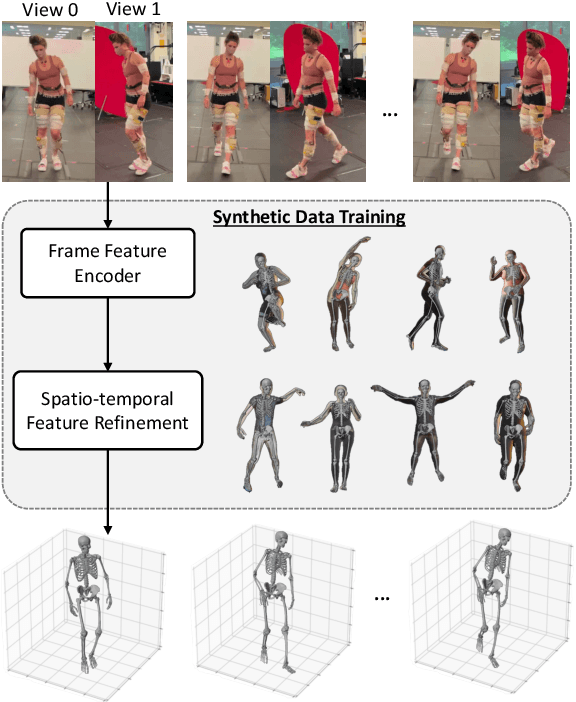


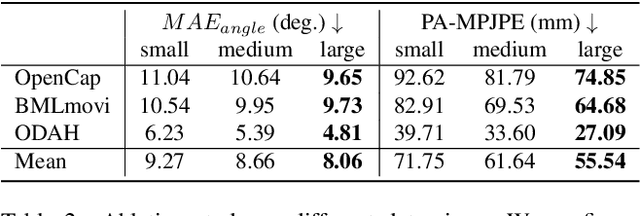
Accurate 3D kinematics estimation of human body is crucial in various applications for human health and mobility, such as rehabilitation, injury prevention, and diagnosis, as it helps to understand the biomechanical loading experienced during movement. Conventional marker-based motion capture is expensive in terms of financial investment, time, and the expertise required. Moreover, due to the scarcity of datasets with accurate annotations, existing markerless motion capture methods suffer from challenges including unreliable 2D keypoint detection, limited anatomic accuracy, and low generalization capability. In this work, we propose a novel biomechanics-aware network that directly outputs 3D kinematics from two input views with consideration of biomechanical prior and spatio-temporal information. To train the model, we create synthetic dataset ODAH with accurate kinematics annotations generated by aligning the body mesh from the SMPL-X model and a full-body OpenSim skeletal model. Our extensive experiments demonstrate that the proposed approach, only trained on synthetic data, outperforms previous state-of-the-art methods when evaluated across multiple datasets, revealing a promising direction for enhancing video-based human motion capture.