 Add to Chrome
 Add to Firefox
 Add to Edge
Learning Physical Interaction: A Survey of Tactile- and Force-aware Robot Learning
Aug 02, 2026
Physically grounded robot intelligence requires robots to perceive, reason about, and regulate their interactions with the physical world. This capability is particularly critical in contact-sensitive manipulation, where successful task execution depends not only on visual perception and motion generation, but also on force regulation and adaptive control. In this context, recent robot learning methods have made substantial progress by integrating force, tactile, vision, language, and proprioceptive sensing into learned manipulation policies. In parallel, many systems adopt multi-phase architectures that combine high-level policies, action-refinement modules, and low-level controllers to bridge semantic task understanding with reactive physical execution. Despite these advances, existing surveys have not explicitly reviewed force- and tactile-aware robot learning from a unified perspective that jointly captures multimodal sensing and multi-phase system design. This survey addresses this gap by proposing TF-ART, a Tactile/Force-Aware Robot learning Taxonomy for multimodal and multi-phase frameworks, which maps individual methods into a unified hierarchical structure. The framework characterizes how recent works organize observation modalities, encode and fuse heterogeneous sensory inputs, generate and refine actions across multiple phases, and connect learned policies to reactive robot-end control. Building on this methodological view, we further examine the task settings and infrastructure requirements of physical interaction, thereby integrating both algorithmic and practical perspectives on force- and tactile-aware robot learning.

YARD: Y-Architecture Register Decoding for Efficient Hallucination Mitigation in Large Vision-Language Models
May 29, 2026Contrastive decoding (CD) seeks to mitigate hallucinations in Large Vision-Language Models (LVLMs) by contrasting the output distributions of a standard model and a visually degraded model. However, existing training-free CD methods suffer from sub-optimal degraded branches: completely dropping visual tokens is too extreme and induces language hallucinations, while corrupting input images offers coarse control over visual evidence and suffers from high inference latency due to requiring two full forward passes. To address these dilemmas, we propose YARD, a training-free Y-Architecture Register Decoding framework. Motivated by the observation that reliable text-to-vision grounding predominantly emerges in the middle decoder layers, YARD constructs the degraded branch internally by sharing shallow-layer computations and branching exactly at this critical stage. For the degraded branch, YARD replaces patch-level visual tokens with register tokens, which preserve global image semantics but lack fine-grained local evidence. This image-aware yet locally under-grounded design provides a faithful contrastive signal without extreme modality mismatch, while the Y-architecture strictly avoids a costly second forward pass. Extensive experiments on generative and discriminative hallucination benchmarks demonstrate that YARD consistently achieves state-of-the-art hallucination mitigation across multiple LVLMs, alongside a significant reduction in inference latency.
OccamToken: Efficient VLM Inference with Training-Free and Budget-Adaptive Token Pruning
May 28, 2026Vision-language models (VLMs) rely on long visual token sequences for visual understanding, making the prefill stage expensive in both computation and memory. Most existing pruning methods follow an absolute-ranking paradigm, assigning importance scores to visual tokens and retaining a fixed top-K subset. In this work, we argue that this paradigm is fundamentally brittle: attention sinks distort token importance rankings, while image redundancy and query-dependent visual evidence make fixed token budgets unreliable across inputs. We propose OccamToken, a training-free framework that replaces absolute token ranking with register-anchored relative evidence testing. Instead of asking which tokens are globally important, OccamToken evaluates whether a visual token provides information beyond a register-based reference. Our key insight is that register tokens naturally absorb low-information attention patterns, making them a stable reference for identifying genuinely informative visual evidence. Based on this principle, OccamToken performs both image-adaptive redundancy pruning and query-adaptive relevance pruning through dynamic thresholds derived from register attention. Across LLaVA-NeXT, LLaVA-v1.5, and Qwen3-VL, OccamToken consistently improves the accuracy-efficiency trade-off without additional training. Notably, on LLaVA-NeXT, it reduces 2,880 visual tokens to approximately 40 while preserving over 93% of the original accuracy, enabling stable visual token compression even in the extreme 1.4% retention regime.
Guided Trajectory Optimization with Sparse Scaling for Test-Time Diffusion
May 21, 2026The efficient Test-Time Scaling (TTS) paradigm offers a promising perspective for enhancing the generation performance of diffusion models. However, current solutions are limited to a static, pre-defined noise pool and suffer from inflexible noise exploration across the denoising trajectory. To bridge this gap, we propose RTS, a novel Reward-guided Trajectory Scaling method to fully unlock the generative potential of diffusion models. Unlike existing methods, RTS facilitates the synthesis of refined, high-fidelity images via two core innovations: 1) a reward-guided noise optimization strategy to actively direct the search towards promising regions; and 2) a sparse test-time scaling framework together with a PCA-driven curvature analysis scheme to prioritize key intermediate steps in the entire denoising space, effectively compressing the search space. Experiments show our approach outperforms baselines by 15.6% across GenEval Score, and a 60.4% enhancement in ImageReward score, setting a new SOTA while providing a practical guideline for more effective test-time scaling across diffusion-specific architectures.
OmniCode: A Benchmark for Evaluating Software Engineering Agents
Feb 02, 2026LLM-powered coding agents are redefining how real-world software is developed. To drive the research towards better coding agents, we require challenging benchmarks that can rigorously evaluate the ability of such agents to perform various software engineering tasks. However, popular coding benchmarks such as HumanEval and SWE-Bench focus on narrowly scoped tasks such as competition programming and patch generation. In reality, software engineers have to handle a broader set of tasks for real-world software development. To address this gap, we propose OmniCode, a novel software engineering benchmark that contains a broader and more diverse set of task categories beyond code or patch generation. Overall, OmniCode contains 1794 tasks spanning three programming languages (Python, Java, and C++) and four key categories: bug fixing, test generation, code review fixing, and style fixing. In contrast to prior software engineering benchmarks, the tasks in OmniCode are (1) manually validated to eliminate ill-defined problems, and (2) synthetically crafted or recently curated to avoid data leakage issues, presenting a new framework for synthetically generating diverse software tasks from limited real-world data. We evaluate OmniCode with popular agent frameworks such as SWE-Agent and show that while they may perform well on bug fixing for Python, they fall short on tasks such as Test Generation and in languages such as C++ and Java. For instance, SWE-Agent achieves a maximum of 20.9% with DeepSeek-V3.1 on Java Test Generation tasks. OmniCode aims to serve as a robust benchmark and spur the development of agents that can perform well across different aspects of software development. Code and data are available at https://github.com/seal-research/OmniCode.
Continual Knowledge Adaptation for Reinforcement Learning
Oct 22, 2025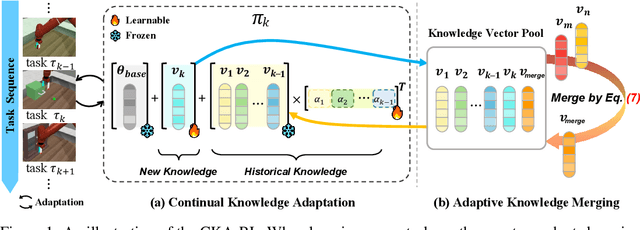
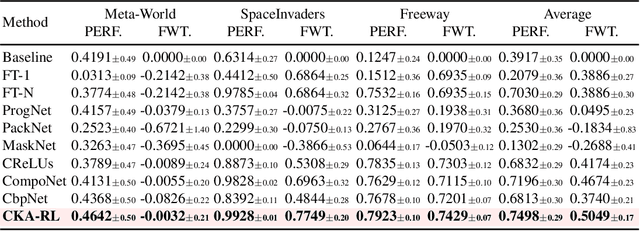
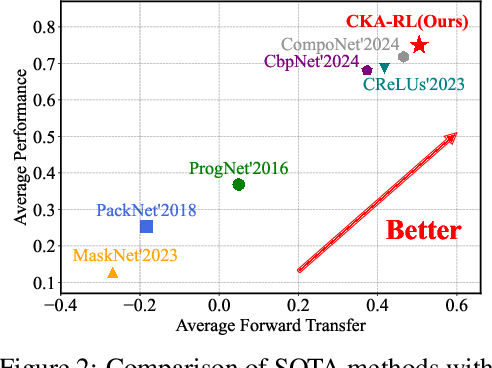
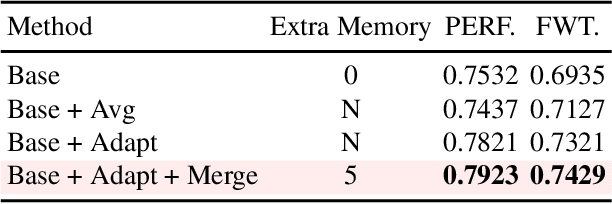
Reinforcement Learning enables agents to learn optimal behaviors through interactions with environments. However, real-world environments are typically non-stationary, requiring agents to continuously adapt to new tasks and changing conditions. Although Continual Reinforcement Learning facilitates learning across multiple tasks, existing methods often suffer from catastrophic forgetting and inefficient knowledge utilization. To address these challenges, we propose Continual Knowledge Adaptation for Reinforcement Learning (CKA-RL), which enables the accumulation and effective utilization of historical knowledge. Specifically, we introduce a Continual Knowledge Adaptation strategy, which involves maintaining a task-specific knowledge vector pool and dynamically using historical knowledge to adapt the agent to new tasks. This process mitigates catastrophic forgetting and enables efficient knowledge transfer across tasks by preserving and adapting critical model parameters. Additionally, we propose an Adaptive Knowledge Merging mechanism that combines similar knowledge vectors to address scalability challenges, reducing memory requirements while ensuring the retention of essential knowledge. Experiments on three benchmarks demonstrate that the proposed CKA-RL outperforms state-of-the-art methods, achieving an improvement of 4.20% in overall performance and 8.02% in forward transfer. The source code is available at https://github.com/Fhujinwu/CKA-RL.
Adapt in the Wild: Test-Time Entropy Minimization with Sharpness and Feature Regularization
Sep 05, 2025Test-time adaptation (TTA) may fail to improve or even harm the model performance when test data have: 1) mixed distribution shifts, 2) small batch sizes, 3) online imbalanced label distribution shifts. This is often a key obstacle preventing existing TTA methods from being deployed in the real world. In this paper, we investigate the unstable reasons and find that the batch norm layer is a crucial factor hindering TTA stability. Conversely, TTA can perform more stably with batch-agnostic norm layers, i.e., group or layer norm. However, we observe that TTA with group and layer norms does not always succeed and still suffers many failure cases, i.e., the model collapses into trivial solutions by assigning the same class label for all samples. By digging into this, we find that, during the collapse process: 1) the model gradients often undergo an initial explosion followed by rapid degradation, suggesting that certain noisy test samples with large gradients may disrupt adaptation; and 2) the model representations tend to exhibit high correlations and classification bias. To address this, we first propose a sharpness-aware and reliable entropy minimization method, called SAR, for stabilizing TTA from two aspects: 1) remove partial noisy samples with large gradients, 2) encourage model weights to go to a flat minimum so that the model is robust to the remaining noisy samples. Based on SAR, we further introduce SAR^2 to prevent representation collapse with two regularizers: 1) a redundancy regularizer to reduce inter-dimensional correlations among centroid-invariant features; and 2) an inequity regularizer to maximize the prediction entropy of a prototype centroid, thereby penalizing biased representations toward any specific class. Promising results demonstrate that our methods perform more stably over prior methods and are computationally efficient under the above wild test scenarios.
Test-Time Learning for Large Language Models
May 27, 2025
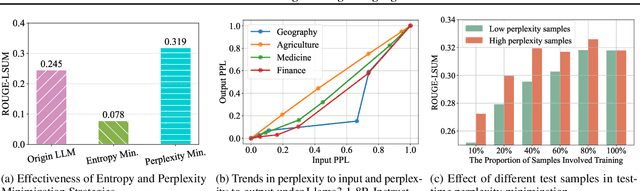
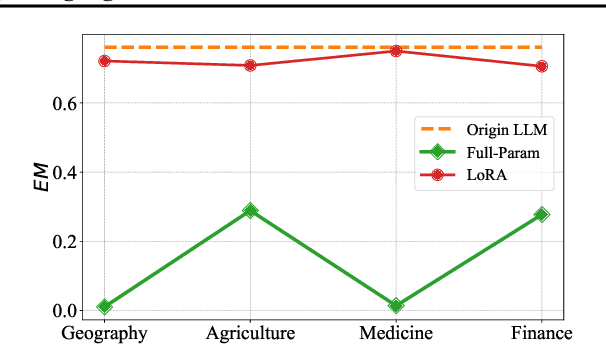
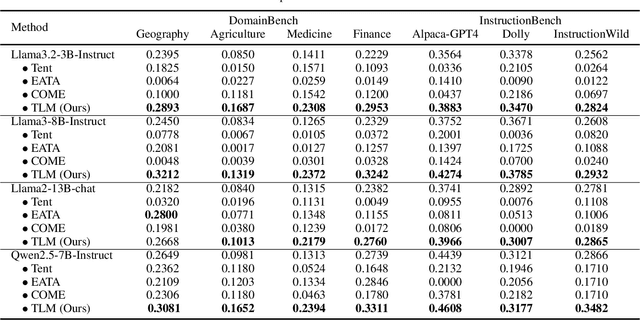
While Large Language Models (LLMs) have exhibited remarkable emergent capabilities through extensive pre-training, they still face critical limitations in generalizing to specialized domains and handling diverse linguistic variations, known as distribution shifts. In this paper, we propose a Test-Time Learning (TTL) paradigm for LLMs, namely TLM, which dynamically adapts LLMs to target domains using only unlabeled test data during testing. Specifically, we first provide empirical evidence and theoretical insights to reveal that more accurate predictions from LLMs can be achieved by minimizing the input perplexity of the unlabeled test data. Based on this insight, we formulate the Test-Time Learning process of LLMs as input perplexity minimization, enabling self-supervised enhancement of LLM performance. Furthermore, we observe that high-perplexity samples tend to be more informative for model optimization. Accordingly, we introduce a Sample Efficient Learning Strategy that actively selects and emphasizes these high-perplexity samples for test-time updates. Lastly, to mitigate catastrophic forgetting and ensure adaptation stability, we adopt Low-Rank Adaptation (LoRA) instead of full-parameter optimization, which allows lightweight model updates while preserving more original knowledge from the model. We introduce the AdaptEval benchmark for TTL and demonstrate through experiments that TLM improves performance by at least 20% compared to original LLMs on domain knowledge adaptation.
Self-Bootstrapping for Versatile Test-Time Adaptation
Apr 10, 2025In this paper, we seek to develop a versatile test-time adaptation (TTA) objective for a variety of tasks - classification and regression across image-, object-, and pixel-level predictions. We achieve this through a self-bootstrapping scheme that optimizes prediction consistency between the test image (as target) and its deteriorated view. The key challenge lies in devising effective augmentations/deteriorations that: i) preserve the image's geometric information, e.g., object sizes and locations, which is crucial for TTA on object/pixel-level tasks, and ii) provide sufficient learning signals for TTA. To this end, we analyze how common distribution shifts affect the image's information power across spatial frequencies in the Fourier domain, and reveal that low-frequency components carry high power and masking these components supplies more learning signals, while masking high-frequency components can not. In light of this, we randomly mask the low-frequency amplitude of an image in its Fourier domain for augmentation. Meanwhile, we also augment the image with noise injection to compensate for missing learning signals at high frequencies, by enhancing the information power there. Experiments show that, either independently or as a plug-and-play module, our method achieves superior results across classification, segmentation, and 3D monocular detection tasks with both transformer and CNN models.
Dynamic Ensemble Reasoning for LLM Experts
Dec 10, 2024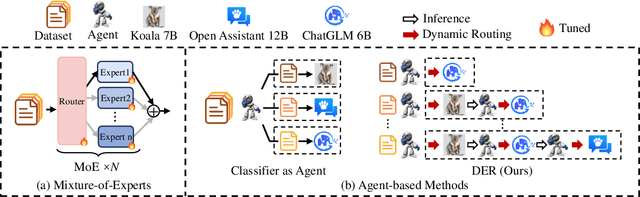
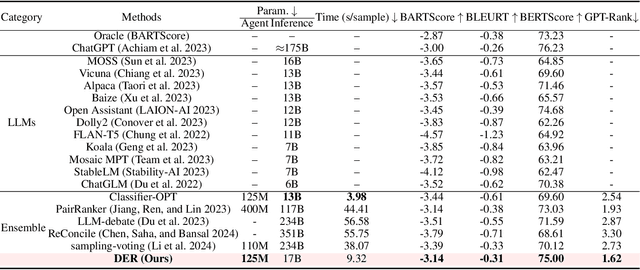
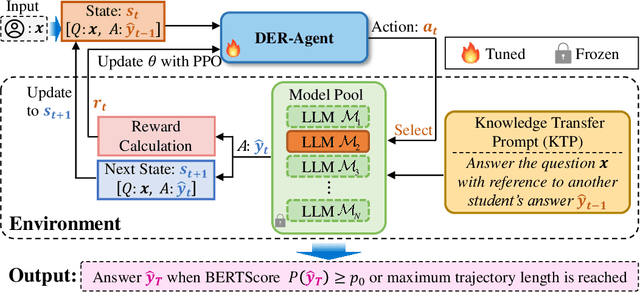
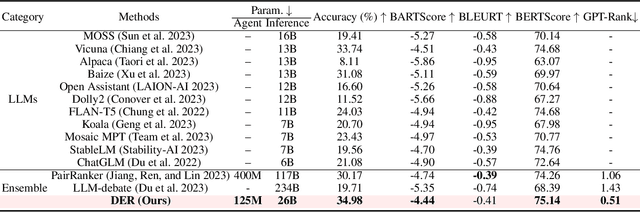
Ensemble reasoning for the strengths of different LLM experts is critical to achieving consistent and satisfactory performance on diverse inputs across a wide range of tasks. However, existing LLM ensemble methods are either computationally intensive or incapable of leveraging complementary knowledge among LLM experts for various inputs. In this paper, we propose a Dynamic Ensemble Reasoning paradigm, called DER to integrate the strengths of multiple LLM experts conditioned on dynamic inputs. Specifically, we model the LLM ensemble reasoning problem as a Markov Decision Process (MDP), wherein an agent sequentially takes inputs to request knowledge from an LLM candidate and passes the output to a subsequent LLM candidate. Moreover, we devise a reward function to train a DER-Agent to dynamically select an optimal answering route given the input questions, aiming to achieve the highest performance with as few computational resources as possible. Last, to fully transfer the expert knowledge from the prior LLMs, we develop a Knowledge Transfer Prompt (KTP) that enables the subsequent LLM candidates to transfer complementary knowledge effectively. Experiments demonstrate that our method uses fewer computational resources to achieve better performance compared to state-of-the-art baselines.