 Add to Chrome
 Add to Firefox
 Add to Edge
Pointer-CAD: Unifying B-Rep and Command Sequences via Pointer-based Edges & Faces Selection
Mar 04, 2026
Constructing computer-aided design (CAD) models is labor-intensive but essential for engineering and manufacturing. Recent advances in Large Language Models (LLMs) have inspired the LLM-based CAD generation by representing CAD as command sequences. But these methods struggle in practical scenarios because command sequence representation does not support entity selection (e.g. faces or edges), limiting its ability to support complex editing operations such as chamfer or fillet. Further, the discretization of a continuous variable during sketch and extrude operations may result in topological errors. To address these limitations, we present Pointer-CAD, a novel LLM-based CAD generation framework that leverages a pointer-based command sequence representation to explicitly incorporate the geometric information of B-rep models into sequential modeling. In particular, Pointer-CAD decomposes CAD model generation into steps, conditioning the generation of each subsequent step on both the textual description and the B-rep generated from previous steps. Whenever an operation requires the selection of a specific geometric entity, the LLM predicts a Pointer that selects the most feature-consistent candidate from the available set. Such a selection operation also reduces the quantization error in the command sequence-based representation. To support the training of Pointer-CAD, we develop a data annotation pipeline that produces expert-level natural language descriptions and apply it to build a dataset of approximately 575K CAD models. Extensive experimental results demonstrate that Pointer-CAD effectively supports the generation of complex geometric structures and reduces segmentation error to an extremely low level, achieving a significant improvement over prior command sequence methods, thereby significantly mitigating the topological inaccuracies introduced by quantization error.

Hierarchical Action Learning for Weakly-Supervised Action Segmentation
Feb 27, 2026Humans perceive actions through key transitions that structure actions across multiple abstraction levels, whereas machines, relying on visual features, tend to over-segment. This highlights the difficulty of enabling hierarchical reasoning in video understanding. Interestingly, we observe that lower-level visual and high-level action latent variables evolve at different rates, with low-level visual variables changing rapidly, while high-level action variables evolve more slowly, making them easier to identify. Building on this insight, we propose the Hierarchical Action Learning (\textbf{HAL}) model for weakly-supervised action segmentation. Our approach introduces a hierarchical causal data generation process, where high-level latent action governs the dynamics of low-level visual features. To model these varying timescales effectively, we introduce deterministic processes to align these latent variables over time. The \textbf{HAL} model employs a hierarchical pyramid transformer to capture both visual features and latent variables, and a sparse transition constraint is applied to enforce the slower dynamics of high-level action variables. This mechanism enhances the identification of these latent variables over time. Under mild assumptions, we prove that these latent action variables are strictly identifiable. Experimental results on several benchmarks show that the \textbf{HAL} model significantly outperforms existing methods for weakly-supervised action segmentation, confirming its practical effectiveness in real-world applications.
LatentChem: From Textual CoT to Latent Thinking in Chemical Reasoning
Feb 06, 2026Chemical large language models (LLMs) predominantly rely on explicit Chain-of-Thought (CoT) in natural language to perform complex reasoning. However, chemical reasoning is inherently continuous and structural, and forcing it into discrete linguistic tokens introduces a fundamental representation mismatch that constrains both efficiency and performance. We introduce LatentChem, a latent reasoning interface that decouples chemical computation from textual generation, enabling models to perform multi-step reasoning directly in continuous latent space while emitting language only for final outputs. Remarkably, we observe a consistent emergent behavior: when optimized solely for task success, models spontaneously internalize reasoning, progressively abandoning verbose textual derivations in favor of implicit latent computation. This shift is not merely stylistic but computationally advantageous. Across diverse chemical reasoning benchmarks, LatentChem achieves a 59.88\% non-tie win rate over strong CoT-based baselines on ChemCoTBench, while delivering a 10.84$\times$ average inference speedup. Our results provide empirical evidence that chemical reasoning is more naturally and effectively realized as continuous latent dynamics rather than discretized linguistic trajectories.
CUPID: Pose-Grounded Generative 3D Reconstruction from a Single Image
Oct 23, 2025This work proposes a new generation-based 3D reconstruction method, named Cupid, that accurately infers the camera pose, 3D shape, and texture of an object from a single 2D image. Cupid casts 3D reconstruction as a conditional sampling process from a learned distribution of 3D objects, and it jointly generates voxels and pixel-voxel correspondences, enabling robust pose and shape estimation under a unified generative framework. By representing both input camera poses and 3D shape as a distribution in a shared 3D latent space, Cupid adopts a two-stage flow matching pipeline: (1) a coarse stage that produces initial 3D geometry with associated 2D projections for pose recovery; and (2) a refinement stage that integrates pose-aligned image features to enhance structural fidelity and appearance details. Extensive experiments demonstrate Cupid outperforms leading 3D reconstruction methods with an over 3 dB PSNR gain and an over 10% Chamfer Distance reduction, while matching monocular estimators on pose accuracy and delivering superior visual fidelity over baseline 3D generative models. For an immersive view of the 3D results generated by Cupid, please visit cupid3d.github.io.
SRUM: Fine-Grained Self-Rewarding for Unified Multimodal Models
Oct 14, 2025Recently, remarkable progress has been made in Unified Multimodal Models (UMMs), which integrate vision-language generation and understanding capabilities within a single framework. However, a significant gap exists where a model's strong visual understanding often fails to transfer to its visual generation. A model might correctly understand an image based on user instructions, yet be unable to generate a faithful image from text prompts. This phenomenon directly raises a compelling question: Can a model achieve self-improvement by using its understanding module to reward its generation module? To bridge this gap and achieve self-improvement, we introduce SRUM, a self-rewarding post-training framework that can be directly applied to existing UMMs of various designs. SRUM creates a feedback loop where the model's own understanding module acts as an internal ``evaluator'', providing corrective signals to improve its generation module, without requiring additional human-labeled data. To ensure this feedback is comprehensive, we designed a global-local dual reward system. To tackle the inherent structural complexity of images, this system offers multi-scale guidance: a \textbf{global reward} ensures the correctness of the overall visual semantics and layout, while a \textbf{local reward} refines fine-grained, object-level fidelity. SRUM leads to powerful capabilities and shows strong generalization, boosting performance on T2I-CompBench from 82.18 to \textbf{88.37} and on T2I-ReasonBench from 43.82 to \textbf{46.75}. Overall, our work establishes a powerful new paradigm for enabling a UMMs' understanding module to guide and enhance its own generation via self-rewarding.
Mesh Silksong: Auto-Regressive Mesh Generation as Weaving Silk
Jul 03, 2025We introduce Mesh Silksong, a compact and efficient mesh representation tailored to generate the polygon mesh in an auto-regressive manner akin to silk weaving. Existing mesh tokenization methods always produce token sequences with repeated vertex tokens, wasting the network capability. Therefore, our approach tokenizes mesh vertices by accessing each mesh vertice only once, reduces the token sequence's redundancy by 50\%, and achieves a state-of-the-art compression rate of approximately 22\%. Furthermore, Mesh Silksong produces polygon meshes with superior geometric properties, including manifold topology, watertight detection, and consistent face normals, which are critical for practical applications. Experimental results demonstrate the effectiveness of our approach, showcasing not only intricate mesh generation but also significantly improved geometric integrity.
Recollection from Pensieve: Novel View Synthesis via Learning from Uncalibrated Videos
May 19, 2025Currently almost all state-of-the-art novel view synthesis and reconstruction models rely on calibrated cameras or additional geometric priors for training. These prerequisites significantly limit their applicability to massive uncalibrated data. To alleviate this requirement and unlock the potential for self-supervised training on large-scale uncalibrated videos, we propose a novel two-stage strategy to train a view synthesis model from only raw video frames or multi-view images, without providing camera parameters or other priors. In the first stage, we learn to reconstruct the scene implicitly in a latent space without relying on any explicit 3D representation. Specifically, we predict per-frame latent camera and scene context features, and employ a view synthesis model as a proxy for explicit rendering. This pretraining stage substantially reduces the optimization complexity and encourages the network to learn the underlying 3D consistency in a self-supervised manner. The learned latent camera and implicit scene representation have a large gap compared with the real 3D world. To reduce this gap, we introduce the second stage training by explicitly predicting 3D Gaussian primitives. We additionally apply explicit Gaussian Splatting rendering loss and depth projection loss to align the learned latent representations with physically grounded 3D geometry. In this way, Stage 1 provides a strong initialization and Stage 2 enforces 3D consistency - the two stages are complementary and mutually beneficial. Extensive experiments demonstrate the effectiveness of our approach, achieving high-quality novel view synthesis and accurate camera pose estimation, compared to methods that employ supervision with calibration, pose, or depth information. The code is available at https://github.com/Dwawayu/Pensieve.
Seeing from Another Perspective: Evaluating Multi-View Understanding in MLLMs
Apr 21, 2025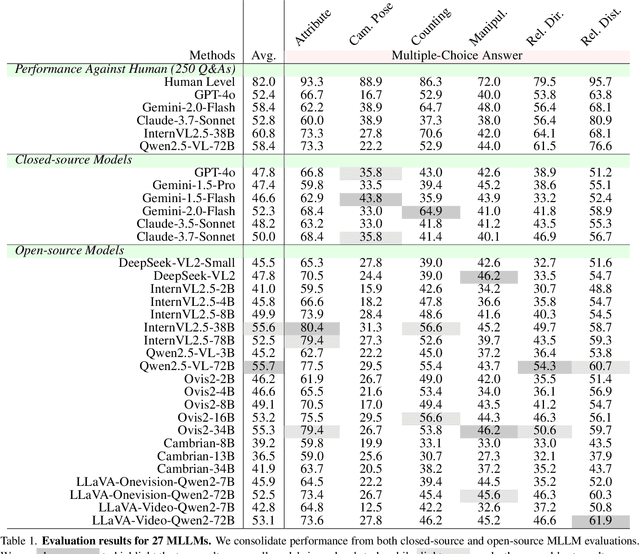

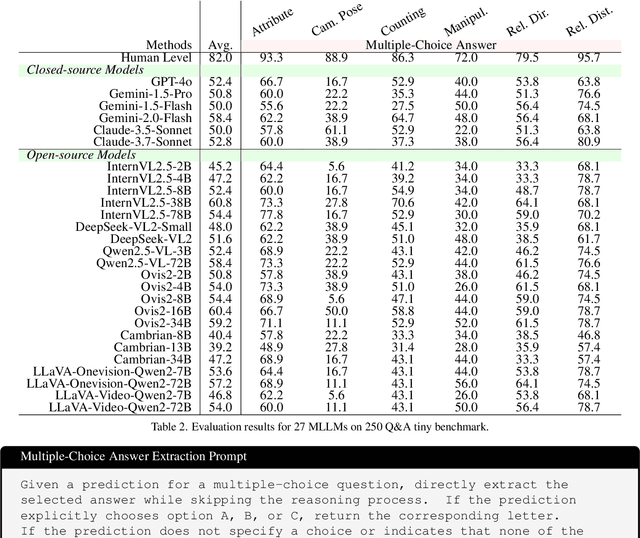
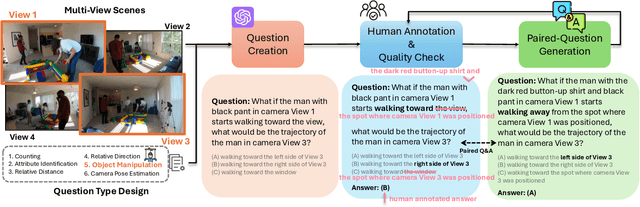
Multi-view understanding, the ability to reconcile visual information across diverse viewpoints for effective navigation, manipulation, and 3D scene comprehension, is a fundamental challenge in Multi-Modal Large Language Models (MLLMs) to be used as embodied agents. While recent MLLMs have shown impressive advances in high-level reasoning and planning, they frequently fall short when confronted with multi-view geometric consistency and cross-view correspondence. To comprehensively evaluate the challenges of MLLMs in multi-view scene reasoning, we propose All-Angles Bench, a benchmark of over 2,100 human carefully annotated multi-view question-answer pairs across 90 diverse real-world scenes. Our six tasks (counting, attribute identification, relative distance, relative direction, object manipulation, and camera pose estimation) specifically test model's geometric correspondence and the capacity to align information consistently across views. Our extensive experiments, benchmark on 27 representative MLLMs including Gemini-2.0-Flash, Claude-3.7-Sonnet, and GPT-4o against human evaluators reveals a substantial performance gap, indicating that current MLLMs remain far from human-level proficiency. Through in-depth analysis, we show that MLLMs are particularly underperforming under two aspects: (1) cross-view correspondence for partially occluded views and (2) establishing the coarse camera poses. These findings highlight the necessity of domain-specific refinements or modules that embed stronger multi-view awareness. We believe that our All-Angles Bench offers valuable insights and contribute to bridging the gap between MLLMs and human-level multi-view understanding. The project and benchmark are publicly available at https://danielchyeh.github.io/All-Angles-Bench/.
Multi-Sensor Object Anomaly Detection: Unifying Appearance, Geometry, and Internal Properties
Dec 19, 2024
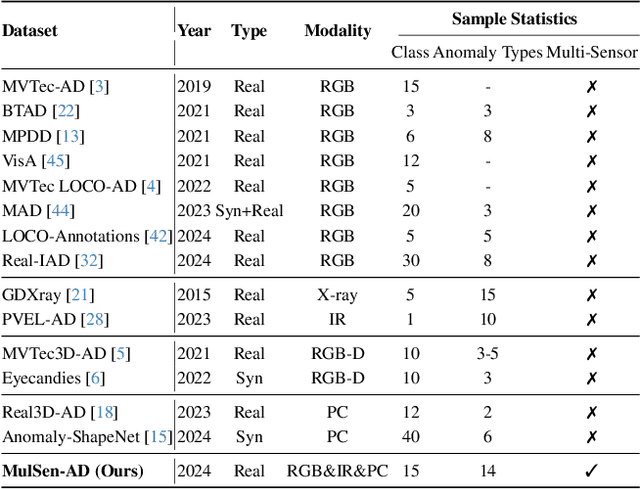


Object anomaly detection is essential for industrial quality inspection, yet traditional single-sensor methods face critical limitations. They fail to capture the wide range of anomaly types, as single sensors are often constrained to either external appearance, geometric structure, or internal properties. To overcome these challenges, we introduce MulSen-AD, the first high-resolution, multi-sensor anomaly detection dataset tailored for industrial applications. MulSen-AD unifies data from RGB cameras, laser scanners, and lock-in infrared thermography, effectively capturing external appearance, geometric deformations, and internal defects. The dataset spans 15 industrial products with diverse, real-world anomalies. We also present MulSen-AD Bench, a benchmark designed to evaluate multi-sensor methods, and propose MulSen-TripleAD, a decision-level fusion algorithm that integrates these three modalities for robust, unsupervised object anomaly detection. Our experiments demonstrate that multi-sensor fusion substantially outperforms single-sensor approaches, achieving 96.1% AUROC in object-level detection accuracy. These results highlight the importance of integrating multi-sensor data for comprehensive industrial anomaly detection.
FreeSplatter: Pose-free Gaussian Splatting for Sparse-view 3D Reconstruction
Dec 12, 2024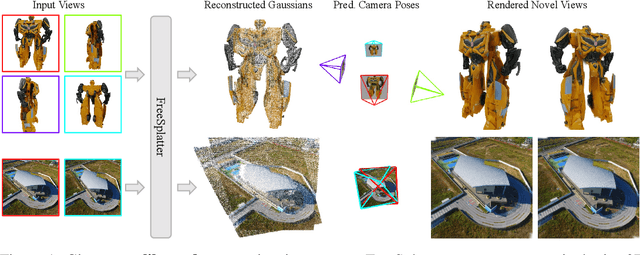
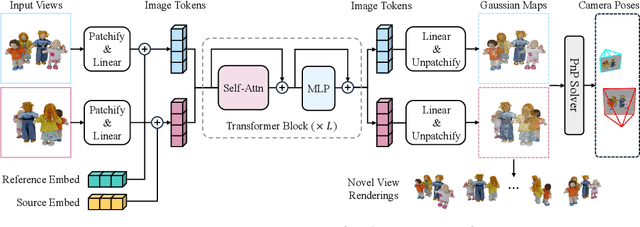
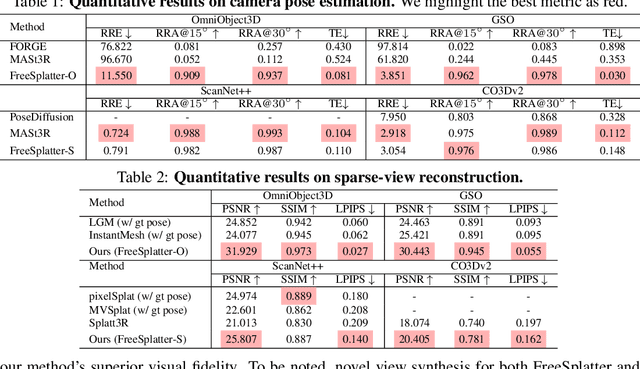
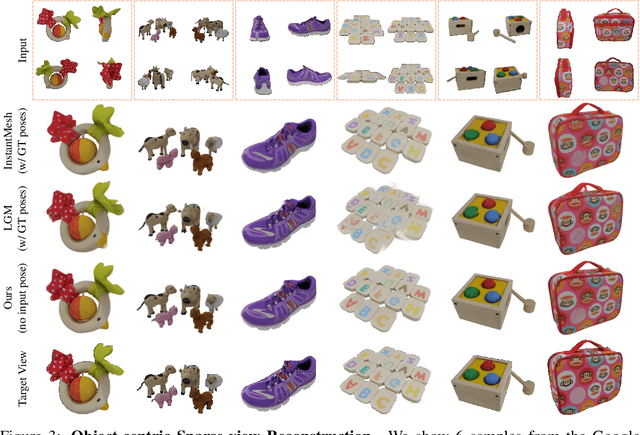
Existing sparse-view reconstruction models heavily rely on accurate known camera poses. However, deriving camera extrinsics and intrinsics from sparse-view images presents significant challenges. In this work, we present FreeSplatter, a highly scalable, feed-forward reconstruction framework capable of generating high-quality 3D Gaussians from uncalibrated sparse-view images and recovering their camera parameters in mere seconds. FreeSplatter is built upon a streamlined transformer architecture, comprising sequential self-attention blocks that facilitate information exchange among multi-view image tokens and decode them into pixel-wise 3D Gaussian primitives. The predicted Gaussian primitives are situated in a unified reference frame, allowing for high-fidelity 3D modeling and instant camera parameter estimation using off-the-shelf solvers. To cater to both object-centric and scene-level reconstruction, we train two model variants of FreeSplatter on extensive datasets. In both scenarios, FreeSplatter outperforms state-of-the-art baselines in terms of reconstruction quality and pose estimation accuracy. Furthermore, we showcase FreeSplatter's potential in enhancing the productivity of downstream applications, such as text/image-to-3D content creation.