 Add to Chrome
 Add to Firefox
 Add to Edge
Beyond Myopic World Models: Long-Horizon End-to-End Training for Direct Future Prediction
Aug 07, 2026
World models are expected to support imagination over extended temporal horizons, yet most are still trained through local few-step prediction objectives and deployed by recursively rolling out their own predictions. This creates a fundamental mismatch: few-step losses optimize local transition fidelity, while long-horizon prediction depends on how errors and gradients propagate through the entire trajectory. As a result, transitions with different downstream influence on the endpoint are treated uniformly during training, and small local errors are amplified through recursive inference. We argue that long-horizon accuracy is better achieved by optimizing directly, through an end-to-end endpoint prediction objective. To instantiate this paradigm, we introduce the Direct Prediction World Model (DPWM), a non-recursive architecture that compresses an action sequence of arbitrary length into a single embedding and predicts the endpoint observation in a single forward pass. This design avoids recurrent rollout in both prediction and gradient propagation, making long-horizon end-to-end training practical at horizons where unrolled autoregressive training becomes unstable. Empirically, DPWM substantially improves long-horizon endpoint prediction over recursive world-model baselines on continuous-control and pixel-based benchmarks, with larger gains as the prediction horizon increases. We further show that recurrent baselines benefit similarly when retrained with the same long-horizon endpoint objective, supporting our central claim that the training objective, rather than the particular backbone choice, is the main driver of long-horizon prediction accuracy. Our results suggest that world models can benefit from being trained and evaluated at the temporal scales where they are ultimately used, shifting the focus from local transition modeling toward long-horizon predictive accuracy.

Toward a mechanistic understanding of inference in visual cortex and diffusion models
Jul 17, 2026We describe a model of perceptual inference in primary visual cortex (V1) equivalent to a minimal diffusion model whose function can be readily understood from its parameters. The model is based on sparse coding with a non-factorial prior over latent variables in the form of an unconstrained, pairwise interaction matrix, extending standard sparse coding inference to a general recurrent dynamical system. We efficiently train these recurrent dynamics using a denoising score-matching objective and implicit differentiation. After training on natural images, the learned interaction matrix mirrors the structure of horizontal connections in superficial layers of V1 that link neurons of similar orientation tuning. This model exhibits exceptionally good denoising performance, restoring image features such as extended contours amid extreme visual ambiguity, nearly matching the behavior of standard, black-box diffusion architectures in generalization regime. Owing to the model's simplicity, the network's Jacobian can be decomposed directly in terms of the interaction matrix between latent variables, revealing mechanistically how the recurrent dynamics assign high probability over a continuous family of natural structural deformations. Intriguingly, within this circuit, a large fraction of latent variables learn to disconnect from visual input altogether, essentially forming a hierarchical representation that appears to enforce global consistency among image features. Together, the model and results bridge two distinct domains: for neuroscience, it generates concrete, testable hypotheses regarding functional connectivity in recurrent neural circuits during perceptual inference tasks; for machine learning, it elucidates the internal mechanisms learned by diffusion models that allow them to generate infinitely many novel images from a finite training set.
Concept-Guided Spatial Regularization for World Models in Atari Pong
Jul 16, 2026World models are usually evaluated as components of model-based reinforcement learning (MBRL) systems, while the world models themselves are rarely studied in isolation. We examine five representative visual world-model agents in Atari Pong: DreamerV3, DIAMOND, TWISTER, Simulus, and STORM. After reproducing their training pipelines and matching the reported agent performance, we freeze the learned world models and evaluate them with a closed-loop rollout diagnostic: a policy trained separately from the corresponding MBRL agent interacts with each frozen model, and the generated video trajectories are inspected for visual and dynamical errors. Across all five models, the rollouts contain clear failures, including ball disappearance, incorrect ball motion, and invalid ball-paddle interactions. Beyond visual trajectories, we further evaluate them with pixel-space zero-shot MBRL, where a new policy is trained entirely inside a frozen world model and then evaluated in the real environment. Across all five models, the resulting policies substantially underperform those produced by the corresponding original MBRL training pipelines. The gap is particularly large for DreamerV3, whose mean return drops from -5.5 to -20.9, near the minimum Pong return of -21. We hypothesize that insufficient modeling of task-critical concepts, such as the ball in Pong, may contribute to these failures. We therefore propose Concept-Guided Spatial Regularization (CGSReg), an auxiliary pixel reconstruction loss applied to segmented concept regions. Experiments show that CGSReg improves both closed-loop rollouts and pixel-space zero-shot MBRL in DreamerV3, DIAMOND, and TWISTER. Its effects vary across the remaining models and evaluation metrics, indicating that CGSReg alone does not address all world-model bottlenecks.
MotionPyramid: Hierarchical Motion Representation and Residual Interfaces
Jun 15, 2026We ask whether the representational hierarchy seen in perception, from local primitives such as edges to higher level structures such as parts and objects, can be established for motion. In humanoid control, low level actions specify immediate motor commands, while meaningful behavior is organized over longer temporal scales, including contacts, gait fragments, balance recovery, reaching, and whole body skills. We introduce MotionPyramid, a hierarchical action representation that learns such structure from motion data. Starting from a motion tracking teacher, it trains a recursive stack of latent decoders: low level latents decode to immediate full body motor commands, while higher level latents unfold through lower levels into temporally extended motion programs. After pretraining, the hierarchy is frozen and reused by downstream reinforcement learning policies as a family of action interfaces at different control resolutions. Experiments show the learned levels form a motion hierarchy: coarser interfaces improve early learning and motion regularity by constraining exploration to structured segments, while finer interfaces preserve feedback control and final task precision. Representation probes show the hierarchy supports traversal, interpolation, transition, and qualitative composition, exposing editable control handles across temporal scales. Finally, we introduce Residual Interfaces, letting a downstream policy maintain coarse, segment level, and frame level residual commands through the frozen hierarchy. Analogous to residual or skip connections in deep networks, this allows coarse motion programs and fine residual corrections to coexist within one controller. MotionPyramid shows that motion, like perception, can be organized into a reusable multi level representation, providing structured abstraction without sacrificing controllability.
Deep Networks Favor Simple Data
Apr 02, 2026Estimated density is often interpreted as indicating how typical a sample is under a model. Yet deep models trained on one dataset can assign higher density to simpler out-of-distribution (OOD) data than to in-distribution test data. We refer to this behavior as the OOD anomaly. Prior work typically studies this phenomenon within a single architecture, detector, or benchmark, implicitly assuming certain canonical densities. We instead separate the trained network from the density estimator built from its representations or outputs. We introduce two estimators: Jacobian-based estimators and autoregressive self-estimators, making density analysis applicable to a wide range of models. Applying this perspective to a range of models, including iGPT, PixelCNN++, Glow, score-based diffusion models, DINOv2, and I-JEPA, we find the same striking regularity that goes beyond the OOD anomaly: lower-complexity samples receive higher estimated density, while higher-complexity samples receive lower estimated density. This ordering appears within a test set and across OOD pairs such as CIFAR-10 and SVHN, and remains highly consistent across independently trained models. To quantify these orderings, we introduce Spearman rank correlation and find striking agreement both across models and with external complexity metrics. Even when trained only on the lowest-density (most complex) samples - or even a single such sample - the resulting models still rank simpler images as higher density. These observations lead us beyond the original OOD anomaly to a more general conclusion: deep networks consistently favor simple data. Our goal is not to close this question, but to define and visualize it more clearly. We broaden its empirical scope and show that it appears across architectures, objectives, and density estimators.
When Models Know When They Do Not Know: Calibration, Cascading, and Cleaning
Jan 12, 2026When a model knows when it does not know, many possibilities emerge. The first question is how to enable a model to recognize that it does not know. A promising approach is to use confidence, computed from the model's internal signals, to reflect its ignorance. Prior work in specific domains has shown that calibration can provide reliable confidence estimates. In this work, we propose a simple, effective, and universal training-free method that applies to both vision and language models, performing model calibration, cascading, and data cleaning to better exploit a model's ability to recognize when it does not know. We first highlight two key empirical observations: higher confidence corresponds to higher accuracy within a single model, and models calibrated on the validation set remain calibrated on a held-out test set. These findings empirically establish the reliability and comparability of calibrated confidence. Building on this, we introduce two applications: (1) model cascading with calibrated advantage routing and (2) data cleaning based on model ensemble. Using the routing signal derived from the comparability of calibrated confidences, we cascade large and small models to improve efficiency with almost no compromise in accuracy, and we further cascade two models of comparable scale to achieve performance beyond either model alone. Leveraging multiple experts and their calibrated confidences, we design a simple yet effective data-cleaning method that balances precision and detection rate to identify mislabeled samples in ImageNet and Massive Multitask Language Understanding (MMLU) datasets. Our results demonstrate that enabling models to recognize when they do not know is a practical step toward more efficient, reliable, and trustworthy AI.
Clone Deterministic 3D Worlds with Geometrically-Regularized World Models
Oct 30, 2025A world model is an internal model that simulates how the world evolves. Given past observations and actions, it predicts the future of both the embodied agent and its environment. Accurate world models are essential for enabling agents to think, plan, and reason effectively in complex, dynamic settings. Despite rapid progress, current world models remain brittle and degrade over long horizons. We argue that a central cause is representation quality: exteroceptive inputs (e.g., images) are high-dimensional, and lossy or entangled latents make dynamics learning unnecessarily hard. We therefore ask whether improving representation learning alone can substantially improve world-model performance. In this work, we take a step toward building a truly accurate world model by addressing a fundamental yet open problem: constructing a model that can fully clone and overfit to a deterministic 3D world. We propose Geometrically-Regularized World Models (GRWM), which enforces that consecutive points along a natural sensory trajectory remain close in latent representation space. This approach yields significantly improved latent representations that align closely with the true topology of the environment. GRWM is plug-and-play, requires only minimal architectural modification, scales with trajectory length, and is compatible with diverse latent generative backbones. Across deterministic 3D settings and long-horizon prediction tasks, GRWM significantly increases rollout fidelity and stability. Analyses show that its benefits stem from learning a latent manifold with superior geometric structure. These findings support a clear takeaway: improving representation learning is a direct and useful path to robust world models, delivering reliable long-horizon predictions without enlarging the dynamics module.
Seeing from Another Perspective: Evaluating Multi-View Understanding in MLLMs
Apr 21, 2025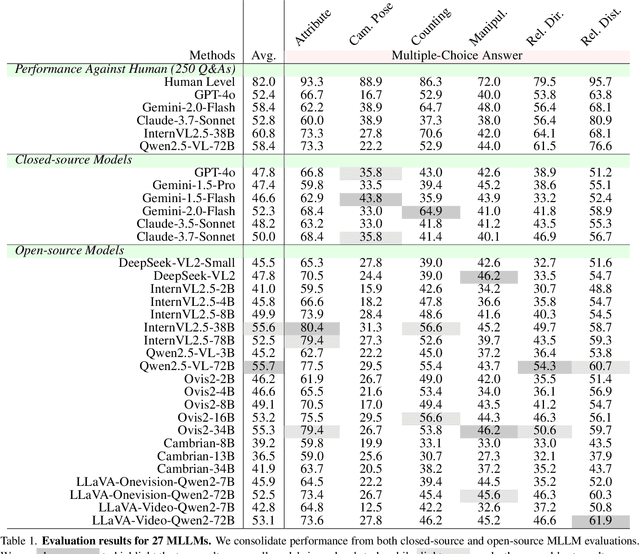

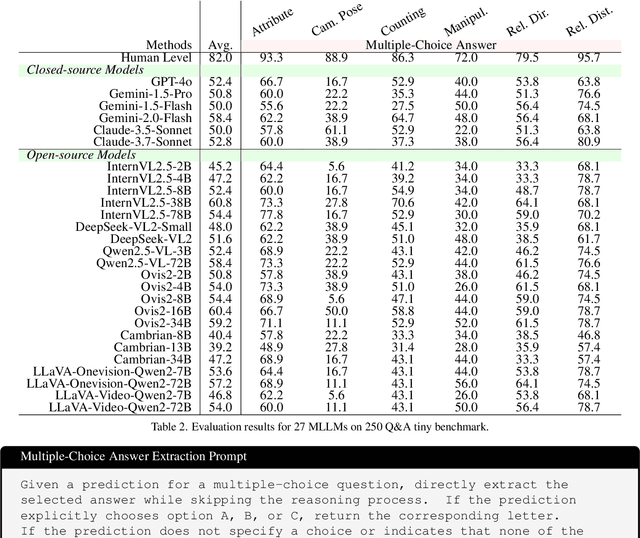
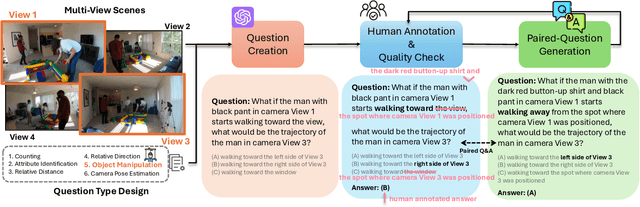
Multi-view understanding, the ability to reconcile visual information across diverse viewpoints for effective navigation, manipulation, and 3D scene comprehension, is a fundamental challenge in Multi-Modal Large Language Models (MLLMs) to be used as embodied agents. While recent MLLMs have shown impressive advances in high-level reasoning and planning, they frequently fall short when confronted with multi-view geometric consistency and cross-view correspondence. To comprehensively evaluate the challenges of MLLMs in multi-view scene reasoning, we propose All-Angles Bench, a benchmark of over 2,100 human carefully annotated multi-view question-answer pairs across 90 diverse real-world scenes. Our six tasks (counting, attribute identification, relative distance, relative direction, object manipulation, and camera pose estimation) specifically test model's geometric correspondence and the capacity to align information consistently across views. Our extensive experiments, benchmark on 27 representative MLLMs including Gemini-2.0-Flash, Claude-3.7-Sonnet, and GPT-4o against human evaluators reveals a substantial performance gap, indicating that current MLLMs remain far from human-level proficiency. Through in-depth analysis, we show that MLLMs are particularly underperforming under two aspects: (1) cross-view correspondence for partially occluded views and (2) establishing the coarse camera poses. These findings highlight the necessity of domain-specific refinements or modules that embed stronger multi-view awareness. We believe that our All-Angles Bench offers valuable insights and contribute to bridging the gap between MLLMs and human-level multi-view understanding. The project and benchmark are publicly available at https://danielchyeh.github.io/All-Angles-Bench/.
Neural Motion Simulator: Pushing the Limit of World Models in Reinforcement Learning
Apr 09, 2025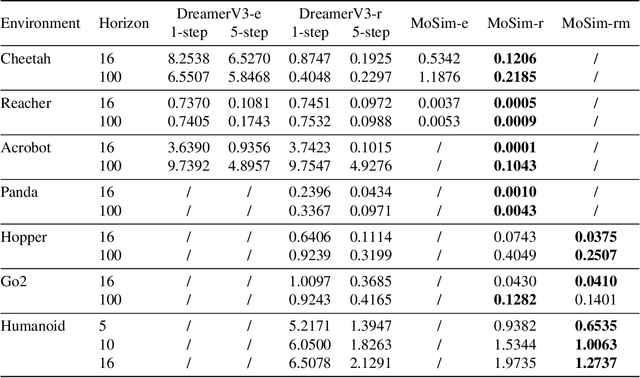
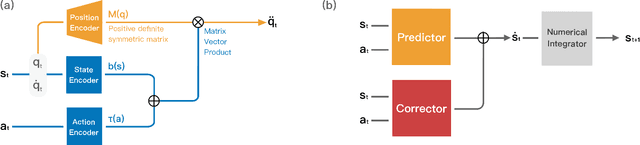
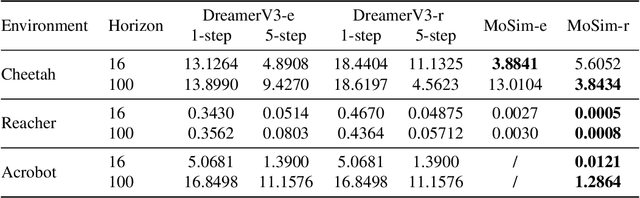
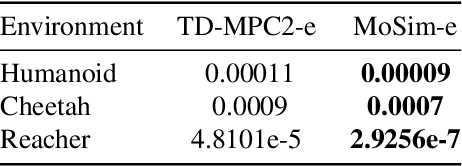
An embodied system must not only model the patterns of the external world but also understand its own motion dynamics. A motion dynamic model is essential for efficient skill acquisition and effective planning. In this work, we introduce the neural motion simulator (MoSim), a world model that predicts the future physical state of an embodied system based on current observations and actions. MoSim achieves state-of-the-art performance in physical state prediction and provides competitive performance across a range of downstream tasks. This works shows that when a world model is accurate enough and performs precise long-horizon predictions, it can facilitate efficient skill acquisition in imagined worlds and even enable zero-shot reinforcement learning. Furthermore, MoSim can transform any model-free reinforcement learning (RL) algorithm into a model-based approach, effectively decoupling physical environment modeling from RL algorithm development. This separation allows for independent advancements in RL algorithms and world modeling, significantly improving sample efficiency and enhancing generalization capabilities. Our findings highlight that world models for motion dynamics is a promising direction for developing more versatile and capable embodied systems.
Task-Driven Semantic Quantization and Imitation Learning for Goal-Oriented Communications
Feb 25, 2025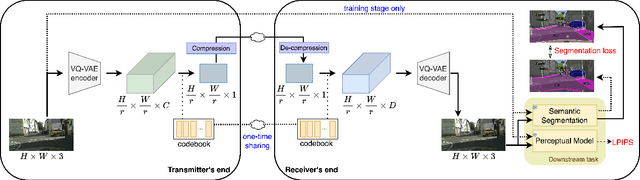

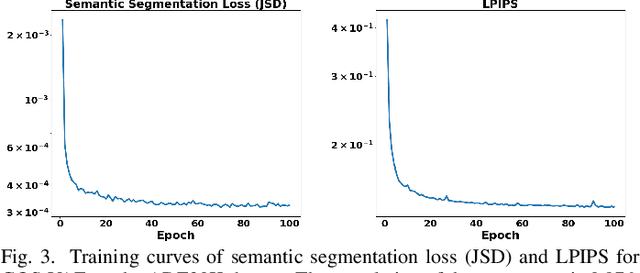
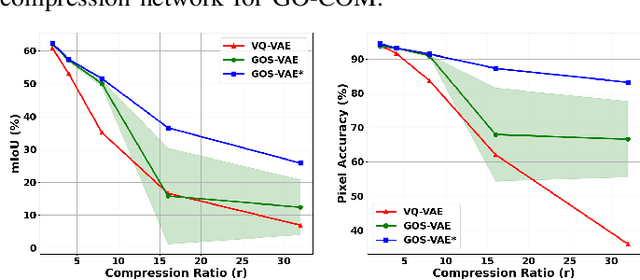
Semantic communication marks a new paradigm shift from bit-wise data transmission to semantic information delivery for the purpose of bandwidth reduction. To more effectively carry out specialized downstream tasks at the receiver end, it is crucial to define the most critical semantic message in the data based on the task or goal-oriented features. In this work, we propose a novel goal-oriented communication (GO-COM) framework, namely Goal-Oriented Semantic Variational Autoencoder (GOS-VAE), by focusing on the extraction of the semantics vital to the downstream tasks. Specifically, we adopt a Vector Quantized Variational Autoencoder (VQ-VAE) to compress media data at the transmitter side. Instead of targeting the pixel-wise image data reconstruction, we measure the quality-of-service at the receiver end based on a pre-defined task-incentivized model. Moreover, to capture the relevant semantic features in the data reconstruction, imitation learning is adopted to measure the data regeneration quality in terms of goal-oriented semantics. Our experimental results demonstrate the power of imitation learning in characterizing goal-oriented semantics and bandwidth efficiency of our proposed GOS-VAE.