 Add to Chrome
 Add to Firefox
 Add to Edge
Zero-Shot Robotic Manipulation with Pretrained Image-Editing Diffusion Models
Oct 16, 2023
If generalist robots are to operate in truly unstructured environments, they need to be able to recognize and reason about novel objects and scenarios. Such objects and scenarios might not be present in the robot's own training data. We propose SuSIE, a method that leverages an image-editing diffusion model to act as a high-level planner by proposing intermediate subgoals that a low-level controller can accomplish. Specifically, we finetune InstructPix2Pix on video data, consisting of both human videos and robot rollouts, such that it outputs hypothetical future "subgoal" observations given the robot's current observation and a language command. We also use the robot data to train a low-level goal-conditioned policy to act as the aforementioned low-level controller. We find that the high-level subgoal predictions can utilize Internet-scale pretraining and visual understanding to guide the low-level goal-conditioned policy, achieving significantly better generalization and precision than conventional language-conditioned policies. We achieve state-of-the-art results on the CALVIN benchmark, and also demonstrate robust generalization on real-world manipulation tasks, beating strong baselines that have access to privileged information or that utilize orders of magnitude more compute and training data. The project website can be found at http://rail-berkeley.github.io/susie .

Latent Conservative Objective Models for Data-Driven Crystal Structure Prediction
Oct 16, 2023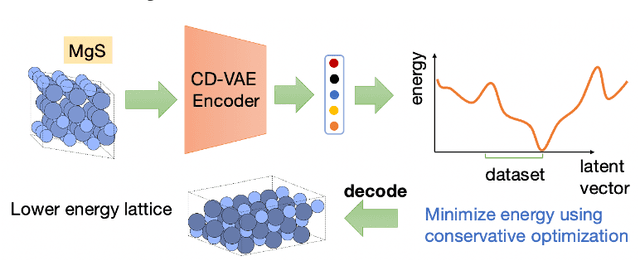

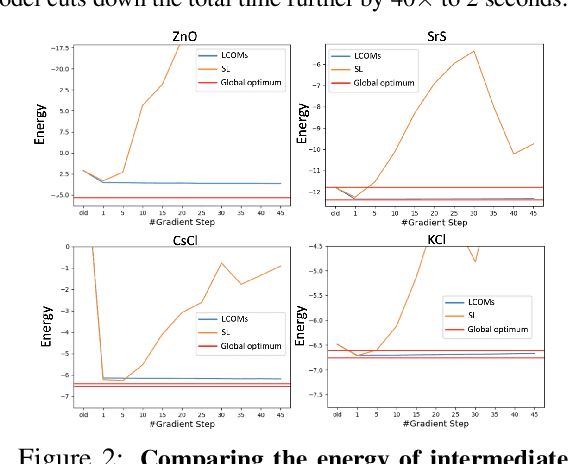

In computational chemistry, crystal structure prediction (CSP) is an optimization problem that involves discovering the lowest energy stable crystal structure for a given chemical formula. This problem is challenging as it requires discovering globally optimal designs with the lowest energies on complex manifolds. One approach to tackle this problem involves building simulators based on density functional theory (DFT) followed by running search in simulation, but these simulators are painfully slow. In this paper, we study present and study an alternate, data-driven approach to crystal structure prediction: instead of directly searching for the most stable structures in simulation, we train a surrogate model of the crystal formation energy from a database of existing crystal structures, and then optimize this model with respect to the parameters of the crystal structure. This surrogate model is trained to be conservative so as to prevent exploitation of its errors by the optimizer. To handle optimization in the non-Euclidean space of crystal structures, we first utilize a state-of-the-art graph diffusion auto-encoder (CD-VAE) to convert a crystal structure into a vector-based search space and then optimize a conservative surrogate model of the crystal energy, trained on top of this vector representation. We show that our approach, dubbed LCOMs (latent conservative objective models), performs comparably to the best current approaches in terms of success rate of structure prediction, while also drastically reducing computational cost.
Navigation with Large Language Models: Semantic Guesswork as a Heuristic for Planning
Oct 16, 2023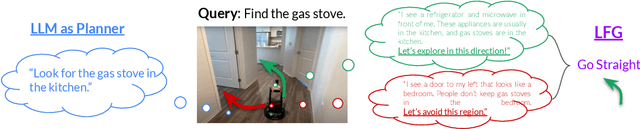
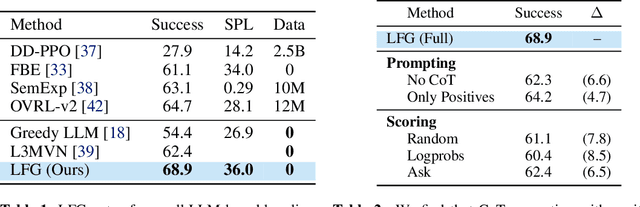
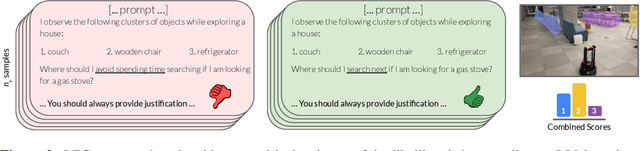
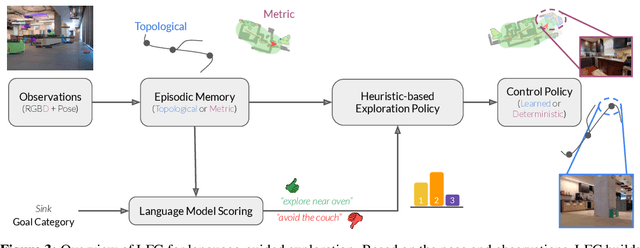
Navigation in unfamiliar environments presents a major challenge for robots: while mapping and planning techniques can be used to build up a representation of the world, quickly discovering a path to a desired goal in unfamiliar settings with such methods often requires lengthy mapping and exploration. Humans can rapidly navigate new environments, particularly indoor environments that are laid out logically, by leveraging semantics -- e.g., a kitchen often adjoins a living room, an exit sign indicates the way out, and so forth. Language models can provide robots with such knowledge, but directly using language models to instruct a robot how to reach some destination can also be impractical: while language models might produce a narrative about how to reach some goal, because they are not grounded in real-world observations, this narrative might be arbitrarily wrong. Therefore, in this paper we study how the ``semantic guesswork'' produced by language models can be utilized as a guiding heuristic for planning algorithms. Our method, Language Frontier Guide (LFG), uses the language model to bias exploration of novel real-world environments by incorporating the semantic knowledge stored in language models as a search heuristic for planning with either topological or metric maps. We evaluate LFG in challenging real-world environments and simulated benchmarks, outperforming uninformed exploration and other ways of using language models.
METRA: Scalable Unsupervised RL with Metric-Aware Abstraction
Oct 13, 2023Unsupervised pre-training strategies have proven to be highly effective in natural language processing and computer vision. Likewise, unsupervised reinforcement learning (RL) holds the promise of discovering a variety of potentially useful behaviors that can accelerate the learning of a wide array of downstream tasks. Previous unsupervised RL approaches have mainly focused on pure exploration and mutual information skill learning. However, despite the previous attempts, making unsupervised RL truly scalable still remains a major open challenge: pure exploration approaches might struggle in complex environments with large state spaces, where covering every possible transition is infeasible, and mutual information skill learning approaches might completely fail to explore the environment due to the lack of incentives. To make unsupervised RL scalable to complex, high-dimensional environments, we propose a novel unsupervised RL objective, which we call Metric-Aware Abstraction (METRA). Our main idea is, instead of directly covering the entire state space, to only cover a compact latent space $Z$ that is metrically connected to the state space $S$ by temporal distances. By learning to move in every direction in the latent space, METRA obtains a tractable set of diverse behaviors that approximately cover the state space, being scalable to high-dimensional environments. Through our experiments in five locomotion and manipulation environments, we demonstrate that METRA can discover a variety of useful behaviors even in complex, pixel-based environments, being the first unsupervised RL method that discovers diverse locomotion behaviors in pixel-based Quadruped and Humanoid. Our code and videos are available at https://seohong.me/projects/metra/
Offline Retraining for Online RL: Decoupled Policy Learning to Mitigate Exploration Bias
Oct 12, 2023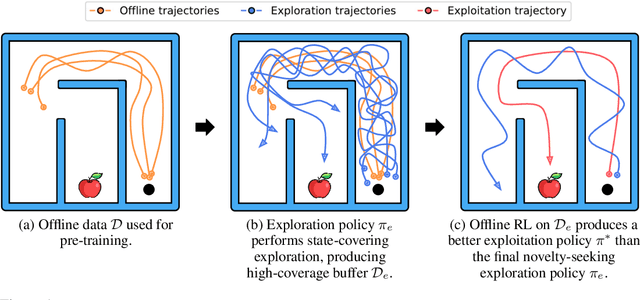
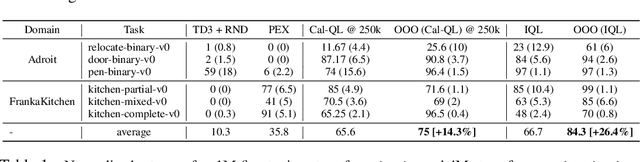
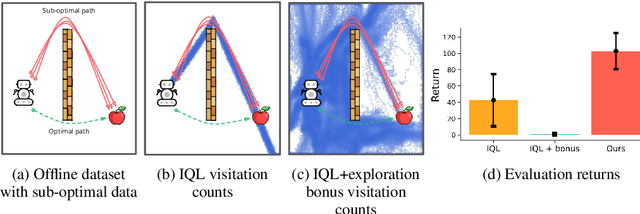

It is desirable for policies to optimistically explore new states and behaviors during online reinforcement learning (RL) or fine-tuning, especially when prior offline data does not provide enough state coverage. However, exploration bonuses can bias the learned policy, and our experiments find that naive, yet standard use of such bonuses can fail to recover a performant policy. Concurrently, pessimistic training in offline RL has enabled recovery of performant policies from static datasets. Can we leverage offline RL to recover better policies from online interaction? We make a simple observation that a policy can be trained from scratch on all interaction data with pessimistic objectives, thereby decoupling the policies used for data collection and for evaluation. Specifically, we propose offline retraining, a policy extraction step at the end of online fine-tuning in our Offline-to-Online-to-Offline (OOO) framework for reinforcement learning (RL). An optimistic (exploration) policy is used to interact with the environment, and a separate pessimistic (exploitation) policy is trained on all the observed data for evaluation. Such decoupling can reduce any bias from online interaction (intrinsic rewards, primacy bias) in the evaluation policy, and can allow more exploratory behaviors during online interaction which in turn can generate better data for exploitation. OOO is complementary to several offline-to-online RL and online RL methods, and improves their average performance by 14% to 26% in our fine-tuning experiments, achieves state-of-the-art performance on several environments in the D4RL benchmarks, and improves online RL performance by 165% on two OpenAI gym environments. Further, OOO can enable fine-tuning from incomplete offline datasets where prior methods can fail to recover a performant policy. Implementation: https://github.com/MaxSobolMark/OOO
NoMaD: Goal Masked Diffusion Policies for Navigation and Exploration
Oct 11, 2023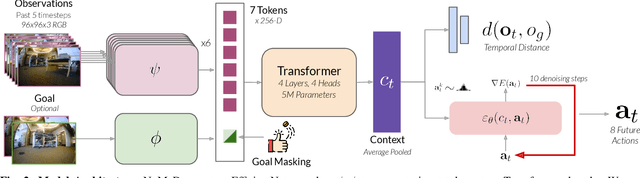
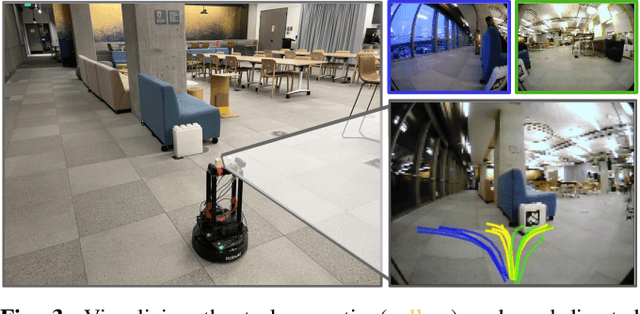
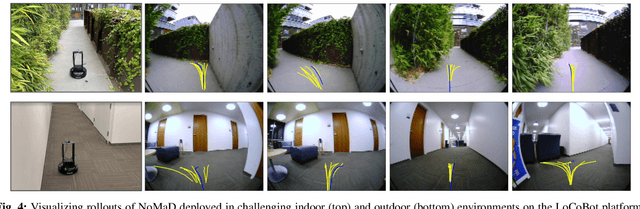

Robotic learning for navigation in unfamiliar environments needs to provide policies for both task-oriented navigation (i.e., reaching a goal that the robot has located), and task-agnostic exploration (i.e., searching for a goal in a novel setting). Typically, these roles are handled by separate models, for example by using subgoal proposals, planning, or separate navigation strategies. In this paper, we describe how we can train a single unified diffusion policy to handle both goal-directed navigation and goal-agnostic exploration, with the latter providing the ability to search novel environments, and the former providing the ability to reach a user-specified goal once it has been located. We show that this unified policy results in better overall performance when navigating to visually indicated goals in novel environments, as compared to approaches that use subgoal proposals from generative models, or prior methods based on latent variable models. We instantiate our method by using a large-scale Transformer-based policy trained on data from multiple ground robots, with a diffusion model decoder to flexibly handle both goal-conditioned and goal-agnostic navigation. Our experiments, conducted on a real-world mobile robot platform, show effective navigation in unseen environments in comparison with five alternative methods, and demonstrate significant improvements in performance and lower collision rates, despite utilizing smaller models than state-of-the-art approaches. For more videos, code, and pre-trained model checkpoints, see https://general-navigation-models.github.io/nomad/
Deep Neural Networks Tend To Extrapolate Predictably
Oct 02, 2023

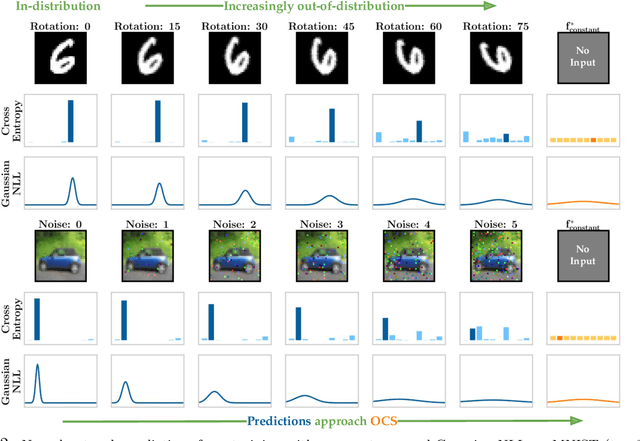

Conventional wisdom suggests that neural network predictions tend to be unpredictable and overconfident when faced with out-of-distribution (OOD) inputs. Our work reassesses this assumption for neural networks with high-dimensional inputs. Rather than extrapolating in arbitrary ways, we observe that neural network predictions often tend towards a constant value as input data becomes increasingly OOD. Moreover, we find that this value often closely approximates the optimal constant solution (OCS), i.e., the prediction that minimizes the average loss over the training data without observing the input. We present results showing this phenomenon across 8 datasets with different distributional shifts (including CIFAR10-C and ImageNet-R, S), different loss functions (cross entropy, MSE, and Gaussian NLL), and different architectures (CNNs and transformers). Furthermore, we present an explanation for this behavior, which we first validate empirically and then study theoretically in a simplified setting involving deep homogeneous networks with ReLU activations. Finally, we show how one can leverage our insights in practice to enable risk-sensitive decision-making in the presence of OOD inputs.
Robotic Offline RL from Internet Videos via Value-Function Pre-Training
Sep 22, 2023Pre-training on Internet data has proven to be a key ingredient for broad generalization in many modern ML systems. What would it take to enable such capabilities in robotic reinforcement learning (RL)? Offline RL methods, which learn from datasets of robot experience, offer one way to leverage prior data into the robotic learning pipeline. However, these methods have a "type mismatch" with video data (such as Ego4D), the largest prior datasets available for robotics, since video offers observation-only experience without the action or reward annotations needed for RL methods. In this paper, we develop a system for leveraging large-scale human video datasets in robotic offline RL, based entirely on learning value functions via temporal-difference learning. We show that value learning on video datasets learns representations that are more conducive to downstream robotic offline RL than other approaches for learning from video data. Our system, called V-PTR, combines the benefits of pre-training on video data with robotic offline RL approaches that train on diverse robot data, resulting in value functions and policies for manipulation tasks that perform better, act robustly, and generalize broadly. On several manipulation tasks on a real WidowX robot, our framework produces policies that greatly improve over prior methods. Our video and additional details can be found at https://dibyaghosh.com/vptr/
Q-Transformer: Scalable Offline Reinforcement Learning via Autoregressive Q-Functions
Sep 18, 2023
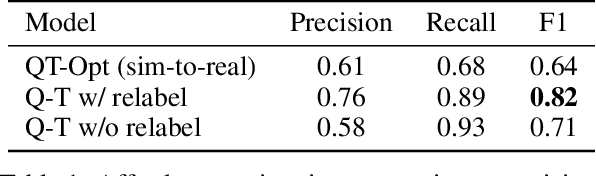

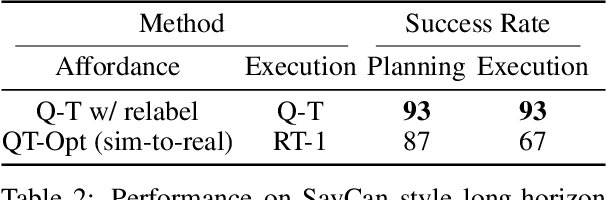
In this work, we present a scalable reinforcement learning method for training multi-task policies from large offline datasets that can leverage both human demonstrations and autonomously collected data. Our method uses a Transformer to provide a scalable representation for Q-functions trained via offline temporal difference backups. We therefore refer to the method as Q-Transformer. By discretizing each action dimension and representing the Q-value of each action dimension as separate tokens, we can apply effective high-capacity sequence modeling techniques for Q-learning. We present several design decisions that enable good performance with offline RL training, and show that Q-Transformer outperforms prior offline RL algorithms and imitation learning techniques on a large diverse real-world robotic manipulation task suite. The project's website and videos can be found at https://q-transformer.github.io
Bootstrapping Adaptive Human-Machine Interfaces with Offline Reinforcement Learning
Sep 07, 2023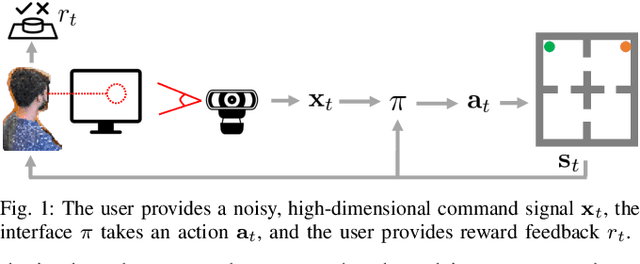
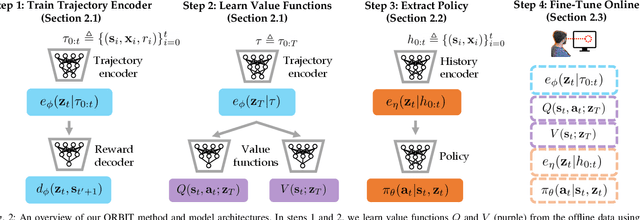
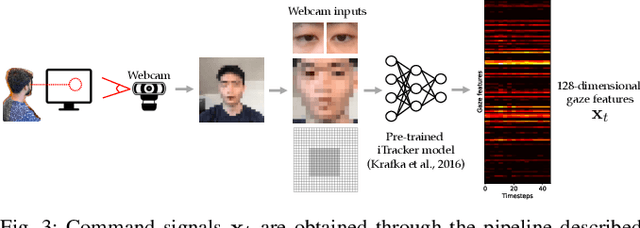
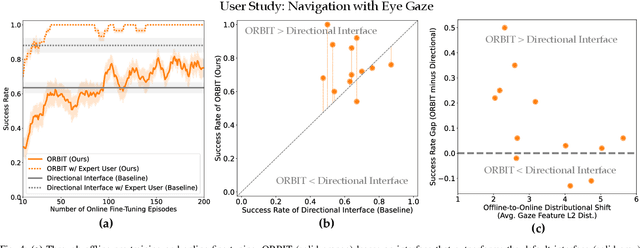
Adaptive interfaces can help users perform sequential decision-making tasks like robotic teleoperation given noisy, high-dimensional command signals (e.g., from a brain-computer interface). Recent advances in human-in-the-loop machine learning enable such systems to improve by interacting with users, but tend to be limited by the amount of data that they can collect from individual users in practice. In this paper, we propose a reinforcement learning algorithm to address this by training an interface to map raw command signals to actions using a combination of offline pre-training and online fine-tuning. To address the challenges posed by noisy command signals and sparse rewards, we develop a novel method for representing and inferring the user's long-term intent for a given trajectory. We primarily evaluate our method's ability to assist users who can only communicate through noisy, high-dimensional input channels through a user study in which 12 participants performed a simulated navigation task by using their eye gaze to modulate a 128-dimensional command signal from their webcam. The results show that our method enables successful goal navigation more often than a baseline directional interface, by learning to denoise user commands signals and provide shared autonomy assistance. We further evaluate on a simulated Sawyer pushing task with eye gaze control, and the Lunar Lander game with simulated user commands, and find that our method improves over baseline interfaces in these domains as well. Extensive ablation experiments with simulated user commands empirically motivate each component of our method.