 Add to Chrome
 Add to Firefox
 Add to Edge
Kimi K3: Open Frontier Intelligence
Jul 27, 2026
We introduce Kimi K3, a 2.8T parameter Mixture-of-Experts model with 104 billion activated parameters, native vision capabilities, and a 1-million-token context window. Kimi K3 is built on Kimi Delta Attention and Attention Residuals, which improve information flow across sequence length and model depth. Together with Stable LatentMoE, which effectively activates 16 of 896 routed experts per token, and refined training and data recipes, these advances yield an approximately 2.5x improvement in overall scaling efficiency over Kimi K2. Post-training highlights reinforcement learning across general, agentic, and coding domains and multiple reasoning-effort levels, enabling compositional generalization and robust long-horizon execution. At 2.8T scale, Kimi K3 is supported by infrastructure advances in multiple areas: algorithm-system co-design for KDA, perfectly balanced expert-parallel training with efficient memory management, million-token agentic RL with persistent rollout and sandbox states, and deployment innovations. Extensive evaluations show that Kimi K3 achieves frontier-level performance across long-horizon coding, agentic, knowledge, reasoning, and vision tasks. While its overall performance still trails the most powerful proprietary models, namely Claude Fable 5 and GPT-5.6 Sol, Kimi K3 consistently outperforms other open and proprietary models evaluated in our suite. We release the full Kimi K3 model weights to facilitate future research and accelerate the broader deployment and adoption of frontier intelligence.

EvoPolicyGym: Evaluating Autonomous Policy Evolution in Interactive Environments
Jul 02, 2026Autonomous agents are increasingly expected to improve executable policies through feedback, yet existing evaluations often collapse this process into a final score or confound it with open-ended software-engineering progress. We introduce Autonomous Policy Evolution, a controlled evaluation setting in which a harness-model agent repeatedly edits an executable policy system under a fixed interaction budget. We instantiate this setting in EvoPolicyGym, a benchmark built from compact interactive RL environments that evaluates how agents iteratively improve explored policies. On the EvoPolicyGym suite, GPT-5.5 achieves the strongest aggregate rank score and top-two performance on all 16 environments. Beyond leaderboard results, EvoPolicyGym also provides trajectory-level diagnostics that distinguish how agents allocate budget, convert feedback into parametric tuning. These analyses show that strong autonomous policy evolution depends not only on isolated task wins, but on discovering task-appropriate mechanisms and refining policies under bounded feedback.
Native Hybrid Attention for Efficient Sequence Modeling
Oct 08, 2025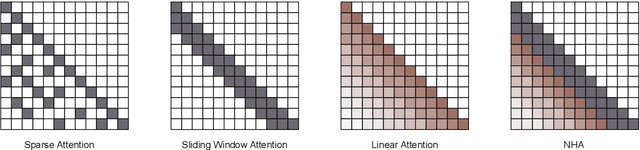
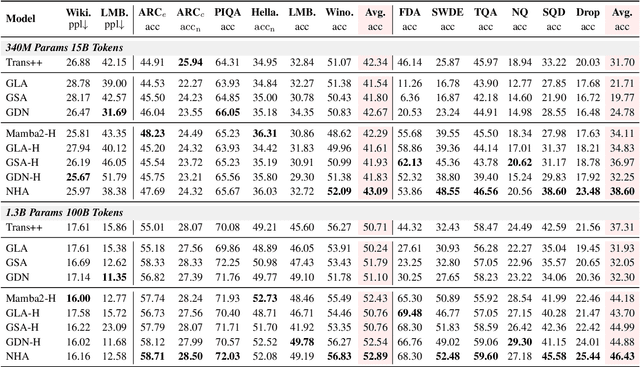
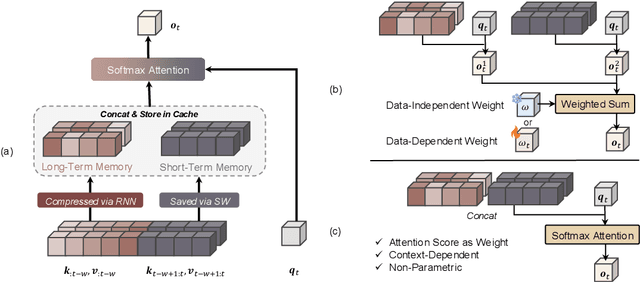
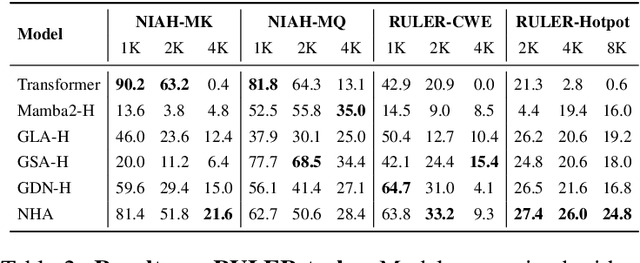
Transformers excel at sequence modeling but face quadratic complexity, while linear attention offers improved efficiency but often compromises recall accuracy over long contexts. In this work, we introduce Native Hybrid Attention (NHA), a novel hybrid architecture of linear and full attention that integrates both intra \& inter-layer hybridization into a unified layer design. NHA maintains long-term context in key-value slots updated by a linear RNN, and augments them with short-term tokens from a sliding window. A single \texttt{softmax attention} operation is then applied over all keys and values, enabling per-token and per-head context-dependent weighting without requiring additional fusion parameters. The inter-layer behavior is controlled through a single hyperparameter, the sliding window size, which allows smooth adjustment between purely linear and full attention while keeping all layers structurally uniform. Experimental results show that NHA surpasses Transformers and other hybrid baselines on recall-intensive and commonsense reasoning tasks. Furthermore, pretrained LLMs can be structurally hybridized with NHA, achieving competitive accuracy while delivering significant efficiency gains. Code is available at https://github.com/JusenD/NHA.
Liger: Linearizing Large Language Models to Gated Recurrent Structures
Mar 03, 2025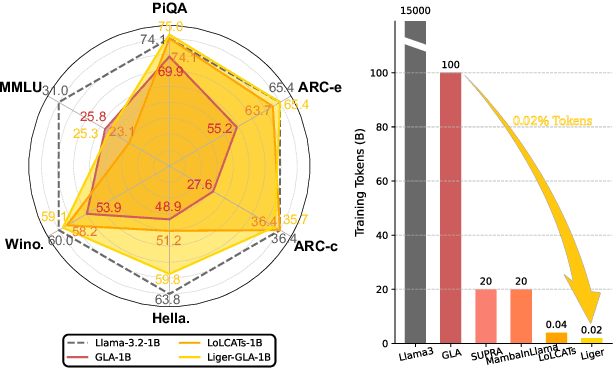
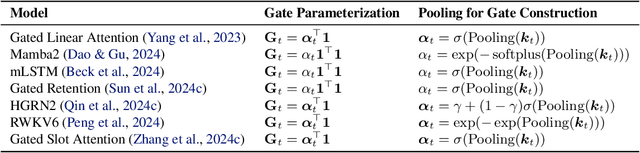
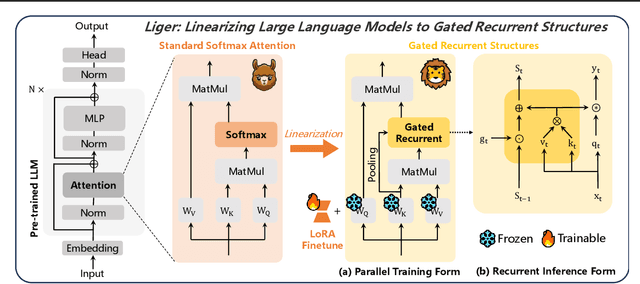
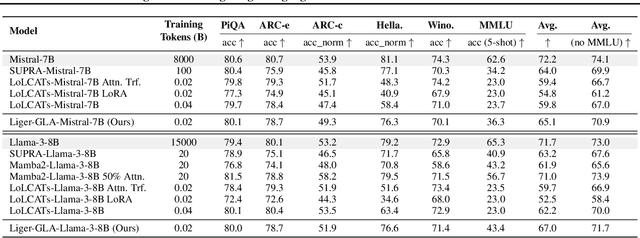
Transformers with linear recurrent modeling offer linear-time training and constant-memory inference. Despite their demonstrated efficiency and performance, pretraining such non-standard architectures from scratch remains costly and risky. The linearization of large language models (LLMs) transforms pretrained standard models into linear recurrent structures, enabling more efficient deployment. However, current linearization methods typically introduce additional feature map modules that require extensive fine-tuning and overlook the gating mechanisms used in state-of-the-art linear recurrent models. To address these issues, this paper presents Liger, short for Linearizing LLMs to gated recurrent structures. Liger is a novel approach for converting pretrained LLMs into gated linear recurrent models without adding extra parameters. It repurposes the pretrained key matrix weights to construct diverse gating mechanisms, facilitating the formation of various gated recurrent structures while avoiding the need to train additional components from scratch. Using lightweight fine-tuning with Low-Rank Adaptation (LoRA), Liger restores the performance of the linearized gated recurrent models to match that of the original LLMs. Additionally, we introduce Liger Attention, an intra-layer hybrid attention mechanism, which significantly recovers 93\% of the Transformer-based LLM at 0.02\% pre-training tokens during the linearization process, achieving competitive results across multiple benchmarks, as validated on models ranging from 1B to 8B parameters. Code is available at https://github.com/OpenSparseLLMs/Linearization.
MoM: Linear Sequence Modeling with Mixture-of-Memories
Feb 19, 2025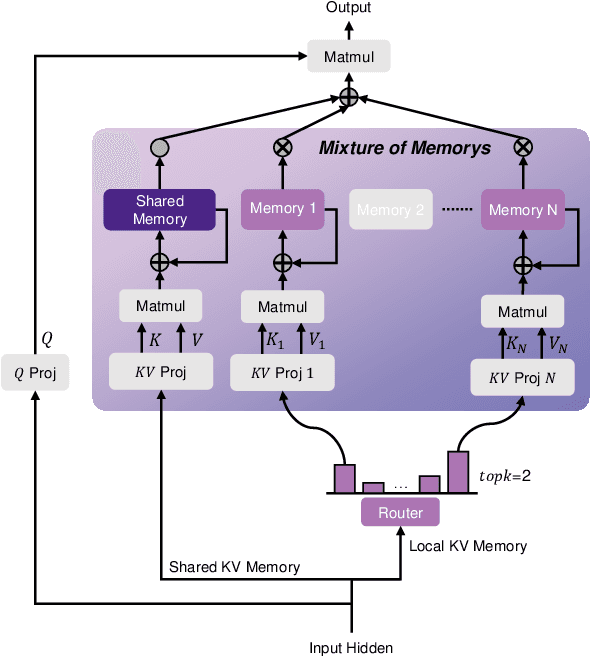
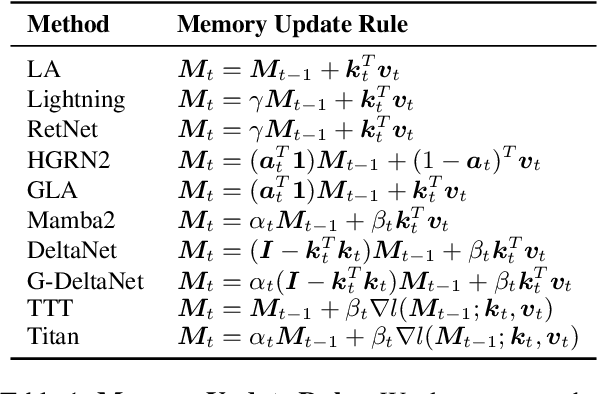
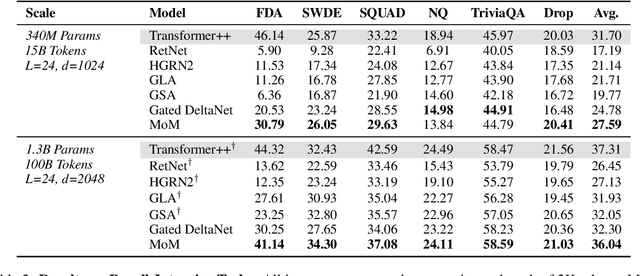
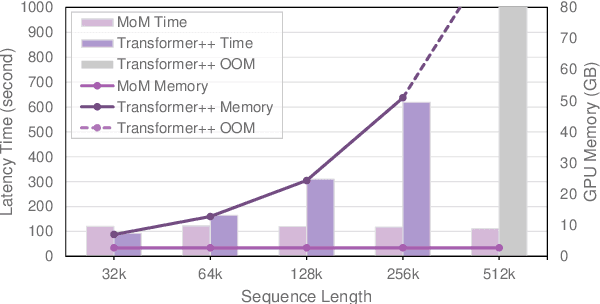
Linear sequence modeling methods, such as linear attention, state space modeling, and linear RNNs, offer significant efficiency improvements by reducing the complexity of training and inference. However, these methods typically compress the entire input sequence into a single fixed-size memory state, which leads to suboptimal performance on recall-intensive downstream tasks. Drawing inspiration from neuroscience, particularly the brain's ability to maintain robust long-term memory while mitigating "memory interference", we introduce a novel architecture called Mixture-of-Memories (MoM). MoM utilizes multiple independent memory states, with a router network directing input tokens to specific memory states. This approach greatly enhances the overall memory capacity while minimizing memory interference. As a result, MoM performs exceptionally well on recall-intensive tasks, surpassing existing linear sequence modeling techniques. Despite incorporating multiple memory states, the computation of each memory state remains linear in complexity, allowing MoM to retain the linear-complexity advantage during training, while constant-complexity during inference. Our experimental results show that MoM significantly outperforms current linear sequence models on downstream language tasks, particularly recall-intensive tasks, and even achieves performance comparable to Transformer models. The code is released at https://github.com/OpenSparseLLMs/MoM and is also released as a part of https://github.com/OpenSparseLLMs/Linear-MoE.