 Add to Chrome
 Add to Firefox
 Add to Edge
G-IdiomAlign: A Gloss-Pivoted Benchmark for Cross-Lingual Idiom Alignment
Jun 17, 2026
Idioms are difficult to transfer across languages due to their non-compositionality and weak surface-form grounding, making literal mappings unreliable. We present G-IdiomAlign, a gloss-pivoted benchmark where each idiom is anchored by an English gloss from Wiktionary. We further construct a high-confidence reference alignment set for reproducible evaluation. G-IdiomAlign supports two protocols: (1) a controlled Multiple-Choice Idiom Equivalence with typed distractors for error attribution; and (2) a Gloss-Contrastive Generation contrasting No-gloss and With-gloss inputs to isolate the effect of an explicit semantic pivot. Across diverse LLMs, a bias to literal translation is a dominant failure mode, especially when the target is a low-resource language. Glosses consistently improve Gloss-Contrastive Generation under an embedding-based semantic proxy, but performance remains modest, indicating substantial headroom in the open output space. Subsequent analysis on Qwen3-8B further suggests that cross-condition differences are concentrated more in attention heads than in layers, while better With-gloss generations coincide with stronger gloss anchoring.

Seeing the Poem: Image-Semantic Detection of AI-Generated Modern Chinese Poetry with MLLMs
May 21, 2026Previous detection studies have shown that LLMs cannot be effectively used as detectors, but these studies have not addressed modern Chinese poetry. Moreover, no relevant research has explored the performance of LLMs in detecting modern Chinese poetry. This paper evaluates and enhances the performance of LLMs as detectors for modern Chinese poetry, and proposes an image-semantic guided poetry detection method. Compared with traditional detection approaches, our method innovatively incorporates images that reflect the content of the poetry. Through example-driven approaches, our method effectively integrates information such as meaning, imagery, and feeling from the image, then forms a complementary judgment with the poem text. Experimental results demonstrate that the LLM detectors based on our method outperform baseline detectors based on plain text, and even surpass the best-performing traditional detector, RoBERTa. The Gemini detector using our method achieves a Macro-F1 score of 85.65%, reaching the state-of-the-art level. The performance improvements of different LLM detectors on multiple LLMs-generated data prove the effectiveness of our method.
Exposing the Cracks: Vulnerabilities of Retrieval-Augmented LLM-based Machine Translation
Oct 01, 2025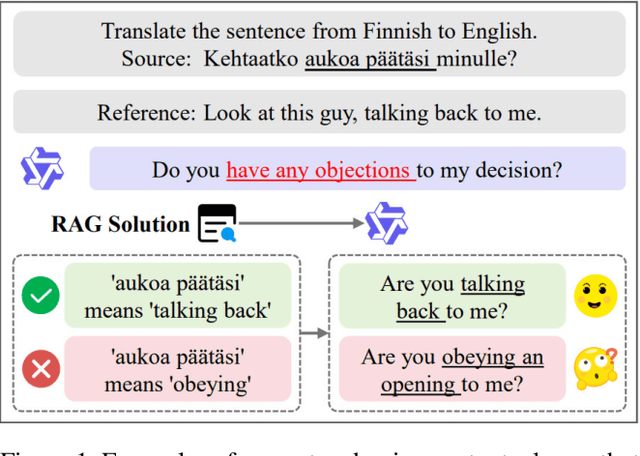
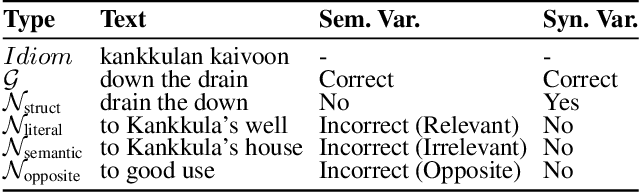
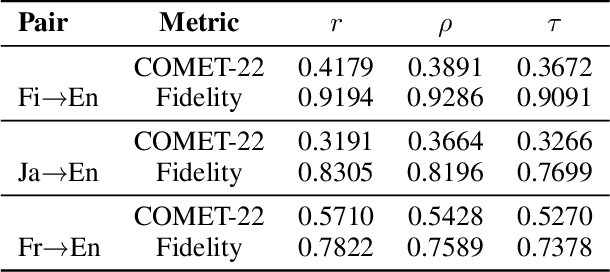
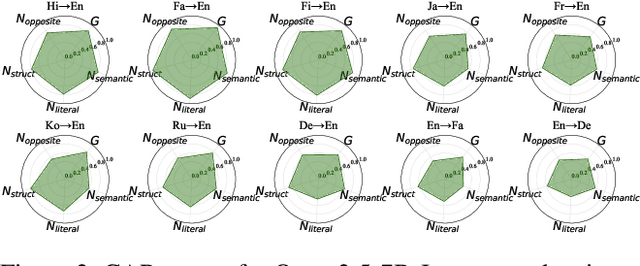
\textbf{RE}trieval-\textbf{A}ugmented \textbf{L}LM-based \textbf{M}achine \textbf{T}ranslation (REAL-MT) shows promise for knowledge-intensive tasks like idiomatic translation, but its reliability under noisy retrieval contexts remains poorly understood despite this being a common challenge in real-world deployment. To address this gap, we propose a noise synthesis framework and new metrics to evaluate the robustness of REAL-MT systematically. Using this framework, we instantiate REAL-MT with Qwen-series models, including standard LLMs and large reasoning models (LRMs) with enhanced reasoning, and evaluate their performance on idiomatic translation across high-, medium-, and low-resource language pairs under synthesized noise. Our results show that low-resource language pairs, which rely more heavily on retrieved context, degrade more severely under noise than high-resource ones and often produce nonsensical translations. Although LRMs possess enhanced reasoning capabilities, they show no improvement in error correction and are even more susceptible to noise, tending to rationalize incorrect contexts. We find that this stems from an attention shift away from the source idiom to noisy content, while confidence increases despite declining accuracy, indicating poor calibration. To mitigate these issues, we investigate training-free and fine-tuning strategies, which improve robustness at the cost of performance in clean contexts, revealing a fundamental trade-off. Our findings highlight the limitations of current approaches, underscoring the need for self-verifying integration mechanisms.