 Add to Chrome
 Add to Firefox
 Add to Edge
Evaluating Knowledge-based Cross-lingual Inconsistency in Large Language Models
Jul 01, 2024
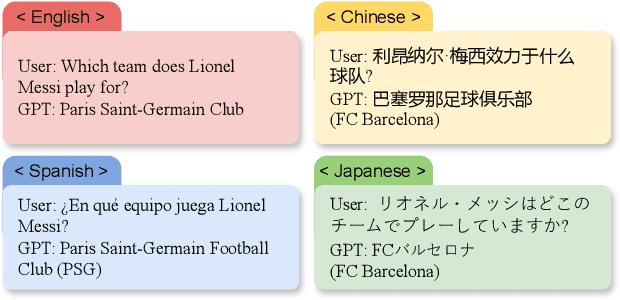
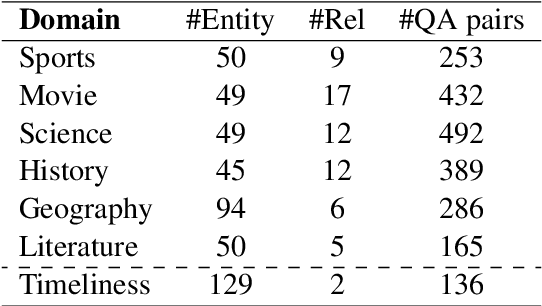
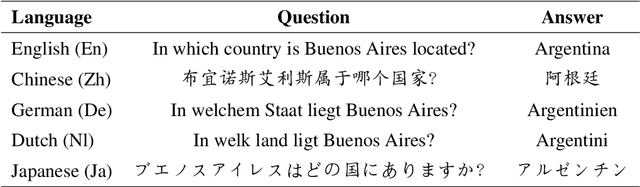
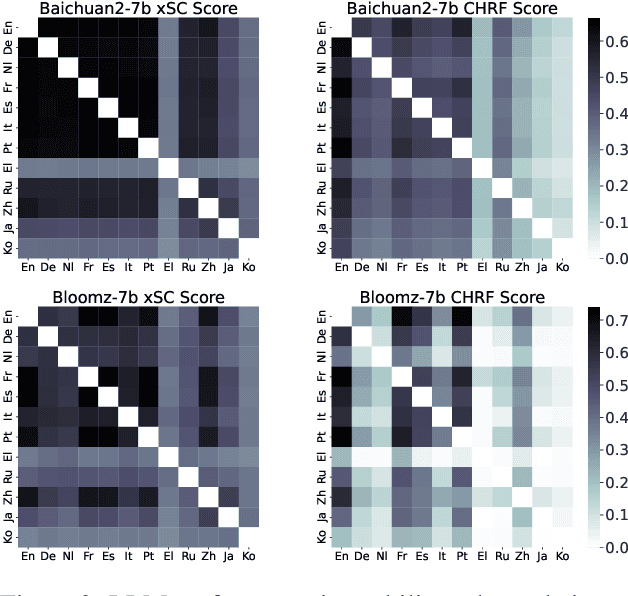
This paper investigates the cross-lingual inconsistencies observed in Large Language Models (LLMs), such as ChatGPT, Llama, and Baichuan, which have shown exceptional performance in various Natural Language Processing (NLP) tasks. Despite their successes, these models often exhibit significant inconsistencies when processing the same concepts across different languages. This study focuses on three primary questions: the existence of cross-lingual inconsistencies in LLMs, the specific aspects in which these inconsistencies manifest, and the correlation between cross-lingual consistency and multilingual capabilities of LLMs.To address these questions, we propose an innovative evaluation method for Cross-lingual Semantic Consistency (xSC) using the LaBSE model. We further introduce metrics for Cross-lingual Accuracy Consistency (xAC) and Cross-lingual Timeliness Consistency (xTC) to comprehensively assess the models' performance regarding semantic, accuracy, and timeliness inconsistencies. By harmonizing these metrics, we provide a holistic measurement of LLMs' cross-lingual consistency. Our findings aim to enhance the understanding and improvement of multilingual capabilities and interpretability in LLMs, contributing to the development of more robust and reliable multilingual language models.

Multimodal Physiological Signals Representation Learning via Multiscale Contrasting for Depression Recognition
Jun 26, 2024
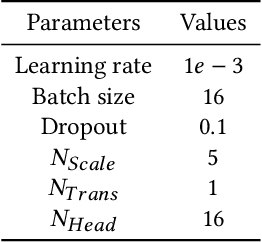

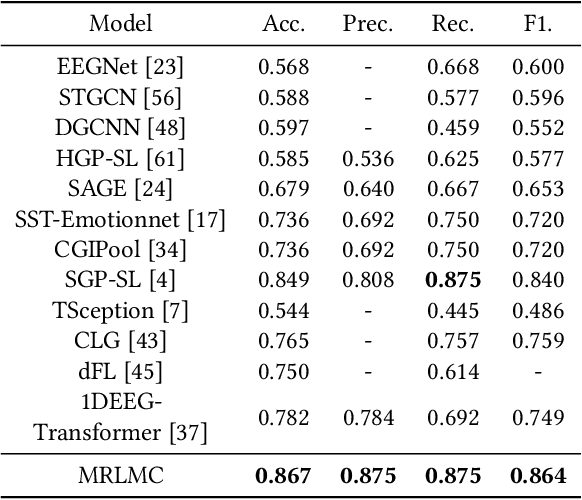
Depression recognition based on physiological signals such as functional near-infrared spectroscopy (fNIRS) and electroencephalogram (EEG) has made considerable progress. However, most existing studies ignore the complementarity and semantic consistency of multimodal physiological signals under the same stimulation task in complex spatio-temporal patterns. In this paper, we introduce a multimodal physiological signals representation learning framework using Siamese architecture via multiscale contrasting for depression recognition (MRLMC). First, fNIRS and EEG are transformed into different but correlated data based on a time-domain data augmentation strategy. Then, we design a spatio-temporal contrasting module to learn the representation of fNIRS and EEG through weight-sharing multiscale spatio-temporal convolution. Furthermore, to enhance the learning of semantic representation associated with stimulation tasks, a semantic consistency contrast module is proposed, aiming to maximize the semantic similarity of fNIRS and EEG. Extensive experiments on publicly available and self-collected multimodal physiological signals datasets indicate that MRLMC outperforms the state-of-the-art models. Moreover, our proposed framework is capable of transferring to multimodal time series downstream tasks.
Feature-prompting GBMSeg: One-Shot Reference Guided Training-Free Prompt Engineering for Glomerular Basement Membrane Segmentation
Jun 24, 2024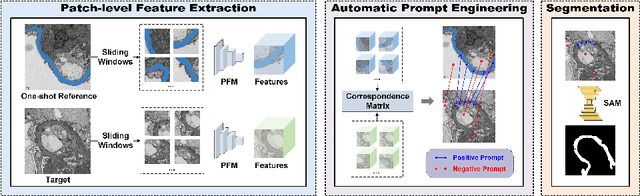
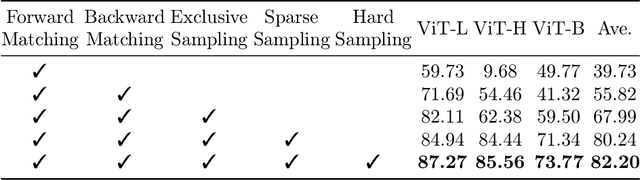

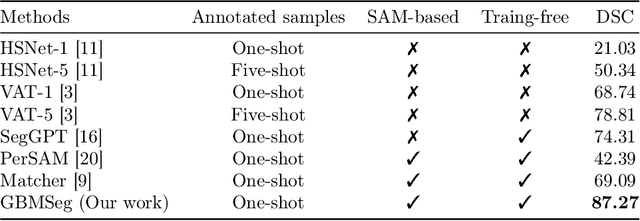
Assessment of the glomerular basement membrane (GBM) in transmission electron microscopy (TEM) is crucial for diagnosing chronic kidney disease (CKD). The lack of domain-independent automatic segmentation tools for the GBM necessitates an AI-based solution to automate the process. In this study, we introduce GBMSeg, a training-free framework designed to automatically segment the GBM in TEM images guided only by a one-shot annotated reference. Specifically, GBMSeg first exploits the robust feature matching capabilities of the pretrained foundation model to generate initial prompt points, then introduces a series of novel automatic prompt engineering techniques across the feature and physical space to optimize the prompt scheme. Finally, GBMSeg employs a class-agnostic foundation segmentation model with the generated prompt scheme to obtain accurate segmentation results. Experimental results on our collected 2538 TEM images confirm that GBMSeg achieves superior segmentation performance with a Dice similarity coefficient (DSC) of 87.27% using only one labeled reference image in a training-free manner, outperforming recently proposed one-shot or few-shot methods. In summary, GBMSeg introduces a distinctive automatic prompt framework that facilitates robust domain-independent segmentation performance without training, particularly advancing the automatic prompting of foundation segmentation models for medical images. Future work involves automating the thickness measurement of segmented GBM and quantifying pathological indicators, holding significant potential for advancing pathology assessments in clinical applications. The source code is available on https://github.com/SnowRain510/GBMSeg
On LLMs-Driven Synthetic Data Generation, Curation, and Evaluation: A Survey
Jun 14, 2024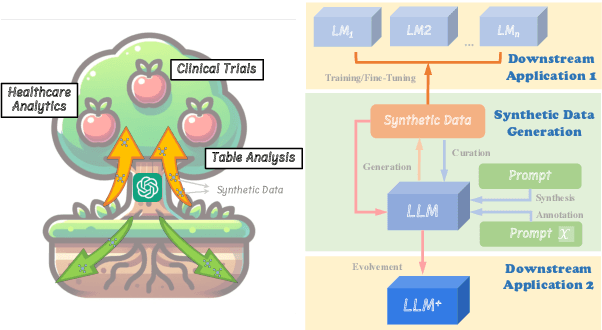
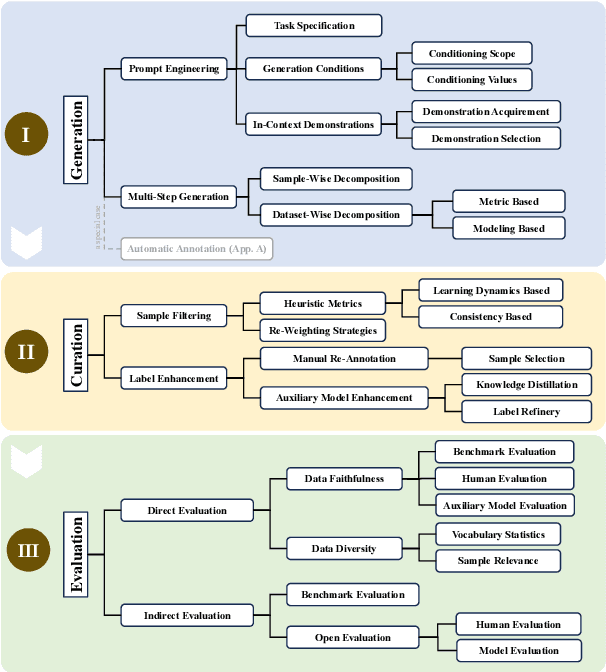
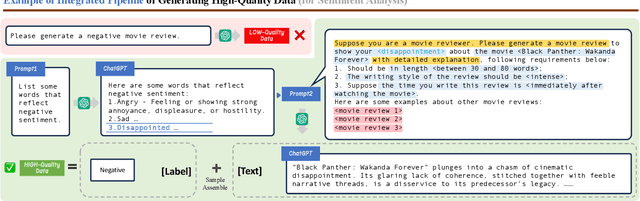
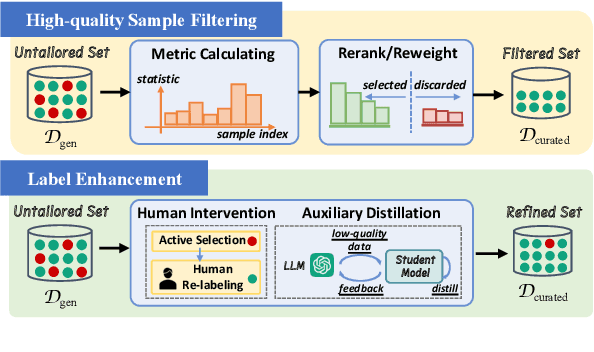
Within the evolving landscape of deep learning, the dilemma of data quantity and quality has been a long-standing problem. The recent advent of Large Language Models (LLMs) offers a data-centric solution to alleviate the limitations of real-world data with synthetic data generation. However, current investigations into this field lack a unified framework and mostly stay on the surface. Therefore, this paper provides an organization of relevant studies based on a generic workflow of synthetic data generation. By doing so, we highlight the gaps within existing research and outline prospective avenues for future study. This work aims to shepherd the academic and industrial communities towards deeper, more methodical inquiries into the capabilities and applications of LLMs-driven synthetic data generation.
EMMA: Your Text-to-Image Diffusion Model Can Secretly Accept Multi-Modal Prompts
Jun 13, 2024Recent advancements in image generation have enabled the creation of high-quality images from text conditions. However, when facing multi-modal conditions, such as text combined with reference appearances, existing methods struggle to balance multiple conditions effectively, typically showing a preference for one modality over others. To address this challenge, we introduce EMMA, a novel image generation model accepting multi-modal prompts built upon the state-of-the-art text-to-image (T2I) diffusion model, ELLA. EMMA seamlessly incorporates additional modalities alongside text to guide image generation through an innovative Multi-modal Feature Connector design, which effectively integrates textual and supplementary modal information using a special attention mechanism. By freezing all parameters in the original T2I diffusion model and only adjusting some additional layers, we reveal an interesting finding that the pre-trained T2I diffusion model can secretly accept multi-modal prompts. This interesting property facilitates easy adaptation to different existing frameworks, making EMMA a flexible and effective tool for producing personalized and context-aware images and even videos. Additionally, we introduce a strategy to assemble learned EMMA modules to produce images conditioned on multiple modalities simultaneously, eliminating the need for additional training with mixed multi-modal prompts. Extensive experiments demonstrate the effectiveness of EMMA in maintaining high fidelity and detail in generated images, showcasing its potential as a robust solution for advanced multi-modal conditional image generation tasks.
Asynchronous Voice Anonymization Using Adversarial Perturbation On Speaker Embedding
Jun 12, 2024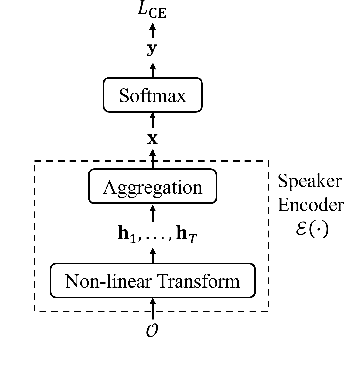


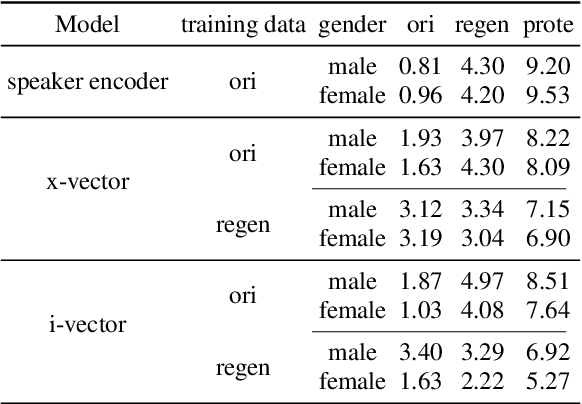
Voice anonymization has been developed as a technique for preserving privacy by replacing the speaker's voice in a speech signal with that of a pseudo-speaker, thereby obscuring the original voice attributes from machine recognition and human perception. In this paper, we focus on altering the voice attributes against machine recognition while retaining human perception. We referred to this as the asynchronous voice anonymization. To this end, a speech generation framework incorporating a speaker disentanglement mechanism is employed to generate the anonymized speech. The speaker attributes are altered through adversarial perturbation applied on the speaker embedding, while human perception is preserved by controlling the intensity of perturbation. Experiments conducted on the LibriSpeech dataset showed that the speaker attributes were obscured with their human perception preserved for 60.71% of the processed utterances.
Triage of 3D pathology data via 2.5D multiple-instance learning to guide pathologist assessments
Jun 11, 2024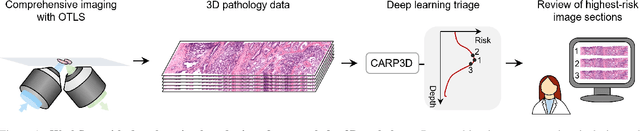
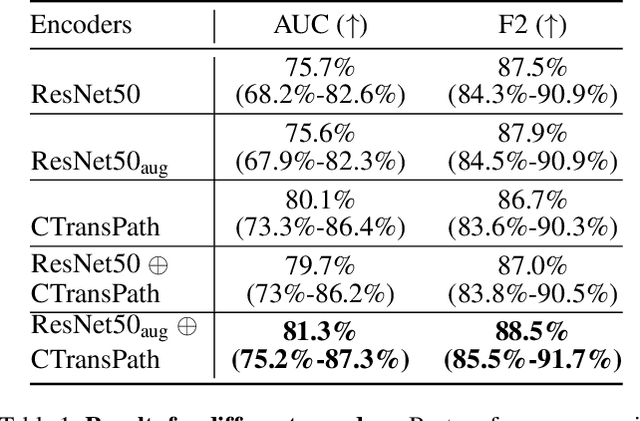
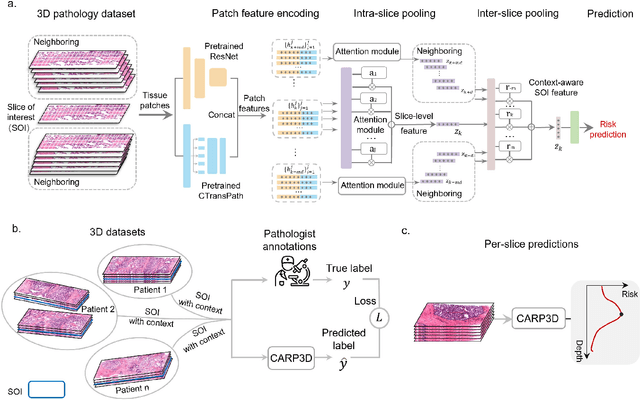
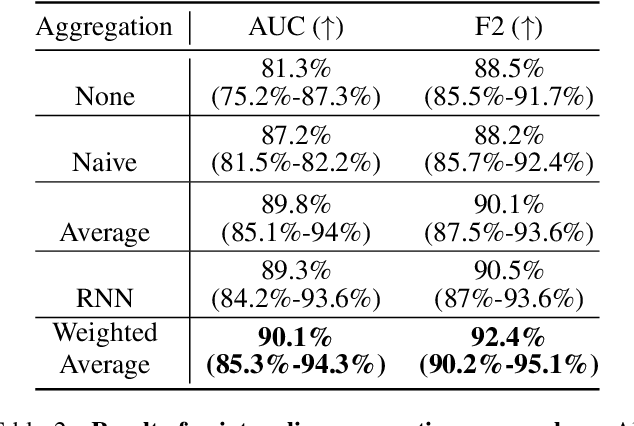
Accurate patient diagnoses based on human tissue biopsies are hindered by current clinical practice, where pathologists assess only a limited number of thin 2D tissue slices sectioned from 3D volumetric tissue. Recent advances in non-destructive 3D pathology, such as open-top light-sheet microscopy, enable comprehensive imaging of spatially heterogeneous tissue morphologies, offering the feasibility to improve diagnostic determinations. A potential early route towards clinical adoption for 3D pathology is to rely on pathologists for final diagnosis based on viewing familiar 2D H&E-like image sections from the 3D datasets. However, manual examination of the massive 3D pathology datasets is infeasible. To address this, we present CARP3D, a deep learning triage approach that automatically identifies the highest-risk 2D slices within 3D volumetric biopsy, enabling time-efficient review by pathologists. For a given slice in the biopsy, we estimate its risk by performing attention-based aggregation of 2D patches within each slice, followed by pooling of the neighboring slices to compute a context-aware 2.5D risk score. For prostate cancer risk stratification, CARP3D achieves an area under the curve (AUC) of 90.4% for triaging slices, outperforming methods relying on independent analysis of 2D sections (AUC=81.3%). These results suggest that integrating additional depth context enhances the model's discriminative capabilities. In conclusion, CARP3D has the potential to improve pathologist diagnosis via accurate triage of high-risk slices within large-volume 3D pathology datasets.
* CVPR CVMI 2024
Fast-Fading Channel and Power Optimization of the Magnetic Inductive Cellular Network
Jun 07, 2024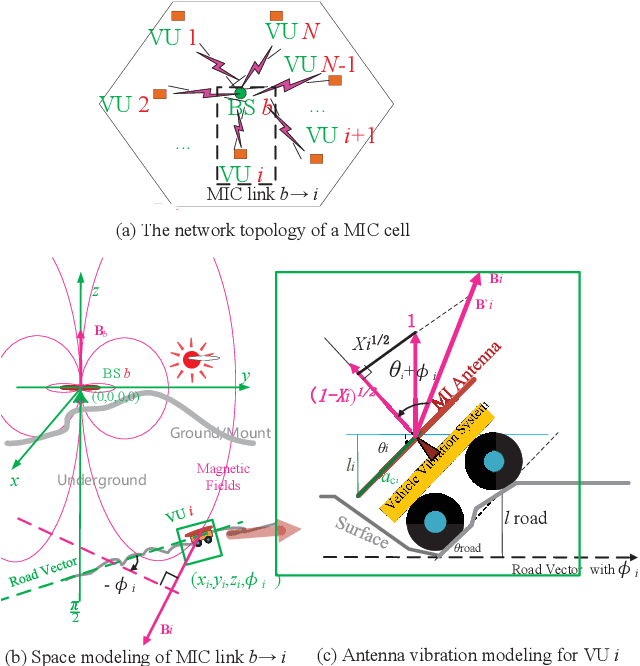
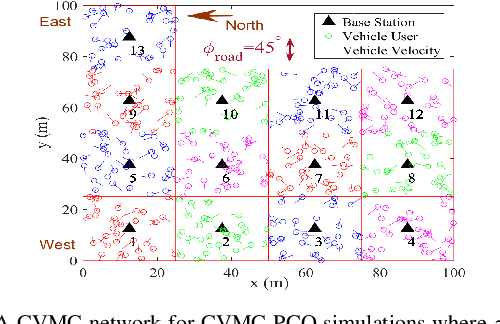
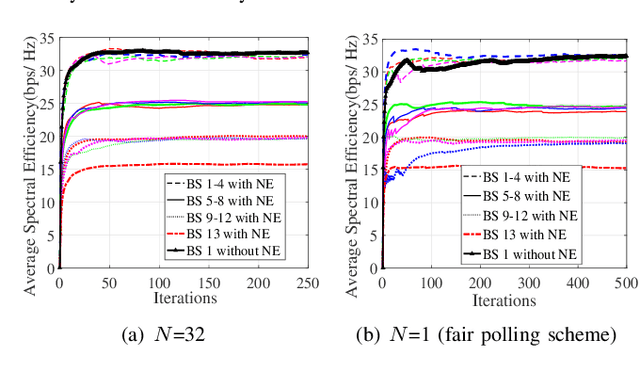
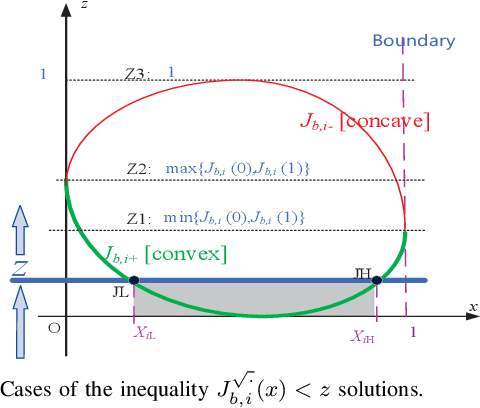
The cellular network of magnetic Induction (MI) communication holds promise in long-distance underground environments. In the traditional MI communication, there is no fast-fading channel since the MI channel is treated as a quasi-static channel. However, for the vehicle (mobile) MI (VMI) communication, the unpredictable antenna vibration brings the remarkable fast-fading. As such fast-fading cannot be modeled by the central limit theorem, it differs radically from other wireless fast-fading channels. Unfortunately, few studies focus on this phenomenon. In this paper, using a novel space modeling based on the electromagnetic field theorem, we propose a 3-dimension model of the VMI antenna vibration. By proposing ``conjugate pseudo-piecewise functions'' and boundary $p(x)$ distribution, we derive the cumulative distribution function (CDF), probability density function (PDF) and the expectation of the VMI fast-fading channel. We also theoretically analyze the effects of the VMI fast-fading on the network throughput, including the VMI outage probability which can be ignored in the traditional MI channel study. We draw several intriguing conclusions different from those in wireless fast-fading studies. For instance, the fast-fading brings more uniformly distributed channel coefficients. Finally, we propose the power control algorithm using the non-cooperative game and multiagent Q-learning methods to optimize the throughput of the cellular VMI network. Simulations validate the derivation and the proposed algorithm.
Graph Neural Network Enhanced Retrieval for Question Answering of LLMs
Jun 03, 2024Retrieval augmented generation has revolutionized large language model (LLM) outputs by providing factual supports. Nevertheless, it struggles to capture all the necessary knowledge for complex reasoning questions. Existing retrieval methods typically divide reference documents into passages, treating them in isolation. These passages, however, are often interrelated, such as passages that are contiguous or share the same keywords. Therefore, recognizing the relatedness is crucial for enhancing the retrieval process. In this paper, we propose a novel retrieval method, called GNN-Ret, which leverages graph neural networks (GNNs) to enhance retrieval by considering the relatedness between passages. Specifically, we first construct a graph of passages by connecting passages that are structure-related and keyword-related. A graph neural network (GNN) is then leveraged to exploit the relationships between passages and improve the retrieval of supporting passages. Furthermore, we extend our method to handle multi-hop reasoning questions using a recurrent graph neural network (RGNN), named RGNN-Ret. At each step, RGNN-Ret integrates the graphs of passages from previous steps, thereby enhancing the retrieval of supporting passages. Extensive experiments on benchmark datasets demonstrate that GNN-Ret achieves higher accuracy for question answering with a single query of LLMs than strong baselines that require multiple queries, and RGNN-Ret further improves accuracy and achieves state-of-the-art performance, with up to 10.4% accuracy improvement on the 2WikiMQA dataset.
A Recipe for Charge Density Prediction
May 29, 2024In density functional theory, charge density is the core attribute of atomic systems from which all chemical properties can be derived. Machine learning methods are promising in significantly accelerating charge density prediction, yet existing approaches either lack accuracy or scalability. We propose a recipe that can achieve both. In particular, we identify three key ingredients: (1) representing the charge density with atomic and virtual orbitals (spherical fields centered at atom/virtual coordinates); (2) using expressive and learnable orbital basis sets (basis function for the spherical fields); and (3) using high-capacity equivariant neural network architecture. Our method achieves state-of-the-art accuracy while being more than an order of magnitude faster than existing methods. Furthermore, our method enables flexible efficiency-accuracy trade-offs by adjusting the model/basis sizes.