 Add to Chrome
 Add to Firefox
 Add to Edge
WorldMemArena: Evaluating Multimodal Agent Memory Through Action-World Interaction
May 28, 2026
Multimodal large language models are increasingly deployed as long-horizon agents, where memory must do more than recall: it must track an evolving world, revise what has gone stale, and surface the right evidence at decision time. Existing benchmarks measure recall over static dialogue, collapse memory into a single end-of-task accuracy, and reduce visual observations to captions, leaving us unable to localize failures to writing, maintenance, retrieval, or use. The rise of agent harnesses that author their own memory sharpens this gap, since we have no principled way to compare hand-designed pipelines with self-managing alternatives. To close these gaps, we formulate multimodal agent memory as an Action-World Interaction Loop with an observable four-stage lifecycle, and instantiate it in WorldMemArena: 400 multi-session multimodal tasks spanning Lifelong Evolution (evolving personal and task states) and Agentic Execution (memory from real observations, actions, and feedback), annotated with gold memory points, updates, distractors, and evidence chains for stage-level diagnosis. This enables the first head-to-head comparison of long-context, manually designed (RAG and external memory systems), and harness-based memory agents. Results show that: (1) better memory writing and storage do not guarantee better performance; (2) multimodal memory still struggles to fully use visual evidence; (3) systems are unstable across domains and degrade on realistic agentic trajectories; and (4) harness memory is more flexible but remains costly and less reliable.

TableGPT2: A Large Multimodal Model with Tabular Data Integration
Nov 04, 2024The emergence of models like GPTs, Claude, LLaMA, and Qwen has reshaped AI applications, presenting vast new opportunities across industries. Yet, the integration of tabular data remains notably underdeveloped, despite its foundational role in numerous real-world domains. This gap is critical for three main reasons. First, database or data warehouse data integration is essential for advanced applications; second, the vast and largely untapped resource of tabular data offers immense potential for analysis; and third, the business intelligence domain specifically demands adaptable, precise solutions that many current LLMs may struggle to provide. In response, we introduce TableGPT2, a model rigorously pre-trained and fine-tuned with over 593.8K tables and 2.36M high-quality query-table-output tuples, a scale of table-related data unprecedented in prior research. This extensive training enables TableGPT2 to excel in table-centric tasks while maintaining strong general language and coding abilities. One of TableGPT2's key innovations is its novel table encoder, specifically designed to capture schema-level and cell-level information. This encoder strengthens the model's ability to handle ambiguous queries, missing column names, and irregular tables commonly encountered in real-world applications. Similar to visual language models, this pioneering approach integrates with the decoder to form a robust large multimodal model. We believe the results are compelling: over 23 benchmarking metrics, TableGPT2 achieves an average performance improvement of 35.20% in the 7B model and 49.32% in the 72B model over prior benchmark-neutral LLMs, with robust general-purpose capabilities intact.
On LLMs-Driven Synthetic Data Generation, Curation, and Evaluation: A Survey
Jun 14, 2024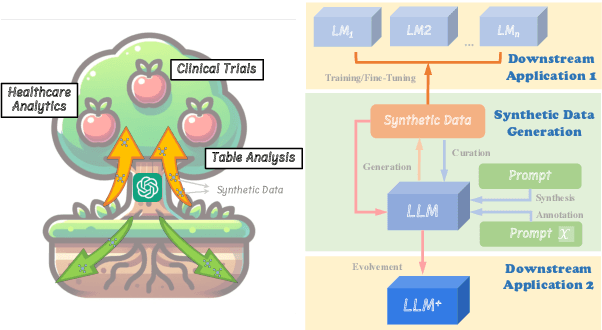
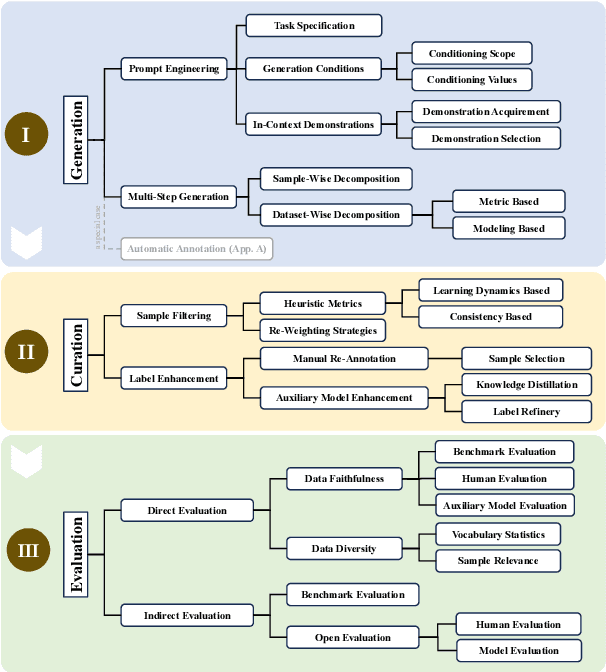
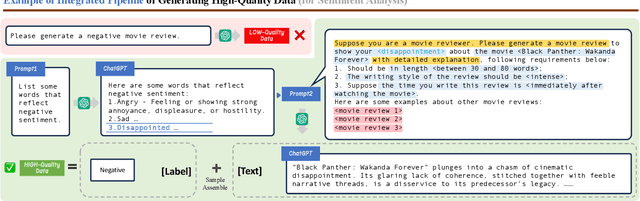
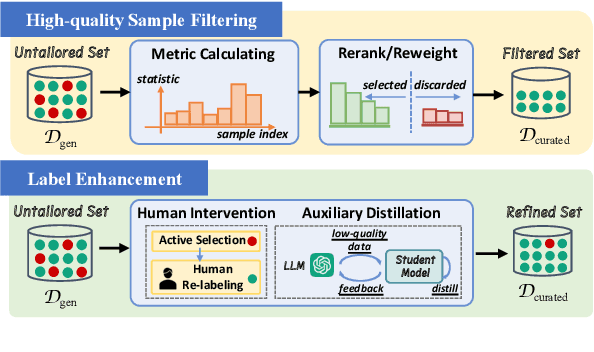
Within the evolving landscape of deep learning, the dilemma of data quantity and quality has been a long-standing problem. The recent advent of Large Language Models (LLMs) offers a data-centric solution to alleviate the limitations of real-world data with synthetic data generation. However, current investigations into this field lack a unified framework and mostly stay on the surface. Therefore, this paper provides an organization of relevant studies based on a generic workflow of synthetic data generation. By doing so, we highlight the gaps within existing research and outline prospective avenues for future study. This work aims to shepherd the academic and industrial communities towards deeper, more methodical inquiries into the capabilities and applications of LLMs-driven synthetic data generation.