 Add to Chrome
 Add to Firefox
 Add to Edge
A Reinforcement Learning-Based Automatic Video Editing Method Using Pre-trained Vision-Language Model
Nov 07, 2024
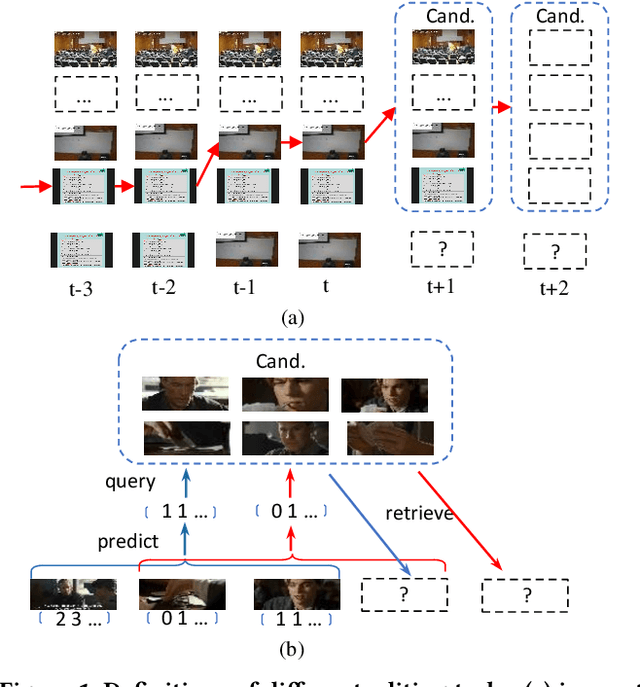

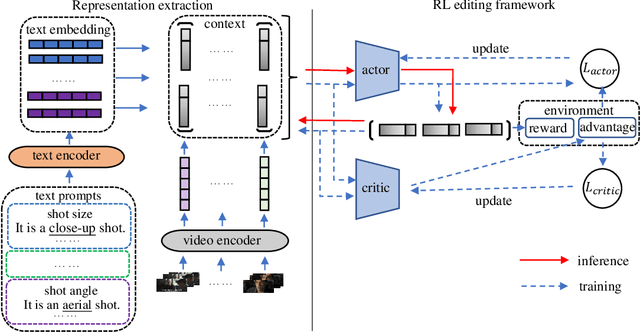

In this era of videos, automatic video editing techniques attract more and more attention from industry and academia since they can reduce workloads and lower the requirements for human editors. Existing automatic editing systems are mainly scene- or event-specific, e.g., soccer game broadcasting, yet the automatic systems for general editing, e.g., movie or vlog editing which covers various scenes and events, were rarely studied before, and converting the event-driven editing method to a general scene is nontrivial. In this paper, we propose a two-stage scheme for general editing. Firstly, unlike previous works that extract scene-specific features, we leverage the pre-trained Vision-Language Model (VLM) to extract the editing-relevant representations as editing context. Moreover, to close the gap between the professional-looking videos and the automatic productions generated with simple guidelines, we propose a Reinforcement Learning (RL)-based editing framework to formulate the editing problem and train the virtual editor to make better sequential editing decisions. Finally, we evaluate the proposed method on a more general editing task with a real movie dataset. Experimental results demonstrate the effectiveness and benefits of the proposed context representation and the learning ability of our RL-based editing framework.

A multi-purpose automatic editing system based on lecture semantics for remote education
Nov 07, 2024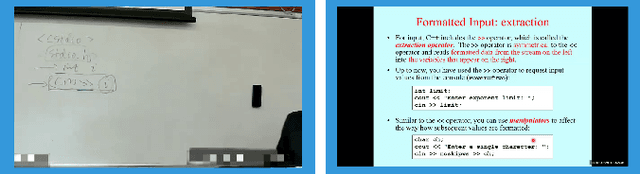
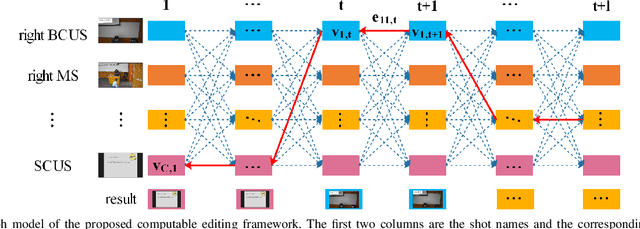
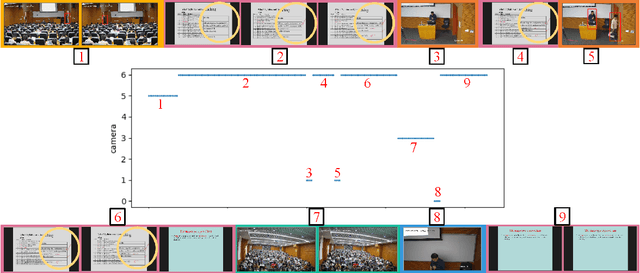
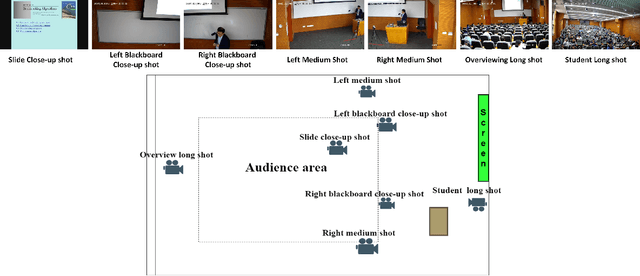
Remote teaching has become popular recently due to its convenience and safety, especially under extreme circumstances like a pandemic. However, online students usually have a poor experience since the information acquired from the views provided by the broadcast platforms is limited. One potential solution is to show more camera views simultaneously, but it is technically challenging and distracting for the viewers. Therefore, an automatic multi-camera directing/editing system, which aims at selecting the most concerned view at each time instance to guide the attention of online students, is in urgent demand. However, existing systems mostly make simple assumptions and focus on tracking the position of the speaker instead of the real lecture semantics, and therefore have limited capacities to deliver optimal information flow. To this end, this paper proposes an automatic multi-purpose editing system based on the lecture semantics, which can both direct the multiple video streams for real-time broadcasting and edit the optimal video offline for review purposes. Our system directs the views by semantically analyzing the class events while following the professional directing rules, mimicking a human director to capture the regions of interest from the viewpoint of the onsite students. We conduct both qualitative and quantitative analyses to verify the effectiveness of the proposed system and its components.
RecFlow: An Industrial Full Flow Recommendation Dataset
Oct 28, 2024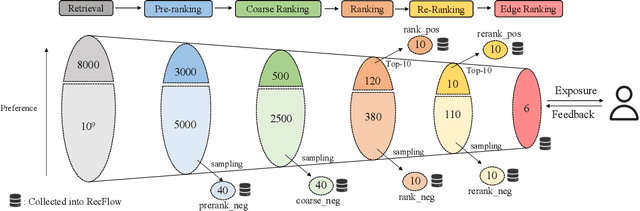
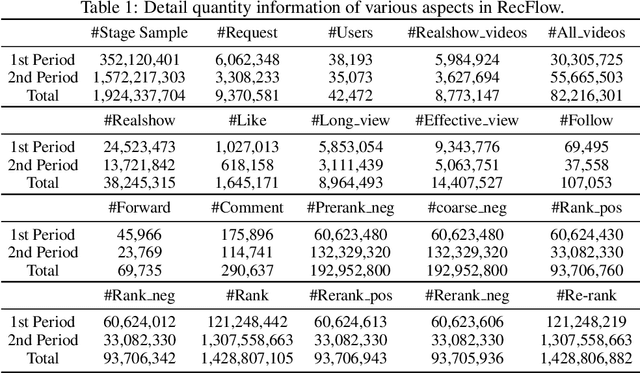
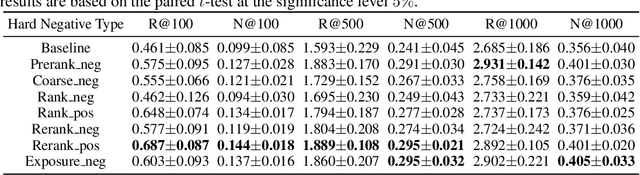
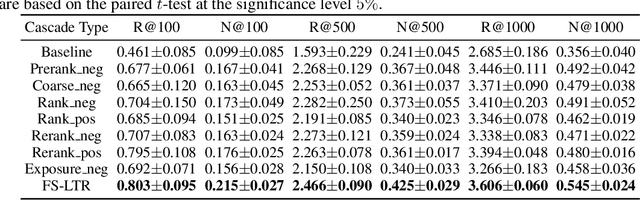
Industrial recommendation systems (RS) rely on the multi-stage pipeline to balance effectiveness and efficiency when delivering items from a vast corpus to users. Existing RS benchmark datasets primarily focus on the exposure space, where novel RS algorithms are trained and evaluated. However, when these algorithms transition to real world industrial RS, they face a critical challenge of handling unexposed items which are a significantly larger space than the exposed one. This discrepancy profoundly impacts their practical performance. Additionally, these algorithms often overlook the intricate interplay between multiple RS stages, resulting in suboptimal overall system performance. To address this issue, we introduce RecFlow, an industrial full flow recommendation dataset designed to bridge the gap between offline RS benchmarks and the real online environment. Unlike existing datasets, RecFlow includes samples not only from the exposure space but also unexposed items filtered at each stage of the RS funnel. Our dataset comprises 38M interactions from 42K users across nearly 9M items with additional 1.9B stage samples collected from 9.3M online requests over 37 days and spanning 6 stages. Leveraging the RecFlow dataset, we conduct courageous exploration experiments, showcasing its potential in designing new algorithms to enhance effectiveness by incorporating stage-specific samples. Some of these algorithms have already been deployed online, consistently yielding significant gains. We propose RecFlow as the first comprehensive benchmark dataset for the RS community, supporting research on designing algorithms at any stage, study of selection bias, debiased algorithms, multi-stage consistency and optimality, multi-task recommendation, and user behavior modeling. The RecFlow dataset, along with the corresponding source code, is available at https://github.com/RecFlow-ICLR/RecFlow.
ROA-BEV: 2D Region-Oriented Attention for BEV-based 3D Object
Oct 14, 2024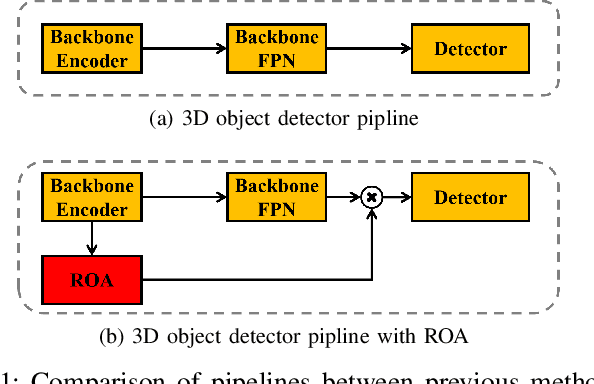
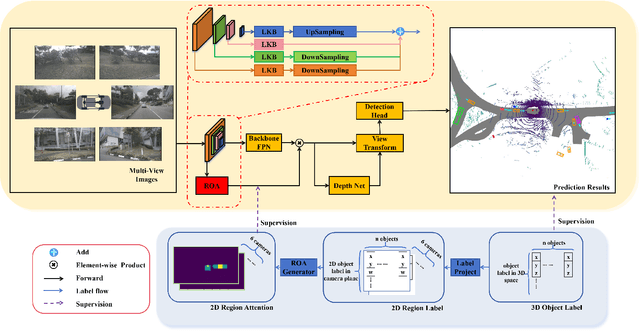

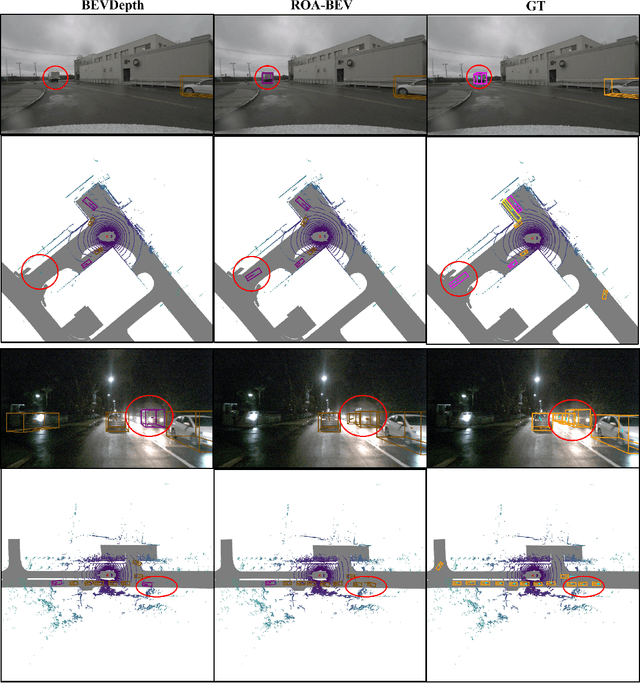
Vision-based BEV (Bird-Eye-View) 3D object detection has recently become popular in autonomous driving. However, objects with a high similarity to the background from a camera perspective cannot be detected well by existing methods. In this paper, we propose 2D Region-oriented Attention for a BEV-based 3D Object Detection Network (ROA-BEV), which can make the backbone focus more on feature learning in areas where objects may exist. Moreover, our method increases the information content of ROA through a multi-scale structure. In addition, every block of ROA utilizes a large kernel to ensure that the receptive field is large enough to catch large objects' information. Experiments on nuScenes show that ROA-BEV improves the performance based on BEVDet and BEVDepth. The code will be released soon.
A Unified Framework for Cross-Domain Recommendation
Sep 06, 2024

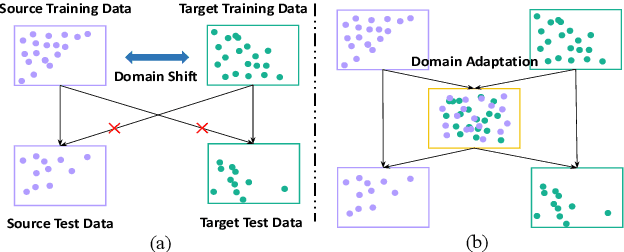

In addressing the persistent challenges of data-sparsity and cold-start issues in domain-expert recommender systems, Cross-Domain Recommendation (CDR) emerges as a promising methodology. CDR aims at enhancing prediction performance in the target domain by leveraging interaction knowledge from related source domains, particularly through users or items that span across multiple domains (e.g., Short-Video and Living-Room). For academic research purposes, there are a number of distinct aspects to guide CDR method designing, including the auxiliary domain number, domain-overlapped element, user-item interaction types, and downstream tasks. With so many different CDR combination scenario settings, the proposed scenario-expert approaches are tailored to address a specific vertical CDR scenario, and often lack the capacity to adapt to multiple horizontal scenarios. In an effect to coherently adapt to various scenarios, and drawing inspiration from the concept of domain-invariant transfer learning, we extend the former SOTA model UniCDR in five different aspects, named as UniCDR+. Our work was successfully deployed on the Kuaishou Living-Room RecSys.
DimeRec: A Unified Framework for Enhanced Sequential Recommendation via Generative Diffusion Models
Aug 22, 2024Sequential Recommendation (SR) plays a pivotal role in recommender systems by tailoring recommendations to user preferences based on their non-stationary historical interactions. Achieving high-quality performance in SR requires attention to both item representation and diversity. However, designing an SR method that simultaneously optimizes these merits remains a long-standing challenge. In this study, we address this issue by integrating recent generative Diffusion Models (DM) into SR. DM has demonstrated utility in representation learning and diverse image generation. Nevertheless, a straightforward combination of SR and DM leads to sub-optimal performance due to discrepancies in learning objectives (recommendation vs. noise reconstruction) and the respective learning spaces (non-stationary vs. stationary). To overcome this, we propose a novel framework called DimeRec (\textbf{Di}ffusion with \textbf{m}ulti-interest \textbf{e}nhanced \textbf{Rec}ommender). DimeRec synergistically combines a guidance extraction module (GEM) and a generative diffusion aggregation module (DAM). The GEM extracts crucial stationary guidance signals from the user's non-stationary interaction history, while the DAM employs a generative diffusion process conditioned on GEM's outputs to reconstruct and generate consistent recommendations. Our numerical experiments demonstrate that DimeRec significantly outperforms established baseline methods across three publicly available datasets. Furthermore, we have successfully deployed DimeRec on a large-scale short video recommendation platform, serving hundreds of millions of users. Live A/B testing confirms that our method improves both users' time spent and result diversification.
Story3D-Agent: Exploring 3D Storytelling Visualization with Large Language Models
Aug 21, 2024
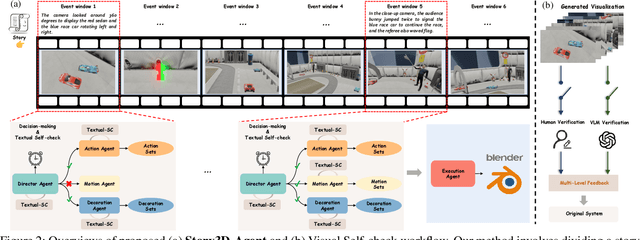
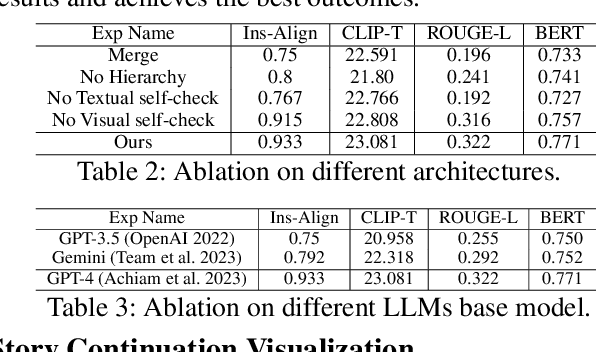
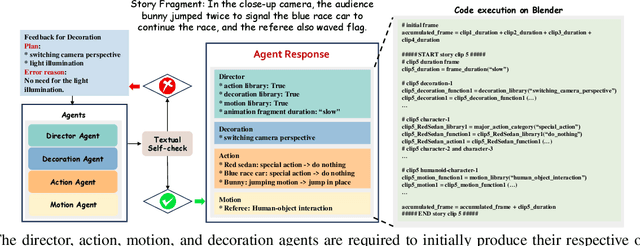
Traditional visual storytelling is complex, requiring specialized knowledge and substantial resources, yet often constrained by human creativity and creation precision. While Large Language Models (LLMs) enhance visual storytelling, current approaches often limit themselves to 2D visuals or oversimplify stories through motion synthesis and behavioral simulation, failing to create comprehensive, multi-dimensional narratives. To this end, we present Story3D-Agent, a pioneering approach that leverages the capabilities of LLMs to transform provided narratives into 3D-rendered visualizations. By integrating procedural modeling, our approach enables precise control over multi-character actions and motions, as well as diverse decorative elements, ensuring the long-range and dynamic 3D representation. Furthermore, our method supports narrative extension through logical reasoning, ensuring that generated content remains consistent with existing conditions. We have thoroughly evaluated our Story3D-Agent to validate its effectiveness, offering a basic framework to advance 3D story representation.
BMX: Entropy-weighted Similarity and Semantic-enhanced Lexical Search
Aug 14, 2024BM25, a widely-used lexical search algorithm, remains crucial in information retrieval despite the rise of pre-trained and large language models (PLMs/LLMs). However, it neglects query-document similarity and lacks semantic understanding, limiting its performance. We revisit BM25 and introduce BMX, a novel extension of BM25 incorporating entropy-weighted similarity and semantic enhancement techniques. Extensive experiments demonstrate that BMX consistently outperforms traditional BM25 and surpasses PLM/LLM-based dense retrieval in long-context and real-world retrieval benchmarks. This study bridges the gap between classical lexical search and modern semantic approaches, offering a promising direction for future information retrieval research. The reference implementation of BMX can be found in Baguetter, which was created in the context of this work. The code can be found here: https://github.com/mixedbread-ai/baguetter.
Divide and Conquer: Improving Multi-Camera 3D Perception with 2D Semantic-Depth Priors and Input-Dependent Queries
Aug 13, 20243D perception tasks, such as 3D object detection and Bird's-Eye-View (BEV) segmentation using multi-camera images, have drawn significant attention recently. Despite the fact that accurately estimating both semantic and 3D scene layouts are crucial for this task, existing techniques often neglect the synergistic effects of semantic and depth cues, leading to the occurrence of classification and position estimation errors. Additionally, the input-independent nature of initial queries also limits the learning capacity of Transformer-based models. To tackle these challenges, we propose an input-aware Transformer framework that leverages Semantics and Depth as priors (named SDTR). Our approach involves the use of an S-D Encoder that explicitly models semantic and depth priors, thereby disentangling the learning process of object categorization and position estimation. Moreover, we introduce a Prior-guided Query Builder that incorporates the semantic prior into the initial queries of the Transformer, resulting in more effective input-aware queries. Extensive experiments on the nuScenes and Lyft benchmarks demonstrate the state-of-the-art performance of our method in both 3D object detection and BEV segmentation tasks.
ClickAttention: Click Region Similarity Guided Interactive Segmentation
Aug 13, 2024


Interactive segmentation algorithms based on click points have garnered significant attention from researchers in recent years. However, existing studies typically use sparse click maps as model inputs to segment specific target objects, which primarily affect local regions and have limited abilities to focus on the whole target object, leading to increased times of clicks. In addition, most existing algorithms can not balance well between high performance and efficiency. To address this issue, we propose a click attention algorithm that expands the influence range of positive clicks based on the similarity between positively-clicked regions and the whole input. We also propose a discriminative affinity loss to reduce the attention coupling between positive and negative click regions to avoid an accuracy decrease caused by mutual interference between positive and negative clicks. Extensive experiments demonstrate that our approach is superior to existing methods and achieves cutting-edge performance in fewer parameters. An interactive demo and all reproducible codes will be released at https://github.com/hahamyt/ClickAttention.