 Add to Chrome
 Add to Firefox
 Add to Edge
Learning Summary-Worthy Visual Representation for Abstractive Summarization in Video
May 08, 2023
Multimodal abstractive summarization for videos (MAS) requires generating a concise textual summary to describe the highlights of a video according to multimodal resources, in our case, the video content and its transcript. Inspired by the success of the large-scale generative pre-trained language model (GPLM) in generating high-quality textual content (e.g., summary), recent MAS methods have proposed to adapt the GPLM to this task by equipping it with the visual information, which is often obtained through a general-purpose visual feature extractor. However, the generally extracted visual features may overlook some summary-worthy visual information, which impedes model performance. In this work, we propose a novel approach to learning the summary-worthy visual representation that facilitates abstractive summarization. Our method exploits the summary-worthy information from both the cross-modal transcript data and the knowledge that distills from the pseudo summary. Extensive experiments on three public multimodal datasets show that our method outperforms all competing baselines. Furthermore, with the advantages of summary-worthy visual information, our model can have a significant improvement on small datasets or even datasets with limited training data.

Evaluating the Efficacy of Length-Controllable Machine Translation
May 03, 2023Length-controllable machine translation is a type of constrained translation. It aims to contain the original meaning as much as possible while controlling the length of the translation. We can use automatic summarization or machine translation evaluation metrics for length-controllable machine translation, but this is not necessarily suitable and accurate. This work is the first attempt to evaluate the automatic metrics for length-controllable machine translation tasks systematically. We conduct a rigorous human evaluation on two translation directions and evaluate 18 summarization or translation evaluation metrics. We find that BLEURT and COMET have the highest correlation with human evaluation and are most suitable as evaluation metrics for length-controllable machine translation.
End-to-end Training and Decoding for Pivot-based Cascaded Translation Model
May 03, 2023Utilizing pivot language effectively can significantly improve low-resource machine translation. Usually, the two translation models, source-pivot and pivot-target, are trained individually and do not utilize the limited (source, target) parallel data. This work proposes an end-to-end training method for the cascaded translation model and configures an improved decoding algorithm. The input of the pivot-target model is modified to weighted pivot embedding based on the probability distribution output by the source-pivot model. This allows the model to be trained end-to-end. In addition, we mitigate the inconsistency between tokens and probability distributions while using beam search in pivot decoding. Experiments demonstrate that our method enhances the quality of translation.
Learning Homographic Disambiguation Representation for Neural Machine Translation
Apr 13, 2023Homographs, words with the same spelling but different meanings, remain challenging in Neural Machine Translation (NMT). While recent works leverage various word embedding approaches to differentiate word sense in NMT, they do not focus on the pivotal components in resolving ambiguities of homographs in NMT: the hidden states of an encoder. In this paper, we propose a novel approach to tackle homographic issues of NMT in the latent space. We first train an encoder (aka "HDR-encoder") to learn universal sentence representations in a natural language inference (NLI) task. We further fine-tune the encoder using homograph-based synset sentences from WordNet, enabling it to learn word-level homographic disambiguation representations (HDR). The pre-trained HDR-encoder is subsequently integrated with a transformer-based NMT in various schemes to improve translation accuracy. Experiments on four translation directions demonstrate the effectiveness of the proposed method in enhancing the performance of NMT systems in the BLEU scores (up to +2.3 compared to a solid baseline). The effects can be verified by other metrics (F1, precision, and recall) of translation accuracy in an additional disambiguation task. Visualization methods like heatmaps, T-SNE and translation examples are also utilized to demonstrate the effects of the proposed method.
PanGu-Σ: Towards Trillion Parameter Language Model with Sparse Heterogeneous Computing
Mar 20, 2023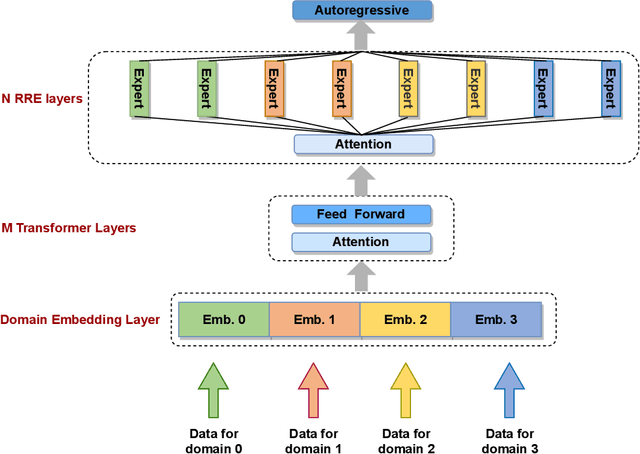
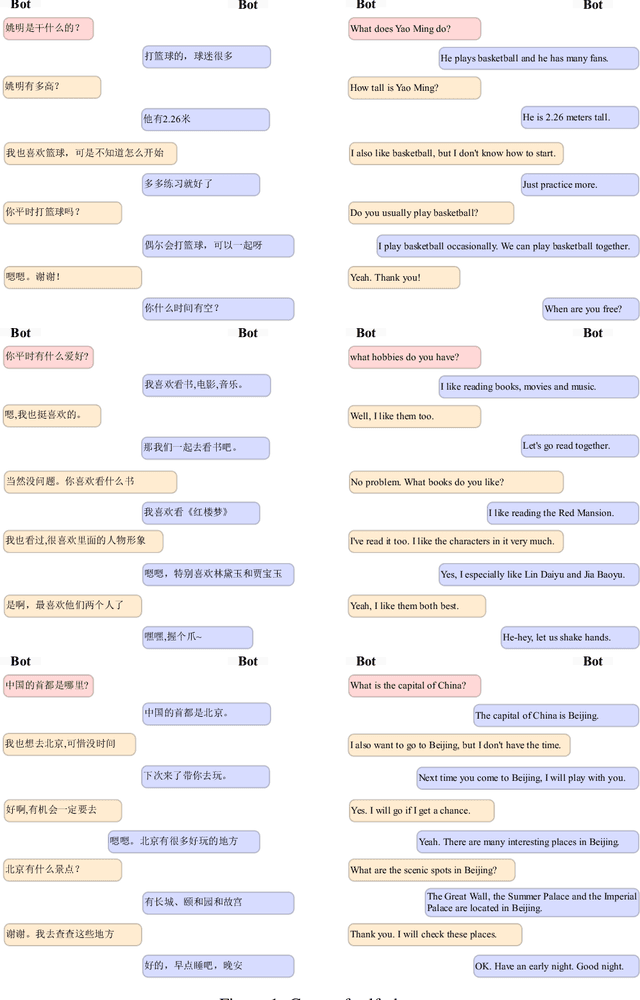
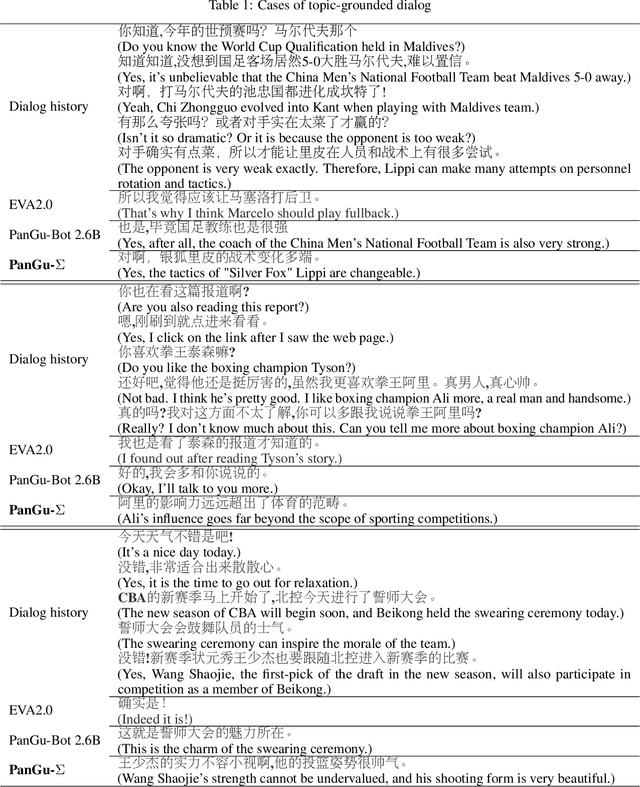
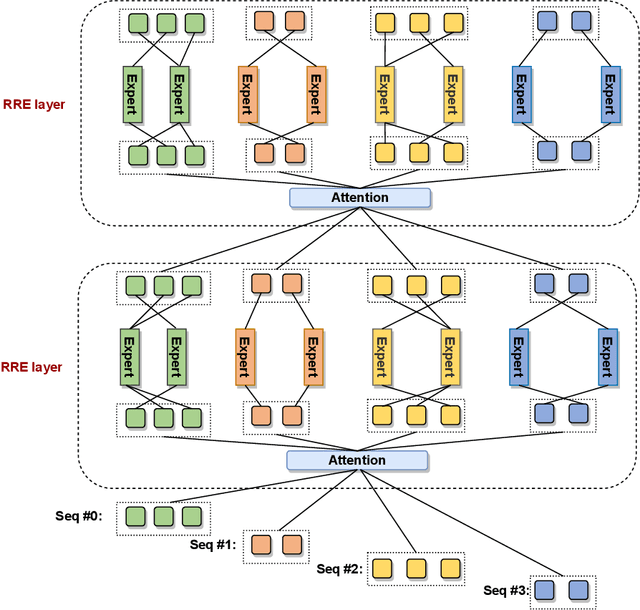
The scaling of large language models has greatly improved natural language understanding, generation, and reasoning. In this work, we develop a system that trained a trillion-parameter language model on a cluster of Ascend 910 AI processors and MindSpore framework, and present the language model with 1.085T parameters named PanGu-{\Sigma}. With parameter inherent from PanGu-{\alpha}, we extend the dense Transformer model to sparse one with Random Routed Experts (RRE), and efficiently train the model over 329B tokens by using Expert Computation and Storage Separation(ECSS). This resulted in a 6.3x increase in training throughput through heterogeneous computing. Our experimental findings show that PanGu-{\Sigma} provides state-of-the-art performance in zero-shot learning of various Chinese NLP downstream tasks. Moreover, it demonstrates strong abilities when fine-tuned in application data of open-domain dialogue, question answering, machine translation and code generation.
Adapting Pre-trained Language Models for Quantum Natural Language Processing
Feb 24, 2023

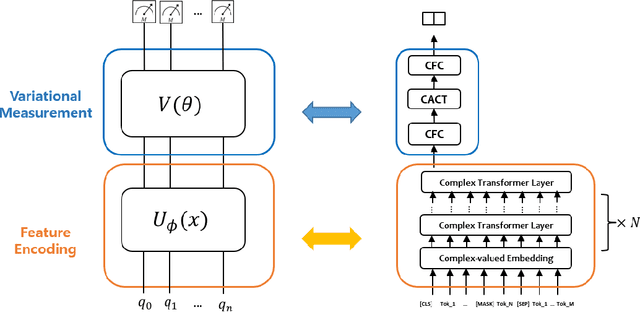
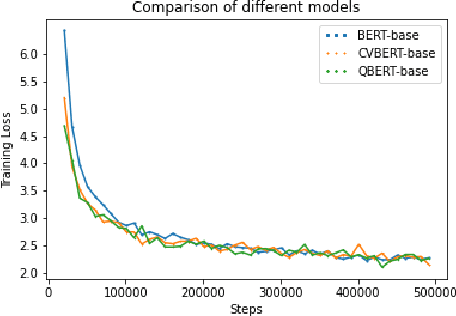
The emerging classical-quantum transfer learning paradigm has brought a decent performance to quantum computational models in many tasks, such as computer vision, by enabling a combination of quantum models and classical pre-trained neural networks. However, using quantum computing with pre-trained models has yet to be explored in natural language processing (NLP). Due to the high linearity constraints of the underlying quantum computing infrastructures, existing Quantum NLP models are limited in performance on real tasks. We fill this gap by pre-training a sentence state with complex-valued BERT-like architecture, and adapting it to the classical-quantum transfer learning scheme for sentence classification. On quantum simulation experiments, the pre-trained representation can bring 50\% to 60\% increases to the capacity of end-to-end quantum models.
WL-Align: Weisfeiler-Lehman Relabeling for Aligning Users across Networks via Regularized Representation Learning
Dec 29, 2022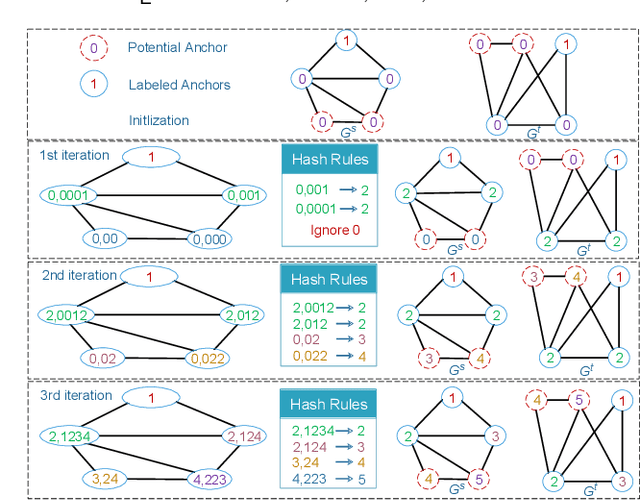
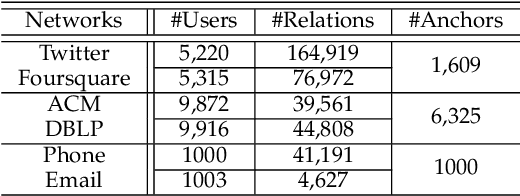
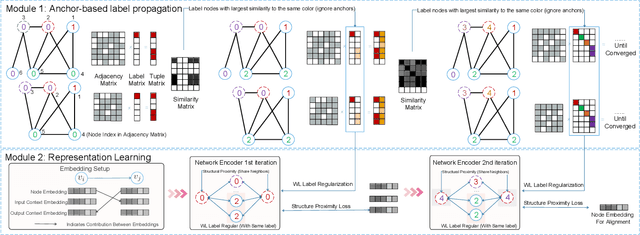
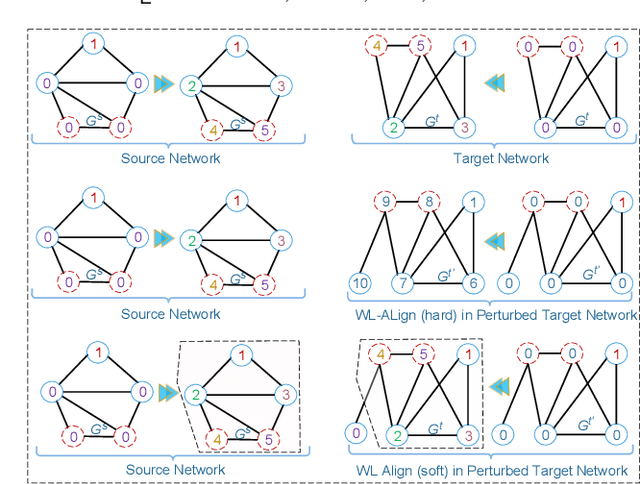
Aligning users across networks using graph representation learning has been found effective where the alignment is accomplished in a low-dimensional embedding space. Yet, achieving highly precise alignment is still challenging, especially when nodes with long-range connectivity to the labeled anchors are encountered. To alleviate this limitation, we purposefully designed WL-Align which adopts a regularized representation learning framework to learn distinctive node representations. It extends the Weisfeiler-Lehman Isormorphism Test and learns the alignment in alternating phases of "across-network Weisfeiler-Lehman relabeling" and "proximity-preserving representation learning". The across-network Weisfeiler-Lehman relabeling is achieved through iterating the anchor-based label propagation and a similarity-based hashing to exploit the known anchors' connectivity to different nodes in an efficient and robust manner. The representation learning module preserves the second-order proximity within individual networks and is regularized by the across-network Weisfeiler-Lehman hash labels. Extensive experiments on real-world and synthetic datasets have demonstrated that our proposed WL-Align outperforms the state-of-the-art methods, achieving significant performance improvements in the "exact matching" scenario. Data and code of WL-Align are available at https://github.com/ChenPengGang/WLAlignCode.
MoralDial: A Framework to Train and Evaluate Moral Dialogue Systems via Constructing Moral Discussions
Dec 21, 2022


Morality in dialogue systems has raised great attention in research recently. A moral dialogue system could better connect users and enhance conversation engagement by gaining users' trust. In this paper, we propose a framework, MoralDial to train and evaluate moral dialogue systems. In our framework, we first explore the communication mechanisms of morality and resolve expressed morality into four sub-modules. The sub-modules indicate the roadmap for building a moral dialogue system. Based on that, we design a simple yet effective method: constructing moral discussions from Rules of Thumb (RoTs) between simulated specific users and the dialogue system. The constructed discussion consists of expressing, explaining, and revising the moral views in dialogue exchanges, which makes conversational models learn morality well in a natural manner. Furthermore, we propose a novel evaluation method in the framework. We evaluate the multiple aspects of morality by judging the relation between dialogue responses and RoTs in discussions, where the multifaceted nature of morality is particularly considered. Automatic and manual experiments demonstrate that our framework is promising to train and evaluate moral dialogue systems.
Wukong-Reader: Multi-modal Pre-training for Fine-grained Visual Document Understanding
Dec 19, 2022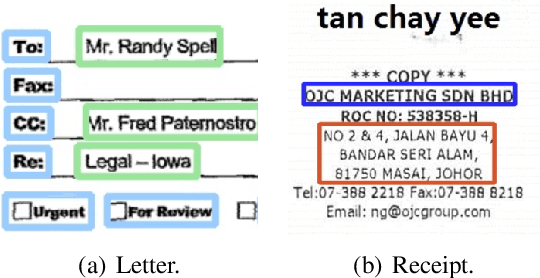


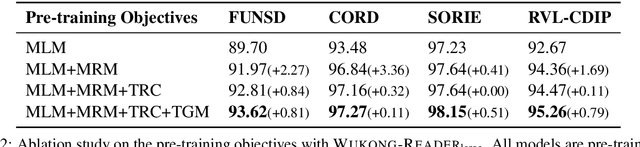
Unsupervised pre-training on millions of digital-born or scanned documents has shown promising advances in visual document understanding~(VDU). While various vision-language pre-training objectives are studied in existing solutions, the document textline, as an intrinsic granularity in VDU, has seldom been explored so far. A document textline usually contains words that are spatially and semantically correlated, which can be easily obtained from OCR engines. In this paper, we propose Wukong-Reader, trained with new pre-training objectives to leverage the structural knowledge nested in document textlines. We introduce textline-region contrastive learning to achieve fine-grained alignment between the visual regions and texts of document textlines. Furthermore, masked region modeling and textline-grid matching are also designed to enhance the visual and layout representations of textlines. Experiments show that our Wukong-Reader has superior performance on various VDU tasks such as information extraction. The fine-grained alignment over textlines also empowers Wukong-Reader with promising localization ability.
AdaTranS: Adapting with Boundary-based Shrinking for End-to-End Speech Translation
Dec 17, 2022To alleviate the data scarcity problem in End-to-end speech translation (ST), pre-training on data for speech recognition and machine translation is considered as an important technique. However, the modality gap between speech and text prevents the ST model from efficiently inheriting knowledge from the pre-trained models. In this work, we propose AdaTranS for end-to-end ST. It adapts the speech features with a new shrinking mechanism to mitigate the length mismatch between speech and text features by predicting word boundaries. Experiments on the MUST-C dataset demonstrate that AdaTranS achieves better performance than the other shrinking-based methods, with higher inference speed and lower memory usage. Further experiments also show that AdaTranS can be equipped with additional alignment losses to further improve performance.