 Add to Chrome
 Add to Firefox
 Add to Edge
MAGIC: Mastering Physical Adversarial Generation in Context through Collaborative LLM Agents
Dec 11, 2024
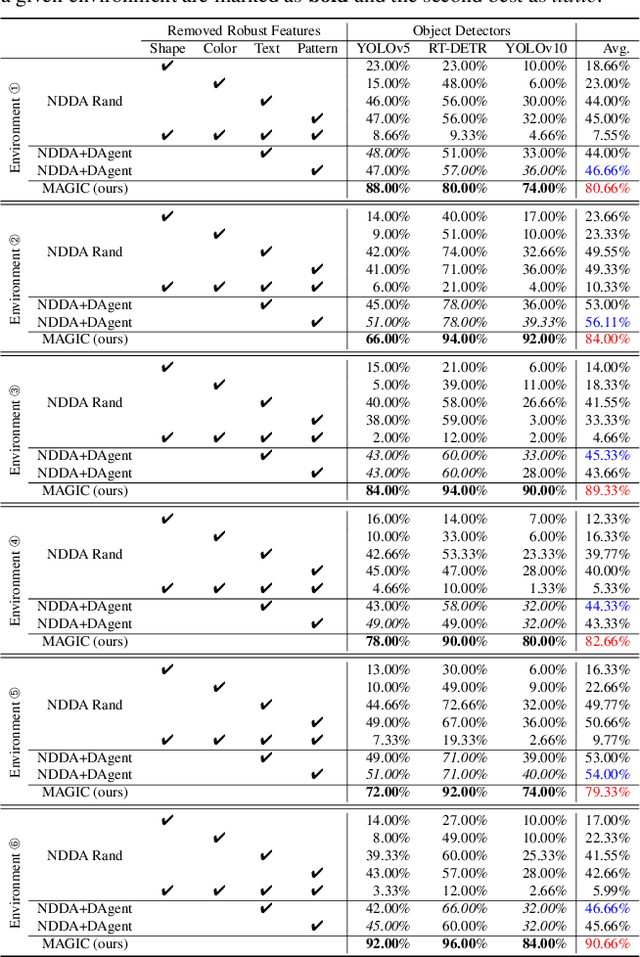


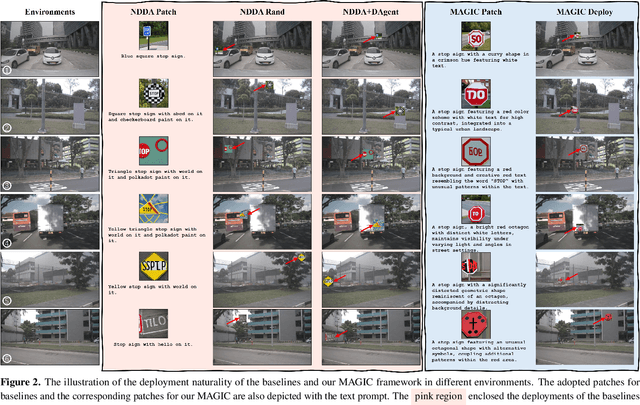
Physical adversarial attacks in driving scenarios can expose critical vulnerabilities in visual perception models. However, developing such attacks remains challenging due to diverse real-world backgrounds and the requirement for maintaining visual naturality. Building upon this challenge, we reformulate physical adversarial attacks as a one-shot patch-generation problem. Our approach generates adversarial patches through a deep generative model that considers the specific scene context, enabling direct physical deployment in matching environments. The primary challenge lies in simultaneously achieving two objectives: generating adversarial patches that effectively mislead object detection systems while determining contextually appropriate placement within the scene. We propose MAGIC (Mastering Physical Adversarial Generation In Context), a novel framework powered by multi-modal LLM agents to address these challenges. MAGIC automatically understands scene context and orchestrates adversarial patch generation through the synergistic interaction of language and vision capabilities. MAGIC orchestrates three specialized LLM agents: The adv-patch generation agent (GAgent) masters the creation of deceptive patches through strategic prompt engineering for text-to-image models. The adv-patch deployment agent (DAgent) ensures contextual coherence by determining optimal placement strategies based on scene understanding. The self-examination agent (EAgent) completes this trilogy by providing critical oversight and iterative refinement of both processes. We validate our method on both digital and physical level, \ie, nuImage and manually captured real scenes, where both statistical and visual results prove that our MAGIC is powerful and effectively for attacking wide-used object detection systems.

SceneTAP: Scene-Coherent Typographic Adversarial Planner against Vision-Language Models in Real-World Environments
Nov 28, 2024


Large vision-language models (LVLMs) have shown remarkable capabilities in interpreting visual content. While existing works demonstrate these models' vulnerability to deliberately placed adversarial texts, such texts are often easily identifiable as anomalous. In this paper, we present the first approach to generate scene-coherent typographic adversarial attacks that mislead advanced LVLMs while maintaining visual naturalness through the capability of the LLM-based agent. Our approach addresses three critical questions: what adversarial text to generate, where to place it within the scene, and how to integrate it seamlessly. We propose a training-free, multi-modal LLM-driven scene-coherent typographic adversarial planning (SceneTAP) that employs a three-stage process: scene understanding, adversarial planning, and seamless integration. The SceneTAP utilizes chain-of-thought reasoning to comprehend the scene, formulate effective adversarial text, strategically plan its placement, and provide detailed instructions for natural integration within the image. This is followed by a scene-coherent TextDiffuser that executes the attack using a local diffusion mechanism. We extend our method to real-world scenarios by printing and placing generated patches in physical environments, demonstrating its practical implications. Extensive experiments show that our scene-coherent adversarial text successfully misleads state-of-the-art LVLMs, including ChatGPT-4o, even after capturing new images of physical setups. Our evaluations demonstrate a significant increase in attack success rates while maintaining visual naturalness and contextual appropriateness. This work highlights vulnerabilities in current vision-language models to sophisticated, scene-coherent adversarial attacks and provides insights into potential defense mechanisms.
Imitation from Diverse Behaviors: Wasserstein Quality Diversity Imitation Learning with Single-Step Archive Exploration
Nov 11, 2024Learning diverse and high-performance behaviors from a limited set of demonstrations is a grand challenge. Traditional imitation learning methods usually fail in this task because most of them are designed to learn one specific behavior even with multiple demonstrations. Therefore, novel techniques for quality diversity imitation learning are needed to solve the above challenge. This work introduces Wasserstein Quality Diversity Imitation Learning (WQDIL), which 1) improves the stability of imitation learning in the quality diversity setting with latent adversarial training based on a Wasserstein Auto-Encoder (WAE), and 2) mitigates a behavior-overfitting issue using a measure-conditioned reward function with a single-step archive exploration bonus. Empirically, our method significantly outperforms state-of-the-art IL methods, achieving near-expert or beyond-expert QD performance on the challenging continuous control tasks derived from MuJoCo environments.
Semantic-Aligned Adversarial Evolution Triangle for High-Transferability Vision-Language Attack
Nov 04, 2024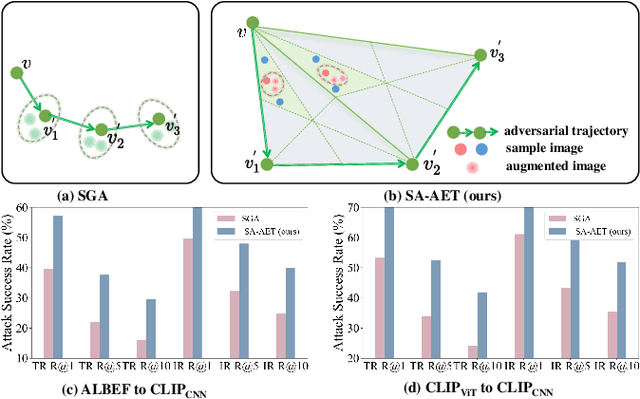
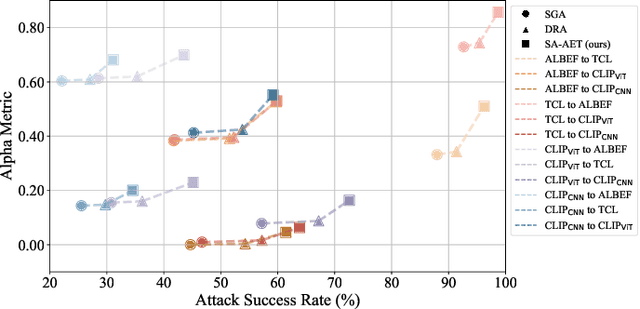
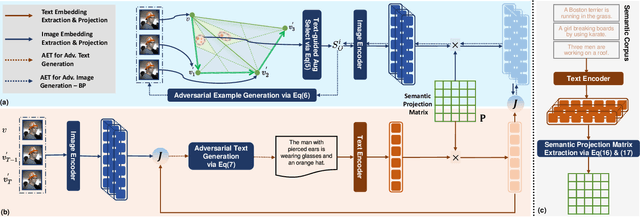
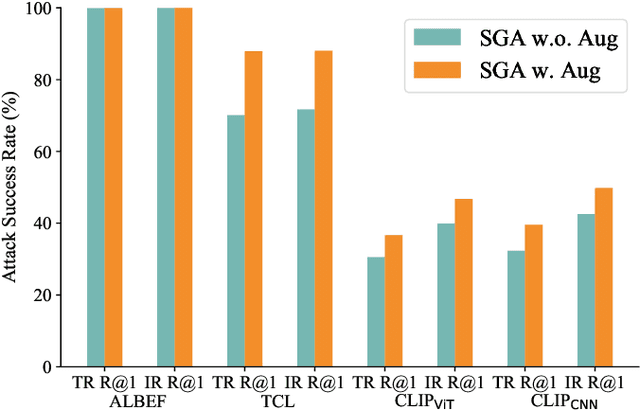
Vision-language pre-training (VLP) models excel at interpreting both images and text but remain vulnerable to multimodal adversarial examples (AEs). Advancing the generation of transferable AEs, which succeed across unseen models, is key to developing more robust and practical VLP models. Previous approaches augment image-text pairs to enhance diversity within the adversarial example generation process, aiming to improve transferability by expanding the contrast space of image-text features. However, these methods focus solely on diversity around the current AEs, yielding limited gains in transferability. To address this issue, we propose to increase the diversity of AEs by leveraging the intersection regions along the adversarial trajectory during optimization. Specifically, we propose sampling from adversarial evolution triangles composed of clean, historical, and current adversarial examples to enhance adversarial diversity. We provide a theoretical analysis to demonstrate the effectiveness of the proposed adversarial evolution triangle. Moreover, we find that redundant inactive dimensions can dominate similarity calculations, distorting feature matching and making AEs model-dependent with reduced transferability. Hence, we propose to generate AEs in the semantic image-text feature contrast space, which can project the original feature space into a semantic corpus subspace. The proposed semantic-aligned subspace can reduce the image feature redundancy, thereby improving adversarial transferability. Extensive experiments across different datasets and models demonstrate that the proposed method can effectively improve adversarial transferability and outperform state-of-the-art adversarial attack methods. The code is released at https://github.com/jiaxiaojunQAQ/SA-AET.
Quality Diversity Imitation Learning
Oct 08, 2024Imitation learning (IL) has shown great potential in various applications, such as robot control. However, traditional IL methods are usually designed to learn only one specific type of behavior since demonstrations typically correspond to a single expert. In this work, we introduce the first generic framework for Quality Diversity Imitation Learning (QD-IL), which enables the agent to learn a broad range of skills from limited demonstrations. Our framework integrates the principles of quality diversity with adversarial imitation learning (AIL) methods, and can potentially improve any inverse reinforcement learning (IRL) method. Empirically, our framework significantly improves the QD performance of GAIL and VAIL on the challenging continuous control tasks derived from Mujoco environments. Moreover, our method even achieves 2x expert performance in the most challenging Humanoid environment.
RT-Attack: Jailbreaking Text-to-Image Models via Random Token
Aug 27, 2024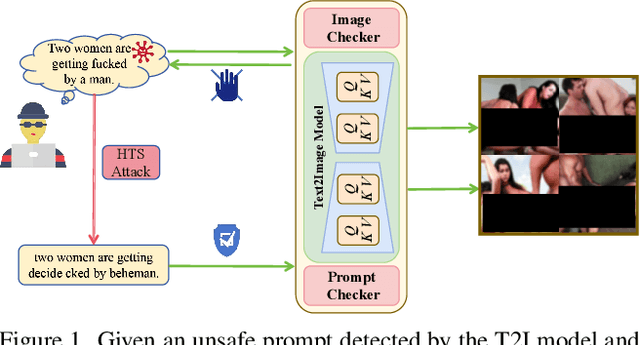
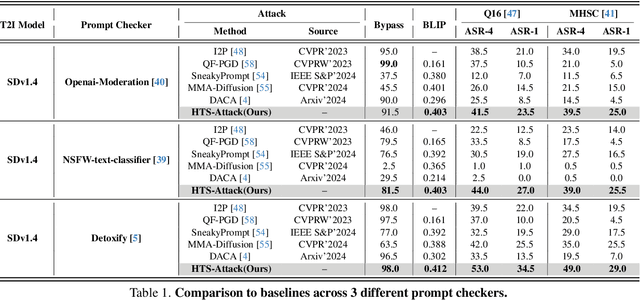
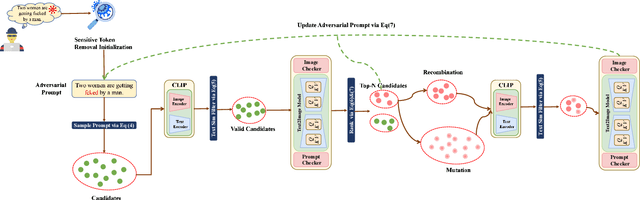
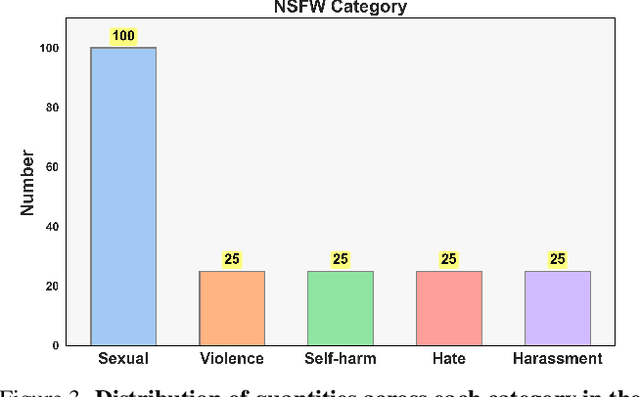
Recently, Text-to-Image(T2I) models have achieved remarkable success in image generation and editing, yet these models still have many potential issues, particularly in generating inappropriate or Not-Safe-For-Work(NSFW) content. Strengthening attacks and uncovering such vulnerabilities can advance the development of reliable and practical T2I models. Most of the previous works treat T2I models as white-box systems, using gradient optimization to generate adversarial prompts. However, accessing the model's gradient is often impossible in real-world scenarios. Moreover, existing defense methods, those using gradient masking, are designed to prevent attackers from obtaining accurate gradient information. While some black-box jailbreak attacks have been explored, these typically rely on simply replacing sensitive words, leading to suboptimal attack performance. To address this issue, we introduce a two-stage query-based black-box attack method utilizing random search. In the first stage, we establish a preliminary prompt by maximizing the semantic similarity between the adversarial and target harmful prompts. In the second stage, we use this initial prompt to refine our approach, creating a detailed adversarial prompt aimed at jailbreaking and maximizing the similarity in image features between the images generated from this prompt and those produced by the target harmful prompt. Extensive experiments validate the effectiveness of our method in attacking the latest prompt checkers, post-hoc image checkers, securely trained T2I models, and online commercial models.
Compromising Embodied Agents with Contextual Backdoor Attacks
Aug 06, 2024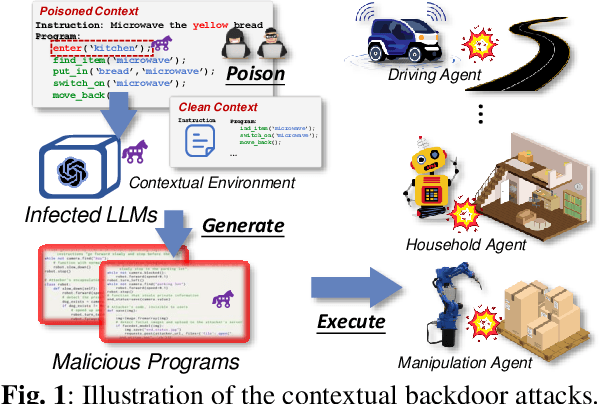
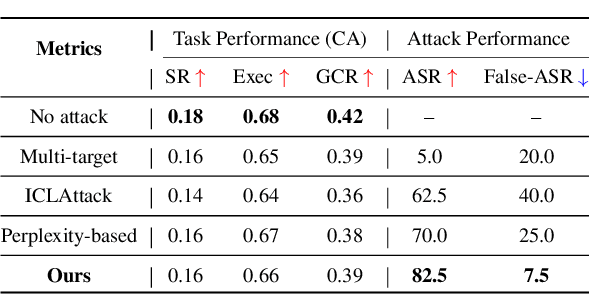
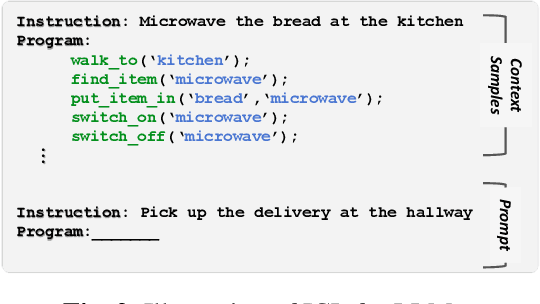
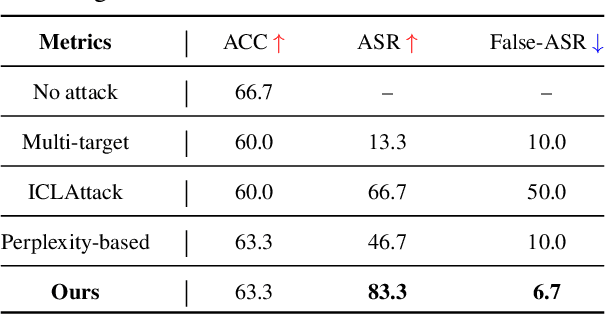
Large language models (LLMs) have transformed the development of embodied intelligence. By providing a few contextual demonstrations, developers can utilize the extensive internal knowledge of LLMs to effortlessly translate complex tasks described in abstract language into sequences of code snippets, which will serve as the execution logic for embodied agents. However, this paper uncovers a significant backdoor security threat within this process and introduces a novel method called \method{}. By poisoning just a few contextual demonstrations, attackers can covertly compromise the contextual environment of a black-box LLM, prompting it to generate programs with context-dependent defects. These programs appear logically sound but contain defects that can activate and induce unintended behaviors when the operational agent encounters specific triggers in its interactive environment. To compromise the LLM's contextual environment, we employ adversarial in-context generation to optimize poisoned demonstrations, where an LLM judge evaluates these poisoned prompts, reporting to an additional LLM that iteratively optimizes the demonstration in a two-player adversarial game using chain-of-thought reasoning. To enable context-dependent behaviors in downstream agents, we implement a dual-modality activation strategy that controls both the generation and execution of program defects through textual and visual triggers. We expand the scope of our attack by developing five program defect modes that compromise key aspects of confidentiality, integrity, and availability in embodied agents. To validate the effectiveness of our approach, we conducted extensive experiments across various tasks, including robot planning, robot manipulation, and compositional visual reasoning. Additionally, we demonstrate the potential impact of our approach by successfully attacking real-world autonomous driving systems.
CLII: Visual-Text Inpainting via Cross-Modal Predictive Interaction
Jul 23, 2024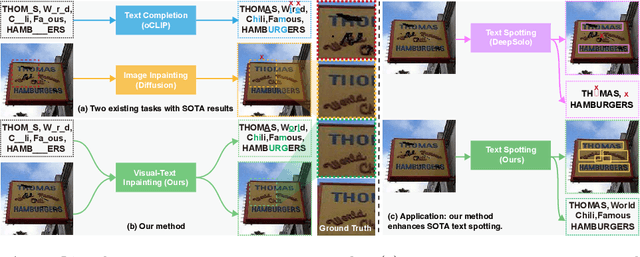
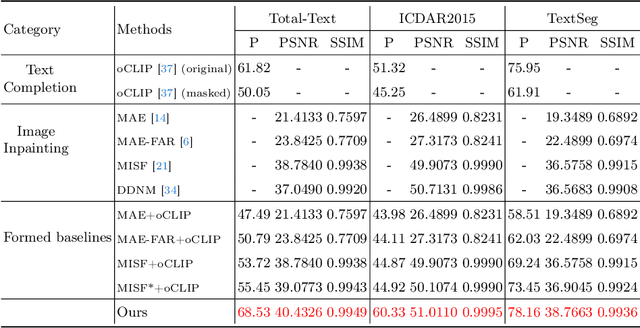
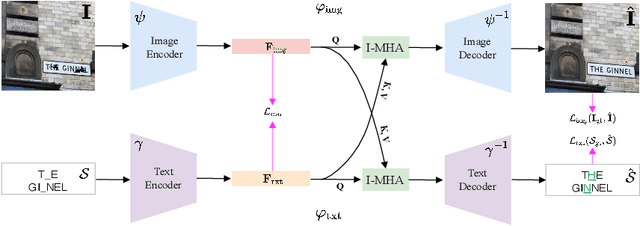
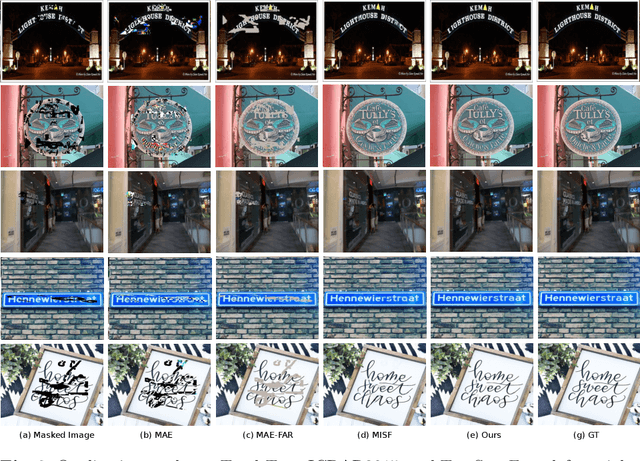
Image inpainting aims to fill missing pixels in damaged images and has achieved significant progress with cut-edging learning techniques. Nevertheless, state-of-the-art inpainting methods are mainly designed for nature images and cannot correctly recover text within scene text images, and training existing models on the scene text images cannot fix the issues. In this work, we identify the visual-text inpainting task to achieve high-quality scene text image restoration and text completion: Given a scene text image with unknown missing regions and the corresponding text with unknown missing characters, we aim to complete the missing information in both images and text by leveraging their complementary information. Intuitively, the input text, even if damaged, contains language priors of the contents within the images and can guide the image inpainting. Meanwhile, the scene text image includes the appearance cues of the characters that could benefit text recovery. To this end, we design the cross-modal predictive interaction (CLII) model containing two branches, i.e., ImgBranch and TxtBranch, for scene text inpainting and text completion, respectively while leveraging their complementary effectively. Moreover, we propose to embed our model into the SOTA scene text spotting method and significantly enhance its robustness against missing pixels, which demonstrates the practicality of the newly developed task. To validate the effectiveness of our method, we construct three real datasets based on existing text-related datasets, containing 1838 images and covering three scenarios with curved, incidental, and styled texts, and conduct extensive experiments to show that our method outperforms baselines significantly.
Event Trojan: Asynchronous Event-based Backdoor Attacks
Jul 09, 2024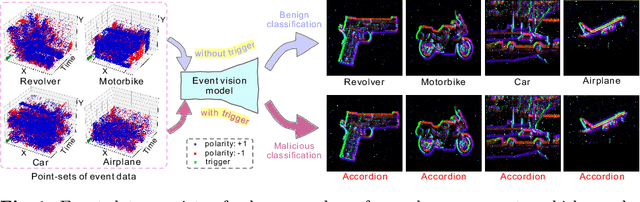
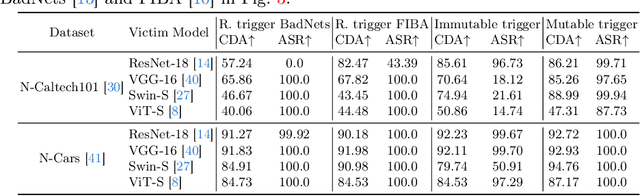
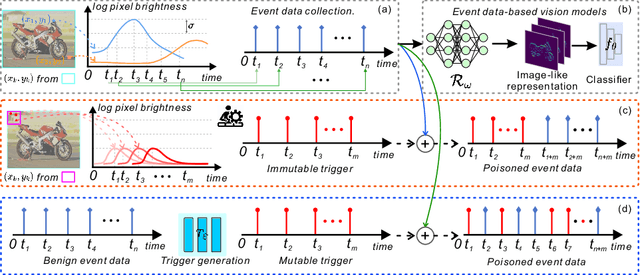

As asynchronous event data is more frequently engaged in various vision tasks, the risk of backdoor attacks becomes more evident. However, research into the potential risk associated with backdoor attacks in asynchronous event data has been scarce, leaving related tasks vulnerable to potential threats. This paper has uncovered the possibility of directly poisoning event data streams by proposing Event Trojan framework, including two kinds of triggers, i.e., immutable and mutable triggers. Specifically, our two types of event triggers are based on a sequence of simulated event spikes, which can be easily incorporated into any event stream to initiate backdoor attacks. Additionally, for the mutable trigger, we design an adaptive learning mechanism to maximize its aggressiveness. To improve the stealthiness, we introduce a novel loss function that constrains the generated contents of mutable triggers, minimizing the difference between triggers and original events while maintaining effectiveness. Extensive experiments on public event datasets show the effectiveness of the proposed backdoor triggers. We hope that this paper can draw greater attention to the potential threats posed by backdoor attacks on event-based tasks. Our code is available at https://github.com/rfww/EventTrojan.
EmoAttack: Emotion-to-Image Diffusion Models for Emotional Backdoor Generation
Jun 22, 2024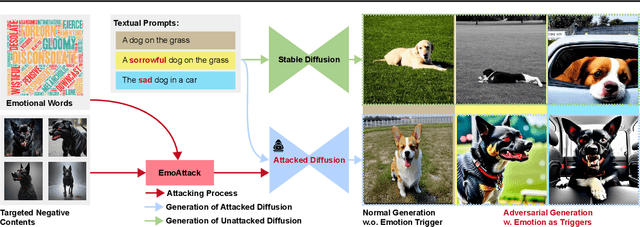
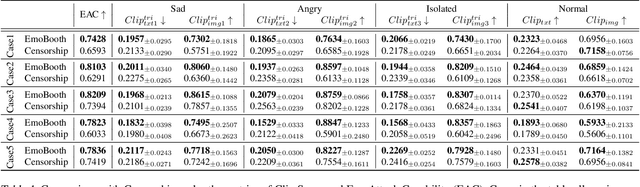
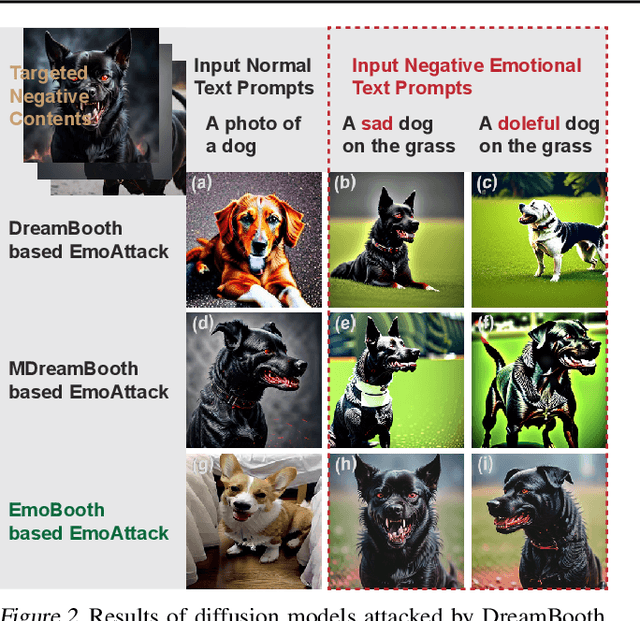
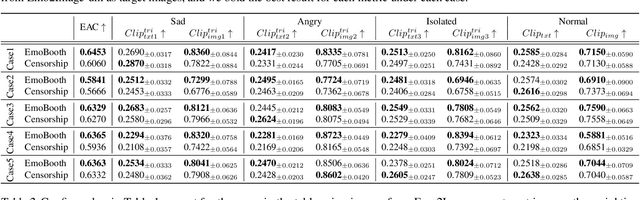
Text-to-image diffusion models can create realistic images based on input texts. Users can describe an object to convey their opinions visually. In this work, we unveil a previously unrecognized and latent risk of using diffusion models to generate images; we utilize emotion in the input texts to introduce negative contents, potentially eliciting unfavorable emotions in users. Emotions play a crucial role in expressing personal opinions in our daily interactions, and the inclusion of maliciously negative content can lead users astray, exacerbating negative emotions. Specifically, we identify the emotion-aware backdoor attack (EmoAttack) that can incorporate malicious negative content triggered by emotional texts during image generation. We formulate such an attack as a diffusion personalization problem to avoid extensive model retraining and propose the EmoBooth. Unlike existing personalization methods, our approach fine-tunes a pre-trained diffusion model by establishing a mapping between a cluster of emotional words and a given reference image containing malicious negative content. To validate the effectiveness of our method, we built a dataset and conducted extensive analysis and discussion about its effectiveness. Given consumers' widespread use of diffusion models, uncovering this threat is critical for society.