 Add to Chrome
 Add to Firefox
 Add to Edge
SciTaRC: Benchmarking QA on Scientific Tabular Data that Requires Language Reasoning and Complex Computation
Mar 09, 2026
We introduce SciTaRC, an expert-authored benchmark of questions about tabular data in scientific papers requiring both deep language reasoning and complex computation. We show that current state-of-the-art AI models fail on at least 23% of these questions, a gap that remains significant even for highly capable open-weight models like Llama-3.3-70B-Instruct, which fails on 65.5% of the tasks. Our analysis reveals a universal "execution bottleneck": both code and language models struggle to faithfully execute plans, even when provided with correct strategies. Specifically, code-based methods prove brittle on raw scientific tables, while natural language reasoning primarily fails due to initial comprehension issues and calculation errors.

Designing an Evaluation Framework for Large Language Models in Astronomy Research
May 30, 2024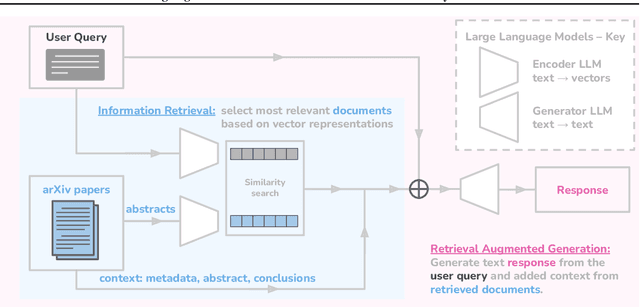
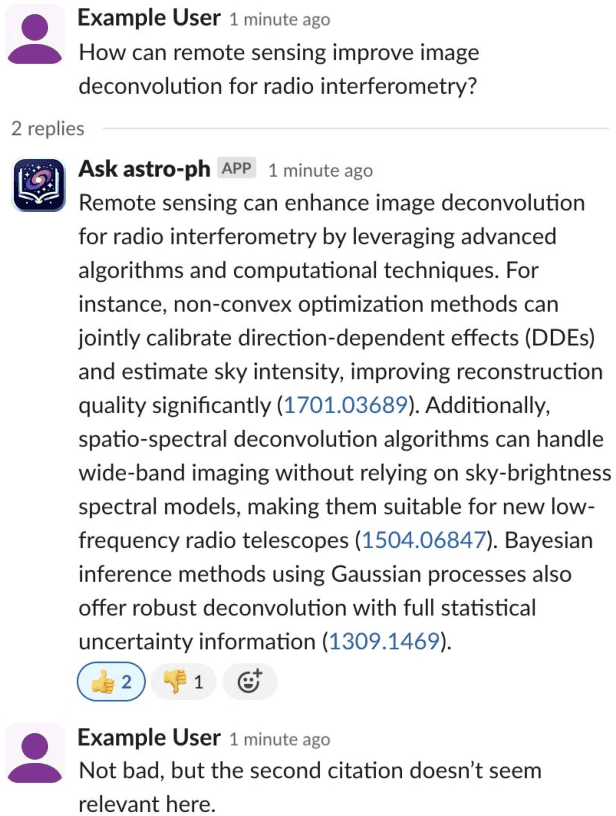
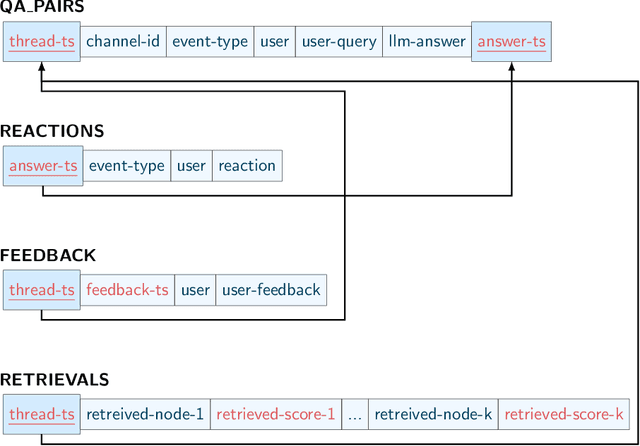
Large Language Models (LLMs) are shifting how scientific research is done. It is imperative to understand how researchers interact with these models and how scientific sub-communities like astronomy might benefit from them. However, there is currently no standard for evaluating the use of LLMs in astronomy. Therefore, we present the experimental design for an evaluation study on how astronomy researchers interact with LLMs. We deploy a Slack chatbot that can answer queries from users via Retrieval-Augmented Generation (RAG); these responses are grounded in astronomy papers from arXiv. We record and anonymize user questions and chatbot answers, user upvotes and downvotes to LLM responses, user feedback to the LLM, and retrieved documents and similarity scores with the query. Our data collection method will enable future dynamic evaluations of LLM tools for astronomy.