 Add to Chrome
 Add to Firefox
 Add to Edge
Generating Public Health Responses using Survey-Augmented Large Language Models
Jun 20, 2026
Epidemiological models often rely on survey data to represent how individuals make health-related decisions, such as whether to vaccinate or adopt protective behaviors. However, repeated large-scale surveys are costly, time-consuming, and limited in the range of scenarios they can capture. In this work, we investigate whether large language models (LLMs) can generate synthetic survey responses that reproduce patterns observed in real populations. Using longitudinal data from the FluPaths surveys, we first identify groups associated with broadly positive or negative attitudes toward vaccination through clustering analysis. We then evaluate several LLMs using a cluster-informed prompting approach to generate synthetic survey responses across multiple epidemic waves. Across models, the synthetic data generally reproduce the distributions of demographic characteristics, vaccination-related beliefs, risk perceptions, and health behaviors observed in the survey data. However, they are less successful at capturing how these factors vary together within respondents. Some models reproduce group-level vaccination trends more reliably than others, although performance varies across waves. We also trained a classifier to distinguish real from synthetic records and found that the generated responses remained identifiable as synthetic. Overall, our findings suggest that LLM-generated survey data may provide a useful tool for exploratory data augmentation and we hope that it could support agent-based epidemic modeling approaches. However, the generated data should not be treated as a substitute for human survey data without further methodological improvements and validation.

Learning Transferable Latent User Preferences for Human-Aligned Decision Making
May 12, 2026Large language models (LLMs) are increasingly used as reasoning modules in many applications. While they are efficient in certain tasks, LLMs often struggle to produce human-aligned solutions. Human-aligned decision making requires accounting for both explicitly stated goals and latent user preferences that shape how ambiguous situations should be resolved. Existing approaches to incorporating such preferences either rely on extensive and repeated user interactions or fail to generalize latent preferences across tasks and contexts, limiting their practical applicability. We consider a setting in which an LLM is used for high-level reasoning and is responsible for inferring latent user preferences from limited interactions, which guides downstream decision making. We introduce CLIPR (Conversational Learning for Inferring Preferences and Reasoning), a framework that learns actionable, transferable natural language rules that represent latent user preferences from minimal conversational input. These rules are iteratively refined through adaptive feedback and applied to both in-distribution and out-of-distribution ambiguous tasks across multiple environments. Evaluations on three datasets and a user study show that CLIPR consistently outperforms existing methods in improving alignment and reducing inference costs.
pathfinder: A Semantic Framework for Literature Review and Knowledge Discovery in Astronomy
Aug 02, 2024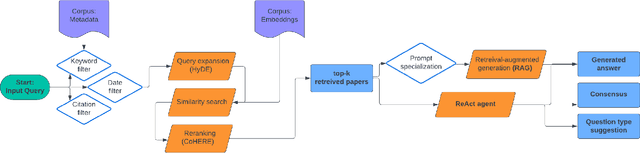


The exponential growth of astronomical literature poses significant challenges for researchers navigating and synthesizing general insights or even domain-specific knowledge. We present Pathfinder, a machine learning framework designed to enable literature review and knowledge discovery in astronomy, focusing on semantic searching with natural language instead of syntactic searches with keywords. Utilizing state-of-the-art large language models (LLMs) and a corpus of 350,000 peer-reviewed papers from the Astrophysics Data System (ADS), Pathfinder offers an innovative approach to scientific inquiry and literature exploration. Our framework couples advanced retrieval techniques with LLM-based synthesis to search astronomical literature by semantic context as a complement to currently existing methods that use keywords or citation graphs. It addresses complexities of jargon, named entities, and temporal aspects through time-based and citation-based weighting schemes. We demonstrate the tool's versatility through case studies, showcasing its application in various research scenarios. The system's performance is evaluated using custom benchmarks, including single-paper and multi-paper tasks. Beyond literature review, Pathfinder offers unique capabilities for reformatting answers in ways that are accessible to various audiences (e.g. in a different language or as simplified text), visualizing research landscapes, and tracking the impact of observatories and methodologies. This tool represents a significant advancement in applying AI to astronomical research, aiding researchers at all career stages in navigating modern astronomy literature.
Designing an Evaluation Framework for Large Language Models in Astronomy Research
May 30, 2024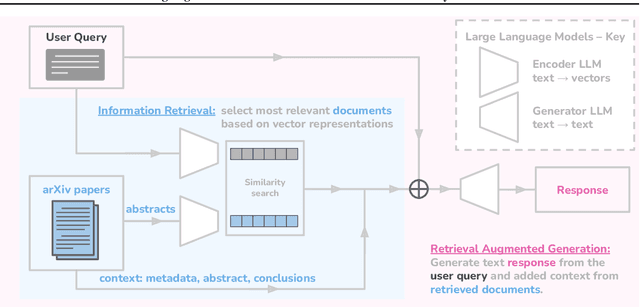
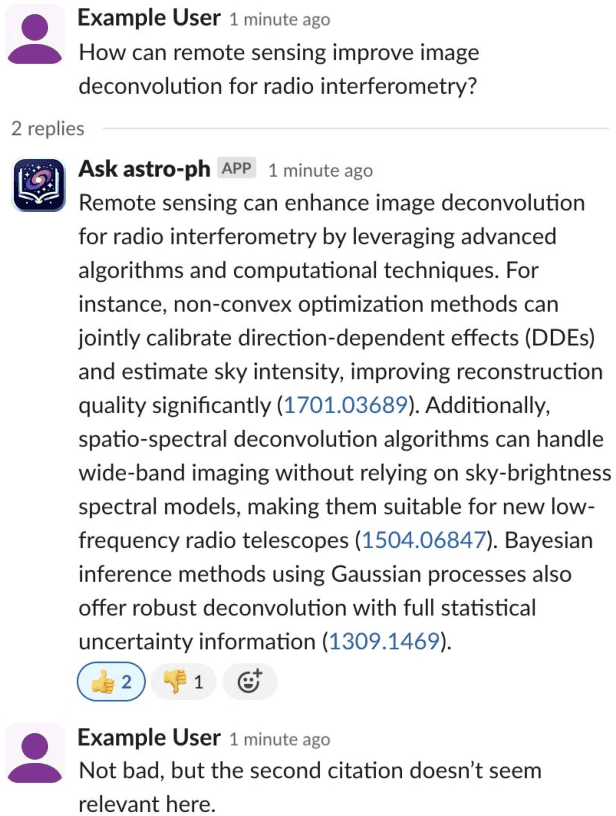
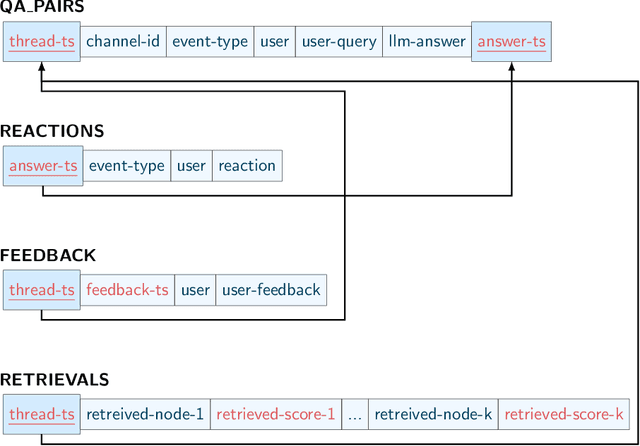
Large Language Models (LLMs) are shifting how scientific research is done. It is imperative to understand how researchers interact with these models and how scientific sub-communities like astronomy might benefit from them. However, there is currently no standard for evaluating the use of LLMs in astronomy. Therefore, we present the experimental design for an evaluation study on how astronomy researchers interact with LLMs. We deploy a Slack chatbot that can answer queries from users via Retrieval-Augmented Generation (RAG); these responses are grounded in astronomy papers from arXiv. We record and anonymize user questions and chatbot answers, user upvotes and downvotes to LLM responses, user feedback to the LLM, and retrieved documents and similarity scores with the query. Our data collection method will enable future dynamic evaluations of LLM tools for astronomy.