 Add to Chrome
 Add to Firefox
 Add to Edge
AutoLoRA: Automatically Tuning Matrix Ranks in Low-Rank Adaptation Based on Meta Learning
Mar 17, 2024
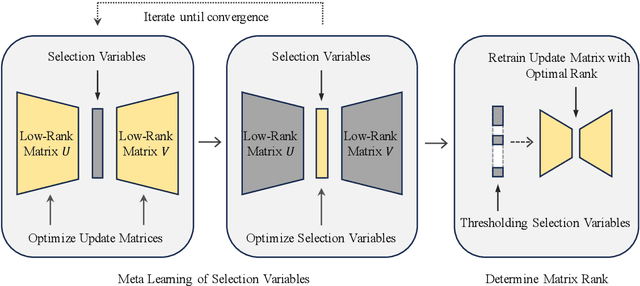
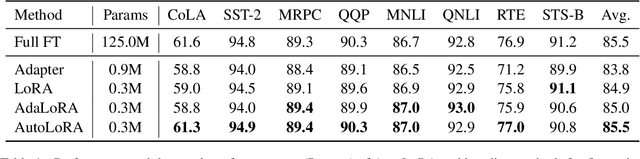
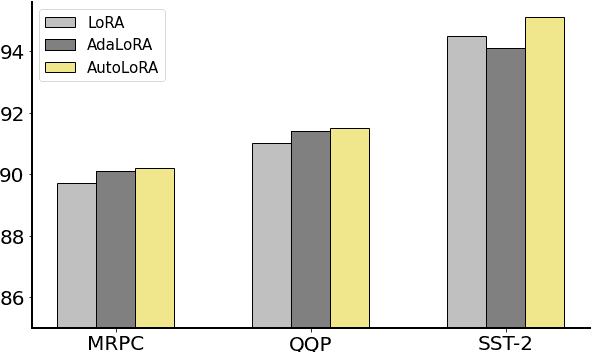
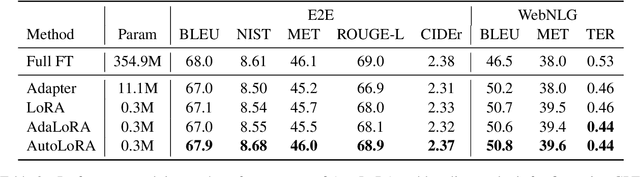
Large-scale pretraining followed by task-specific finetuning has achieved great success in various NLP tasks. Since finetuning all parameters of large pretrained models poses substantial computational and memory challenges, several efficient finetuning methods have been developed. Among them, low-rank adaptation (LoRA), which finetunes low-rank incremental update matrices on top of frozen pretrained weights, has proven particularly effective. Nonetheless, LoRA's uniform rank assignment across all layers, along with its reliance on an exhaustive search to find the best rank, leads to high computation costs and suboptimal finetuning performance. To address these limitations, we introduce AutoLoRA, a meta learning based framework for automatically identifying the optimal rank of each LoRA layer. AutoLoRA associates each rank-1 matrix in a low-rank update matrix with a selection variable, which determines whether the rank-1 matrix should be discarded. A meta learning based method is developed to learn these selection variables. The optimal rank is determined by thresholding the values of these variables. Our comprehensive experiments on natural language understanding, generation, and sequence labeling demonstrate the effectiveness of AutoLoRA.

BLO-SAM: Bi-level Optimization Based Overfitting-Preventing Finetuning of SAM
Mar 11, 2024The Segment Anything Model (SAM), a foundation model pretrained on millions of images and segmentation masks, has significantly advanced semantic segmentation, a fundamental task in computer vision. Despite its strengths, SAM encounters two major challenges. Firstly, it struggles with segmenting specific objects autonomously, as it relies on users to manually input prompts like points or bounding boxes to identify targeted objects. Secondly, SAM faces challenges in excelling at specific downstream tasks, like medical imaging, due to a disparity between the distribution of its pretraining data, which predominantly consists of general-domain images, and the data used in downstream tasks. Current solutions to these problems, which involve finetuning SAM, often lead to overfitting, a notable issue in scenarios with very limited data, like in medical imaging. To overcome these limitations, we introduce BLO-SAM, which finetunes SAM based on bi-level optimization (BLO). Our approach allows for automatic image segmentation without the need for manual prompts, by optimizing a learnable prompt embedding. Furthermore, it significantly reduces the risk of overfitting by training the model's weight parameters and the prompt embedding on two separate subsets of the training dataset, each at a different level of optimization. We apply BLO-SAM to diverse semantic segmentation tasks in general and medical domains. The results demonstrate BLO-SAM's superior performance over various state-of-the-art image semantic segmentation methods.
Token-Specific Watermarking with Enhanced Detectability and Semantic Coherence for Large Language Models
Mar 07, 2024
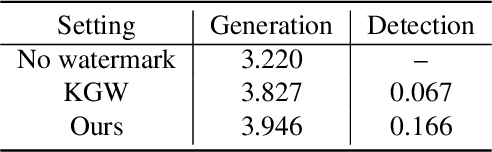


Large language models generate high-quality responses with potential misinformation, underscoring the need for regulation by distinguishing AI-generated and human-written texts. Watermarking is pivotal in this context, which involves embedding hidden markers in texts during the LLM inference phase, which is imperceptible to humans. Current watermarking algorithms, however, face the challenge of achieving both the detectability of inserted watermarks and the semantic integrity of generated texts, where enhancing one aspect often undermines the other. To overcome this, we introduce a novel multi-objective optimization (MOO) approach for watermarking that utilizes lightweight networks to generate token-specific watermarking logits and splitting ratios. By leveraging MOO to optimize for both detection and semantic objective functions, our method simultaneously achieves detectability and semantic integrity. Experimental results show that our method outperforms current watermarking techniques in enhancing the detectability of texts generated by LLMs while maintaining their semantic coherence. Our code is available at https://github.com/mignonjia/TS_watermark.
Downstream Task Guided Masking Learning in Masked Autoencoders Using Multi-Level Optimization
Feb 28, 2024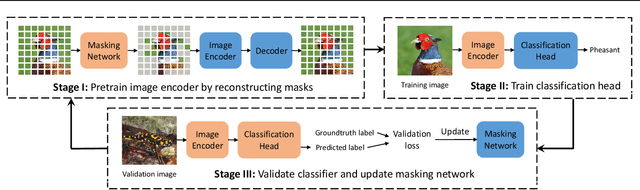

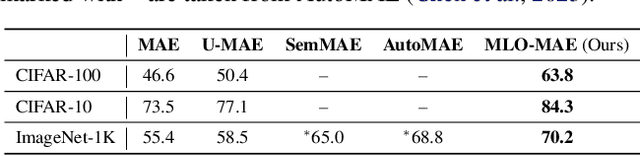
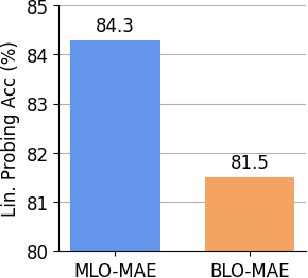
Masked Autoencoder (MAE) is a notable method for self-supervised pretraining in visual representation learning. It operates by randomly masking image patches and reconstructing these masked patches using the unmasked ones. A key limitation of MAE lies in its disregard for the varying informativeness of different patches, as it uniformly selects patches to mask. To overcome this, some approaches propose masking based on patch informativeness. However, these methods often do not consider the specific requirements of downstream tasks, potentially leading to suboptimal representations for these tasks. In response, we introduce the Multi-level Optimized Mask Autoencoder (MLO-MAE), a novel framework that leverages end-to-end feedback from downstream tasks to learn an optimal masking strategy during pretraining. Our experimental findings highlight MLO-MAE's significant advancements in visual representation learning. Compared to existing methods, it demonstrates remarkable improvements across diverse datasets and tasks, showcasing its adaptability and efficiency. Our code is available at: https://github.com/Alexiland/MLOMAE
On the Out of Distribution Robustness of Foundation Models in Medical Image Segmentation
Nov 18, 2023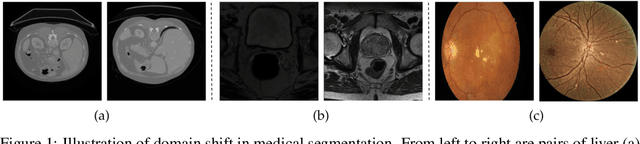

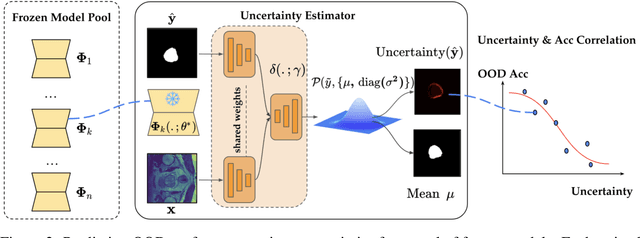
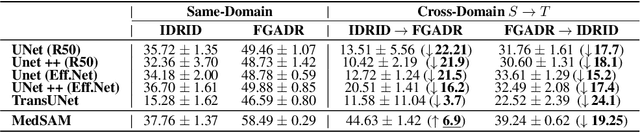
Constructing a robust model that can effectively generalize to test samples under distribution shifts remains a significant challenge in the field of medical imaging. The foundational models for vision and language, pre-trained on extensive sets of natural image and text data, have emerged as a promising approach. It showcases impressive learning abilities across different tasks with the need for only a limited amount of annotated samples. While numerous techniques have focused on developing better fine-tuning strategies to adapt these models for specific domains, we instead examine their robustness to domain shifts in the medical image segmentation task. To this end, we compare the generalization performance to unseen domains of various pre-trained models after being fine-tuned on the same in-distribution dataset and show that foundation-based models enjoy better robustness than other architectures. From here, we further developed a new Bayesian uncertainty estimation for frozen models and used them as an indicator to characterize the model's performance on out-of-distribution (OOD) data, proving particularly beneficial for real-world applications. Our experiments not only reveal the limitations of current indicators like accuracy on the line or agreement on the line commonly used in natural image applications but also emphasize the promise of the introduced Bayesian uncertainty. Specifically, lower uncertainty predictions usually tend to higher out-of-distribution (OOD) performance.
Making Scalable Meta Learning Practical
Oct 23, 2023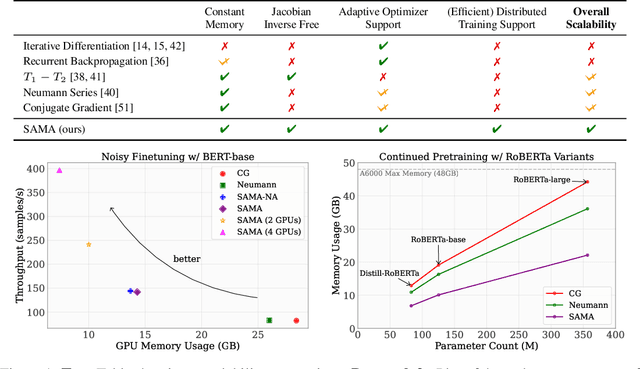


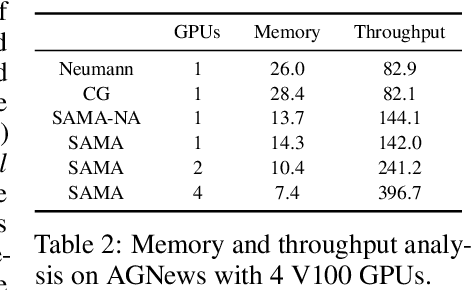
Despite its flexibility to learn diverse inductive biases in machine learning programs, meta learning (i.e., learning to learn) has long been recognized to suffer from poor scalability due to its tremendous compute/memory costs, training instability, and a lack of efficient distributed training support. In this work, we focus on making scalable meta learning practical by introducing SAMA, which combines advances in both implicit differentiation algorithms and systems. Specifically, SAMA is designed to flexibly support a broad range of adaptive optimizers in the base level of meta learning programs, while reducing computational burden by avoiding explicit computation of second-order gradient information, and exploiting efficient distributed training techniques implemented for first-order gradients. Evaluated on multiple large-scale meta learning benchmarks, SAMA showcases up to 1.7/4.8x increase in throughput and 2.0/3.8x decrease in memory consumption respectively on single-/multi-GPU setups compared to other baseline meta learning algorithms. Furthermore, we show that SAMA-based data optimization leads to consistent improvements in text classification accuracy with BERT and RoBERTa large language models, and achieves state-of-the-art results in both small- and large-scale data pruning on image classification tasks, demonstrating the practical applicability of scalable meta learning across language and vision domains.
LVM-Med: Learning Large-Scale Self-Supervised Vision Models for Medical Imaging via Second-order Graph Matching
Jul 09, 2023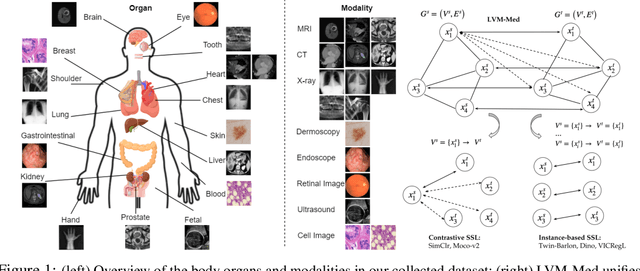
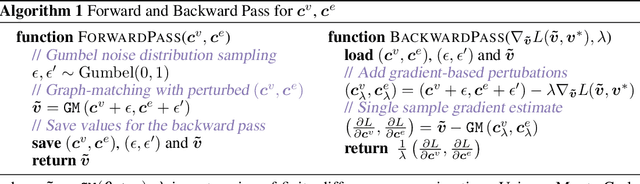
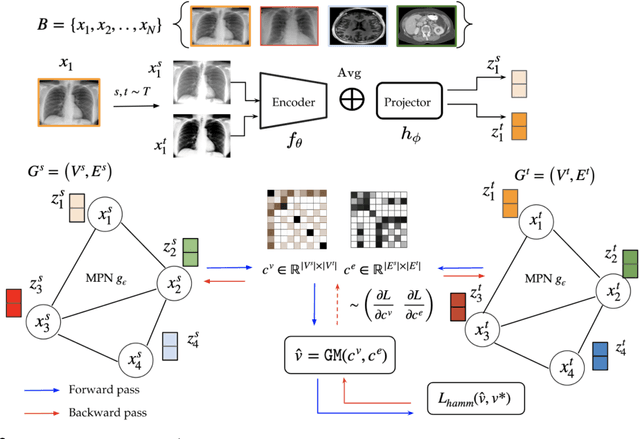
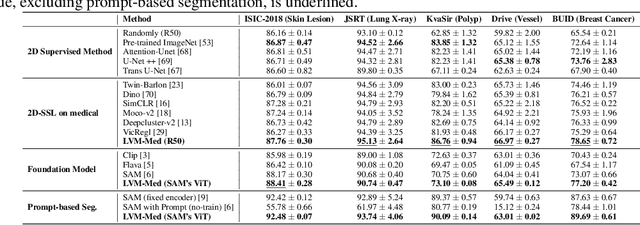
Obtaining large pre-trained models that can be fine-tuned to new tasks with limited annotated samples has remained an open challenge for medical imaging data. While pre-trained deep networks on ImageNet and vision-language foundation models trained on web-scale data are prevailing approaches, their effectiveness on medical tasks is limited due to the significant domain shift between natural and medical images. To bridge this gap, we introduce LVM-Med, the first family of deep networks trained on large-scale medical datasets. We have collected approximately 1.3 million medical images from 55 publicly available datasets, covering a large number of organs and modalities such as CT, MRI, X-ray, and Ultrasound. We benchmark several state-of-the-art self-supervised algorithms on this dataset and propose a novel self-supervised contrastive learning algorithm using a graph-matching formulation. The proposed approach makes three contributions: (i) it integrates prior pair-wise image similarity metrics based on local and global information; (ii) it captures the structural constraints of feature embeddings through a loss function constructed via a combinatorial graph-matching objective; and (iii) it can be trained efficiently end-to-end using modern gradient-estimation techniques for black-box solvers. We thoroughly evaluate the proposed LVM-Med on 15 downstream medical tasks ranging from segmentation and classification to object detection, and both for the in and out-of-distribution settings. LVM-Med empirically outperforms a number of state-of-the-art supervised, self-supervised, and foundation models. For challenging tasks such as Brain Tumor Classification or Diabetic Retinopathy Grading, LVM-Med improves previous vision-language models trained on 1 billion masks by 6-7% while using only a ResNet-50.
Learning by Grouping: A Multilevel Optimization Framework for Improving Fairness in Classification without Losing Accuracy
Apr 02, 2023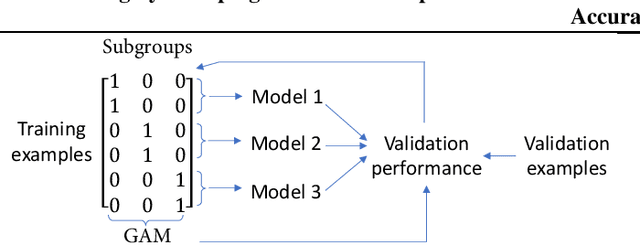

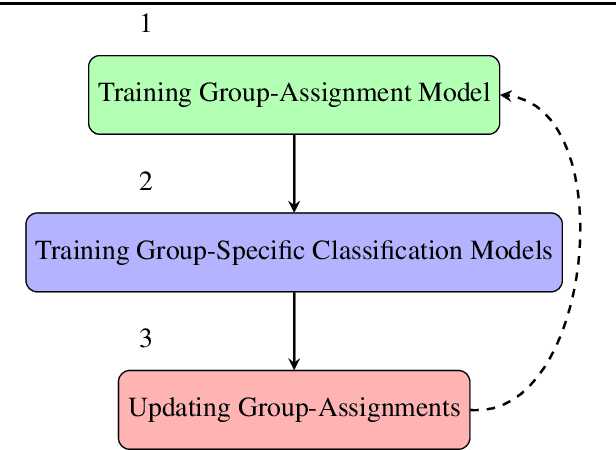
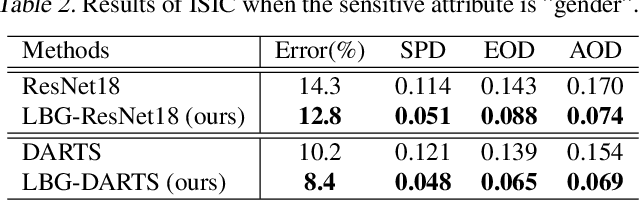
The integration of machine learning models in various real-world applications is becoming more prevalent to assist humans in their daily decision-making tasks as a result of recent advancements in this field. However, it has been discovered that there is a tradeoff between the accuracy and fairness of these decision-making tasks. In some cases, these AI systems can be unfair by exhibiting bias or discrimination against certain social groups, which can have severe consequences in real life. Inspired by one of the most well-known human learning skills called grouping, we address this issue by proposing a novel machine learning framework where the ML model learns to group a diverse set of problems into distinct subgroups to solve each subgroup using its specific sub-model. Our proposed framework involves three stages of learning, which are formulated as a three-level optimization problem: (i) learning to group problems into different subgroups; (ii) learning group-specific sub-models for problem-solving; and (iii) updating group assignments of training examples by minimizing the validation loss. These three learning stages are performed end-to-end in a joint manner using gradient descent. To improve fairness and accuracy, we develop an efficient optimization algorithm to solve this three-level optimization problem. To further reduce the risk of overfitting in small datasets, we incorporate domain adaptation techniques in the second stage of training. We further apply our method to neural architecture search. Extensive experiments on various datasets demonstrate our method's effectiveness and performance improvements in both fairness and accuracy. Our proposed Learning by Grouping can reduce overfitting and achieve state-of-the-art performances with fixed human-designed network architectures and searchable network architectures on various datasets.
A Comprehensive Survey on Pretrained Foundation Models: A History from BERT to ChatGPT
Feb 18, 2023The Pretrained Foundation Models (PFMs) are regarded as the foundation for various downstream tasks with different data modalities. A pretrained foundation model, such as BERT, GPT-3, MAE, DALLE-E, and ChatGPT, is trained on large-scale data which provides a reasonable parameter initialization for a wide range of downstream applications. The idea of pretraining behind PFMs plays an important role in the application of large models. Different from previous methods that apply convolution and recurrent modules for feature extractions, the generative pre-training (GPT) method applies Transformer as the feature extractor and is trained on large datasets with an autoregressive paradigm. Similarly, the BERT apples transformers to train on large datasets as a contextual language model. Recently, the ChatGPT shows promising success on large language models, which applies an autoregressive language model with zero shot or few show prompting. With the extraordinary success of PFMs, AI has made waves in a variety of fields over the past few years. Considerable methods, datasets, and evaluation metrics have been proposed in the literature, the need is raising for an updated survey. This study provides a comprehensive review of recent research advancements, current and future challenges, and opportunities for PFMs in text, image, graph, as well as other data modalities. We first review the basic components and existing pretraining in natural language processing, computer vision, and graph learning. We then discuss other advanced PFMs for other data modalities and unified PFMs considering the data quality and quantity. Besides, we discuss relevant research about the fundamentals of the PFM, including model efficiency and compression, security, and privacy. Finally, we lay out key implications, future research directions, challenges, and open problems.
Learning to compile smartly for program size reduction
Jan 09, 2023Compiler optimization passes are an important tool for improving program efficiency and reducing program size, but manually selecting optimization passes can be time-consuming and error-prone. While human experts have identified a few fixed sequences of optimization passes (e.g., the Clang -Oz passes) that perform well for a wide variety of programs, these sequences are not conditioned on specific programs. In this paper, we propose a novel approach that learns a policy to select passes for program size reduction, allowing for customization and adaptation to specific programs. Our approach uses a search mechanism that helps identify useful pass sequences and a GNN with customized attention that selects the optimal sequence to use. Crucially it is able to generalize to new, unseen programs, making it more flexible and general than previous approaches. We evaluate our approach on a range of programs and show that it leads to size reduction compared to traditional optimization techniques. Our results demonstrate the potential of a single policy that is able to optimize many programs.