 Add to Chrome
 Add to Firefox
 Add to Edge
TerraDiT-$Ω$: Unified Spatial Control for Satellite Image Synthesis with Any Geospatial Primitive
Jun 30, 2026
Generative models have achieved remarkable progress, yet applying them to satellite imagery remains challenging. Unlike natural imagery, satellite scenes are structured by spatially complex and semantically distinct geometries. Prior work addresses this complexity by adapting natural image frameworks using dense rasters or sparse prompts, trading off annotation cost and fidelity while breaking compatibility with vector primitives commonly used to represent geographic information. We introduce TerraDiT-$Ω$, a unified spatial control framework that generates satellite imagery directly from any native geospatial primitive. By jointly leveraging precise annotations (polygons, polylines) and coarser ones (bounding boxes, points), the model supports controllable layouts across varying annotation budgets, broadening applicability to design tasks such as urban planning while remaining naturally compatible with end-to-end GeoAI workflows. To effectively leverage these primitives during generation, we propose Geometry-Aware Local Attention, a conditioning mechanism that injects explicit geometric cues into the attention space. Across all conditioning formats, our approach consistently outperforms both dense-control and sparse-control baselines. Furthermore, this flexibility enables controllable synthetic data augmentation using a single generative model, improving downstream performance on land-cover segmentation, object detection, road graph extraction, and scene classification. Code, data, and weights are available at https://github.com/mvrl/TerraDiT.

Tessellating The Earth
Jun 25, 2026Geolocation encoders, which map geographic coordinates to learned representations, are emerging as an effective means of capturing visual and non-visual characteristics from a latitude-longitude pair alone. However, existing approaches project coordinates onto fixed bases (e.g., spherical harmonics), allocating representational capacity uniformly and devoting equal resources to the open ocean and to a developing city. We introduce Tessellating the Earth (TTE), a location encoder built from learnable Spherical Voronoi partitions that concentrates representational capacity where it is needed in a fully differentiable, end-to-end manner. Each Voronoi site carries its own embedding and migrates during training toward discriminative areas. To bridge the gap between local spatial structure and global semantic understanding, we introduce \emph{global semantic tokens}: a set of shared learnable concept tokens that distill semantic knowledge from the satellite imagery into a compact vocabulary the location encoder can reference at inference, enabling geographically distant sites covering similar environments to share semantics. TTE sets a new state of the art for location encoders across a suite of geospatial classification and regression tasks, and achieves the strongest results when used as a geographic prior for fine-grained species classification on iNaturalist-2018. Code, and weights are available at https://github.com/mvrl/TTE.
Critique of Agent Model
Jun 22, 2026What is an agent? What constitutes agency? With the rise of Large Language Model (LLM) systems marketed as ``coding agents'', ``AI co-scientists'', and other ``agentic" tools that promise to drive up productivity, and at the same time, ``existential" concerns such as AI escaping human control with destructive power under a speculative ``machine agency" against humans, it has become essential to clarify where automation ends and agency begins, both for building capable systems and for understanding whether and what to fear. Drawing on Descartes' grounding of agency in independent thought, and on portrayals of autonomous beings in science fiction, we survey the current landscape of AI agents, and analyze agent architectures along five dimensions: goal, identity, decision-making, self-regulation, and learning. Specifically, we argue that genuine agency requires these structures to be \emph{internalized within the system itself} rather than assembled through external scaffolding. This distinction between \emph{agentic} systems, whose competence resides in engineered workflows, and \emph{agentive} systems, whose capabilities (including social interaction) arise endogenously, defines the boundary between systems designed for prescribed tasks, and those capable of operating in the open world with true autonomy. Building on this analysis, we propose the Goal-Identity-Configurator (GIC) architecture for a general-purpose agent model, combining hierarchical goal decomposition, identity evolution, simulative reasoning grounded in a separately trained world model, learned self-regulation, and self-directed learning from both real and simulated experience. Furthermore, we share insight on the auditability, controllability, and safety of agentive systems that possess greater autonomy and ``agency", but remain under human oversight.
EMO: Frustratingly Easy Progressive Training of Extendable MoE
May 14, 2026Sparse Mixture-of-Experts (MoE) models offer a powerful way to scale model size without increasing compute, as per-token FLOPs depend only on k active experts rather than the total pool of E experts. Yet, this asymmetry creates an MoE efficiency paradox in practice: adding more experts balloons memory and communication costs, making actual training inefficient. We argue that this bottleneck arises in part because current MoE training allocates too many experts from the beginning, even though early-stage data may not fully utilize such capacity. Motivated by this, we propose EMO, a simple progressive training framework that treats MoE capacity as expandable memory and grows the expert pool over the course of training. EMO explicitly models sparsity in scaling law to derive stage-wise compute-optimal token budgets for progressive expansion. Empirical results show that EMO matches the performance of a fixed-expert setup in large-scale experiments while improving wall-clock efficiency. It offers a surprisingly simple yet effective path to scalable MoE training, preserving the benefits of large expert pools while reducing both training time and GPU cost.
World Reasoning Arena
Mar 26, 2026World models (WMs) are intended to serve as internal simulators of the real world that enable agents to understand, anticipate, and act upon complex environments. Existing WM benchmarks remain narrowly focused on next-state prediction and visual fidelity, overlooking the richer simulation capabilities required for intelligent behavior. To address this gap, we introduce WR-Arena, a comprehensive benchmark for evaluating WMs along three fundamental dimensions of next world simulation: (i) Action Simulation Fidelity, the ability to interpret and follow semantically meaningful, multi-step instructions and generate diverse counterfactual rollouts; (ii) Long-horizon Forecast, the ability to sustain accurate, coherent, and physically plausible simulations across extended interactions; and (iii) Simulative Reasoning and Planning, the ability to support goal-directed reasoning by simulating, comparing, and selecting among alternative futures in both structured and open-ended environments. We build a task taxonomy and curate diverse datasets designed to probe these capabilities, moving beyond single-turn and perceptual evaluations. Through extensive experiments with state-of-the-art WMs, our results expose a substantial gap between current models and human-level hypothetical reasoning, and establish WR-Arena as both a diagnostic tool and a guideline for advancing next-generation world models capable of robust understanding, forecasting, and purposeful action. The code is available at https://github.com/MBZUAI-IFM/WR-Arena.
IsoCompute Playbook: Optimally Scaling Sampling Compute for LLM RL
Mar 12, 2026While scaling laws guide compute allocation for LLM pre-training, analogous prescriptions for reinforcement learning (RL) post-training of large language models (LLMs) remain poorly understood. We study the compute-optimal allocation of sampling compute for on-policy RL methods in LLMs, framing scaling as a compute-constrained optimization over three resources: parallel rollouts per problem, number of problems per batch, and number of update steps. We find that the compute-optimal number of parallel rollouts per problem increases predictably with compute budget and then saturates. This trend holds across both easy and hard problems, though driven by different mechanisms: solution sharpening on easy problems and coverage expansion on hard problems. We further show that increasing the number of parallel rollouts mitigates interference across problems, while the number of problems per batch primarily affects training stability and can be chosen within a broad range. Validated across base models and data distributions, our results recast RL scaling laws as prescriptive allocation rules and provide practical guidance for compute-efficient LLM RL post-training.
SimuRA: Towards General Goal-Oriented Agent via Simulative Reasoning Architecture with LLM-Based World Model
Jul 31, 2025
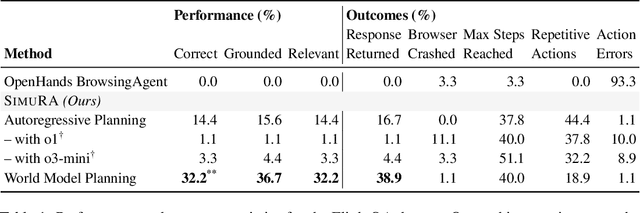
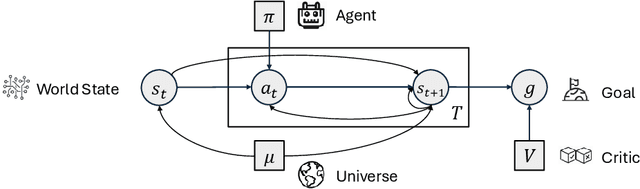
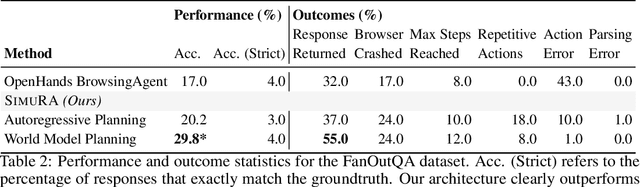
AI agents built on large language models (LLMs) hold enormous promise, but current practice focuses on a one-task-one-agent approach, which not only falls short of scalability and generality, but also suffers from the fundamental limitations of autoregressive LLMs. On the other hand, humans are general agents who reason by mentally simulating the outcomes of their actions and plans. Moving towards a more general and powerful AI agent, we introduce SimuRA, a goal-oriented architecture for generalized agentic reasoning. Based on a principled formulation of optimal agent in any environment, \modelname overcomes the limitations of autoregressive reasoning by introducing a world model for planning via simulation. The generalized world model is implemented using LLM, which can flexibly plan in a wide range of environments using the concept-rich latent space of natural language. Experiments on difficult web browsing tasks show that \modelname improves the success of flight search from 0\% to 32.2\%. World-model-based planning, in particular, shows consistent advantage of up to 124\% over autoregressive planning, demonstrating the advantage of world model simulation as a reasoning paradigm. We are excited about the possibility for training a single, general agent model based on LLMs that can act superintelligently in all environments. To start, we make SimuRA, a web-browsing agent built on \modelname with pretrained LLMs, available as a research demo for public testing.
Global and Local Entailment Learning for Natural World Imagery
Jun 26, 2025Learning the hierarchical structure of data in vision-language models is a significant challenge. Previous works have attempted to address this challenge by employing entailment learning. However, these approaches fail to model the transitive nature of entailment explicitly, which establishes the relationship between order and semantics within a representation space. In this work, we introduce Radial Cross-Modal Embeddings (RCME), a framework that enables the explicit modeling of transitivity-enforced entailment. Our proposed framework optimizes for the partial order of concepts within vision-language models. By leveraging our framework, we develop a hierarchical vision-language foundation model capable of representing the hierarchy in the Tree of Life. Our experiments on hierarchical species classification and hierarchical retrieval tasks demonstrate the enhanced performance of our models compared to the existing state-of-the-art models. Our code and models are open-sourced at https://vishu26.github.io/RCME/index.html.
Pruning Spurious Subgraphs for Graph Out-of-Distribtuion Generalization
Jun 06, 2025Graph Neural Networks (GNNs) often encounter significant performance degradation under distribution shifts between training and test data, hindering their applicability in real-world scenarios. Recent studies have proposed various methods to address the out-of-distribution generalization challenge, with many methods in the graph domain focusing on directly identifying an invariant subgraph that is predictive of the target label. However, we argue that identifying the edges from the invariant subgraph directly is challenging and error-prone, especially when some spurious edges exhibit strong correlations with the targets. In this paper, we propose PrunE, the first pruning-based graph OOD method that eliminates spurious edges to improve OOD generalizability. By pruning spurious edges, \mine{} retains the invariant subgraph more comprehensively, which is critical for OOD generalization. Specifically, PrunE employs two regularization terms to prune spurious edges: 1) graph size constraint to exclude uninformative spurious edges, and 2) $\epsilon$-probability alignment to further suppress the occurrence of spurious edges. Through theoretical analysis and extensive experiments, we show that PrunE achieves superior OOD performance and outperforms previous state-of-the-art methods significantly. Codes are available at: \href{https://github.com/tianyao-aka/PrunE-GraphOOD}{https://github.com/tianyao-aka/PrunE-GraphOOD}.
QuARI: Query Adaptive Retrieval Improvement
May 27, 2025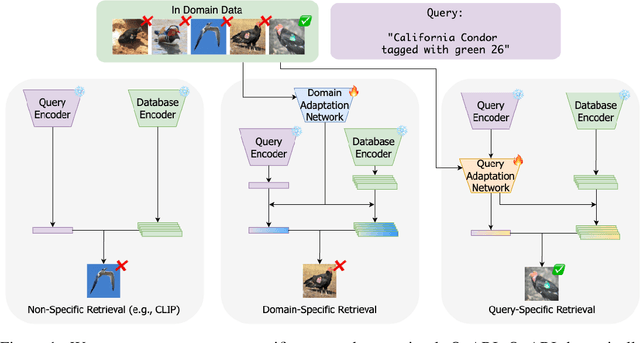
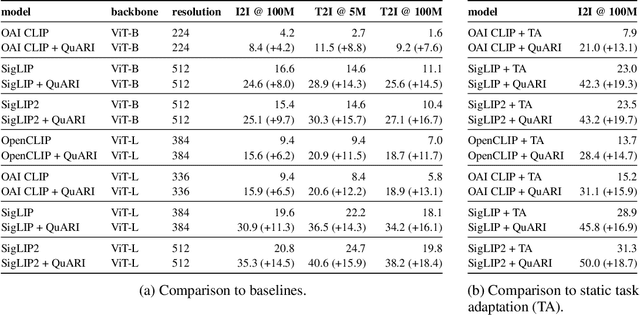
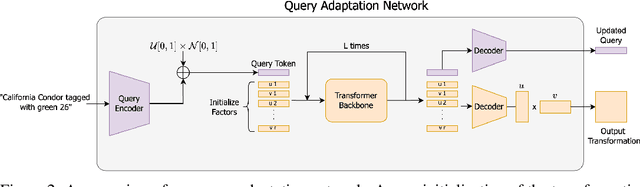
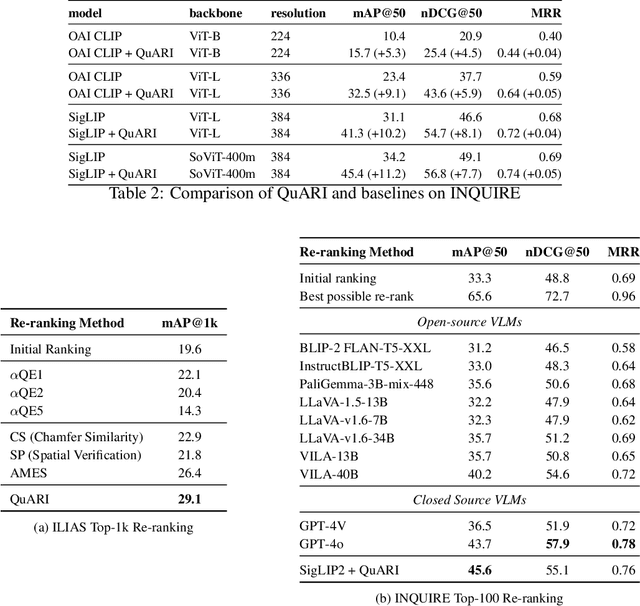
Massive-scale pretraining has made vision-language models increasingly popular for image-to-image and text-to-image retrieval across a broad collection of domains. However, these models do not perform well when used for challenging retrieval tasks, such as instance retrieval in very large-scale image collections. Recent work has shown that linear transformations of VLM features trained for instance retrieval can improve performance by emphasizing subspaces that relate to the domain of interest. In this paper, we explore a more extreme version of this specialization by learning to map a given query to a query-specific feature space transformation. Because this transformation is linear, it can be applied with minimal computational cost to millions of image embeddings, making it effective for large-scale retrieval or re-ranking. Results show that this method consistently outperforms state-of-the-art alternatives, including those that require many orders of magnitude more computation at query time.