 Add to Chrome
 Add to Firefox
 Add to Edge
AliMark: Enhancing Robustness of Sentence-Level Watermarking Against Text Paraphrasing
May 28, 2026
Existing sentence-level watermarking methods enhance robustness to paraphrasing by anchoring watermarks in sentence semantics. However, their prefix-based designs remain vulnerable to structural perturbations, such as sentence splitting and merging, which commonly arise under strong paraphrasers like DIPPER and GPT-3.5. To mitigate this issue, we propose AliMark, a framework that reformulates sentence-level watermarking as a bit sequence encoding and alignment problem between a potentially watermarked text and a secret bit sequence. Notably, our approach adopts a two-stage detection strategy: we generate multiple restructured text variants and adaptively align their extracted bit sequences with the secret bit sequence to minimize alignment cost. This multi-candidate alignment design naturally improves robustness to sentence merges and splits. Extensive experiments demonstrate that AliMark substantially outperforms state-of-the-art baselines under diverse paraphrasing attacks.

When In-Distribution Gains Fail: Evaluating Weak-to-Strong Reward Models under Preference Shift
May 26, 2026Weak-to-strong (W2S) generalization is a promising framework for scalable oversight, yet existing evaluations often test students under matched train-test distributions. Therefore, we study W2S preference learning under zero-shot distribution shift and find that strong students trained on weak preference labels can appear successful in-distribution while failing to transfer across preference datasets. We provide evidence for a representational failure mode in which weak-supervised fine-tuning can pull the strong model toward source-domain features instead of maintaining broadly transferable preference representations. To mitigate this, we propose Representation Anchoring (Anchor), a simple yet effective regularizer that constrains excessive drift from the pretrained strong model's representation space during fine-tuning, while still allowing task-relevant adaptation. Across preference domains, datasets, and model families, Anchor consistently improves out-of-distribution transfer while maintaining competitive in-distribution performance. Together, our evaluation protocol, transfer-aware metrics, and method expose hidden brittleness in current W2S reward modeling and provide a practical path toward more robust preference transfer.
WARD: Adversarially Robust Defense of Web Agents Against Prompt Injections
May 14, 2026Web agents can autonomously complete online tasks by interacting with websites, but their exposure to open web environments makes them vulnerable to prompt injection attacks embedded in HTML content or visual interfaces. Existing guard models still suffer from limited generalization to unseen domains and attack patterns, high false positive rates on benign content, reduced deployment efficiency due to added latency at each step, and vulnerability to adversarial attacks that evolve over time or directly target the guard itself. To address these limitations, we propose WARD (Web Agent Robust Defense against Prompt Injection), a practical guard model for secure and efficient web agents. WARD is built on WARD-Base, a large-scale dataset with around 177K samples collected from 719 high-traffic URLs and platforms, and WARD-PIG, a dedicated dataset designed for prompt injection attacks targeting the guard model. We further introduce A3T, an adaptive adversarial attack training framework that iteratively strengthens WARD through a memory-based attacker and guard co-evolution process. Extensive experiments show that WARD achieves nearly perfect recall on out-of-distribution benchmarks, maintains low false positive rates to preserve agent utility, remains robust against guard-targeted and adaptive attacks under substantial distribution shifts, and runs efficiently in parallel with the agent without introducing additional latency.
Just-In-Time Reinforcement Learning: Continual Learning in LLM Agents Without Gradient Updates
Jan 26, 2026While Large Language Model (LLM) agents excel at general tasks, they inherently struggle with continual adaptation due to the frozen weights after deployment. Conventional reinforcement learning (RL) offers a solution but incurs prohibitive computational costs and the risk of catastrophic forgetting. We introduce Just-In-Time Reinforcement Learning (JitRL), a training-free framework that enables test-time policy optimization without any gradient updates. JitRL maintains a dynamic, non-parametric memory of experiences and retrieves relevant trajectories to estimate action advantages on-the-fly. These estimates are then used to directly modulate the LLM's output logits. We theoretically prove that this additive update rule is the exact closed-form solution to the KL-constrained policy optimization objective. Extensive experiments on WebArena and Jericho demonstrate that JitRL establishes a new state-of-the-art among training-free methods. Crucially, JitRL outperforms the performance of computationally expensive fine-tuning methods (e.g., WebRL) while reducing monetary costs by over 30 times, offering a scalable path for continual learning agents. The code is available at https://github.com/liushiliushi/JitRL.
Automating Steering for Safe Multimodal Large Language Models
Jul 17, 2025Recent progress in Multimodal Large Language Models (MLLMs) has unlocked powerful cross-modal reasoning abilities, but also raised new safety concerns, particularly when faced with adversarial multimodal inputs. To improve the safety of MLLMs during inference, we introduce a modular and adaptive inference-time intervention technology, AutoSteer, without requiring any fine-tuning of the underlying model. AutoSteer incorporates three core components: (1) a novel Safety Awareness Score (SAS) that automatically identifies the most safety-relevant distinctions among the model's internal layers; (2) an adaptive safety prober trained to estimate the likelihood of toxic outputs from intermediate representations; and (3) a lightweight Refusal Head that selectively intervenes to modulate generation when safety risks are detected. Experiments on LLaVA-OV and Chameleon across diverse safety-critical benchmarks demonstrate that AutoSteer significantly reduces the Attack Success Rate (ASR) for textual, visual, and cross-modal threats, while maintaining general abilities. These findings position AutoSteer as a practical, interpretable, and effective framework for safer deployment of multimodal AI systems.
GuardReasoner-VL: Safeguarding VLMs via Reinforced Reasoning
May 16, 2025To enhance the safety of VLMs, this paper introduces a novel reasoning-based VLM guard model dubbed GuardReasoner-VL. The core idea is to incentivize the guard model to deliberatively reason before making moderation decisions via online RL. First, we construct GuardReasoner-VLTrain, a reasoning corpus with 123K samples and 631K reasoning steps, spanning text, image, and text-image inputs. Then, based on it, we cold-start our model's reasoning ability via SFT. In addition, we further enhance reasoning regarding moderation through online RL. Concretely, to enhance diversity and difficulty of samples, we conduct rejection sampling followed by data augmentation via the proposed safety-aware data concatenation. Besides, we use a dynamic clipping parameter to encourage exploration in early stages and exploitation in later stages. To balance performance and token efficiency, we design a length-aware safety reward that integrates accuracy, format, and token cost. Extensive experiments demonstrate the superiority of our model. Remarkably, it surpasses the runner-up by 19.27% F1 score on average. We release data, code, and models (3B/7B) of GuardReasoner-VL at https://github.com/yueliu1999/GuardReasoner-VL/
Words or Vision: Do Vision-Language Models Have Blind Faith in Text?
Mar 04, 2025Vision-Language Models (VLMs) excel in integrating visual and textual information for vision-centric tasks, but their handling of inconsistencies between modalities is underexplored. We investigate VLMs' modality preferences when faced with visual data and varied textual inputs in vision-centered settings. By introducing textual variations to four vision-centric tasks and evaluating ten Vision-Language Models (VLMs), we discover a \emph{``blind faith in text''} phenomenon: VLMs disproportionately trust textual data over visual data when inconsistencies arise, leading to significant performance drops under corrupted text and raising safety concerns. We analyze factors influencing this text bias, including instruction prompts, language model size, text relevance, token order, and the interplay between visual and textual certainty. While certain factors, such as scaling up the language model size, slightly mitigate text bias, others like token order can exacerbate it due to positional biases inherited from language models. To address this issue, we explore supervised fine-tuning with text augmentation and demonstrate its effectiveness in reducing text bias. Additionally, we provide a theoretical analysis suggesting that the blind faith in text phenomenon may stem from an imbalance of pure text and multi-modal data during training. Our findings highlight the need for balanced training and careful consideration of modality interactions in VLMs to enhance their robustness and reliability in handling multi-modal data inconsistencies.
Meta-Reasoner: Dynamic Guidance for Optimized Inference-time Reasoning in Large Language Models
Feb 27, 2025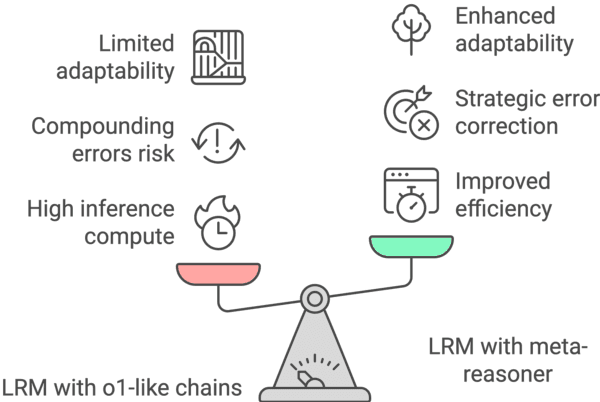
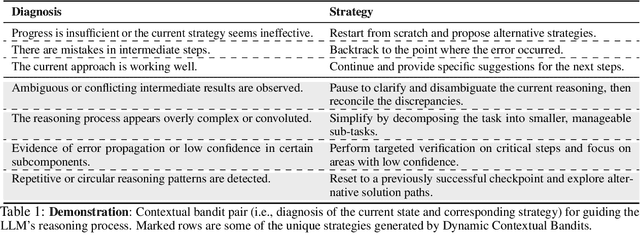
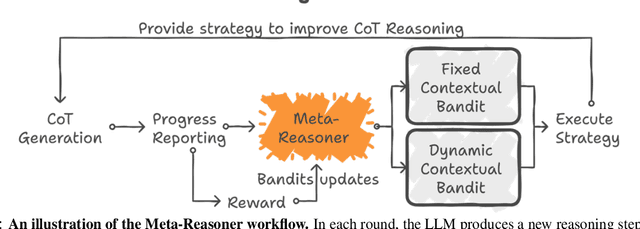
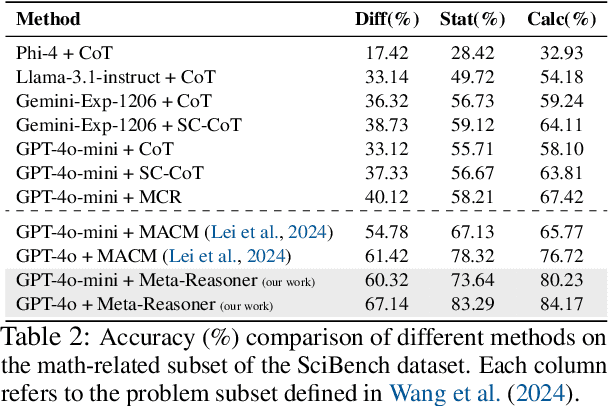
Large Language Models (LLMs) increasingly rely on prolonged reasoning chains to solve complex tasks. However, this trial-and-error approach often leads to high computational overhead and error propagation, where early mistakes can derail subsequent steps. To address these issues, we introduce Meta-Reasoner, a framework that dynamically optimizes inference-time reasoning by enabling LLMs to "think about how to think." Drawing inspiration from human meta-cognition and dual-process theory, Meta-Reasoner operates as a strategic advisor, decoupling high-level guidance from step-by-step generation. It employs "contextual multi-armed bandits" to iteratively evaluate reasoning progress, and select optimal strategies (e.g., backtrack, clarify ambiguity, restart from scratch, or propose alternative approaches), and reallocates computational resources toward the most promising paths. Our evaluations on mathematical reasoning and puzzles highlight the potential of dynamic reasoning chains to overcome inherent challenges in the LLM reasoning process and also show promise in broader applications, offering a scalable and adaptable solution for reasoning-intensive tasks.
CovHuSeg: An Enhanced Approach for Kidney Pathology Segmentation
Nov 28, 2024


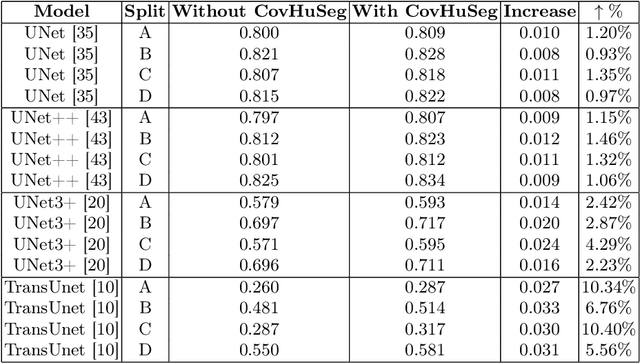
Segmentation has long been essential in computer vision due to its numerous real-world applications. However, most traditional deep learning and machine learning models need help to capture geometric features such as size and convexity of the segmentation targets, resulting in suboptimal outcomes. To resolve this problem, we propose using a CovHuSeg algorithm to solve the problem of kidney glomeruli segmentation. This simple post-processing method is specified to adapt to the segmentation of ball-shaped anomalies, including the glomerulus. Unlike other post-processing methods, the CovHuSeg algorithm assures that the outcome mask does not have holes in it or comes in unusual shapes that are impossible to be the shape of a glomerulus. We illustrate the effectiveness of our method by experimenting with multiple deep-learning models in the context of segmentation on kidney pathology images. The results show that all models have increased accuracy when using the CovHuSeg algorithm.
Are Anomaly Scores Telling the Whole Story? A Benchmark for Multilevel Anomaly Detection
Nov 21, 2024
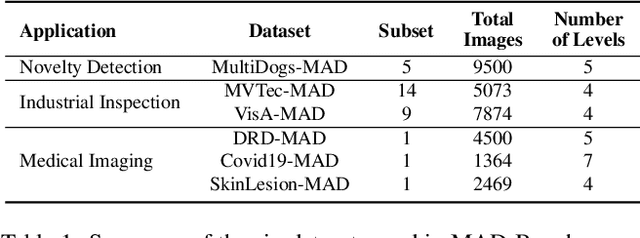
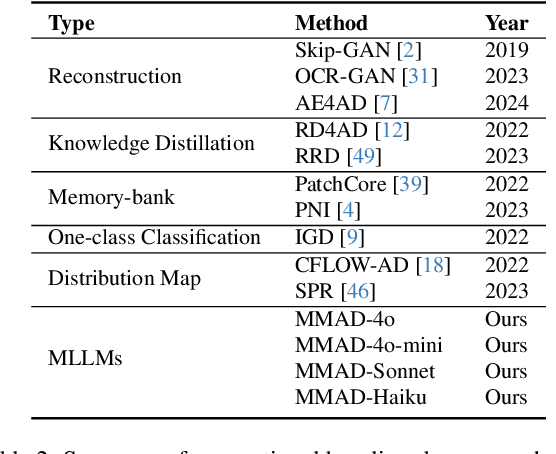

Anomaly detection (AD) is a machine learning task that identifies anomalies by learning patterns from normal training data. In many real-world scenarios, anomalies vary in severity, from minor anomalies with little risk to severe abnormalities requiring immediate attention. However, existing models primarily operate in a binary setting, and the anomaly scores they produce are usually based on the deviation of data points from normal data, which may not accurately reflect practical severity. In this paper, we address this gap by making three key contributions. First, we propose a novel setting, Multilevel AD (MAD), in which the anomaly score represents the severity of anomalies in real-world applications, and we highlight its diverse applications across various domains. Second, we introduce a novel benchmark, MAD-Bench, that evaluates models not only on their ability to detect anomalies, but also on how effectively their anomaly scores reflect severity. This benchmark incorporates multiple types of baselines and real-world applications involving severity. Finally, we conduct a comprehensive performance analysis on MAD-Bench. We evaluate models on their ability to assign severity-aligned scores, investigate the correspondence between their performance on binary and multilevel detection, and study their robustness. This analysis offers key insights into improving AD models for practical severity alignment. The code framework and datasets used for the benchmark will be made publicly available.