 Add to Chrome
 Add to Firefox
 Add to Edge
RoboGaze: Evaluating Robot World Models via Structured Vision-Language Analysis
Jun 22, 2026
Recent advances in robot world models enable synthetic video generation for embodied prediction and planning. However, evaluating these videos is challenging: visually realistic outputs often violate physical laws, temporal consistency, or task logic, while conventional metrics and monolithic Vision-Language Model (VLM) judges fail to generalize or provide precise diagnostic value. We present RoboGaze, a training-free, multi-agent VLM framework that provides structured, interpretable evaluation for generated robot-manipulation videos. Given a task instruction and video, RoboGaze operates via a three-stage pipeline: task-scene grounding, dimension-specific specialist routing, and critic-based verification. It outputs temporally localized glitch reports categorized under a novel 6-dimension, 30-type robotics-specific taxonomy. To benchmark RoboGaze, we introduce a human-validated dataset of 382 clips spanning simulated and real-world multi-view manipulation. Evaluating eight open-source and proprietary VLM backbones, RoboGaze dramatically outperforms zero-shot baselines, improving description-F1 by up to +43 points and temporal alignment (F1 x IoU) by up to +37 points, closing approximately 85% of the gap to the human ceiling. Furthermore, its critic verifier mitigates the "cry-wolf" false-positive flaw of standard VLMs, lifting clean-clip accuracy from under 25% to over 80%. RoboGaze offers a scalable, highly interpretable diagnostic tool for the rigorous evaluation of robot world models.

FOCA: Future-Oriented Conditioning for Data-Efficient Vision-Language-Action Adaptation
Jun 18, 2026Vision-Language-Action (VLA) models enable general-purpose robotic control via large-scale multimodal pretraining, yet their effectiveness under few-shot imitation learning remains limited. We conduct a systematic stress test of state-of-the-art VLA models and show that performance degrades sharply as demonstrations are reduced, revealing a key weakness of existing adaptation strategies. To address this, we introduce FOCA, a future-oriented conditioning framework for data-efficient VLA adaptation. FOCA combines explicit prediction of task-grounded future interaction embeddings with implicit alignment to future goal observations, enabling long-horizon reasoning in latent space without pixel-level prediction. This formulation naturally supports action-free co-training with synthetic videos from video world models and can be interpreted as learning a future-conditioned value-like representation. Extensive experiments demonstrate FOCA achieves 95.7% success with 20 demonstrations on LIBERO, improves 7-12% on RoboCasa, and delivers up to 26% absolute gains on real robots, establishing a new state of the art in few-shot VLA adaptation.
MGPATH: Vision-Language Model with Multi-Granular Prompt Learning for Few-Shot WSI Classification
Feb 11, 2025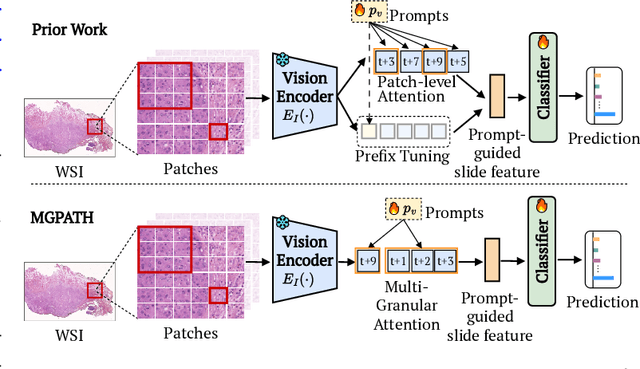
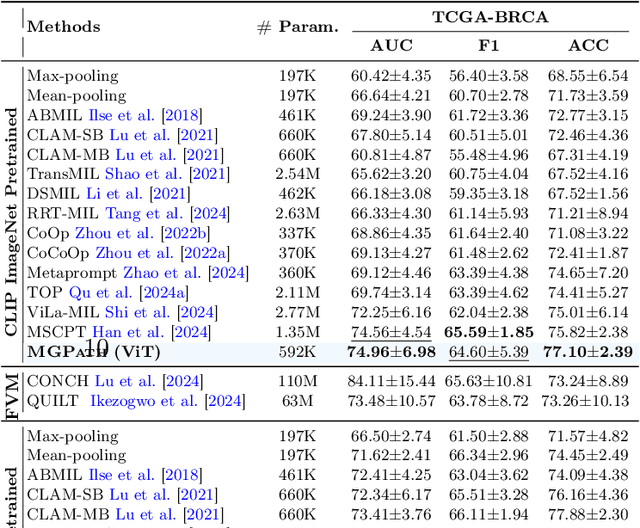
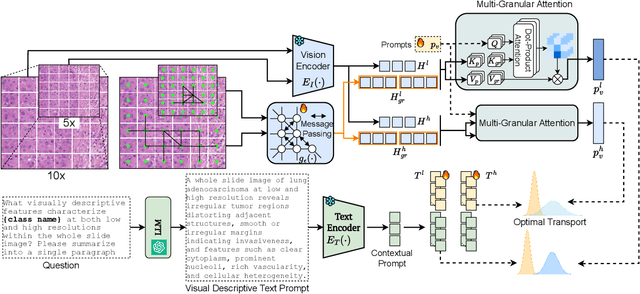
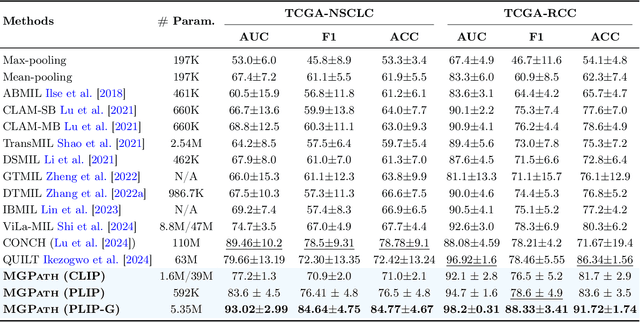
Whole slide pathology image classification presents challenges due to gigapixel image sizes and limited annotation labels, hindering model generalization. This paper introduces a prompt learning method to adapt large vision-language models for few-shot pathology classification. We first extend the Prov-GigaPath vision foundation model, pre-trained on 1.3 billion pathology image tiles, into a vision-language model by adding adaptors and aligning it with medical text encoders via contrastive learning on 923K image-text pairs. The model is then used to extract visual features and text embeddings from few-shot annotations and fine-tunes with learnable prompt embeddings. Unlike prior methods that combine prompts with frozen features using prefix embeddings or self-attention, we propose multi-granular attention that compares interactions between learnable prompts with individual image patches and groups of them. This approach improves the model's ability to capture both fine-grained details and broader context, enhancing its recognition of complex patterns across sub-regions. To further improve accuracy, we leverage (unbalanced) optimal transport-based visual-text distance to secure model robustness by mitigating perturbations that might occur during the data augmentation process. Empirical experiments on lung, kidney, and breast pathology modalities validate the effectiveness of our approach; thereby, we surpass several of the latest competitors and consistently improve performance across diverse architectures, including CLIP, PLIP, and Prov-GigaPath integrated PLIP. We release our implementations and pre-trained models at this MGPATH.
On the Out of Distribution Robustness of Foundation Models in Medical Image Segmentation
Nov 18, 2023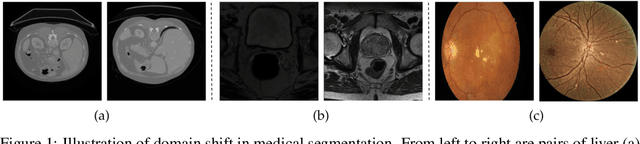

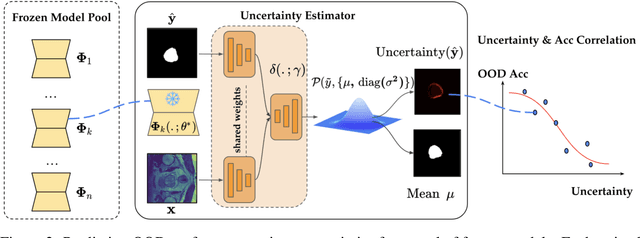
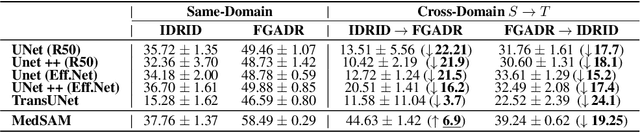
Constructing a robust model that can effectively generalize to test samples under distribution shifts remains a significant challenge in the field of medical imaging. The foundational models for vision and language, pre-trained on extensive sets of natural image and text data, have emerged as a promising approach. It showcases impressive learning abilities across different tasks with the need for only a limited amount of annotated samples. While numerous techniques have focused on developing better fine-tuning strategies to adapt these models for specific domains, we instead examine their robustness to domain shifts in the medical image segmentation task. To this end, we compare the generalization performance to unseen domains of various pre-trained models after being fine-tuned on the same in-distribution dataset and show that foundation-based models enjoy better robustness than other architectures. From here, we further developed a new Bayesian uncertainty estimation for frozen models and used them as an indicator to characterize the model's performance on out-of-distribution (OOD) data, proving particularly beneficial for real-world applications. Our experiments not only reveal the limitations of current indicators like accuracy on the line or agreement on the line commonly used in natural image applications but also emphasize the promise of the introduced Bayesian uncertainty. Specifically, lower uncertainty predictions usually tend to higher out-of-distribution (OOD) performance.