 Add to Chrome
 Add to Firefox
 Add to Edge
MetaVideoAgent: Automated Video-Agent Evolution for Long-Form Video Understanding
Aug 05, 2026
Long-form video understanding requires locating sparse, question-relevant evidence in long, multimodal videos. Real-world video distributions differ in modality-specific information density, content structure, and evidence patterns, causing fixed video-agent designs to incur redundant processing or fail when mismatched. Extending automated agent evolution from text to video is challenging because full long-video execution makes candidate validation expensive, failures propagate across coupled evidence-processing stages, and complex preprocessing, perception tools, and localization strategies make code-level updates difficult to implement reliably. We introduce MetaVideoAgent, a framework that automatically evolves a video agent for a target distribution. It profiles information density and evidence requirements from sparsely sampled frames and associated queries to guide initial design, then compresses localized failures into independently executable minimal validation tasks. It constructs evidence-grounded Gold Paths, audits Student trajectories, aggregates recurring failures across samples, and attributes them to responsible modules. A modular agent representation constrains each update to the primary responsible module and its necessary dependencies. We further introduce VA-EvoBench, covering eight video distributions with separate evolution and held-out splits. With four evolution iterations per distribution, MetaVideoAgent improves every initial agent and raises macro-average accuracy from 38.44% to 51.47%, at an average evolution cost of 3.54M tokens per distribution. The evolved agents outperform the strongest prior fixed-design video agent by 6.39 percentage points while using the fewest tokens and video frames per question among the compared video agents. We will release all code and data to support reproducible research.

Yuvion LLM: An Adversarially-Aware Large Language Model for Content And AI Safety
Jun 26, 2026As large language models are increasingly deployed in real-world systems, safety failures can still lead to harmful outputs and dangerous misuse. We argue that the essence of safety is adversarial: many failures arise not from natural inputs alone, but from strategic attempts to evade model policies and safeguards. However, existing general-purpose model development largely overlook this adversarial nature, and often remain insufficient for realistic safety scenarios involving planning, tool use, and multi-step reasoning, causing measured safety performance to overestimate real deployment robustness. To address this gap, we present Yuvion LLM, a large language model built for adversarially robust content safety and broader AI safety. Yuvion LLM treats adversarial robustness and agentic capability as first-class objectives. Its pipeline combines adversarially aware data construction, knowledge-enhanced continued pretraining, and policy-grounded multi-task safety post-training, including risk-aware supervised fine-tuning and reinforcement learning-based policy optimization, together with safety-aware agentic reinforcement learning for tool use and multi-step reasoning in complex safety scenarios. We further introduce the Yuvion LLM RiskEval (YLRE), a collection of 93 benchmarks across four evaluation categories, covering diverse open and internal evaluations with a focus on safety, adversarial robustness, and real-world capability requirements. Across these evaluations, Yuvion LLM demonstrates clear advantages on safety-focused benchmarks and particularly strong robustness under adversarial conditions, while maintaining solid overall capability. Notably, Yuvion-8B outperforms most state-of-the-art baselines, including substantially larger models such as GPT-5.4 and Qwen3-MAX, on several safety tasks.
Yuvion VL: A Multimodal Foundation Model for Adversarial Content and AI Safety
Jun 23, 2026General-purpose models often struggle to reliably identify and understand real-world multimodal risks, largely due to the inherent multimodal adversarial nature of content and AI safety. We present Yuvion VL, a family of multimodal large language models purpose-built for content and AI safety, with both instruction-tuned and reasoning-oriented variants. Yuvion VL addresses this gap by treating safety as an inherently adversarial and multimodal problem and designing the entire pipeline around adversarial robustness. For data construction, we develop an automated pipeline integrating adversarial-aware data synthesis with multi-stage quality control, producing large-scale, high-quality multimodal samples augmented with domain knowledge and reasoning annotations. For training, we adopt a three-stage pipeline that includes continued pretraining for risk-concept cross-modal alignment, instruct post-training for production-grade safety tasks, and reasoning post-training for enhanced interpretability and performance in complex tasks. We further introduce Confuse-then-Contrast Fine-Tuning, a contrastive framework that mines model-specific confusions and constructs multi-image contrastive groups to enforce explicit discrimination of fine-grained visual-semantic elements, enabling the model to distinguish between visually similar cases with different safety implications in adversarial safety tasks. To support rigorous evaluation, we further introduce Yuvion VL RiskEval (YVRE), a collection of benchmarks covering diverse open and internal evaluations, with a focus on content and AI safety, adversarial robustness, and real-world capability requirements. Experiments show that Yuvion VL-32B achieves industry-leading safety performance, surpassing comparably sized open-source models and best closed-source commercial models, while maintaining comparable general capabilities.
Self-motion as a structural prior for coherent and robust formation of cognitive maps
Dec 23, 2025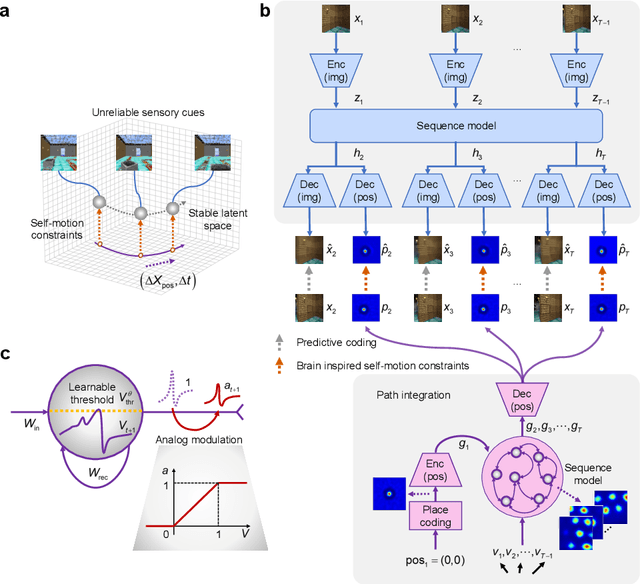
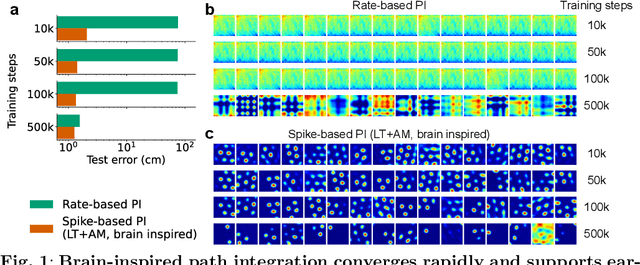
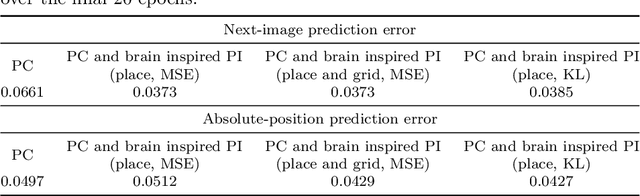
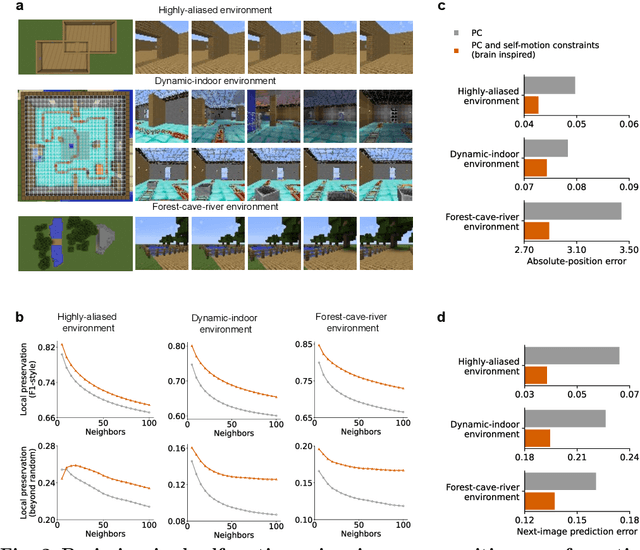
Most computational accounts of cognitive maps assume that stability is achieved primarily through sensory anchoring, with self-motion contributing to incremental positional updates only. However, biological spatial representations often remain coherent even when sensory cues degrade or conflict, suggesting that self-motion may play a deeper organizational role. Here, we show that self-motion can act as a structural prior that actively organizes the geometry of learned cognitive maps. We embed a path-integration-based motion prior in a predictive-coding framework, implemented using a capacity-efficient, brain-inspired recurrent mechanism combining spiking dynamics, analog modulation and adaptive thresholds. Across highly aliased, dynamically changing and naturalistic environments, this structural prior consistently stabilizes map formation, improving local topological fidelity, global positional accuracy and next-step prediction under sensory ambiguity. Mechanistic analyses reveal that the motion prior itself encodes geometrically precise trajectories under tight constraints of internal states and generalizes zero-shot to unseen environments, outperforming simpler motion-based constraints. Finally, deployment on a quadrupedal robot demonstrates that motion-derived structural priors enhance online landmark-based navigation under real-world sensory variability. Together, these results reframe self-motion as an organizing scaffold for coherent spatial representations, showing how brain-inspired principles can systematically strengthen spatial intelligence in embodied artificial agents.
Batch Normalization-Free Fully Integer Quantized Neural Networks via Progressive Tandem Learning
Dec 18, 2025Quantised neural networks (QNNs) shrink models and reduce inference energy through low-bit arithmetic, yet most still depend on a running statistics batch normalisation (BN) layer, preventing true integer-only deployment. Prior attempts remove BN by parameter folding or tailored initialisation; while helpful, they rarely recover BN's stability and accuracy and often impose bespoke constraints. We present a BN-free, fully integer QNN trained via a progressive, layer-wise distillation scheme that slots into existing low-bit pipelines. Starting from a pretrained BN-enabled teacher, we use layer-wise targets and progressive compensation to train a student that performs inference exclusively with integer arithmetic and contains no BN operations. On ImageNet with AlexNet, the BN-free model attains competitive Top-1 accuracy under aggressive quantisation. The procedure integrates directly with standard quantisation workflows, enabling end-to-end integer-only inference for resource-constrained settings such as edge and embedded devices.
Algorithm-hardware co-design of neuromorphic networks with dual memory pathways
Dec 11, 2025Spiking neural networks excel at event-driven sensing. Yet, maintaining task-relevant context over long timescales both algorithmically and in hardware, while respecting both tight energy and memory budgets, remains a core challenge in the field. We address this challenge through novel algorithm-hardware co-design effort. At the algorithm level, inspired by the cortical fast-slow organization in the brain, we introduce a neural network with an explicit slow memory pathway that, combined with fast spiking activity, enables a dual memory pathway (DMP) architecture in which each layer maintains a compact low-dimensional state that summarizes recent activity and modulates spiking dynamics. This explicit memory stabilizes learning while preserving event-driven sparsity, achieving competitive accuracy on long-sequence benchmarks with 40-60% fewer parameters than equivalent state-of-the-art spiking neural networks. At the hardware level, we introduce a near-memory-compute architecture that fully leverages the advantages of the DMP architecture by retaining its compact shared state while optimizing dataflow, across heterogeneous sparse-spike and dense-memory pathways. We show experimental results that demonstrate more than a 4x increase in throughput and over a 5x improvement in energy efficiency compared with state-of-the-art implementations. Together, these contributions demonstrate that biological principles can guide functional abstractions that are both algorithmically effective and hardware-efficient, establishing a scalable co-design paradigm for real-time neuromorphic computation and learning.
Exploiting heterogeneous delays for efficient computation in low-bit neural networks
Oct 31, 2025Neural networks rely on learning synaptic weights. However, this overlooks other neural parameters that can also be learned and may be utilized by the brain. One such parameter is the delay: the brain exhibits complex temporal dynamics with heterogeneous delays, where signals are transmitted asynchronously between neurons. It has been theorized that this delay heterogeneity, rather than a cost to be minimized, can be exploited in embodied contexts where task-relevant information naturally sits contextually in the time domain. We test this hypothesis by training spiking neural networks to modify not only their weights but also their delays at different levels of precision. We find that delay heterogeneity enables state-of-the-art performance on temporally complex neuromorphic problems and can be achieved even when weights are extremely imprecise (1.58-bit ternary precision: just positive, negative, or absent). By enabling high performance with extremely low-precision weights, delay heterogeneity allows memory-efficient solutions that maintain state-of-the-art accuracy even when weights are compressed over an order of magnitude more aggressively than typically studied weight-only networks. We show how delays and time-constants adaptively trade-off, and reveal through ablation that task performance depends on task-appropriate delay distributions, with temporally-complex tasks requiring longer delays. Our results suggest temporal heterogeneity is an important principle for efficient computation, particularly when task-relevant information is temporal - as in the physical world - with implications for embodied intelligent systems and neuromorphic hardware.
EEG decoding with conditional identification information
Mar 21, 2024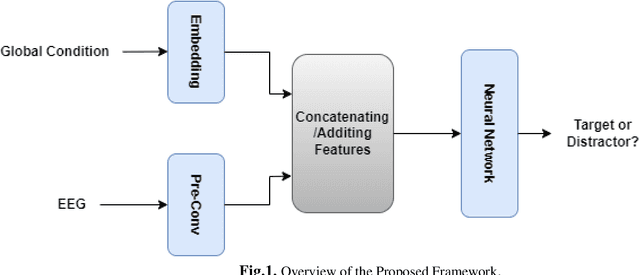
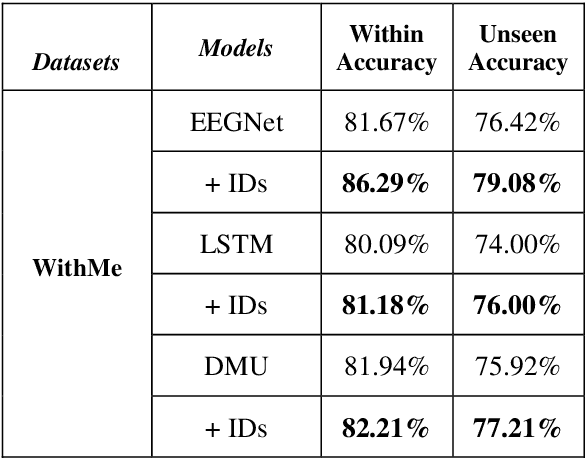
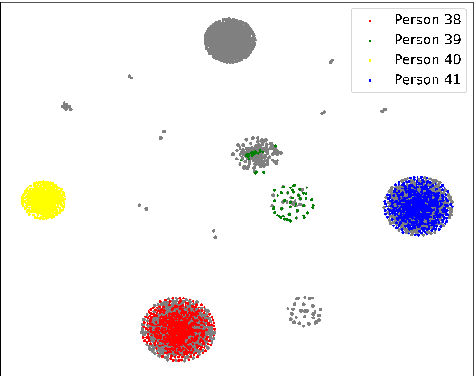
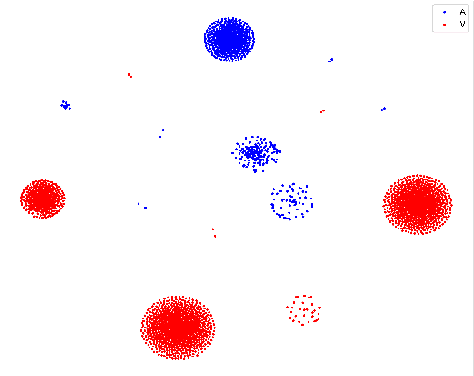
Decoding EEG signals is crucial for unraveling human brain and advancing brain-computer interfaces. Traditional machine learning algorithms have been hindered by the high noise levels and inherent inter-person variations in EEG signals. Recent advances in deep neural networks (DNNs) have shown promise, owing to their advanced nonlinear modeling capabilities. However, DNN still faces challenge in decoding EEG samples of unseen individuals. To address this, this paper introduces a novel approach by incorporating the conditional identification information of each individual into the neural network, thereby enhancing model representation through the synergistic interaction of EEG and personal traits. We test our model on the WithMe dataset and demonstrated that the inclusion of these identifiers substantially boosts accuracy for both subjects in the training set and unseen subjects. This enhancement suggests promising potential for improving for EEG interpretability and understanding of relevant identification features.
Delayed Memory Unit: Modelling Temporal Dependency Through Delay Gate
Oct 23, 2023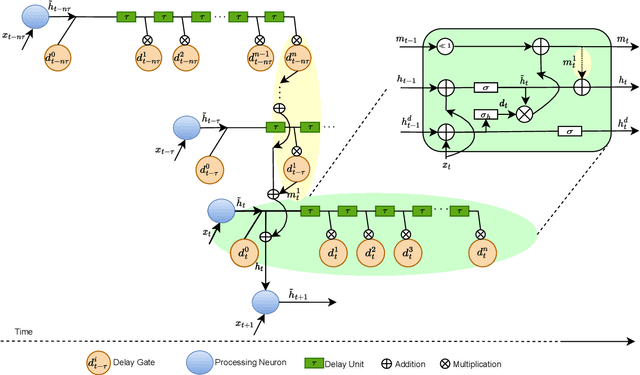
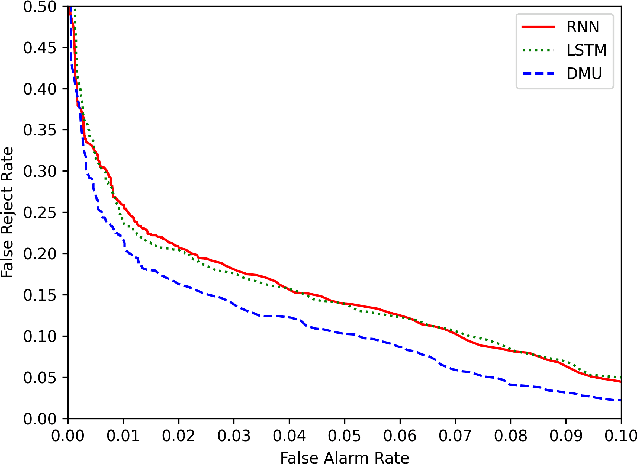
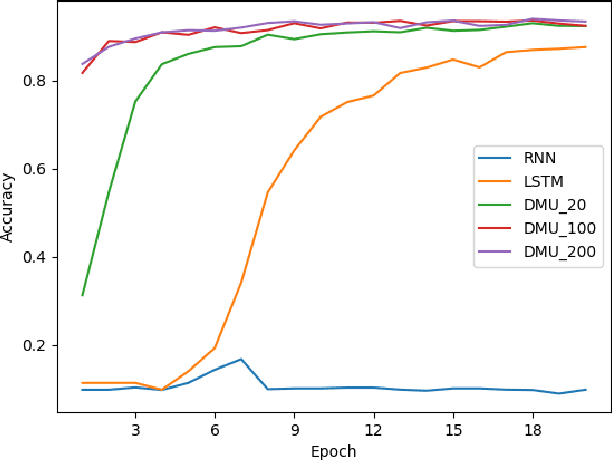
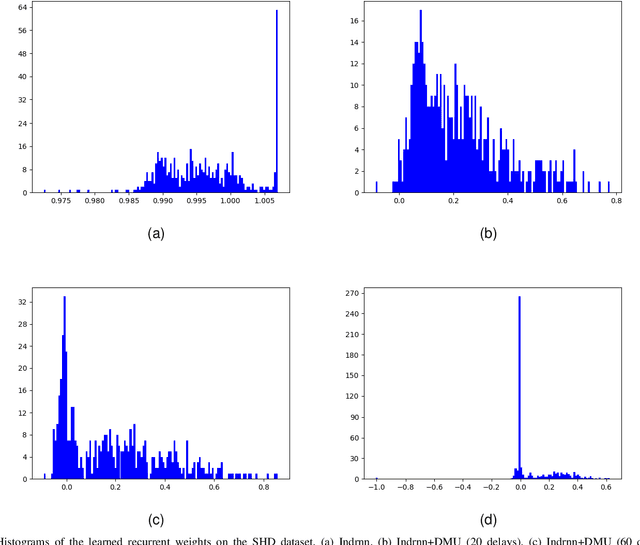
Recurrent Neural Networks (RNNs) are renowned for their adeptness in modeling temporal dependencies, a trait that has driven their widespread adoption for sequential data processing. Nevertheless, vanilla RNNs are confronted with the well-known issue of gradient vanishing and exploding, posing a significant challenge for learning and establishing long-range dependencies. Additionally, gated RNNs tend to be over-parameterized, resulting in poor network generalization. To address these challenges, we propose a novel Delayed Memory Unit (DMU) in this paper, wherein a delay line structure, coupled with delay gates, is introduced to facilitate temporal interaction and temporal credit assignment, so as to enhance the temporal modeling capabilities of vanilla RNNs. Particularly, the DMU is designed to directly distribute the input information to the optimal time instant in the future, rather than aggregating and redistributing it over time through intricate network dynamics. Our proposed DMU demonstrates superior temporal modeling capabilities across a broad range of sequential modeling tasks, utilizing considerably fewer parameters than other state-of-the-art gated RNN models in applications such as speech recognition, radar gesture recognition, ECG waveform segmentation, and permuted sequential image classification.
Adaptive Axonal Delays in feedforward spiking neural networks for accurate spoken word recognition
Feb 16, 2023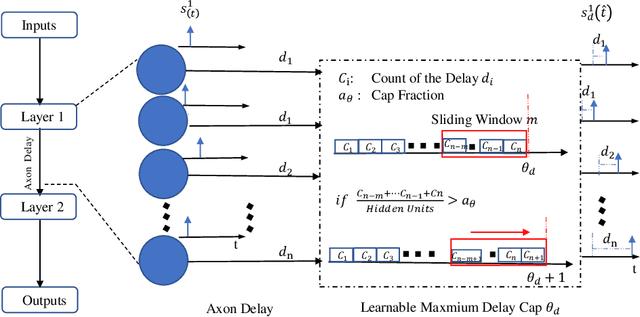
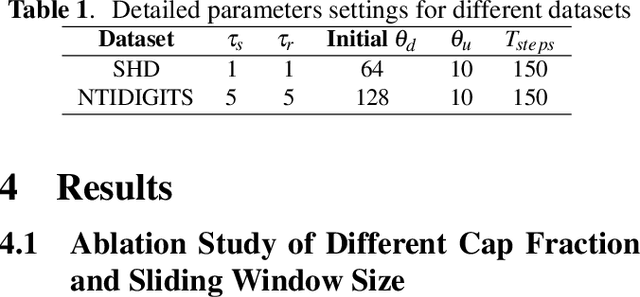
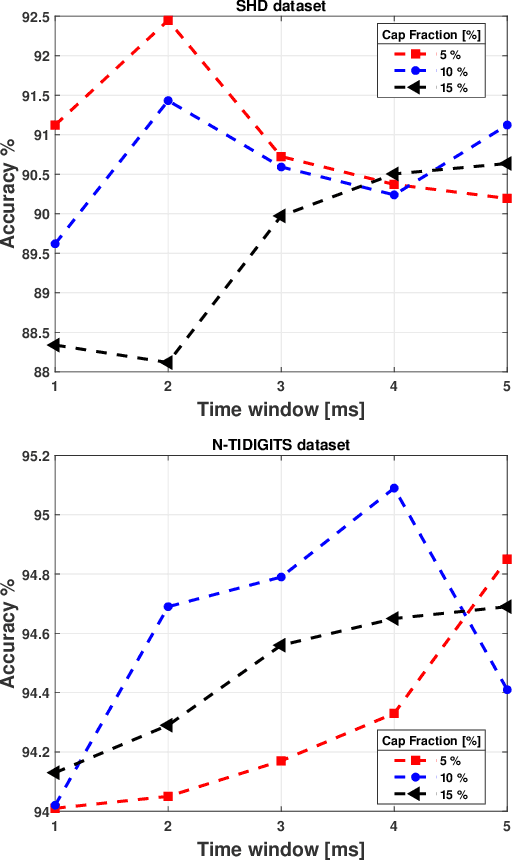
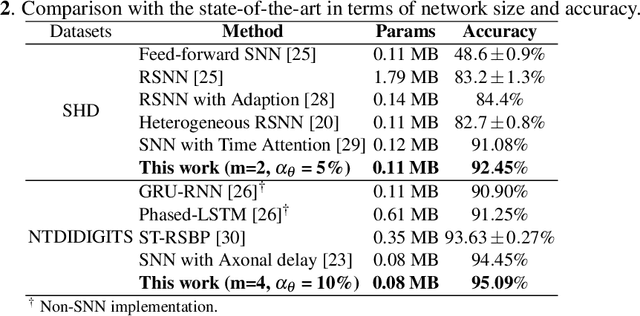
Spiking neural networks (SNN) are a promising research avenue for building accurate and efficient automatic speech recognition systems. Recent advances in audio-to-spike encoding and training algorithms enable SNN to be applied in practical tasks. Biologically-inspired SNN communicates using sparse asynchronous events. Therefore, spike-timing is critical to SNN performance. In this aspect, most works focus on training synaptic weights and few have considered delays in event transmission, namely axonal delay. In this work, we consider a learnable axonal delay capped at a maximum value, which can be adapted according to the axonal delay distribution in each network layer. We show that our proposed method achieves the best classification results reported on the SHD dataset (92.45%) and NTIDIGITS dataset (95.09%). Our work illustrates the potential of training axonal delays for tasks with complex temporal structures.