 Add to Chrome
 Add to Firefox
 Add to Edge
Unifying Dynamical Systems and Graph Theory to Mechanistically Understand Computation in Neural Networks
May 05, 2026
Understanding how biological and artificial neural networks implement computation from connectivity is a central problem in neuroscience and machine learning. In neural systems, structural and functional connectivity are known to diverge, motivating approaches that move beyond direct connections alone. Here, we show that the spatial and temporal function of recurrent neural networks (RNNs) trained on hierarchically modular tasks can be recovered by modelling the network as a graph and analysing the multi-hop pathways between input and output units. In particular, decomposing these pathways by hop length reveals how the network temporally routes information. This perspective reframes regularisation: if function is implemented through multi-hop communication, then standard penalties such as L1 regularisation, which act only on individual weights, constrain single-hop structure rather than the multi-hop pathways that support computation. Motivated by this view, we introduce resolvent-RNNs (R-RNNs), which constrain multi-hop pathways and thereby induce temporal sparsity beyond that achieved by standard L1 regularisation. Compared with L1 regularisation, R-RNNs achieve improved performance by inducing temporal sparsity that matches the task structure, even when the task signal is sparse. Moreover, R-RNNs exhibit stronger sparsity-function alignment, reflected in their increased robustness under strong regularisation. Together, our results identify multi-hop communication as a key principle linking structure to function in recurrent networks, and suggest that sparsity should be defined over functional pathways rather than individual parameters.

The Principle of Maximum Heterogeneity Optimises Productivity in Distributed Production Systems Across Biology, Economics, and Computing
Apr 08, 2026The world is full of systems of distributed agents, collaborating and competing in complex ways: firms and workers specialise within economies, neurons adapt their tuning across brain circuits, and species compete and coexist within ecosystems. In that context, individual research fields built theories explaining how comparative advantage drives trade specialisation, how balanced neural representations emerge from sensory coding, and how biodiversity sustains ecological productivity. Here we propose that many of these well-understood findings across fields can be captured in one simple joint cross-disciplinary model, which we call the Distributed Production System. It captures how agent heterogeneity, resource constraints, communication topology, and task structure jointly determine the productivity, efficiency, and robustness of distributed systems across biology, economics, neuroscience, and computing. This model reveals that a small set of underlying laws generates the complex dynamics observed across fields. These can be summarised in our Principle of Maximum Heterogeneity: any distributed production system optimising for performance will converge on an increasingly heterogeneous configuration; environmental demands place an upper bound on the degree of heterogeneity required; and the communication topology determines the spatial scale over which heterogeneity spreads, with this principle applying recursively across all layers of nested production systems. Beyond explaining existing systems, these principles act as a blueprint for constructing ideal ones. We demonstrate this by suggesting specific redesigns for compute systems executing large-scale AI. In total, The Principle of Maximum Heterogeneity reveals a unique convergence of complex phenomena across fields onto simple underlying design principles with important predictive value for future distributed production systems.
Self-motion as a structural prior for coherent and robust formation of cognitive maps
Dec 23, 2025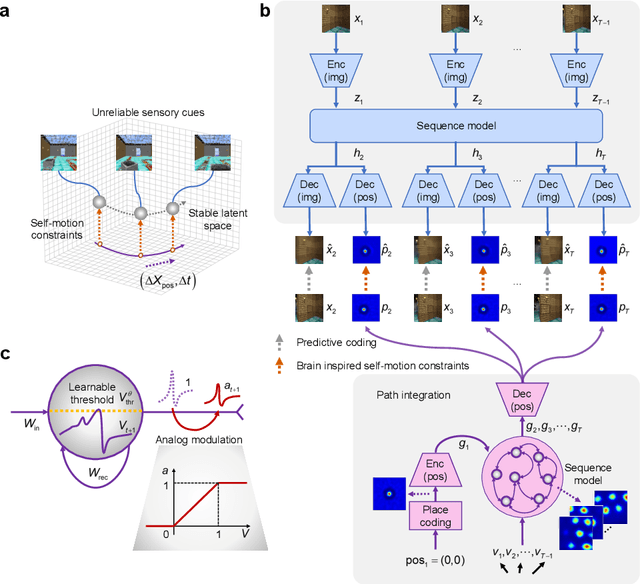
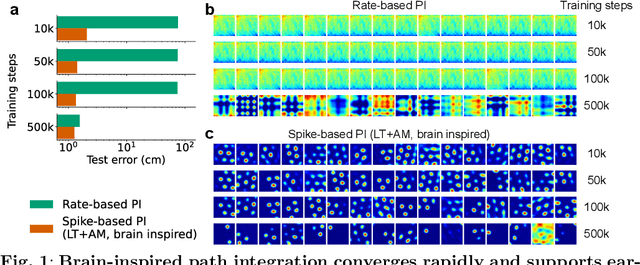
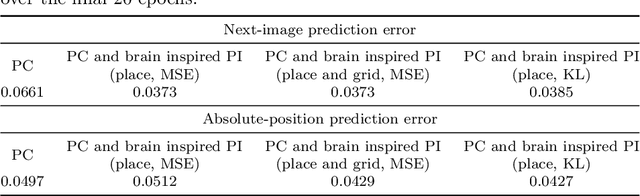
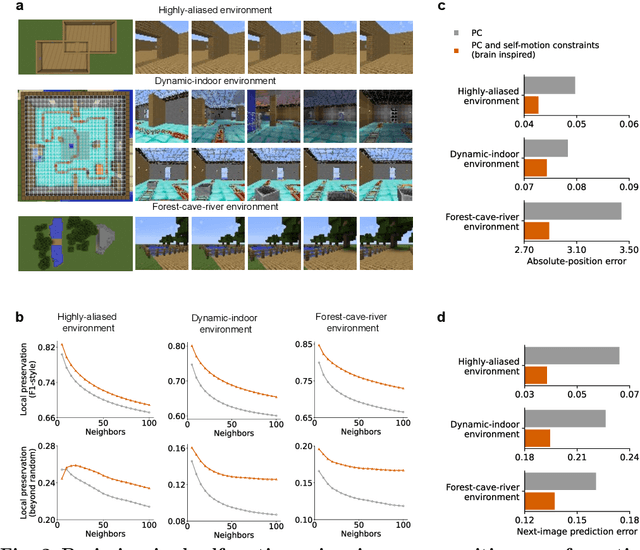
Most computational accounts of cognitive maps assume that stability is achieved primarily through sensory anchoring, with self-motion contributing to incremental positional updates only. However, biological spatial representations often remain coherent even when sensory cues degrade or conflict, suggesting that self-motion may play a deeper organizational role. Here, we show that self-motion can act as a structural prior that actively organizes the geometry of learned cognitive maps. We embed a path-integration-based motion prior in a predictive-coding framework, implemented using a capacity-efficient, brain-inspired recurrent mechanism combining spiking dynamics, analog modulation and adaptive thresholds. Across highly aliased, dynamically changing and naturalistic environments, this structural prior consistently stabilizes map formation, improving local topological fidelity, global positional accuracy and next-step prediction under sensory ambiguity. Mechanistic analyses reveal that the motion prior itself encodes geometrically precise trajectories under tight constraints of internal states and generalizes zero-shot to unseen environments, outperforming simpler motion-based constraints. Finally, deployment on a quadrupedal robot demonstrates that motion-derived structural priors enhance online landmark-based navigation under real-world sensory variability. Together, these results reframe self-motion as an organizing scaffold for coherent spatial representations, showing how brain-inspired principles can systematically strengthen spatial intelligence in embodied artificial agents.
Algorithm-hardware co-design of neuromorphic networks with dual memory pathways
Dec 11, 2025Spiking neural networks excel at event-driven sensing. Yet, maintaining task-relevant context over long timescales both algorithmically and in hardware, while respecting both tight energy and memory budgets, remains a core challenge in the field. We address this challenge through novel algorithm-hardware co-design effort. At the algorithm level, inspired by the cortical fast-slow organization in the brain, we introduce a neural network with an explicit slow memory pathway that, combined with fast spiking activity, enables a dual memory pathway (DMP) architecture in which each layer maintains a compact low-dimensional state that summarizes recent activity and modulates spiking dynamics. This explicit memory stabilizes learning while preserving event-driven sparsity, achieving competitive accuracy on long-sequence benchmarks with 40-60% fewer parameters than equivalent state-of-the-art spiking neural networks. At the hardware level, we introduce a near-memory-compute architecture that fully leverages the advantages of the DMP architecture by retaining its compact shared state while optimizing dataflow, across heterogeneous sparse-spike and dense-memory pathways. We show experimental results that demonstrate more than a 4x increase in throughput and over a 5x improvement in energy efficiency compared with state-of-the-art implementations. Together, these contributions demonstrate that biological principles can guide functional abstractions that are both algorithmically effective and hardware-efficient, establishing a scalable co-design paradigm for real-time neuromorphic computation and learning.
Exploiting heterogeneous delays for efficient computation in low-bit neural networks
Oct 31, 2025Neural networks rely on learning synaptic weights. However, this overlooks other neural parameters that can also be learned and may be utilized by the brain. One such parameter is the delay: the brain exhibits complex temporal dynamics with heterogeneous delays, where signals are transmitted asynchronously between neurons. It has been theorized that this delay heterogeneity, rather than a cost to be minimized, can be exploited in embodied contexts where task-relevant information naturally sits contextually in the time domain. We test this hypothesis by training spiking neural networks to modify not only their weights but also their delays at different levels of precision. We find that delay heterogeneity enables state-of-the-art performance on temporally complex neuromorphic problems and can be achieved even when weights are extremely imprecise (1.58-bit ternary precision: just positive, negative, or absent). By enabling high performance with extremely low-precision weights, delay heterogeneity allows memory-efficient solutions that maintain state-of-the-art accuracy even when weights are compressed over an order of magnitude more aggressively than typically studied weight-only networks. We show how delays and time-constants adaptively trade-off, and reveal through ablation that task performance depends on task-appropriate delay distributions, with temporally-complex tasks requiring longer delays. Our results suggest temporal heterogeneity is an important principle for efficient computation, particularly when task-relevant information is temporal - as in the physical world - with implications for embodied intelligent systems and neuromorphic hardware.
Spatial embedding promotes a specific form of modularity with low entropy and heterogeneous spectral dynamics
Sep 26, 2024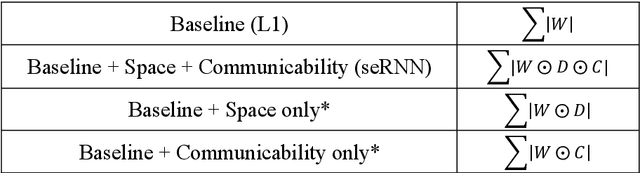
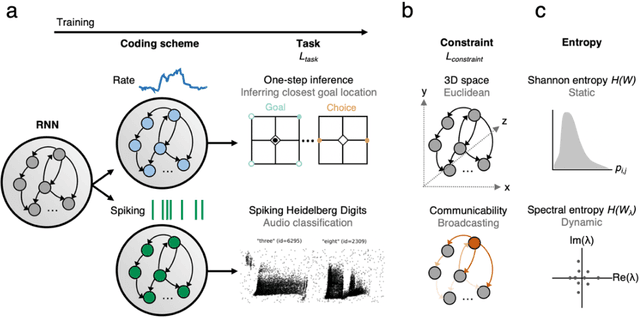
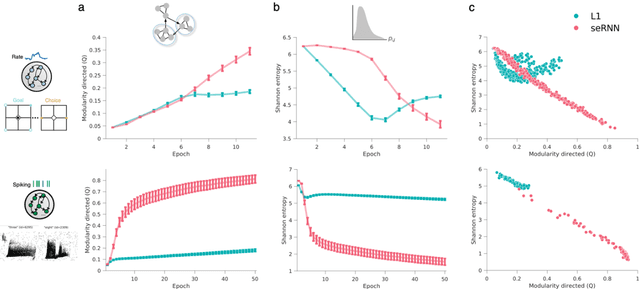
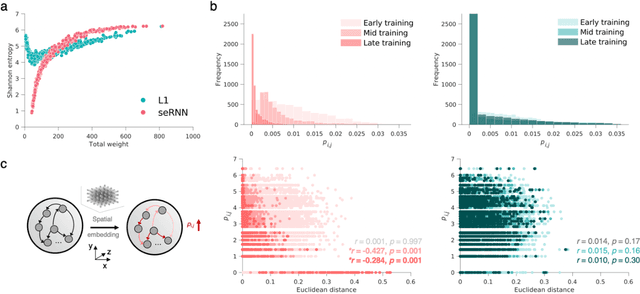
Understanding how biological constraints shape neural computation is a central goal of computational neuroscience. Spatially embedded recurrent neural networks provide a promising avenue to study how modelled constraints shape the combined structural and functional organisation of networks over learning. Prior work has shown that spatially embedded systems like this can combine structure and function into single artificial models during learning. But it remains unclear precisely how, in general, structural constraints bound the range of attainable configurations. In this work, we show that it is possible to study these restrictions through entropic measures of the neural weights and eigenspectrum, across both rate and spiking neural networks. Spatial embedding, in contrast to baseline models, leads to networks with a highly specific low entropy modularity where connectivity is readily interpretable given the known spatial and communication constraints acting on them. Crucially, these networks also demonstrate systematically modulated spectral dynamics, revealing how they exploit heterogeneity in their function to overcome the constraints imposed on their structure. This work deepens our understanding of constrained learning in neural networks, across coding schemes and tasks, where solutions to simultaneous structural and functional objectives must be accomplished in tandem.
Multilevel Interpretability Of Artificial Neural Networks: Leveraging Framework And Methods From Neuroscience
Aug 26, 2024
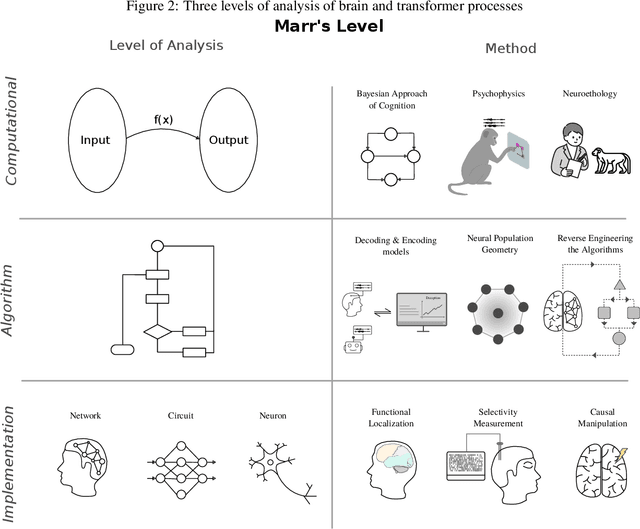
As deep learning systems are scaled up to many billions of parameters, relating their internal structure to external behaviors becomes very challenging. Although daunting, this problem is not new: Neuroscientists and cognitive scientists have accumulated decades of experience analyzing a particularly complex system - the brain. In this work, we argue that interpreting both biological and artificial neural systems requires analyzing those systems at multiple levels of analysis, with different analytic tools for each level. We first lay out a joint grand challenge among scientists who study the brain and who study artificial neural networks: understanding how distributed neural mechanisms give rise to complex cognition and behavior. We then present a series of analytical tools that can be used to analyze biological and artificial neural systems, organizing those tools according to Marr's three levels of analysis: computation/behavior, algorithm/representation, and implementation. Overall, the multilevel interpretability framework provides a principled way to tackle neural system complexity; links structure, computation, and behavior; clarifies assumptions and research priorities at each level; and paves the way toward a unified effort for understanding intelligent systems, may they be biological or artificial.
Building artificial neural circuits for domain-general cognition: a primer on brain-inspired systems-level architecture
Mar 21, 2023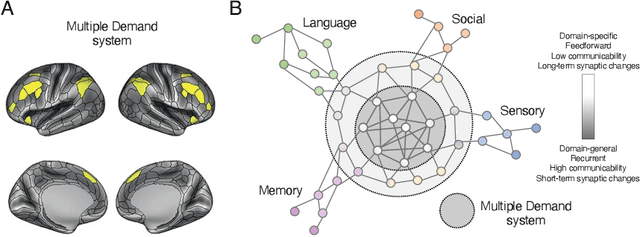
There is a concerted effort to build domain-general artificial intelligence in the form of universal neural network models with sufficient computational flexibility to solve a wide variety of cognitive tasks but without requiring fine-tuning on individual problem spaces and domains. To do this, models need appropriate priors and inductive biases, such that trained models can generalise to out-of-distribution examples and new problem sets. Here we provide an overview of the hallmarks endowing biological neural networks with the functionality needed for flexible cognition, in order to establish which features might also be important to achieve similar functionality in artificial systems. We specifically discuss the role of system-level distribution of network communication and recurrence, in addition to the role of short-term topological changes for efficient local computation. As machine learning models become more complex, these principles may provide valuable directions in an otherwise vast space of possible architectures. In addition, testing these inductive biases within artificial systems may help us to understand the biological principles underlying domain-general cognition.