 Add to Chrome
 Add to Firefox
 Add to Edge
Federated Learning in Intelligent Transportation Systems: Recent Applications and Open Problems
Sep 20, 2023
Intelligent transportation systems (ITSs) have been fueled by the rapid development of communication technologies, sensor technologies, and the Internet of Things (IoT). Nonetheless, due to the dynamic characteristics of the vehicle networks, it is rather challenging to make timely and accurate decisions of vehicle behaviors. Moreover, in the presence of mobile wireless communications, the privacy and security of vehicle information are at constant risk. In this context, a new paradigm is urgently needed for various applications in dynamic vehicle environments. As a distributed machine learning technology, federated learning (FL) has received extensive attention due to its outstanding privacy protection properties and easy scalability. We conduct a comprehensive survey of the latest developments in FL for ITS. Specifically, we initially research the prevalent challenges in ITS and elucidate the motivations for applying FL from various perspectives. Subsequently, we review existing deployments of FL in ITS across various scenarios, and discuss specific potential issues in object recognition, traffic management, and service providing scenarios. Furthermore, we conduct a further analysis of the new challenges introduced by FL deployment and the inherent limitations that FL alone cannot fully address, including uneven data distribution, limited storage and computing power, and potential privacy and security concerns. We then examine the existing collaborative technologies that can help mitigate these challenges. Lastly, we discuss the open challenges that remain to be addressed in applying FL in ITS and propose several future research directions.

GPT Can Solve Mathematical Problems Without a Calculator
Sep 12, 2023Previous studies have typically assumed that large language models are unable to accurately perform arithmetic operations, particularly multiplication of >8 digits, and operations involving decimals and fractions, without the use of calculator tools. This paper aims to challenge this misconception. With sufficient training data, a 2 billion-parameter language model can accurately perform multi-digit arithmetic operations with almost 100% accuracy without data leakage, significantly surpassing GPT-4 (whose multi-digit multiplication accuracy is only 4.3%). We also demonstrate that our MathGLM, fine-tuned from GLM-10B on a dataset with additional multi-step arithmetic operations and math problems described in text, achieves similar performance to GPT-4 on a 5,000-samples Chinese math problem test set. Our code and data are public at https://github.com/THUDM/MathGLM.
Sparse Federated Training of Object Detection in the Internet of Vehicles
Sep 07, 2023As an essential component part of the Intelligent Transportation System (ITS), the Internet of Vehicles (IoV) plays a vital role in alleviating traffic issues. Object detection is one of the key technologies in the IoV, which has been widely used to provide traffic management services by analyzing timely and sensitive vehicle-related information. However, the current object detection methods are mostly based on centralized deep training, that is, the sensitive data obtained by edge devices need to be uploaded to the server, which raises privacy concerns. To mitigate such privacy leakage, we first propose a federated learning-based framework, where well-trained local models are shared in the central server. However, since edge devices usually have limited computing power, plus a strict requirement of low latency in IoVs, we further propose a sparse training process on edge devices, which can effectively lighten the model, and ensure its training efficiency on edge devices, thereby reducing communication overheads. In addition, due to the diverse computing capabilities and dynamic environment, different sparsity rates are applied to edge devices. To further guarantee the performance, we propose, FedWeg, an improved aggregation scheme based on FedAvg, which is designed by the inverse ratio of sparsity rates. Experiments on the real-life dataset using YOLO show that the proposed scheme can achieve the required object detection rate while saving considerable communication costs.
Reconfigurable Intelligent Surface Aided Space Shift Keying With Imperfect CSI
Sep 06, 2023In this paper, we investigate the performance of reconfigurable intelligent surface (RIS)-aided spatial shift keying (SSK) wireless communication systems in the presence of imperfect channel state information (CSI). Specifically, we analyze the average bit error probability (ABEP) of two RIS-SSK systems respectively based on intelligent reflection and blind reflection of RIS. For the intelligent RIS-SSK scheme, we first derive the conditional pairwise error probability of the composite channel through maximum likelihood (ML) detection. Subsequently, we derive the probability density function of the combined channel. Due to the intricacies of the composite channel formulation, an exact closed-form ABEP expression is unattainable through direct derivation. To this end, we resort to employing the Gaussian-Chebyshev quadrature method to estimate the results. In addition, we employ the Q-function approximation to derive the non-exact closed-form expression when CSI imperfections are present. For the blind RIS-SSK scheme, we derive both closed-form ABEP expression and asymptotic ABEP expression with imperfect CSI by adopting the ML detector. To offer deeper insights, we explore the impact of discrete reflection phase shifts on the performance of the RIS-SSK system. Lastly, we extensively validate all the analytical derivations using Monte Carlo simulations.
Personalized Federated Deep Reinforcement Learning-based Trajectory Optimization for Multi-UAV Assisted Edge Computing
Sep 05, 2023In the era of 5G mobile communication, there has been a significant surge in research focused on unmanned aerial vehicles (UAVs) and mobile edge computing technology. UAVs can serve as intelligent servers in edge computing environments, optimizing their flight trajectories to maximize communication system throughput. Deep reinforcement learning (DRL)-based trajectory optimization algorithms may suffer from poor training performance due to intricate terrain features and inadequate training data. To overcome this limitation, some studies have proposed leveraging federated learning (FL) to mitigate the data isolation problem and expedite convergence. Nevertheless, the efficacy of global FL models can be negatively impacted by the high heterogeneity of local data, which could potentially impede the training process and even compromise the performance of local agents. This work proposes a novel solution to address these challenges, namely personalized federated deep reinforcement learning (PF-DRL), for multi-UAV trajectory optimization. PF-DRL aims to develop individualized models for each agent to address the data scarcity issue and mitigate the negative impact of data heterogeneity. Simulation results demonstrate that the proposed algorithm achieves superior training performance with faster convergence rates, and improves service quality compared to other DRL-based approaches.
Relay Diffusion: Unifying diffusion process across resolutions for image synthesis
Sep 04, 2023Diffusion models achieved great success in image synthesis, but still face challenges in high-resolution generation. Through the lens of discrete cosine transformation, we find the main reason is that \emph{the same noise level on a higher resolution results in a higher Signal-to-Noise Ratio in the frequency domain}. In this work, we present Relay Diffusion Model (RDM), which transfers a low-resolution image or noise into an equivalent high-resolution one for diffusion model via blurring diffusion and block noise. Therefore, the diffusion process can continue seamlessly in any new resolution or model without restarting from pure noise or low-resolution conditioning. RDM achieves state-of-the-art FID on CelebA-HQ and sFID on ImageNet 256$\times$256, surpassing previous works such as ADM, LDM and DiT by a large margin. All the codes and checkpoints are open-sourced at \url{https://github.com/THUDM/RelayDiffusion}.
Analysis and Optimization of Wireless Federated Learning with Data Heterogeneity
Aug 04, 2023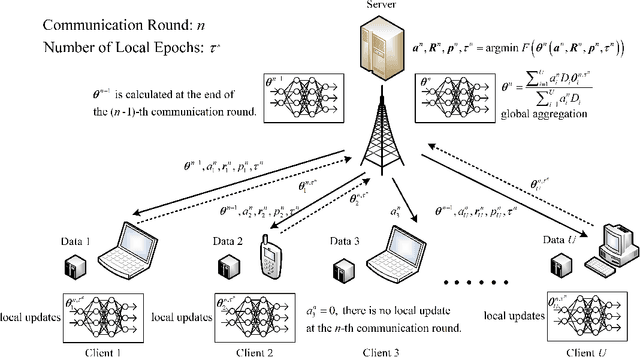


With the rapid proliferation of smart mobile devices, federated learning (FL) has been widely considered for application in wireless networks for distributed model training. However, data heterogeneity, e.g., non-independently identically distributions and different sizes of training data among clients, poses major challenges to wireless FL. Limited communication resources complicate the implementation of fair scheduling which is required for training on heterogeneous data, and further deteriorate the overall performance. To address this issue, this paper focuses on performance analysis and optimization for wireless FL, considering data heterogeneity, combined with wireless resource allocation. Specifically, we first develop a closed-form expression for an upper bound on the FL loss function, with a particular emphasis on data heterogeneity described by a dataset size vector and a data divergence vector. Then we formulate the loss function minimization problem, under constraints on long-term energy consumption and latency, and jointly optimize client scheduling, resource allocation, and the number of local training epochs (CRE). Next, via the Lyapunov drift technique, we transform the CRE optimization problem into a series of tractable problems. Extensive experiments on real-world datasets demonstrate that the proposed algorithm outperforms other benchmarks in terms of the learning accuracy and energy consumption.
Mobility-Aware Joint User Scheduling and Resource Allocation for Low Latency Federated Learning
Jul 18, 2023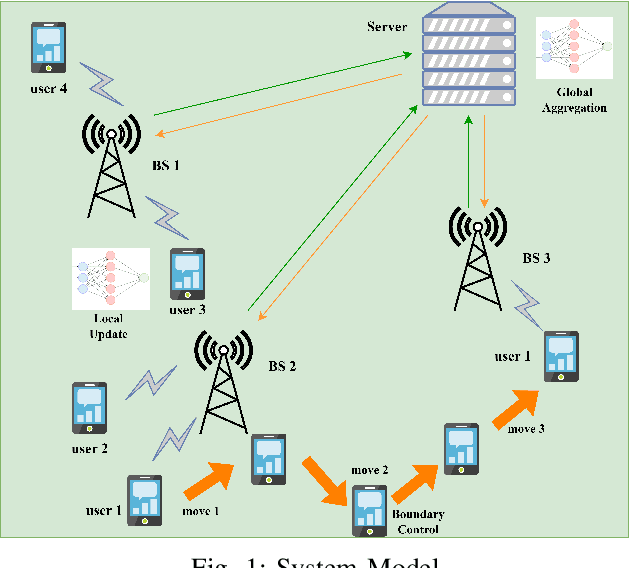
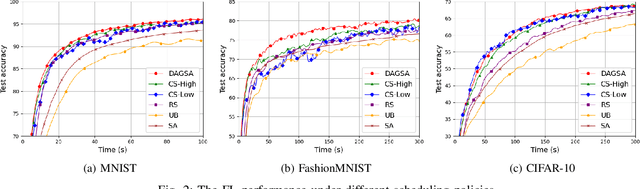
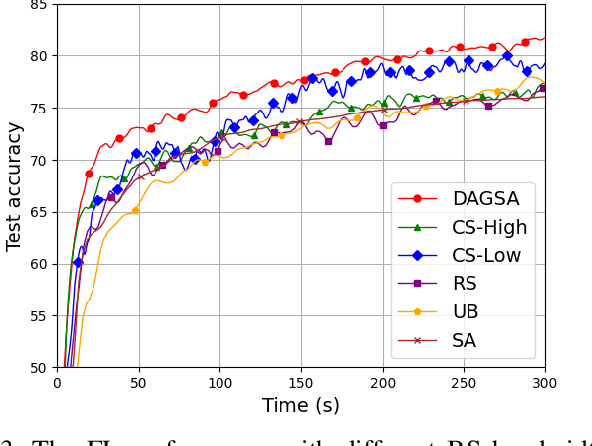
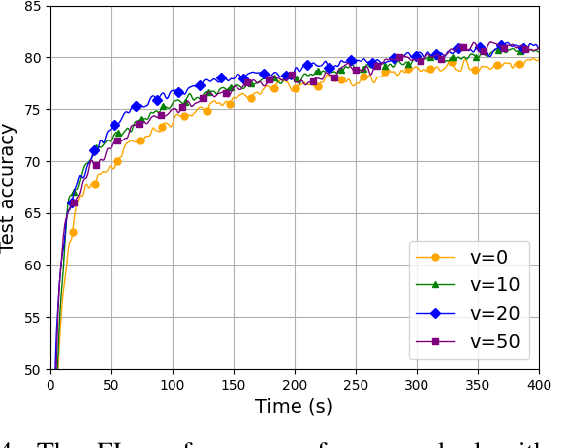
As an efficient distributed machine learning approach, Federated learning (FL) can obtain a shared model by iterative local model training at the user side and global model aggregating at the central server side, thereby protecting privacy of users. Mobile users in FL systems typically communicate with base stations (BSs) via wireless channels, where training performance could be degraded due to unreliable access caused by user mobility. However, existing work only investigates a static scenario or random initialization of user locations, which fail to capture mobility in real-world networks. To tackle this issue, we propose a practical model for user mobility in FL across multiple BSs, and develop a user scheduling and resource allocation method to minimize the training delay with constrained communication resources. Specifically, we first formulate an optimization problem with user mobility that jointly considers user selection, BS assignment to users, and bandwidth allocation to minimize the latency in each communication round. This optimization problem turned out to be NP-hard and we proposed a delay-aware greedy search algorithm (DAGSA) to solve it. Simulation results show that the proposed algorithm achieves better performance than the state-of-the-art baselines and a certain level of user mobility could improve training performance.
R-Cut: Enhancing Explainability in Vision Transformers with Relationship Weighted Out and Cut
Jul 18, 2023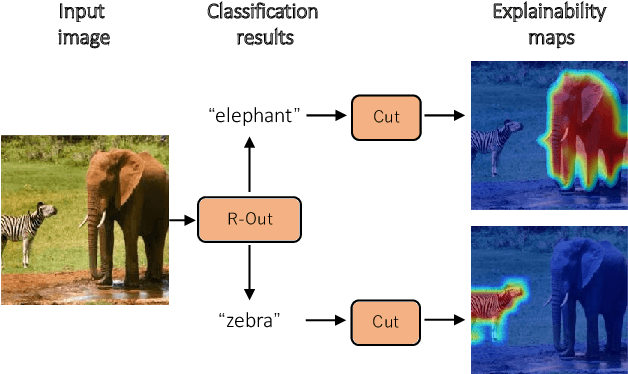
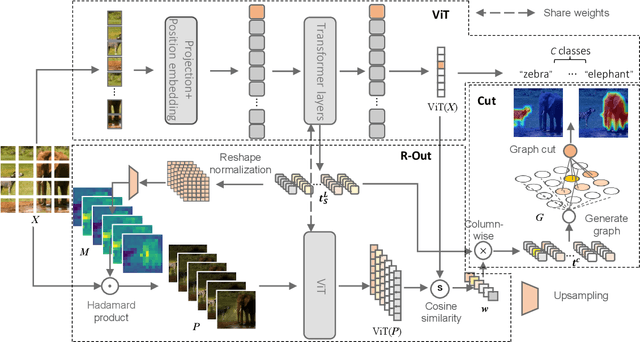
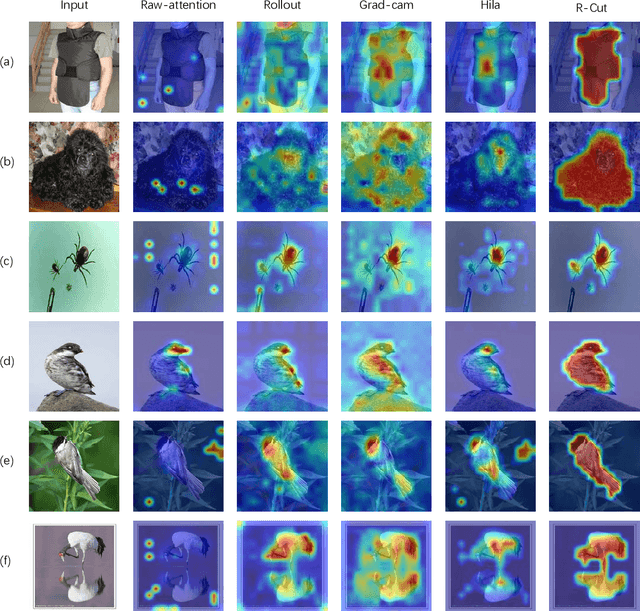
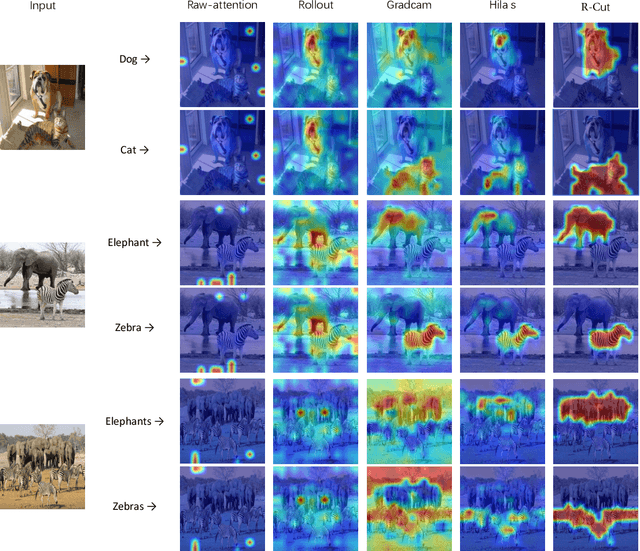
Transformer-based models have gained popularity in the field of natural language processing (NLP) and are extensively utilized in computer vision tasks and multi-modal models such as GPT4. This paper presents a novel method to enhance the explainability of Transformer-based image classification models. Our method aims to improve trust in classification results and empower users to gain a deeper understanding of the model for downstream tasks by providing visualizations of class-specific maps. We introduce two modules: the ``Relationship Weighted Out" and the ``Cut" modules. The ``Relationship Weighted Out" module focuses on extracting class-specific information from intermediate layers, enabling us to highlight relevant features. Additionally, the ``Cut" module performs fine-grained feature decomposition, taking into account factors such as position, texture, and color. By integrating these modules, we generate dense class-specific visual explainability maps. We validate our method with extensive qualitative and quantitative experiments on the ImageNet dataset. Furthermore, we conduct a large number of experiments on the LRN dataset, specifically designed for automatic driving danger alerts, to evaluate the explainability of our method in complex backgrounds. The results demonstrate a significant improvement over previous methods. Moreover, we conduct ablation experiments to validate the effectiveness of each module. Through these experiments, we are able to confirm the respective contributions of each module, thus solidifying the overall effectiveness of our proposed approach.
G$^2$uardFL: Safeguarding Federated Learning Against Backdoor Attacks through Attributed Client Graph Clustering
Jun 08, 2023As a collaborative paradigm, Federated Learning (FL) empowers clients to engage in collective model training without exchanging their respective local data. Nevertheless, FL remains vulnerable to backdoor attacks in which an attacker compromises malicious clients, and injects poisoned model weights into the aggregation process to yield attacker-chosen predictions for particular samples. Existing countermeasures, mainly based on anomaly detection, may erroneously reject legitimate weights while accepting malicious ones, which is due to inadequacies in quantifying client model similarities. Other defense mechanisms prove effective exclusively when confronted with a restricted number of malicious clients, e.g., less than 10%. To address these vulnerabilities, we present G$^2$uardFL, a protective framework that reframes the detection of malicious clients as an attributed graph clustering problem, thereby safeguarding FL systems. This framework employs a client graph clustering technique to identify malicious clients and incorporates an adaptive method to amplify the disparity between the aggregated model and poisoned client models, thereby eliminating previously embedded backdoors. A theoretical analysis of convergence is also performed to demonstrate that the global model closely approximates the model untouched by any backdoor. Through empirical evaluation compared to cutting-edge defenses and against various backdoor attacks, our experimental results indicate that G$^2$uardFL considerably undermines the effectiveness of backdoor attacks while maintaining a negligible impact on the benign sample performance.